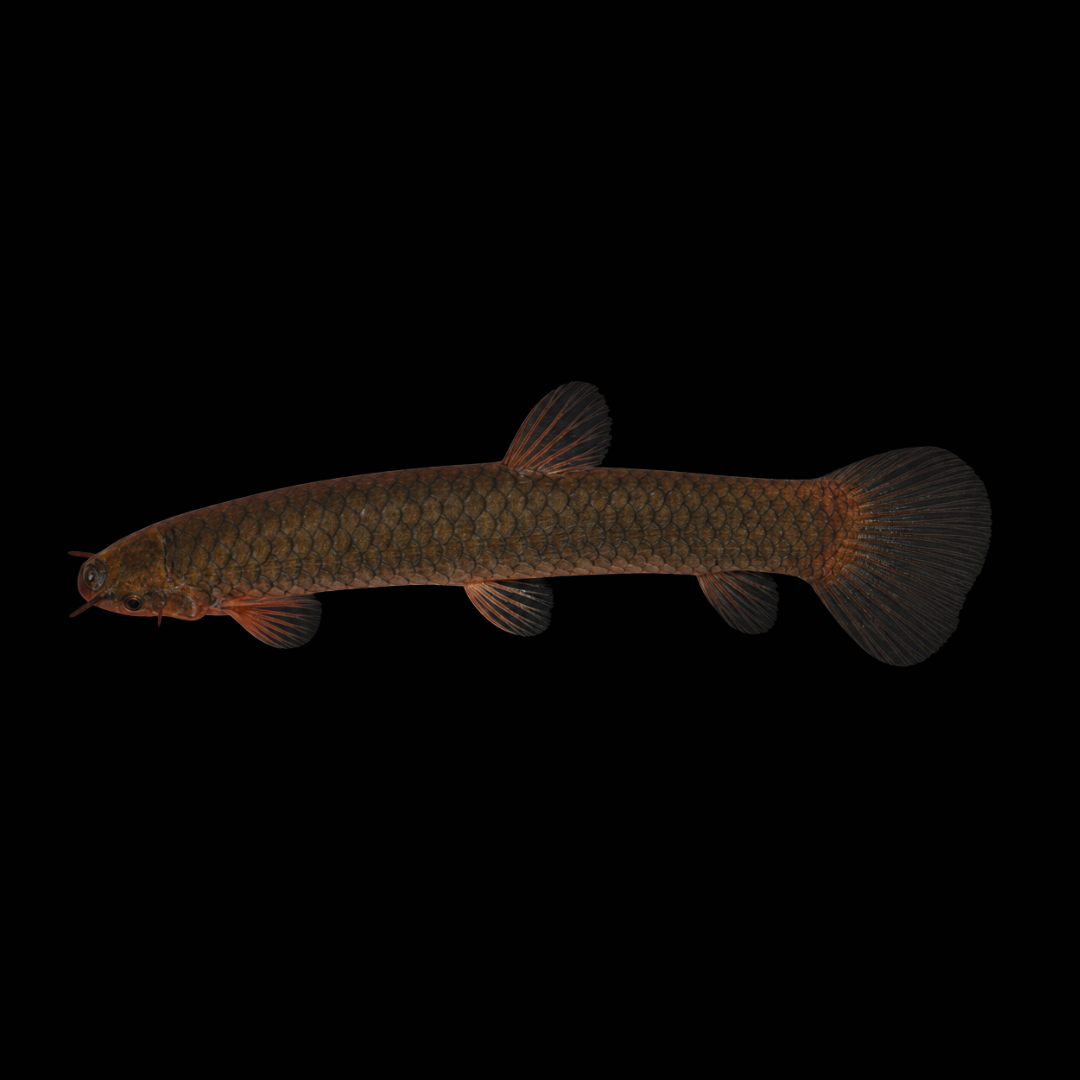
アフリカンマッドフィッシュは、西アフリカから中央アフリカに分布するネズミギス目の淡水魚です。褐色を基調とした細長い体は一見控えめですが、口の構造はほかの魚とは大きく異なります。閉じているときには下顎が頭部の後方を向くほど大きく折りたたまれ、採餌時には先端の柔らかな吻が前方へ展開します。この特殊な口を使い、底面のデトリタスや付着藻類などの細かな餌を丁寧に拾い集めます。また、内部が細かく区画された浮き袋を空気呼吸に利用できることも大きな特徴です。飼育では派手な泳ぎよりも、底を探りながら吻を伸ばす独特の採餌行動をじっくり観察する楽しさがあります。The African mudfish is a freshwater gonorynchiform distributed across parts of West and Central Africa. Its elongated brownish body may look understated at first, but its feeding apparatus is highly unusual. When the mouth is closed, the lower jaw is folded so dramatically that it points toward the rear of the head; during feeding, the soft terminal proboscis deploys forward. This specialized mechanism allows the fish to collect fine foods such as detritus and attached algae from bottom surfaces. Another distinctive feature is its finely compartmentalized swim bladder, which is used in air breathing. In aquaria, much of the fascination comes from watching the fish methodically probe the bottom and extend its unusual mouth while feeding.
基本情報 / Basic Information
学名 / Scientific Name
Phractolaemus ansorgii Boulenger, 1901
通称 / Common Name
アフリカンマッドフィッシュ、ヒンジマウスHingemouth
分類 / Family
ネズミギス目。フラクトラエムス科(Phractolaemidae)として扱う分類がある一方、クネリア科(Kneriidae)のフラクトラエムス亜科として扱う体系もあります。現生のフラクトラエムス属は本種1種のみです。Order Gonorynchiformes. It is treated as the sole living species of Phractolaemus in the family Phractolaemidae by some classifications, while other systems place it in the subfamily Phractolaeminae within Kneriidae.
英名 / English Name
Hingemouth
分布 / Distribution
西アフリカから中央アフリカ。ベナンのノクエ湖・ウェメ川水系から、ナイジェリアのオグン川、オセ川、ニジェール・デルタ、カメルーンのクロス川にかけて分布し、さらにコンゴ共和国およびコンゴ民主共和国のコンゴ川中流域でも記録されています。West and Central Africa, from Lake Nokoué and the Ouémé system in Benin through the Ogun, Ose and Niger Delta systems of Nigeria to the Cross River in Cameroon, with additional records from the middle Congo basin in the Republic of the Congo and the Democratic Republic of the Congo.
最大体長 / Max Size
全長約25cm。流通個体ではそれより小さいサイズも多く見られますが、飼育設備は最大サイズを見込んで選ぶと安心です。About 25 cm total length. Many aquarium specimens are encountered at smaller sizes, but housing should be planned with the documented maximum size in mind.
寿命 / Lifespan
信頼できる飼育下寿命のデータは乏しく、明確な年数は不明です。Reliable captive lifespan data are scarce, and a well-supported lifespan in years is not currently established.
飼育環境 / Aquarium Environment
水槽サイズ / Tank Size
成魚の長期飼育では90cm規格水槽程度以上を目安にすると管理しやすいでしょう。若魚は60cm規格水槽でも飼育できますが、本種は最大25cmに達するため、成長後は底面積に余裕のある環境が適しています。For long-term adult care, an aquarium around a standard Japanese 90 cm tank or larger is a practical target. Juveniles can be maintained in a 60 cm tank, but because the species can reach about 25 cm, adults benefit from substantially more bottom area.
水温 / Temperature
25〜28℃程度を中心に管理します。種の生息環境データでは25〜30℃が示されており、急激な温度変化を避けることが重要です。Maintain roughly 25–28°C for routine aquarium care. Species records indicate tropical conditions around 25–30°C, and sudden temperature changes should be avoided.
水質 / Water Quality
pH6.0〜8.0程度が目安です。特定の数値へ無理に合わせるより、アンモニアや亜硝酸を蓄積させず、安定した水質を維持することを優先します。落葉や流木を使ったタンニンを含む環境も、生息地の雰囲気を再現する選択肢になります。A pH of roughly 6.0–8.0 is a useful reference range. Rather than forcing the water toward a precise number, prioritize stable conditions with no accumulation of ammonia or nitrite. Tannin-stained water created with leaves or wood can also be used to evoke aspects of its natural habitat.
レイアウト / Layout
底床には角のない細かな砂が向いています。吻を伸ばして底面をなぞるように採餌するため、鋭い砂利や石は避けます。流れは強くしすぎず、流木や植物などで落ち着ける場所を作りつつ、空気呼吸のために水面へ無理なく上がれる空間を確保します。Fine, smooth sand is a suitable substrate. Because the fish repeatedly extends its proboscis while working along bottom surfaces, sharp gravel and stones should be avoided. Keep the current moderate, provide sheltered areas with wood or plants, and ensure unobstructed access to the surface for air breathing.
注意点 / Precautions
流通個体は野生採集魚であることが多く、導入直後は体表の傷や痩せ、餌への反応をよく確認します。水合わせは急がず、十分に立ち上がった水槽へ導入してください。また、本種は空気呼吸を行うため、水面への通り道をふさがないことも大切です。Many aquarium specimens are wild-caught, so newly acquired fish should be checked carefully for abrasions, poor body condition, and feeding response. Acclimate them gradually into a mature aquarium. Because the species breathes air, access to the water surface must also remain unobstructed.
餌と給餌 / Feeding
餌の種類 / Diet
野生下では、デトリタスや付着藻類を中心に利用する微小摂食性の魚です。飼育下では冷凍ブラインシュリンプ、冷凍赤虫、細かく砕いた沈下性飼料などが候補になります。2024年に報告された摂餌実験では、藻類ペレット、スピルリナ粉末、冷凍ブラインシュリンプを混ぜた細かな餌が使われています。In the wild it is a microphagous feeder that makes substantial use of detritus and attached algae. In captivity, suitable foods include frozen brine shrimp, frozen bloodworms, and finely crushed sinking foods. A 2024 feeding study used a fine slurry made from crushed algae pellets, spirulina powder, and frozen brine shrimp.
給餌のポイント / Feeding Tips
大きな餌を丸のみする魚ではなく、底面にある細かな餌をゆっくり探して食べます。餌は一か所へ固めず、底床の数か所へ少量ずつ行き渡らせると、本来の採餌行動を引き出しやすくなります。混泳水槽では素早い魚に先取りされやすいため、本種が実際に食べているかを毎回確認してください。This is not a fish adapted to gulping large food items. It searches slowly and precisely for small particles on the bottom. Distributing small amounts of food over several bottom areas can encourage natural feeding behavior. In community aquaria, confirm that faster tank mates are not consuming the food before the hingemouth can reach it.
性格と混泳 / Temperament and Tank Mates
性格 / Temperament
おおむね温和で、活発に他魚を追い回すタイプではありません。研究個体が同種複数で飼育された例もありますが、社会行動についての詳しい情報はまだ限られています。Generally peaceful and not known as an active chaser of other fishes. Research specimens have been housed communally with conspecifics, although detailed information on the species’ social behavior remains limited.
混泳の相性 / Compatibility
攻撃性が低く、給餌競争の激しくない魚が向いています。小〜中型の温和な魚を候補にし、縄張り性の強い魚や、底餌を素早く食べ尽くす魚との組み合わせは避けるのが無難です。混泳では攻撃の有無だけでなく、本種が十分に餌を取れているかを重視してください。Choose peaceful companions that do not create intense competition at feeding time. Small to medium-sized non-aggressive species are generally more suitable than territorial fishes or fast feeders that rapidly clear food from the bottom. In mixed tanks, adequate food access is as important as the absence of overt aggression.
病気と対策 / Diseases and Prevention
かかりやすい病気 / Common Diseases
本種に特有の代表的な疾病については、信頼できる情報が十分に蓄積されていません。実際の飼育では、野生採集魚に共通する問題として、輸送時のスレ傷、痩せ、二次感染などに注意します。Reliable information on diseases specifically characteristic of this species is limited. In practice, issues common to wild-caught aquarium fishes—such as transport abrasions, poor body condition, and secondary infections—deserve particular attention.
対策と予防 / Prevention
新規導入魚は状態をよく観察し、可能であれば隔離水槽で餌食いと体表を確認してから本水槽へ移します。濾過の効いた安定した水を保ち、底床やレイアウトで吻や体表を傷つけないことが基本です。薬剤を使う場合は症状を見極め、魚種不明のまま漫然と投薬しないようにします。Observe new arrivals carefully and, where possible, use a quarantine aquarium to confirm feeding response and skin condition before transfer to the main tank. Maintain stable, well-filtered water and avoid furnishings that could damage the proboscis or body. When medication is required, treat a clearly identified problem rather than dosing indiscriminately.
増やし方(繁殖) / Breeding
雌雄の判別 / Sexing
繁殖に関係すると考えられる角質状の結節が体側に現れることが知られています。文献では雌雄の双方に結節があるとされる一方、観賞魚流通の報告では成熟したオスで体側や眼の周囲の結節が目立つ例もあります。繁殖期以外に外見だけで確実に雌雄を判別する方法は、十分には確立されていません。Keratinized tubercles associated with breeding are known to occur on the body. Literature reports lateral tubercles in both sexes, while aquarium-trade observations describe conspicuous tubercles on the flanks and around the eyes of mature males. A consistently reliable method of sexing fish by external appearance outside the breeding period is not well established.
繁殖形態 / Reproduction
卵生です。卵は透明感のある黄緑色で、直径約1.5〜1.7mmとされ、大型のメスでは数千個の卵を持つことがあります。一方、産卵場所、親による保護、孵化までの時間など、繁殖行動の詳細は公開情報が少なく、泡巣を作ると断定できる根拠も確認されていません。Oviparous. The eggs are reported to be translucent yellow-green and about 1.5–1.7 mm in diameter, and large females may carry several thousand eggs. However, published information on spawning site, parental care, and incubation is sparse, and reliable evidence that this species constructs a bubble nest has not been established.
繁殖のポイント / Breeding Tips
飼育下繁殖の再現性のある手順は、現時点では十分に確立されていません。まずは複数個体を良好な状態で成熟させ、安定した水質と十分な栄養を保つことが基本になります。結節の発達や腹部の変化が見られた場合は、産卵行動を妨げない静かな環境を維持し、卵を確認できたときには親魚から隔離できる準備をしておくとよいでしょう。A repeatable captive-breeding protocol is not yet well established. The first priority is to bring multiple individuals into mature, well-conditioned health under stable water conditions with adequate nutrition. If breeding tubercles or abdominal enlargement become apparent, keep the aquarium calm and be prepared to separate any eggs from the adults if spawning is observed.
雑学と豆知識 / Trivia and Fun Facts
1. 1901年、ニジェール・デルタの標本から記載 / 1. Described in 1901 from Niger Delta material
Phractolaemus ansorgiiは、ジョルジュ・アルベール・ブーランジェによって1901年に記載されました。タイプ標本は、エチオプ川とジェイミソン川の合流地点付近で採集されたものです。種小名ansorgiiは、標本を提供したイギリスの探検家・博物学者ウィリアム・ジョン・アンソルジに献名されました。後にPhractolaemus spinosusなど別名で記載された個体群も、現在は本種のシノニムとして整理されています。Phractolaemus ansorgii was described by George Albert Boulenger in 1901 from specimens collected near the junction of the Ethiop and Jamieson rivers in the Niger Delta. The specific name ansorgii honors the British explorer and naturalist William John Ansorge, who supplied the material. Names later proposed for related specimens, including Phractolaemus spinosus, are now treated as synonyms of this species.
2. 下顎がほぼ180度反転する、きわめて特殊な口 / 2. An extraordinary jaw rotated almost 180 degrees
2024年の解剖学・運動学研究では、閉口時の下顎が一般的な硬骨魚とは反対に後方へ向き、通常の位置からほぼ180度回転した配置になっていることが詳しく示されました。口の先端部は骨格だけで支えられているのではなく、硝子細胞軟骨や強い結合組織を含む柔軟な構造でできています。吻を前へ伸ばす距離は頭長の30%を超えることがあり、底面の形に合わせて上下方向にも動かせるという、非常に珍しい摂餌装置です。A 2024 anatomical and kinematic study showed in detail that, when the mouth is closed, the lower jaw points caudally rather than rostrally and is rotated almost 180 degrees from the usual teleost configuration. The terminal mouth is not supported solely by the oral jaw bones but by flexible tissues that include hyaline-cell cartilage and strong connective tissues. Protrusion can exceed 30% of head length, and the mouth can also be directed dorsally or ventrally to match different feeding surfaces.
3. 速さよりも正確さを選んだ採餌運動 / 3. A feeding mechanism built for precision rather than speed
同じ研究では、吻を前へ出す平均速度は約2.74cm/秒でした。素早い獲物を追う魚の顎運動と比べると遅い一方、研究者は、この構造がさまざまな方向や表面形状に対応して細かな餌を探る器用さにつながっている可能性を指摘しています。水槽で見られるゆっくりとした採餌は、鈍い動きなのではなく、この魚が選んだ独自の食べ方そのものといえます。The same study measured an average protrusion speed of about 2.74 cm per second. That is slow compared with the rapid jaw movements of fishes that capture evasive prey, but the researchers suggested that the unusual design may favor dexterity across different directions and surface textures. The deliberate feeding seen in aquaria is therefore not simply sluggishness; it reflects a highly specialized way of gathering food.
4. 浮き袋が「肺のように」働く / 4. A swim bladder that functions like a lung
本種の浮き袋は多数の小区画に分かれた構造を持ち、空気呼吸に利用されます。森林内の池や沼など、溶存酸素が少なくなりやすい環境で暮らす本種にとって、この能力は重要な適応です。実際に、コンゴ川流域では酸素がきわめて少ない場所から記録された例があります。飼育下でも水面へ上がって空気を取り込めるようにしておく必要があります。The swim bladder is divided into many small compartments and is used in air breathing. This is an important adaptation for a fish inhabiting forest pools and swamps where dissolved oxygen can become very low. The species has even been recorded from extremely oxygen-poor conditions in the Congo basin. In captivity, it must therefore always be able to reach the surface to take air.
5. 泡巣を作る「アンソルギー」とは別の魚 / 5. Not the bubble-nesting fish that shares the name ansorgii
本種と混同しやすい魚に、ミクロクテノポマ・アンソルギー(Microctenopoma ansorgii)がいます。どちらも種小名にansorgiiを持ちますが、ミクロクテノポマはアナバス類の仲間で、泡巣を作る繁殖魚として知られています。一方、Phractolaemus ansorgiiについては、透明感のある黄緑色の卵や繁殖期の結節は記録されているものの、泡巣形成を裏づける信頼できる資料は確認されていません。名前が似ていても、分類も生態もまったく異なる魚です。A species easily confused with this fish is Microctenopoma ansorgii. Both share the specific epithet ansorgii, but Microctenopoma belongs to the anabantoid lineage and is known as a bubble-nest builder. In Phractolaemus ansorgii, translucent yellow-green eggs and breeding tubercles have been reported, but reliable documentation of bubble-nest construction has not been established. Similar names therefore conceal two fishes with very different taxonomy and biology.
6. 細長い姿でも、体幹は意外に円筒形 / 6. Slender in outline, but surprisingly cylindrical in cross-section
頭部は上下にやや扁平で強く骨化していますが、体幹部は細長い円筒形に近く、断面もおおむね丸い魚です。背ビレと尻ビレには棘条がなく、それぞれ6本の軟条を持ちます。口ばかりが注目されがちですが、こうした基本形態にもネズミギス目の中で独自に進化してきた本種らしさが表れています。Although the head is depressed and strongly ossified, the trunk is elongated and generally cylindrical, with a roughly circular cross-section. The dorsal and anal fins lack spines and each have six soft rays. The extraordinary mouth attracts most of the attention, but the rest of the body also reflects the distinctive evolutionary history of this isolated gonorynchiform lineage.
まとめ / Conclusion
アフリカンマッドフィッシュの魅力は、派手な色彩よりも、長い進化の中で形づくられた独特の機能にあります。折りたたまれた顎をゆっくりと展開し、柔らかな吻で底面を探る姿は、ほかの観賞魚ではなかなか見られません。さらに、空気呼吸に適応した浮き袋まで備えており、泥底や低酸素環境で暮らすための工夫が小さな体の随所に詰まっています。The appeal of the African mudfish lies less in brilliant coloration than in the remarkable functions shaped by its evolutionary history. Watching the folded jaws deploy slowly as the soft proboscis works over the bottom is unlike the feeding behavior of most aquarium fishes. Its air-breathing swim bladder adds another layer of specialization, revealing a fish exquisitely adapted to muddy, oxygen-poor freshwater habitats.
迎える際は、最大25cmほどになることを見込み、底面積に余裕のある水槽と傷のつきにくい底床を用意し、水面への経路を確保します。そして何より、細かな餌を焦らず探せる環境を整えることが大切です。目立つ動きで水槽を賑わせる魚ではありませんが、じっくり観察するほど構造と行動の面白さが見えてくる、まさに「知るほど惹かれる」タイプの珍魚です。When keeping this species, plan for a fish that can reach about 25 cm, provide generous bottom area and a non-abrasive substrate, and keep the route to the surface open. Most importantly, create conditions in which it can search calmly for fine food without excessive competition. It is not a fish that dominates an aquarium through constant movement, but one whose anatomy and behavior become more rewarding the longer they are observed.
Fricke, R., Eschmeyer, W. N. & van der Laan, R. (eds.) (2026). Eschmeyer’s Catalog of Fishes: Genera, Species, References. California Academy of Sciences. Electronic version, accessed 24 July 2026.
主な確認範囲:有効学名、記載年、タイプ産地、シノニム、科レベルの分類、広域分布。
Lévêque, C. & Paugy, D. (2003). Phractolaemidae. In D. Paugy, C. Lévêque & G. G. Teugels (eds.), The Fresh and Brackish Water Fishes of West Africa, Vol. 1, pp. 229–231. IRD, Muséum national d’Histoire naturelle & Musée royal de l’Afrique centrale.
Evans, A. J., Naylor, E. R., Lujan, N. K., Kawano, S. M. & Hernandez, L. P. (2024). Deploy the proboscis!: Functional morphology and kinematics of a novel form of extreme jaw protrusion in the hingemouth, Phractolaemus ansorgii (Gonorynchiformes). Journal of Anatomy, 244(6), 929–942. DOI: 10.1111/joa.14020. PMID: 38308591.
Thys van den Audenaerde, D. F. E. (1959). Existence d’une vessie natatoire pulmonoïde chez Phractolaemus ansorgei. Revue de Zoologie et de Botanique Africaines, 59, 364–366.
Wiley, M. L. & Collette, B. B. (1970). Breeding tubercles and contact organs in fishes: their occurrence, structure, and significance. Bulletin of the American Museum of Natural History, 143(3), 143–216.
主な確認範囲:本種の雌雄に見られる繁殖結節と、産卵時の接触維持に関係すると考えられる機能。
Francis-Floyd, R. & Petty, B. D. (2026 update). Routine Health Care of Fish. Merck Veterinary Manual.






コメント