

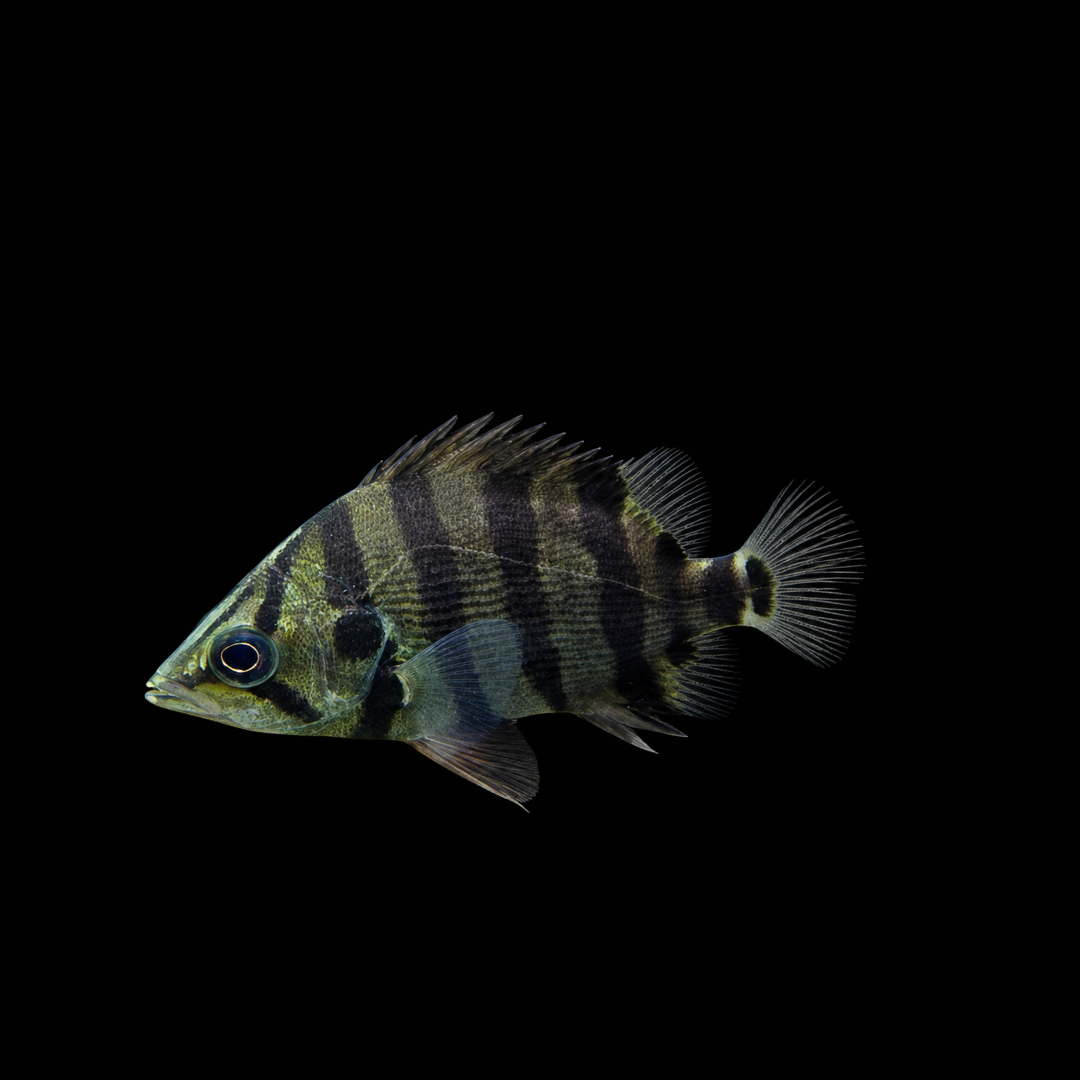
解説 / Description
メニーバータイガーは、銀灰色から褐色を帯びた体に、太い暗色帯と細い不完全帯が重なるダトニオイデス属の肉食魚です。大河川の河口や沿岸ラグーンなどの汽水域を代表的な生息地とする一方、潮汐の影響を受けない淡水河川や湖沼からも記録されており、淡水から汽水まで利用する広い適応力を備えています。体側の複雑な縦帯、背ビレ前方で強くくぼむ頭部の輪郭、大きめの鱗が本種を見分ける手掛かりです。幼魚では、体を傾けて漂流する落ち葉のように見せる行動がダトニオイデス類で知られています。成長すると物陰から獲物を狙い、前方へ大きく伸びる口で小魚や甲殻類を吸い込むように捕らえます。公表されている最大標準体長は約30cmですが、体高と厚みがあるため、成魚には広い底面積、強力なろ過、安定した水質が欠かせません。 The silver tigerfish is a predatory Datnioides species with a silvery-grey to brown body marked by broad dark bars and additional narrow, incomplete bars. It is strongly associated with estuaries and coastal lagoons, yet it is also recorded from freshwater rivers and lakes beyond tidal influence, demonstrating an ability to use both fresh and brackish habitats. Its complex bar pattern, strongly concave predorsal profile and relatively large scales are useful identification features. Juvenile Datnioides are known to drift at an angle like fallen leaves. As they grow, they become ambush predators that use a highly protrusible mouth to draw in fishes and crustaceans. The published maximum is about 30 cm standard length, but the species has a deep, thick body and therefore requires generous floor space, powerful filtration and stable water conditions.
基本情報 / Basic Information
| 学名 / Scientific Name | Datnioides polota (Hamilton, 1822) |
|---|---|
| 通称 / Common Name | メニーバータイガー、メニーバーダトニオ、シルバータイガー。旧来の流通名としてシックスバンドタイガー、メニーバーナンダスなどが使われることもあります。Many-bar tigerfish, many-bar datnoid and silver tigerfish. Older trade names include six-band tigerfish and many-bar nandid. |
| 分類 / Family | 条鰭類・ニザダイ目・マツダイ科・ダトニオイデス属。FishBaseとEschmeyer’s Catalog of Fishesはマツダイ科に置いていますが、文献や分類体系によってはダトニオイデス科、スズキ目などの旧来の組み合わせが用いられます。Ray-finned fishes, order Acanthuriformes, family Lobotidae, genus Datnioides. FishBase and Eschmeyer’s Catalog of Fishes place the genus in Lobotidae, while older literature and alternative classifications may use Datnioididae and Perciformes. |
| 英名 / English Name | Silver Tigerfish / Four-banded Tigerfish / Four-barred Tigerfish |
| 分布 / Distribution | 南アジアから東南アジア、ニューギニアにかけて広く分布します。資料によって範囲の示し方には差がありますが、パキスタンまたはインド周辺からバングラデシュ、インドシナ、スンダ列島を経てニューギニアまで記録されています。大河川の河口、沿岸ラグーン、マングローブ水域のほか、潮汐の影響を受けない淡水河川や湖沼にも生息します。Widely distributed from South and Southeast Asia to New Guinea. Published accounts differ in detail, but records extend from Pakistan or India and Bangladesh through Indochina and Sundaland to New Guinea. The species inhabits estuaries, coastal lagoons and mangrove waters, as well as freshwater rivers and lakes above tidal influence. |
| 最大体長 / Max Size | 公表されている最大値は標準体長約30cmです。スマトラ島ムシ川の調査では全長35cmの個体が報告されています。標準体長と全長は測定方法が異なるため、数値を直接比較しないよう注意が必要です。The published maximum is about 30 cm standard length. A Musi River study in Sumatra reported a specimen measuring 35 cm total length. Standard length and total length are different measurements and should not be compared directly. |
| 寿命 / Lifespan | 本種に限定した信頼性の高い寿命資料は見当たりません。ダトニオイデス類は長期飼育の対象になるため、年単位ではなく、長期にわたって維持できる水槽と管理体制を前提に迎えます。Reliable species-specific longevity data are not available. Datnioides are long-term aquarium commitments, so the fish should be acquired only when the aquarium and husbandry plan can be maintained for many years. |
飼育環境 / Aquarium Environment
| 水槽サイズ / Tank Size | 幼魚は60〜90cm規格水槽で育成できますが、これは一時的な育成環境です。成魚1匹には、体高と旋回スペースを考慮して、少なくとも120×60cm程度の底面を持つ120cmワイド水槽を実用上の目安とします。余裕を確保できる150〜180cm水槽では、遊泳空間と水質の安定性が高まります。これらは実験で定められた生物学的最小値ではなく、成魚を無理なく管理するための飼育上の目安です。Juveniles can be raised temporarily in standard 60–90 cm aquariums. For one adult, a practical starting point is a 120 cm wide tank with a footprint of roughly 120 × 60 cm, allowing for the fish’s body depth and turning space. Aquariums of 150–180 cm provide greater swimming room and more stable water quality. These dimensions are husbandry guidelines, not experimentally determined biological minimums. |
|---|---|
| 水温 / Temperature | 24〜27℃を安定して維持するのが実用的です。FishBaseには22〜26℃の記録があり、近年の汽水池での稚魚育成試験では平均約27℃で良好な生残が得られています。野外調査では30℃の水域から採集された例もありますが、短い観察値を飼育上の最適温度とみなすことはできません。設定値そのものより、急激な変化を避けることを優先します。 A stable 24–27°C is a practical aquarium range. FishBase lists 22–26°C, while a recent brackish-pond nursery trial achieved good survival at mean temperatures near 27°C. Fish have also been sampled from water at 30°C, but a field observation does not establish an aquarium optimum. Preventing abrupt temperature change is more important than targeting a single exact value. |
| 水質 / Water Quality | 淡水から弱汽水まで飼育可能ですが、すべての個体に共通する唯一の最適値は確立されていません。ICAR-CIBAの試験では0〜15pptで死亡が認められず、20pptでは50%の死亡が報告されました。2026年の汽水池試験では、平均塩分約6.4〜7.4ppt、平均pH約7.7〜8.1で稚魚が育成されています。一方、淡水のムシ川調査では塩分0、pH6.5の地点から採集されており、本種の適応幅が広いことが分かります。購入店の管理水を確認し、淡水または5〜10ppt程度の弱汽水へ段階的に合わせてください。塩分を付ける場合は人工海水を用い、短期間で大きく変化させません。The species can be maintained in freshwater or low-end brackish water, but no single universal optimum has been established. An ICAR-CIBA trial reported no mortality from 0 to 15 ppt, but 50% mortality at 20 ppt. A 2026 nursery trial reared juveniles at mean salinities of about 6.4–7.4 ppt and mean pH values of about 7.7–8.1. In contrast, a Musi River field study collected fish at salinity 0 and pH 6.5, demonstrating broad environmental tolerance. Confirm the retailer’s holding water and acclimate gradually to either freshwater or low-end brackish water around 5–10 ppt. When salt is used, mix marine aquarium salt separately and avoid rapid changes. |
| レイアウト / Layout | 中央から前面に広い遊泳空間を残し、後方や側面には流木、丸みのある石、根を模した装飾などで落ち着ける陰と視線を遮る場所を作ります。底床は細砂など掃除しやすい素材が扱いやすく、サンゴ砂やアラゴナイトは水質を変化させるため、必要性を確認して少量から用います。成魚は力が強いので、装飾は倒れないよう固定し、ヒーターには丈夫なカバーを付けるか、ろ過槽内へ隔離します。肉食魚の排せつ量に対応できる強力なろ過と十分な酸素供給が必要です。Leave a broad swimming area across the centre and front, while providing shade and visual barriers at the back and sides with driftwood, rounded rocks or root-like structures. Fine sand or another easy-to-clean substrate is practical. Coral sand and aragonite alter water chemistry and should be used only when their buffering effect is needed. Adults are powerful, so secure all décor and protect heaters with a strong guard or place them in a sump. Powerful filtration and ample aeration are required for the waste load of a carnivorous fish. |
| 注意点 / Precautions | アンモニアと亜硝酸は常に検出されない状態を保ち、硝酸塩と有機物の蓄積を定期換水で抑えます。換水量は水量、給餌量、ろ過能力に合わせますが、週1回20〜30%程度から始め、測定値を見て調整すると管理しやすくなります。汽水飼育では蒸発しても塩分は水槽内に残るため、蒸発分の足し水には塩を加えません。導入時は購入店の水温、pH、塩分を確認し、差が大きい場合は魚の状態と輸送水の劣化を見ながら段階的に合わせます。Keep ammonia and nitrite undetectable and control nitrate and dissolved organic waste with regular water changes. A weekly change of roughly 20–30% is a useful starting point, adjusted to water volume, feeding and filtration. In brackish aquariums, evaporation removes water but leaves salt behind, so top-off water should not contain additional salt. At introduction, check the retailer’s temperature, pH and salinity, and correct large differences gradually while considering the condition of the fish and the deterioration of shipping water. |
餌と給餌 / Feeding
| 餌の種類 / Diet | 自然界では魚類、エビ類、カニ類、水生昆虫の幼虫などを捕食します。飼育下では、幼魚に冷凍アカムシ、小型のエビ、刻んだオキアミなどを与え、成長に応じてエビ、オキアミ、貝肉、脂肪の少ない魚の切り身、ミミズ、肉食魚用の沈下性ペレットへ広げます。活魚だけに依存すると、病原体の持ち込みと栄養の偏りが起こりやすいため、冷凍餌や人工飼料を主軸にします。牛ハツや鶏肉など陸上動物の肉は、本種の自然な食性とかけ離れているため、常用しません。In nature it preys on fishes, prawns, crabs and aquatic insect larvae. Juveniles can be offered frozen bloodworm, small shrimp and chopped krill, with larger fish receiving shrimp, krill, mollusc meat, lean fish flesh, earthworms and sinking carnivore pellets. Exclusive reliance on live feeder fish increases the risk of pathogens and nutritional imbalance, so frozen and formulated foods should form the core of the diet. Meat from terrestrial animals, such as beef heart or chicken, is far removed from the natural diet and should not be used routinely. |
|---|---|
| 給餌のポイント / Feeding Tips | 幼魚は成長を見ながら少量を1日1回程度、成魚は体形と水温に応じて週2〜3回を目安にします。腹部が不自然に張るほど与えず、食べ残しは早めに回収してください。人工飼料へ切り替える際は、好物のエビやオキアミと同時に沈下性ペレットを落とし、徐々に人工飼料の割合を増やします。同じ餌だけを続けず、甲殻類、魚肉、貝肉、人工飼料を組み合わせて栄養の偏りを抑えます。Offer juveniles small daily meals while monitoring growth. Adults commonly do well with two or three meals per week, adjusted to body condition and temperature. Do not feed until the abdomen is unnaturally distended, and remove leftovers promptly. When converting a fish to pellets, offer sinking carnivore pellets together with familiar shrimp or krill and gradually increase the pellet proportion. Rotate crustaceans, fish flesh, mollusc meat and formulated diets to reduce nutritional imbalance. |
性格と混泳 / Temperament and Tank Mates
| 性格 / Temperament | 物陰で静止して獲物を待つことが多い待ち伏せ型の捕食魚です。餌や周囲の動きには素早く反応します。幼魚は複数で見られることがありますが、成長すると同種や似た体形の魚に攻撃性を示す個体もいます。輸送直後、消灯時、劣位になったとき、水質が不安定なときには体色が暗くなりやすく、黒化だけで病気と判断することはできません。呼吸、食欲、体表、糞、水質、同居魚との関係を合わせて確認します。A quiet ambush predator that often waits near cover and reacts rapidly to food or movement. Juveniles may be observed together, but some adults become aggressive toward conspecifics or similarly shaped fishes. Newly transported, subordinate or stressed fish, and fish seen after lights-out, may darken considerably. Dark coloration alone is not a diagnosis; assess respiration, appetite, skin, faeces, water quality and social pressure together. |
|---|---|
| 混泳の相性 / Compatibility | 単独飼育が最も管理しやすい魚です。混泳する場合は、口に入らない大きさで、本種と同じ水温・塩分条件に適応できる丈夫な魚を選びます。アーチャーフィッシュ、モノダクティルス、スキャットなどは水質面で候補になりますが、成魚サイズ、性格、必要水量が異なるため、大型水槽で個体ごとに相性を確認します。同種を少数だけで飼うと攻撃が一匹へ集中する場合があります。複数飼育は十分に広い水槽、多数の視線遮蔽物、退避用水槽を準備したうえで行い、数をそろえれば必ず成功するとは考えないでください。小魚、細身の魚、弱い長ヒレ魚は捕食や追尾の対象になります。Single-specimen care is the easiest to manage. Tank mates must be too large to swallow, robust and able to tolerate the same temperature and salinity. Archerfishes, monos and scats may be compatible in water chemistry, but their adult size, behaviour and space requirements differ, so compatibility must be judged individually in a large aquarium. In small conspecific groups, aggression may focus on one fish. Multiple Datnioides should be attempted only with ample space, numerous visual barriers and a separate tank available, and no group size guarantees success. Small, slender or delicate long-finned fishes are likely to be hunted or harassed. |
病気と対策 / Diseases and Prevention
| かかりやすい病気 / Common Diseases | 本種だけに特有の病気が確立されているわけではありません。輸入直後の個体では、白点病などの外部寄生虫、鰓寄生虫、細菌性の体表炎症、ヒレの傷み、白濁眼、拒食が問題になります。野生採集個体では体内寄生虫も考慮します。黒化だけで病名を決めず、呼吸数、粘液、体表、糞、食欲、水質測定値を総合して判断します。No disease is known to be unique to this species. Newly imported fish may suffer from ich and other external parasites, gill parasites, bacterial skin inflammation, fin damage, cloudy eyes or loss of appetite. Internal parasites should also be considered in wild-caught specimens. Do not diagnose from dark coloration alone; evaluate respiration, mucus, skin, faeces, appetite and measured water quality together. |
|---|---|
| 対策と予防 / Prevention | 新しい個体は別水槽で観察し、購入店の塩分とpHを確認して、導入先との差を急に変えないようにします。観察期間は3〜4週間が一つの目安ですが、症状や入荷状況に応じて延長します。成熟した生物ろ過、十分な溶存酸素、安定した温度と塩分、清潔な底面が基本的な予防策です。治療薬は原因を推定してから使用し、汽水では薬効や毒性が変わる可能性があるため、製品表示と魚病の専門家の助言に従います。黒化が続く場合は、刺激を増やすのではなく、水質、照明、隠れ場所、攻撃関係を順番に見直します。Observe new fish in a separate aquarium, confirm the retailer’s salinity and pH, and avoid abrupt differences at transfer. Three to four weeks is a useful quarantine guideline, extended when symptoms or shipment history warrant it. Mature biological filtration, high dissolved oxygen, stable temperature and salinity, and a clean substrate are the foundations of prevention. Use medication only after narrowing down the likely cause; salinity can alter drug performance and toxicity, so follow product instructions and professional fish-health advice. If darkening persists, review water quality, lighting, shelter and aggression rather than increasing stimulation. |
増やし方(繁殖) / Breeding
| 雌雄の判別 / Sexing | 外見だけで確実に雌雄を判別する方法は確立されていません。成熟した雌は卵巣の発達に伴って腹部がふくらむ場合がありますが、体形や栄養状態との区別は困難です。確実な確認には生殖腺の観察など専門的な方法が必要です。No reliable method has been established for sexing the species by external appearance. Mature females may become fuller as the ovaries develop, but this is difficult to distinguish from normal body shape or nutritional condition. Reliable confirmation requires specialist methods such as gonadal examination. |
|---|---|
| 繁殖形態 / Reproduction | 卵生です。スマトラ島ムシ川で2011年3〜5月に採集された86個体の調査では、複数の生殖腺成熟段階が確認され、卵径の分布から、一度にすべての卵を放出しない部分産卵型と判断されました。同研究は年に複数回産卵する可能性も示していますが、3か月間の地域調査であるため、全分布域で年間を通じて産卵すると断定することはできません。親魚による卵や仔魚の保護行動も、飼育に応用できるほど詳しく解明されていません。Oviparous. A study of 86 fish collected from the Musi River between March and May 2011 found several gonadal stages and an egg-size distribution consistent with partial spawning rather than releasing all eggs at once. The study also suggested repeated spawning within a year, but a three-month regional survey cannot establish year-round spawning across the entire range. Parental care of eggs or larvae is not described in enough detail to guide aquarium breeding. |
| 繁殖のポイント / Breeding Tips | 家庭水槽で再現性のある繁殖方法は確立されていません。ICAR-CIBAでは野生個体を用いた親魚養成と塩分耐性試験が進められ、2026年にはバングラデシュの汽水池で野外採集稚魚の育成密度を比較した研究が公表されました。これらは親魚候補や稚魚を飼育する技術の前進ですが、水槽や池で成熟、産卵、孵化、仔魚育成までを連続して再現する完全養殖が広く確立したことを意味しません。繁殖を目指すには、親魚の成熟条件、産卵刺激、卵の性質、仔魚の初期餌料を個別に解明する必要があります。A repeatable home-aquarium breeding method has not been established. ICAR-CIBA has worked on broodstock development and salinity tolerance using wild fish, and a 2026 Bangladeshi study compared stocking densities for nursery rearing of wild-collected juveniles in brackish ponds. These are advances in holding broodstock candidates and juveniles, but they do not demonstrate widely established closed-cycle production from maturation and spawning through hatching and larval rearing. Further work is needed on maturation conditions, spawning cues, egg characteristics and first foods for larvae. |
雑学と豆知識 / Trivia and Fun Facts
| 1. 学名がたどった二百年の道のり / 1. A scientific name with a two-century history | 本種は1822年、フランシス・ブキャナン=ハミルトンによって、ガンジス川河口の魚としてCoius polotaの名で記載されました。その後はDatnioides quadrifasciatusという名も広く使われましたが、quadrifasciatusは命名上利用できない名称と整理され、polotaが有効な種小名として採用されています。また、Coius属のタイプ種がキノボリウオのシノニムと判断されたため、タイガーパーチ類にはBleekerが1853年に提唱したDatnioidesが使われるようになりました。現在の有効名はDatnioides polotaですが、分類史を反映して古い学名が資料や流通名に残っています。Francis Buchanan-Hamilton described the species from the Ganges estuary in 1822 as Coius polota. Datnioides quadrifasciatus later became widely used, but quadrifasciatus was determined to be unavailable under zoological nomenclature, leaving polota as the valid specific name. The type species of Coius was subsequently identified as a synonym of the climbing perch, so Bleeker’s 1853 genus Datnioides became the correct genus for the tiger perches. The valid name is now Datnioides polota, although older names remain in literature and the aquarium trade. |
|---|---|
| 2. 「メニーバー」を形づくる帯と鱗 / 2. Bars and scales behind the “many-bar” name | 体側には最大7本の完全な暗色帯が現れ、その間に1〜4本の細い不完全帯が入ることがあります。さらに、背ビレ前方の輪郭が強くくぼみ、第1鰓弓の鰓耙数が20〜23本、側線系列の鱗が約40〜60枚と比較的大きいことも重要な識別点です。販売名に含まれる「シックスバンド」や「フォーバンド」だけで同定すると、個体差の大きい模様に惑わされます。帯の本数だけでなく、頭部の輪郭、細帯の入り方、鱗の大きさを組み合わせて見ることで、本種らしい特徴が明確になります。The body may show up to seven complete dark bars, with one to four narrow incomplete bars between them. Other useful characters include a strongly concave predorsal profile, 20–23 gill rakers on the first arch and relatively large scales, about 40–60 in the lateral series. Trade names such as “six-band” or “four-band” can be misleading because the pattern is variable. Identification is more reliable when bar arrangement, head profile and scale size are considered together. |
| 3. 落ち葉に見える幼魚の姿勢 / 3. The leaf-like posture of juveniles | ダトニオイデス類の幼魚では、体を横倒し気味にして漂い、落ち葉のように見せる行動が知られています。深い体と縦帯は、この姿勢になると水中の漂流物に似た輪郭を作ります。捕食者から見つかりにくくする防御的な意味が主と考えられますが、獲物への接近を助ける可能性もあります。ただし、本種だけを対象に機能を実験的に検証した研究は限られるため、攻撃的擬態と断定するより、複数の利点を持ち得る擬態行動として理解するのが適切です。Juvenile Datnioides are known to drift while tilted on their side, resembling a fallen leaf. Their deep body and vertical bars create the outline of floating debris in this posture. Concealment from predators is the most likely benefit, although it may also assist approach to prey. Because the function has not been experimentally demonstrated specifically for D. polota, it is best treated as a camouflage behaviour with several possible advantages rather than definitively labelled as aggressive mimicry. |
| 4. 淡水と汽水の両方に現れる理由 / 4. Why the species occurs in both fresh and brackish water | 本種は河口や汽水ラグーンを代表的な生息地としながら、潮汐の影響がない淡水河川や湖沼からも記録されています。ICAR-CIBAの試験では0〜15pptで死亡が見られず、20pptで死亡率が上昇しました。また、ムシ川では塩分0の地点から採集され、2026年の稚魚育成試験では約6〜7pptの汽水池が使われています。これらは淡水か汽水かの二者択一ではなく、個体群や生活段階に応じて塩分勾配を利用する魚であることを示します。飼育では「必ず汽水」「必ず淡水」と決め付けず、入荷個体の管理履歴を確認して急変を避けることが重要です。The species is strongly associated with estuaries and brackish lagoons, yet it is also recorded from freshwater rivers and lakes beyond tidal influence. An ICAR-CIBA trial found no mortality from 0 to 15 ppt but increased mortality at 20 ppt. Fish were collected at salinity 0 in the Musi River, while a 2026 nursery study used ponds averaging about 6–7 ppt. These findings show a fish that uses a salinity gradient rather than fitting a simple freshwater-or-brackish label. Aquarium care should therefore follow the water history of the individual and avoid abrupt change. |
| 5. 黒化は原因ではなく観察の手掛かり / 5. Darkening is a clue, not a cause | 銀色の体が黒く沈む現象は、照明、背景、緊張、社会的順位、夜間の休息、水質など、複数の条件で起こります。明るい背景で体色が軽くなる個体はいますが、白い水槽へ移せば必ず発色するわけではありません。黒化が長く続く場合は、体色だけを変えようとせず、アンモニア、亜硝酸、pH、塩分、呼吸、食欲、隠れ場所、攻撃関係を順番に確認します。色の変化は病名ではなく、水槽内で起きていることを見直すための観察材料です。Darkening can be influenced by lighting, background, fear, social rank, nighttime rest and water quality. Some individuals lighten against a pale background, but a white aquarium does not guarantee bright coloration. If darkening persists, do not try to manipulate colour alone; check ammonia, nitrite, pH, salinity, respiration, appetite, shelter and aggression in sequence. Colour change is not a disease name but an observation that prompts a review of aquarium conditions. |
| 6. 流通名よりも管理履歴を確認する / 6. Holding history matters more than the trade name | 日本ではメニーバータイガー、メニーバーダトニオ、シックスバンドタイガーなど複数の名称で流通します。市場価格や入荷量は時期によって変わり、現在も野生由来の個体が中心と考えられます。購入時には販売名だけでなく、学名、全長、入荷日、現在食べている餌、管理している塩分とpH、治療歴を確認することが大切です。特に塩分履歴が分かれば、自宅での導入時に生じる浸透圧の急変を避けやすくなります。In Japan the species is traded under several names, including many-bar tiger, many-bar datnoid and six-band tigerfish. Prices and availability vary, and the trade still appears to rely mainly on wild-origin fish. At purchase, confirm the scientific name, size, arrival date, current food, holding salinity and pH, and treatment history. Knowing the salinity history is especially useful for avoiding abrupt osmotic change during transfer to the home aquarium. |
| 7. 保全評価と養殖研究は別の尺度で読む / 7. Conservation status and culture research use different scales | IUCNの世界評価では2019年に軽度懸念とされています。これは種全体の絶滅リスクが現時点で高いと評価されていないことを示しますが、地域ごとの減少や採集圧が存在しないという意味ではありません。2026年の稚魚育成論文は表題で本種を「endangered」と表現していますが、世界的なIUCNカテゴリーとは一致しないため、地域的な希少性や保全上の問題意識を表した語として分けて読む必要があります。親魚養成や稚魚育成の研究は進んでいるものの、完全養殖の確立には産卵と仔魚期を含む生活環全体の再現が必要です。The global IUCN assessment listed the species as Least Concern in 2019. This means the species is not currently judged to face a high global extinction risk, but it does not rule out local decline or collection pressure. A 2026 nursery paper uses “endangered” in its title, but that wording does not match the global IUCN category and should be read as a regional or conservation-context description. Broodstock and nursery research is advancing, but closed-cycle production still requires repeatable spawning and larval rearing through the full life cycle. |
まとめ / Conclusion
メニーバータイガーは、銀灰色の体に複雑な縦帯をまとい、静かに獲物を待つ姿と、瞬時に口を伸ばす捕食動作を併せ持つ魚です。公表されている最大標準体長は約30cmですが、深い体高と厚み、肉食魚らしい排せつ量を考えると、成魚には120cmワイド水槽以上を目安とした十分な空間と強力なろ過が求められます。 The silver tigerfish combines a silvery-grey body and complex vertical bars with the contrast between quiet ambush behaviour and a sudden protrusible-mouth strike. Although its published maximum is about 30 cm standard length, its deep body and carnivorous waste load call for substantial space, with a 120 cm wide aquarium or larger serving as a practical adult guideline, together with powerful filtration.
淡水と汽水の双方から記録される本種では、特定の塩分やpHを一律に当てはめるより、購入時の管理水を確認し、水温・塩分・pHを急変させないことが長期飼育の基礎になります。十分な設備を先に整え、餌と混泳相手を慎重に選び、野生由来である可能性にも配慮して迎えることで、銀色の地肌と変化に富む帯模様、ダトニオイデスならではの捕食行動を長く観察できます。中型の肉食魚としての存在感と、河口から淡水域へ広がる生態の奥深さを、水槽内で感じさせる魅力的な一種です。 Because the species is recorded from both fresh and brackish water, long-term success depends less on imposing one universal salinity or pH than on confirming the seller’s holding water and preventing abrupt changes in temperature, salinity and pH. With adequate equipment prepared in advance, carefully selected food and tank mates, and consideration for its likely wild origin, the fish can display its silver ground colour, variable bars and characteristic Datnioides predatory behaviour for years. It is an impressive medium-sized predator that also reflects the ecological complexity of habitats linking estuaries and inland freshwaters.
分布マップ
メニーバータイガーは、パキスタンまたはインド周辺からバングラデシュ、インドシナ、スンダ列島を経てニューギニアまで、南アジアから東南アジアの広い範囲に分布します。
この地図のマーカーは、南アジアから東南アジア、ニューギニアに及ぶ広い分布をイメージしやすくするための概略代表地点です。実際の採集地点や厳密な生息範囲を示すものではありません。
メニーバータイガー(Datnioides polota)参考文献・根拠資料
分類、分布、生息環境、飼育条件、繁殖、疾病予防に関する記述を支える資料として、査読論文、公的研究機関の報告書、国際機関の技術資料、魚類学・獣医学の専門データベースを選定しています。店舗、通販サイト、個人ブログ、一般的なまとめサイトは含めていません。
資料の読み方:本種を直接扱う資料を優先し、疾病・検疫については観賞魚および生きた水生動物全般を対象とする専門資料で補っています。各文献名の下に、記事内のどの内容を支える資料かを記載しています。
分類・形態・分布・生息環境
-
Fricke, R., Eschmeyer, W. N. & Van der Laan, R.(eds.)Eschmeyer’s Catalog of Fishes: Datnioides polota.有効学名、命名者、マツダイ科への配置、南・東南アジアからニューギニアに及ぶ分布、淡水・汽水での記録を確認する基礎資料。
-
Kottelat, M. 2000. The type species of the genus-group names Coius Hamilton, 1822 and Datnia Cuvier, 1829 and the type-genus of the family-group name Datnioididae Bleeker, 1858. Journal of South Asian Natural History, 5(1): 91–94.CoiusとDatnioidesをめぐる属名の整理、旧学名が残る理由など、記事内の命名史を支える分類学資料。
-
Roberts, T. R. & Kottelat, M. 1994. The Indo-Pacific tigerperches, with a new species from the Mekong basin (Pisces: Coiidae). Ichthyological Exploration of Freshwaters, 5(3): 257–266.体側の帯、頭部輪郭、鰓耙数、側線系列の鱗数などの識別形質と、河口・沿岸ラグーン・淡水域を含む分布および生息環境を支える主要な分類学資料。
-
Froese, R. & Pauly, D.(eds.)FishBase: Datnioides polota.分類、淡水・汽水性、分布、最大標準体長30cm、22~26℃の記録、形態的識別点、魚類・エビ・カニ・水生昆虫幼虫を食べる食性を横断的に確認できる専門データベース。
-
Ahmad, A. B. 2020. Datnioides polota. The IUCN Red List of Threatened Species 2020.世界的な分布、生息環境、生態、利用状況および2019年8月9日評価の「軽度懸念(Least Concern)」を確認する保全評価資料。
飼育条件・塩分適応・繁殖
-
ICAR–Central Institute of Brackishwater Aquaculture. 2022. ICAR-CIBA Annual Report 2021, p. 77.野生個体を用いた親魚候補の養成、卵巣観察、塩分耐性試験を報告。0~15pptでは死亡がなく、20pptでは50%の死亡が観察されたという記事内の塩分説明を直接支える公的研究報告。
-
Ridho, M. R. 2021. Reproduction aspect of tiger fish (Datnioides polota Hamilton) in Musi River, South Sumatera. IOP Conference Series: Earth and Environmental Science, 860: 012110.ムシ川個体群の体長・体重、生殖腺成熟度、性比、産卵数、卵径分布、部分産卵型という判断を支える種別研究。全長35cmの個体と調査地点の水質記録も含む。
-
Sonia, S. S., Mostofa, M. G., Islam, M. L. & Bhadra, A. 2026. Nursery Rearing of Endangered Mangrove Fish Datnioides polota: Effects of Stocking Density on Growth and Survival. Aquaculture, Fish and Fisheries, 6(3): e70253.野外採集稚魚を汽水池で育成し、飼育水の水温・塩分・pH、収容密度、成長および生残を比較した研究。弱汽水での稚魚育成実績を支える最新の査読論文。
病気・検疫・管理上の注意
-
Arthur, J. R., Bondad-Reantaso, M. G. & Subasinghe, R. P. 2008. Procedures for the Quarantine of Live Aquatic Animals: A Manual. FAO Fisheries Technical Paper No. 502. Rome: FAO.新規導入魚の隔離、器具の専用化、消毒、排水管理、観察と検査を含む検疫の基本原則を支える国際機関の技術資料。
-
Merck Veterinary Manual. Disorders and Diseases of Fish.外部・鰓寄生虫、細菌性疾患、皮膚と粘液の障害、呼吸異常などの観察点、顕微鏡検査の必要性、薬剤使用時の注意、検疫と衛生管理の重要性を支える獣医学資料。
-
Department for Environment, Food & Rural Affairs. Selling Animals as Pets Licensing: Statutory Guidance for Local Authorities. Updated 1 June 2026.アンモニア・亜硝酸の蓄積防止、水質測定、温度と水質の急変回避、新規個体の馴致・隔離、残餌と廃棄物の除去、器具を介した交差感染防止を支える公的飼養管理基準。
文献から直接確定できない飼育上の目安
成魚に対する120cmワイド水槽という目安、成魚への週2~3回の給餌、特定魚種との混泳可否、背景色や社会的順位と黒化の関係は、本種を対象とした比較実験で確立された数値・結論ではありません。これらは体形、最大体長、食性、排せつ量、捕食性、一般的な魚類管理原則から導いた実務上の推奨として扱い、絶対条件とは表現しないことが適切です。
最終確認日:2026年7月22日。オンライン資料は更新やURL変更が行われる場合があります。




コメント