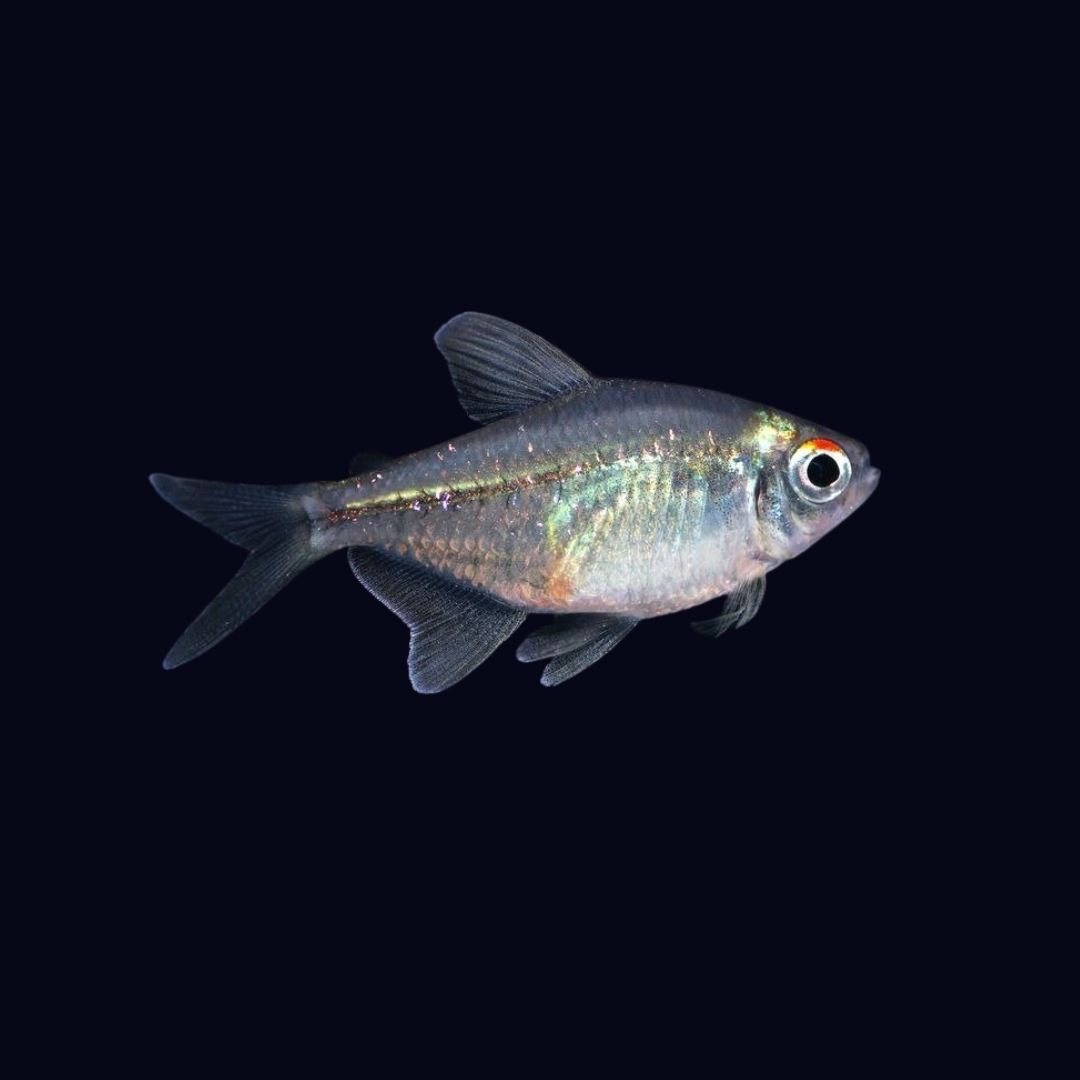
ダイヤモンドテトラは、ベネズエラ北部のバレンシア湖水系を故郷とする小型の南米テトラです。幼魚のうちは一見すると控えめな印象ですが、成熟するにつれて体側の鱗が宝石のように輝き、特に雄では背鰭や臀鰭が優雅に伸び、落ち着いた水草水槽の中で強い存在感を放ちます。この輝きは単なる体色ではなく、鱗の下に並ぶグアニン結晶によって光が反射・干渉する構造色によるものです。飼育は比較的しやすい一方で、本来の美しさを引き出すには、群れでの飼育、薄暗い照明、清潔で安定した弱酸性から中性の水質、そして良質な餌が大切になります。The Diamond Tetra is a small South American tetra native to the Lake Valencia basin in northern Venezuela. Juveniles can look rather plain, but as they mature, the scales along the flanks develop a jewel-like shine, and mature males grow elegant extensions on the dorsal and anal fins. This brilliance is not merely pigment-based coloration; it is structural color produced by light reflecting and interfering within guanine crystals arranged beneath the scales. Although the species is generally easy to keep, its full beauty is best expressed in groups, under subdued lighting, with clean and stable slightly acidic to neutral water, and a nutritious diet.
基本情報 / Basic Information
学名 / Scientific Name
Makunaima pittieri。旧学名は Moenkhausia pittieri です。. Formerly known as Moenkhausia pittieri.
通称 / Common Name
ダイヤモンドテトラ、ダイヤモンドカラシンDiamond Tetra
分類 / Family
カラシン目、アケストロルハムフス科、マクナイマ属。現行の主要な分類データベースでは、旧来の広い意味でのカラシン科ではなく、アケストロルハムフス科として扱われています。亜科は資料により表記差があり、Catalog of Fishes では Stichonodontinae とされます。一方、解説資料や二次資料では Megalamphodinae と表記される場合もあり、亜科名を調べる際は資料による違いに注意が必要です。Order Characiformes, family Acestrorhamphidae, genus Makunaima. Major current taxonomic databases treat this species in Acestrorhamphidae rather than in the broad traditional Characidae. Subfamily usage varies by source; Catalog of Fishes places it in Stichonodontinae, while some secondary references may use Megalamphodinae. Bear these differences between sources in mind when checking subfamily names.
英名 / English Name
Diamond Tetra
分布 / Distribution
南米ベネズエラ北部、バレンシア湖水系とその周辺の流入河川・小川。IUCNレッドリストでは絶滅危惧 EN とされ、野生個体群は生息地の汚染や分断により強く圧迫されていると考えられています。Northern Venezuela, especially the Lake Valencia basin and nearby inflowing streams. The species is listed as Endangered on the IUCN Red List, and wild populations are considered heavily pressured by habitat degradation, pollution, and fragmentation.
最大体長 / Max Size
約6cm。雄は鰭が伸びるため、実際の存在感は体長以上に大きく見えます。About 6 cm. Mature males can appear larger because of their extended fins.
寿命 / Lifespan
一般的に3年から5年ほど。安定した水質と栄養管理が良い環境では、6年程度生きることもあります。Typically around 3 to 5 years. In stable, well-managed aquariums, individuals may live for about 6 years.
飼育環境 / Aquarium Environment
水槽サイズ / Tank Size
最低でも60cm規格水槽、できれば60cmワイド水槽以上が安心です。一般的な60cm規格水槽は水量約57L前後、60cmワイド水槽では約100L前後が目安になります。6匹以上、できれば8匹から10匹以上の群れで泳がせると本来の落ち着きと美しさが出やすくなります。余裕を持って育てるなら90cm規格水槽も適しています。A standard 60 cm aquarium is the practical minimum, while a 60 cm wide tank or larger is preferable. A typical standard 60 cm tank holds roughly 57 liters, while a 60 cm wide tank is closer to about 100 liters. Keep at least 6 individuals, preferably 8 to 10 or more, to encourage natural confidence and display. A standard 90 cm aquarium is also excellent for a more spacious setup.
水温 / Temperature
24℃から28℃。繁殖を狙う場合は、状態を見ながら27℃から29℃程度のやや高めに調整します。24 to 28°C. For breeding attempts, slightly warmer water around 27 to 29°C may be used with careful observation.
水質 / Water Quality
弱酸性から中性、pH 5.5から7.0前後が適します。硬度は軟水から中程度の硬度、目安として5から12 dGH程度です。日本の多くの地域の水道水には比較的なじみやすい魚ですが、硝酸塩が蓄積すると輝きや体調に影響しやすいため、定期的な換水で清潔さを保ちます。Slightly acidic to neutral water is suitable, roughly pH 5.5 to 7.0. Soft to moderately hard water, around 5 to 12 dGH, is appropriate. The species often adapts well to many Japanese tap water conditions, but nitrate accumulation can affect condition and brilliance, so regular water changes are important.
レイアウト / Layout
暗色系の底床、流木、陰性水草、有茎草、浮草を組み合わせた落ち着いたレイアウトが向きます。マジックリーフなどの落葉を少量入れると、タンニンやフミン酸により水が薄く色づき、原産地の小川に近い雰囲気を作れます。明るすぎる照明よりも、浮草や水草で光をやわらげた環境のほうが、体側の金属光沢が美しく見えます。A calm layout with dark substrate, driftwood, shade-tolerant plants, stem plants, and floating plants works very well. Adding a small amount of leaf litter, such as catappa leaves, can gently tint the water with tannins and humic substances, giving the aquarium a stream-like South American atmosphere. Subdued lighting softened by plants usually shows the metallic body shine better than intense direct light.
注意点 / Precautions
単独や少数飼育では神経質になり、色が抜けたり隠れがちになったりします。必ず群れで飼育し、急な水質変化を避けてください。店頭の幼魚は地味に見えることがありますが、これは本来の魅力がまだ出ていない段階です。数ヶ月かけて育てる魚として迎えると、成長の楽しみが大きくなります。When kept singly or in too small a group, this fish may become nervous, pale, or reclusive. Keep it in a group and avoid sudden water quality changes. Juveniles in shops may appear plain, but this is simply before their adult brilliance has developed. It is best appreciated as a fish that rewards patient grow-out over several months.
餌と給餌 / Feeding
餌の種類 / Diet
雑食性で、良質なフレークフードや小粒の顆粒フードをよく食べます。仕上げには冷凍赤虫、ブラインシュリンプ、ミジンコ、冷凍または清浄なイトメなどを適度に組み合わせると効果的です。英語の飼育情報で見かける mysis shrimp はアミ類の餌を指し、国内ではイサザアミや冷凍アミ類などが餌として使われます。This omnivorous species readily accepts high-quality flakes and fine granules. For better conditioning, offer frozen bloodworms, brine shrimp, daphnia, and frozen or clean live small worms in moderation. The term mysis shrimp in English care sources can be understood as small mysid or frozen mysid-type foods used in aquarium feeding.
給餌のポイント / Feeding Tips
1日1回から2回、数分で食べ切れる量を与えます。美しい光沢を保つには、単に多く与えるのではなく、消化しやすい人工飼料を基本に、良質な動物性タンパク質を少量ずつ加えることが大切です。食べ残しは水質悪化につながるため、特に小型水槽では過給餌に注意します。Feed once or twice daily, only as much as the fish can finish within a few minutes. To maintain good brilliance, do not simply feed heavily; instead, use digestible prepared foods as the staple and supplement with small amounts of high-quality animal protein. Uneaten food quickly degrades water quality, especially in smaller aquariums.
性格と混泳 / Temperament and Tank Mates
性格 / Temperament
温和で、群れを作って中層を泳ぐ性質があります。雄同士は鰭を広げて見せ合うディスプレイを行いますが、通常は大きなけがにつながる争いにはなりにくい魚です。むしろ複数の雄がいることで発色や鰭の張りが引き出されることがあります。It is peaceful and tends to swim in groups in the midwater. Males may display to each other by spreading their fins, but serious injury is uncommon. Having several males in a suitable group can even encourage better color and fin display.
混泳の相性 / Compatibility
ネオンテトラ、カージナルテトラ、ラミーノーズテトラなどの小型から中型の温和なカラシン、コリドラス、小型ラスボラ、ドワーフグラミー、アピストグラマなどとの混泳に向きます。ヒレをかじる癖のあるスマトラのような魚、極端に気の強い魚、大型肉食魚との混泳は避けます。Good tank mates include peaceful small to medium tetras such as Neon Tetras, Cardinal Tetras, and Rummy-nose Tetras, as well as Corydoras, small rasboras, dwarf gouramis, and Apistogramma. Avoid fin-nipping species such as Tiger Barbs, overly aggressive fish, and large predatory species.
病気と対策 / Diseases and Prevention
かかりやすい病気 / Common Diseases
白点病、尾ぐされ病、カラムナリス症、水質悪化に伴う肌荒れや痩せに注意します。輸入直後や導入直後は体力が落ちていることがあるため、急な水温変化やpHショックが引き金になる場合があります。Watch for ich, fin rot, columnaris-like infections, skin irritation, and weight loss associated with poor water quality. Newly imported or recently introduced fish may be weakened, and sudden temperature or pH changes can trigger disease.
対策と予防 / Prevention
導入時は水合わせを丁寧に行い、可能であれば隔離水槽で様子を見ます。普段は週1回を目安に20%から30%程度の換水を行い、ろ過を安定させます。体色のくすみや鰭の閉じは、病気の前段階としてストレスや水質悪化を知らせていることがあるため、早めに水質を確認してください。Acclimate carefully when introducing new fish, and use a quarantine tank if possible. In normal care, change about 20 to 30 percent of the water weekly and maintain stable filtration. Dull coloration or clamped fins can be early signs of stress or deteriorating water quality, so check water parameters promptly.
増やし方(繁殖) / Breeding
雌雄の判別 / Sexing
成熟した雄は雌よりやや細身で、背鰭、臀鰭、腹鰭が長く伸び、体側の反射鱗も強く目立ちます。雌は雄より丸みがあり、抱卵すると腹部がふっくらします。幼魚では判別が難しく、性差が分かりやすくなるまで数ヶ月かかります。Mature males are usually slimmer and develop longer dorsal, anal, and pelvic fins, with stronger reflective scaling. Females are rounder, especially when carrying eggs. Juveniles are difficult to sex, and the differences become clearer only after several months of growth.
繁殖形態 / Reproduction
ばらまき型の産卵を行う卵生魚です。親は卵を保護せず、むしろ食べてしまうことがあるため、繁殖を狙う場合は本水槽とは別に繁殖水槽を用意します。It is an egg-scattering species. The parents do not guard the eggs and may eat them, so a separate breeding tank is recommended for planned breeding.
繁殖のポイント / Breeding Tips
繁殖水槽は薄暗くし、スポンジフィルターを使って水流を穏やかにします。pH 5.5から6.5程度、軟水、27℃から29℃前後を目安にし、ウィローモス、産卵モップ、産卵用メッシュなどで卵が親から逃げ込める構造を作ります。十分に仕上げたペアまたは少数グループを夕方に入れると、条件が合えば翌朝に産卵することがあります。産卵後は親を戻し、卵は暗めの環境で管理します。孵化はおおむね24時間から36時間、自由遊泳はその数日後で、初期飼料はインフゾリアや液状稚魚用飼料から始め、口が大きくなったらブラインシュリンプ幼生へ切り替えます。Keep the breeding tank dim, use a gentle sponge filter, and aim for soft water around pH 5.5 to 6.5 and 27 to 29°C. Provide Java moss, spawning mops, or a spawning mesh so eggs can fall out of reach of the adults. Well-conditioned pairs or small groups may spawn the next morning after being introduced in the evening. Remove the adults after spawning and keep the eggs in subdued light. Eggs usually hatch in about 24 to 36 hours, with free swimming several days later. Start fry on infusoria or liquid fry food, then move to newly hatched brine shrimp as soon as they are large enough.
雑学と豆知識 / Trivia and Fun Facts
1. 学名が語る分類の大きな転換 / 1. A Scientific Name That Tells a Taxonomic Story
ダイヤモンドテトラは長い間 Moenkhausia pittieri として親しまれてきました。しかし、近年の系統分類研究により、従来のモンクホーシャ属には複数の系統が含まれることが示され、本種は Makunaima 属へ移されました。属名の Makunaima は、アマゾン地域の神話に登場する創造神にちなむ名前です。つまり、この魚の学名には、外見上の特徴を手がかりにした古典的分類から、系統関係を重視する現代分類へと移り変わる、魚類学そのものの物語が刻まれています。For many years, the Diamond Tetra was known as Moenkhausia pittieri. Recent phylogenetic studies indicated that the traditional genus Moenkhausia contained multiple lineages, and this species was transferred to the genus Makunaima. The name Makunaima refers to a creator deity from Amazonian mythology. In that sense, the scientific name records a broader story in ichthyology: the shift from classification based mainly on outward characters to modern taxonomy that emphasizes evolutionary relationships.
2. 種小名 pittieri に込められた人物の名 / 2. The Person Remembered in pittieri
種小名の pittieri は、ベネズエラの自然研究に大きく関わったスイス出身の地理学者・植物学者アンリ・フランソワ・ピティエに由来すると考えられています。原産地周辺にはアンリ・ピティエ国立公園もあり、この魚の名前をたどると、南米の自然史研究と保全の歴史へつながっていきます。水槽の中で輝く小さなテトラの名前に、現地の自然を記録し守ろうとした人々の足跡が残っているのは、とても味わい深い点です。The species epithet pittieri is thought to honor Henri François Pittier, a Swiss-born geographer and botanist closely associated with the study of Venezuelan nature. The nearby Henri Pittier National Park also bears his name. Following the name of this small shimmering tetra therefore leads us into the history of natural history research and conservation in northern Venezuela.
3. 輝きの正体は色素ではなく構造色 / 3. Its Shine Is Structural, Not Just Pigment
ダイヤモンドテトラの体側の輝きは、赤や青の色素が塗られているような発色とは異なります。鱗の下にある虹色色素胞の中で、グアニン結晶がごく薄い板のように重なり、光を反射・干渉させることで金属的な光沢を生み出します。そのため、見る角度や照明の当たり方によって、銀、緑、紫を帯びたように表情が変わります。明るすぎる水槽より、少し陰影のある水草水槽でこそ、この構造色は静かに、しかし驚くほど強く浮かび上がります。The shining flanks of the Diamond Tetra are not produced simply by red or blue pigments. Within iridophores beneath the scales, guanine crystals are arranged as thin reflective plates, creating metallic brilliance through reflection and light interference. This is why the fish can look silver, greenish, or violet depending on the viewing angle and lighting. Rather than under harsh light, its structural color often appears most striking in a planted aquarium with gentle shadows.
4. 光沢は健康状態のサインにもなる / 4. Brilliance Can Reflect Condition
アクアリストがよく言う「仕上がった個体」は、単に見た目が派手な魚という意味だけではありません。清潔な水、落ち着いた群れ、適切な栄養がそろうと、魚は余計なストレスを受けにくくなり、鰭を広げ、体側の反射もよく見えるようになります。構造色そのものの強弱を水質だけで単純に説明することはできませんが、硝酸塩の蓄積、急な水質変化、強すぎる照明、栄養の偏りが続くと、魚は色あせたように見えることがあります。ダイヤモンドテトラの輝きは、日々の管理状態を観察するうえで役立つ、繊細なコンディションの目安と考えるとよいでしょう。When aquarists describe a fish as well-conditioned, they are not only talking about showy appearance. Clean water, a calm group, and suitable nutrition reduce unnecessary stress, allowing the fish to spread its fins and show its reflective flanks more clearly. The intensity of structural color cannot be explained by water quality alone, but nitrate buildup, sudden water changes, overly intense lighting, or poor diet may leave the fish looking washed out. The brilliance of the Diamond Tetra is best treated as a useful, delicate indicator of overall condition rather than as a single-cause diagnostic sign.
5. 水槽では定番種、野生では危機にある魚 / 5. Common in Aquariums, Threatened in the Wild
日本では比較的手に入りやすい定番の小型カラシンですが、原産地の野生個体群は決して安泰ではありません。IUCNレッドリストでは絶滅危惧 EN と評価されており、バレンシア湖水系では都市化、生活排水、工業排水、農業由来の栄養塩などによる生息環境の悪化が問題視されています。現在流通する多くの個体はブリード個体であり、これにより観賞魚需要が野生採集に直結しにくくなっている点は重要です。一方で、私たちが水槽で楽しむその姿の背景には、原産地の川をどう守るかという保全上の課題が続いています。In Japan, the Diamond Tetra is a familiar and relatively obtainable aquarium fish, but wild populations in its native range are far from secure. It is listed as Endangered on the IUCN Red List, and habitat degradation in the Lake Valencia basin from urbanization, domestic wastewater, industrial discharge, and agricultural nutrients is a major concern. Many individuals in the aquarium trade are captive-bred, which helps reduce direct pressure on wild populations. Still, behind the fish we enjoy in aquariums lies the continuing question of how to protect the waters where the species evolved.
6. 水槽で増やせる魚だからこそ生まれる保全の希望 / 6. Conservation Hope Because It Can Be Bred in Aquariums
雑学5で触れたように、ダイヤモンドテトラは水槽内ではよく知られた魚である一方、原産地では生息環境の悪化に直面しています。ここで重要になるのが、本種が飼育下で繁殖可能な魚であるという点です。もし野生の川が汚染や分断によって一度空白地帯になってしまっても、遺伝的な由来や放流先の環境を慎重に確認したうえで、繁殖個体を使って個体群の回復を目指すという選択肢が生まれます。実際に本種では、現地関係者による再導入を視野に入れた保全プロジェクトが紹介されています。これは「水槽で増やせるから簡単に放せばよい」という話ではありません。病原体の持ち込み、遺伝的な混乱、放流先の水質や餌資源など、確認すべき条件は多くあります。それでも、アクアリウムで培われた水質管理や繁殖技術が、野生個体群を未来へつなぐ手がかりになり得るという点は、この魚が持つ大きな物語のひとつです。As noted in trivia item 5, the Diamond Tetra is familiar in aquariums, yet its native habitats face serious degradation. This is where one important point becomes meaningful: the species can be bred in captivity. If a wild stream becomes locally empty because of pollution or fragmentation, carefully managed captive-bred fish may offer one possible route toward population recovery, provided that genetic origin and release-site conditions are properly examined. Conservation work for this species has indeed been described with reintroduction in mind. This does not mean that aquarium-bred fish should simply be released. Disease risk, genetic mixing, water quality, food availability, and habitat suitability all need careful assessment. Even so, the water management and breeding skills developed in aquarium keeping may become part of the path that helps wild populations persist into the future.
まとめ / Conclusion
ダイヤモンドテトラは、丈夫で飼いやすい一面を持ちながら、真価を発揮するまでに時間を要する奥深い魚です。60cm規格水槽以上で群れを作り、薄暗い水草レイアウト、安定した弱酸性から中性の水質、良質な餌を整えることで、成魚ならではの宝石のような輝きと伸びやかな鰭を楽しむことができます。The Diamond Tetra is hardy and approachable, yet it is also a rewarding fish that takes time to reveal its full character. In a standard 60 cm aquarium or larger, kept as a group with subdued planted aquascaping, stable slightly acidic to neutral water, and good nutrition, mature individuals display jewel-like brilliance and elegant fins.
また、本種は分類学の再編、構造色の生体物理、原産地での保全問題まで、多くの物語を持つ魚でもあります。水槽の中で美しく育てることは、その背景にある南米の水辺や保全活動に思いを向けるきっかけにもなります。単なる定番種としてではなく、時間をかけて仕上げる価値のある、知的好奇心を満たしてくれるテトラとしておすすめできます。This species also carries many stories, from taxonomic revision and the biophysics of structural color to conservation issues in its native range. Keeping it beautifully in an aquarium can become a way to appreciate the South American waters and conservation work behind the fish. Rather than seeing it as just a common tetra, it is best appreciated as a species worth patiently developing and understanding.
Mikolji, I., Lasso-Alcalá, O., Quintero-T., E. and Bello P., J. A. 2024. Moenkhausia pittieri. The IUCN Red List of Threatened Species 2024: e.T177428990A177428994.
https://www.iucnredlist.org/species/177428990/177428994絶滅危惧 EN、原産地における保全状況、生息地悪化に関する確認に使用。
Terán, G. E., Benitez, M. F. and Mirande, J. M. 2020. Opening the Trojan horse: phylogeny of Astyanax, two new genera and resurrection of Psalidodon (Teleostei: Characidae). Zoological Journal of the Linnean Society, 190(4): 1217–1234.
https://academic.oup.com/zoolinnean/article-abstract/190/4/1217/5819054Makunaima 属の設立と属名の背景確認に使用。本種の属変更を扱った資料とは区別しています。
Melo, B. F. et al. 2024. Phylogenomics of Characidae, a hyper-diverse Neotropical freshwater fish lineage, with a phylogenetic classification including four families (Teleostei: Characiformes). Zoological Journal of the Linnean Society, 202(1): zlae101.
https://academic.oup.com/zoolinnean/article-abstract/202/1/zlae101/7748269本種を Makunaima 属へ移す新組合せ、旧来の広義カラシン科の再編、Acestrorhamphidaeを含む科レベル分類の確認に使用。







コメント