



解説 / Description
ブセファランドラ sp. 斑入 ‘マーブル’は、ボルネオ島の渓流に生えるサトイモ科ブセファランドラ属の小型水草をもとにした斑入り品種です。緑色の葉に、クリーム色から白色の斑が大理石の模様のように不規則に入ります。もとになったのは「グリーンウェービー」の名で親しまれてきたピグマエア(Bucephalandra pygmaea)の系統とされ、栽培や増殖の過程で見いだされた斑入りの変異株を選んで殖やしたものと考えられています。斑の入り方は葉ごとに異なるため、新しい葉が開くたびにどんな模様が現れるかを見届けるのが、この品種を育てるいちばんの楽しみです。 Bucephalandra sp. ‘Marble’ (variegated) is a variegated cultivar of a small aroid from the rainforest streams of Borneo. Its green leaves carry irregular cream-to-white variegation that resembles marble veining. It is generally attributed to the Bucephalandra pygmaea line long sold as ‘Green Wavy’, and is thought to be a variegated sport that was found during cultivation and propagation and then selected and multiplied. Each leaf is patterned differently, so seeing what every new leaf brings is one of the great pleasures of growing it.
ブセファランドラの仲間は、流れの速い川の岩肌に張り付いて暮らす「渓流植物」です。増水期には水に沈み、渇水期には水面から姿を現す環境に適応しているため、水中でも水上でも育てられます。ただし斑の白い部分は光合成ができないので、緑一色の原種よりもさらにゆっくりと育ちます。焦らず時間をかけて株を育てていくことが、この水草と上手に付き合うこつです。現在の国内流通は、害虫などの心配が少ない組織培養株が中心となり、以前よりも入手しやすくなりました。 Bucephalandra are rheophytes that cling to rocks in fast-flowing streams. They are adapted to being submerged during floods and exposed during dry periods, so they can be grown both underwater and emersed. The white parts of the leaves cannot photosynthesize, however, so this variety grows even more slowly than the all-green original. Building up a plant patiently over time is the key to enjoying it. In Japan today it is supplied mainly as tissue-culture plants, which carry little risk of pests and are easier to obtain than before.
基本情報 / Basic Information
| 学名 / Scientific Name | Bucephalandra sp. ‘Marble’ (variegated) ピグマエア(Bucephalandra pygmaea)系統の斑入り変異とされる園芸品種で、正式な学名をもつ種ではありません。原種のピグマエアは、19世紀にイタリアの植物学者ベッカリによって Microcasia pygmaea の名で記載され、2010年代の分類の見直しでブセファランドラ属に移されました。A cultivated variegated form generally attributed to the Bucephalandra pygmaea line, not a formally named species. The parent species was described in the 19th century by the Italian botanist Odoardo Beccari as Microcasia pygmaea and was moved to Bucephalandra in a taxonomic revision in the 2010s. |
|---|---|
| 通称 / Common Name | ブセファランドラ 斑入りマーブル、ブセ マーブル(斑入り)など。名前の似た「レインボーマーブル」は、葉色や質感の異なる別系統として扱われます。Variegated Bucephalandra ‘Marble’, Buce Marble (variegated). ‘Rainbow Marble’ has a similar name but is treated as a separate line with different coloration and leaf texture. |
| 分類 / Family | サトイモ科 ブセファランドラ属Araceae, genus Bucephalandra |
| 分布 / Distribution | 原種のピグマエアはボルネオ島に分布し、渓流沿いの岩盤や転石の表面にマット状の群落をつくります。斑入りのこの品種は栽培下で見いだされたもので、野生での自生は知られていません。The parent species, B. pygmaea, occurs on Borneo, where it forms mats on bedrock and boulders along streams. This variegated form was found in cultivation and is not known from the wild. |
| 育成難易度 / Difficulty | 普通。株そのものは丈夫ですが、成長がきわめて遅く、導入直後には葉が溶けることもあるため、根気が求められます。斑を保つには、先祖返りした芽の管理も欠かせません。Moderate. The plant itself is hardy, but it grows very slowly and its leaves may melt after planting, so patience is required. Keeping the variegation also means dealing with reverted green shoots. |
育成環境 / Cultivation Environment
| 光量 / Light | 弱い光から中程度の光が適しています。暗すぎると成長がほとんど止まりますが、光が強すぎると白い斑の部分が葉焼けを起こしやすくなります。強い照明の水槽では照明の真下を避け、流木の陰など半日陰になる位置に置くと安定して育ちます。Low to moderate light is best. Too little light stalls growth almost completely, while overly strong light easily scorches the white variegated areas. In brightly lit tanks, avoid the spot directly under the lamp; a partly shaded position, such as the shadow of driftwood, gives the most stable growth. |
|---|---|
| CO2添加 / CO2 Injection | 添加しなくても育ちますが、少量でも添加すると成長が上向き、新しい葉の展開や斑のコントラストが良くなります。Not required, but even a modest amount of CO2 speeds up growth and improves new leaf development and variegation contrast. |
| 水質 / Water Quality | 水温22〜26℃、pH5.0〜7.5(弱酸性〜中性)、総硬度(GH)3〜12程度が目安です。高水温が苦手で、28℃を超える状態が続くと根茎が傷んだり葉が溶けたりしやすくなります。夏場は冷却ファンや水槽用クーラーで水温を抑えてください。急な水質の変化も避けましょう。Temperature 22–26°C, pH 5.0–7.5 (slightly acidic to neutral), GH roughly 3–12. It dislikes heat: if temperatures stay above 28°C, the rhizome is more likely to deteriorate and the leaves to melt, so use a cooling fan or chiller in summer. Also avoid sudden changes in water chemistry. |
| 底床 / Substrate | 石や流木に活着させて育てるため、底床の種類は問いません。ただし根茎(リゾーム)をソイルや砂利に埋めると腐りやすいので、底床に植え込まないでください。サンゴ砂のように水をアルカリ性に傾ける素材は避けます。活着させた株は主に水中から栄養をとり、成長もゆっくりなので、液体肥料はごく控えめで十分です。Because it is grown attached to rock or wood, the type of substrate does not matter. Never plant the rhizome in soil or gravel, as it rots easily when buried. Avoid materials such as coral sand that push the water alkaline. An attached plant draws its nutrients mainly from the water, and since it grows slowly, a very light dose of liquid fertilizer is plenty. |
レイアウト / Layout
| 配置 / Positioning | 小型なので、前景から中景にかけての石組みや流木の根元に活着させると映えます。黒っぽい溶岩石や流木の上では、白い斑がくっきりと浮かび上がります。30cmキューブ水槽(約27L)や45cm規格水槽(約35L)など、小型水槽の主役にも向いています。陰性水草なので、パルダリウムやアクアテラリウムの水際に使うのもおすすめです。Being small, it looks best attached to rocks or driftwood roots in the foreground to midground. On dark lava rock or wood, the white variegation stands out clearly. It also works well as the centerpiece of small tanks such as a 30 cm cube (about 27 L) or a 45 cm standard tank (about 35 L), and as a shade-tolerant plant it suits the waterline of paludariums and aquaterrariums. |
|---|---|
| 注意点 / Precautions | 固定にはテグスか水草用の瞬間接着剤を使います。接着剤は根茎の下側に少量ずつ点付けし、新芽や葉に付かないよう注意してください。しっかり活着するまでには数週間から数ヶ月かかるため、固定した後はなるべく位置を動かさないようにします。置き場所は、強い水流が直接当たらず、葉先がかすかに揺れる程度の流れがある位置が理想です。Attach it with fishing line or aquatic-safe superglue. Apply glue in small dots on the underside of the rhizome and keep it off new shoots and leaves. Firm attachment takes weeks to months, so avoid moving the plant once it is fixed. The ideal spot is out of strong direct flow but with enough gentle current to keep the leaf tips slightly moving. |
増やし方(トリミング) / Propagation & Trimming
| 増やし方 / Propagation | 根茎が伸びて株が大きくなったら、それぞれに葉が数枚残るように清潔なハサミで切り分け、別々に活着させます。成長が遅いので、株分けは十分に育ってから行いましょう。斑入りの芽が付いている部分を親株として残しておくと、模様を受け継いだ株を増やしやすくなります。Once the rhizome has grown, cut it with clean scissors so that each piece keeps several leaves, then attach the pieces separately. Because growth is slow, wait until the plant is well established before dividing. Keeping the portions with variegated shoots as mother plants makes it easier to multiply plants that carry the pattern. |
|---|---|
| トリミング / Trimming | 普段は、古い葉や傷んだ葉を付け根から取り除く程度で十分です。大切なのは、斑がまったく入らない緑一色の芽(先祖返り)が出たときの対応です。緑の芽は光合成の能力が高く成長も早いため、放っておくと次第に株全体が原種の姿に戻ってしまいます。見つけたら早めに根茎の付け根から切り離しましょう。反対に、真っ白な葉だけの芽は自力で光合成ができず弱りやすいので、緑と斑がほどよく混ざった芽を残すようにします。Normally it is enough to remove old or damaged leaves at the base. The important task is dealing with all-green reverted shoots. These photosynthesize more efficiently and grow faster, so if left alone they gradually turn the whole plant back into the plain green form. Cut them off at the rhizome as soon as you spot them. Conversely, shoots with entirely white leaves cannot feed themselves and tend to weaken, so favor shoots with a balanced mix of green and variegation. |
病気と対策(コケなど) / Pests & Algae
| かかりやすい病気 / Common Issues | 導入直後に葉が透けて溶け落ちることがありますが、多くは培養環境や水上から水中への変化に順応する過程で起こる反応です。一方、根茎が黒く柔らかくなり異臭がする場合は、腐敗が進んでいます。また、葉の寿命が長く表面に汚れがたまりやすいため、黒髭ゴケが付きやすい水草でもあります。Leaves may turn translucent and melt away soon after planting. In most cases this is a response to adjusting from culture conditions or from emersed to submersed growth. A rhizome that turns black, soft, and foul-smelling, however, indicates rot. Because its leaves are long-lived and collect debris, this plant is also prone to black beard algae. |
|---|---|
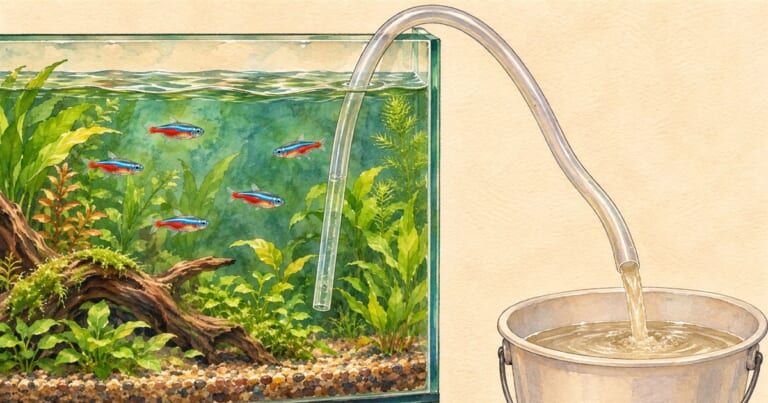
| 対策と予防 / Prevention | 葉が溶けても、慌てて株を移したり照明や肥料を変えたりすると、かえって株を弱らせてしまいます。根茎が硬く、緑色から茶色を保っていれば、時間はかかっても新芽を出してくれます。腐った部分は清潔なハサミで切り取り、健康な部分だけを残してください。コケを防ぐには、適度な水流と定期的な換水で葉の表面をきれいに保つことが大切です。黒髭ゴケが付いた場合は、市販のオキシドール(濃度約3%)を使う方法がよく知られています。フィルターを止めてスポイトで患部に直接吹きかけ、数分置いてからフィルターを再開するか、水槽全体に添加する場合は水量1Lあたり0.25ml程度のごく少量から始めます。濃度が高すぎると水草の葉やろ過バクテリア、エビ類に悪影響が出るので、慎重に行ってください。白っぽくなって弱ったコケは、ヤマトヌマエビが食べてくれるようになります。Even if leaves melt, rushing to move the plant or change the lighting or fertilizer only weakens it further. As long as the rhizome is firm and green to brown, it will put out new shoots, even if it takes time. Cut away rotten sections with clean scissors and keep only the healthy parts. To prevent algae, keep the leaves clean with gentle flow and regular water changes. If black beard algae appears, household hydrogen peroxide (about 3%) is a well-known remedy: either stop the filter, apply it directly to the algae with a pipette, and restart the filter after a few minutes, or, when dosing the whole tank, start very low at about 0.25 ml per liter. Too high a concentration can harm the plant’s leaves, filter bacteria, and shrimp, so proceed carefully. Once the algae turns pale and weakens, Amano shrimp will readily eat it. |
雑学と豆知識 / Trivia and Fun Facts
| 1. 「牛の頭」と名付けられた水草 / 1. A Plant Named “Bull’s Head” | ブセファランドラという属名は、ギリシャ語の「牛(bous)」「頭(kephale)」「雄(andros)」を組み合わせたものです。雄花の形を牛の頭に見立てて名付けられました。アレキサンダー大王の愛馬ブケファロス(「牛の頭」の意)と同じ語源をもつ名前です。サトイモ科の仲間らしく、水槽の中でも仏炎苞に包まれた小さな花を咲かせることがあり、その開花は育てる人へのささやかなご褒美になっています。The genus name combines the Greek words bous (bull), kephale (head), and andros (male), and refers to the male flowers, whose shape was likened to a bull’s head. It shares its root with Bucephalus, Alexander the Great’s horse, whose name also means “bull-headed.” Like other aroids, it sometimes blooms even underwater, producing a small flower wrapped in a spathe, a modest reward for its keeper. |
|---|---|
| 2. 斑は「細胞の層」が描く模様 / 2. Variegation Drawn by Layers of Cells | 植物の芽の先端にある成長点は、いくつかの細胞の層が重なってできています。この品種のような斑入りでは、そのうちの一部の層に葉緑素を作れない細胞が含まれていると考えられます。性質の異なる細胞が一つの体に同居しているこうした状態を「キメラ」と呼びます。つまりマーブル模様は、正常な緑の細胞と葉緑素をもたない細胞が入り組むことで生まれる、偶然のデザインです。ただしこのバランスは不安定で、緑の細胞が勢いを増せば原種の姿に戻り、葉緑素をもたない細胞ばかりになれば真っ白な葉になります。斑入り株の美しさは、こうした揺らぎの上に成り立っているのです。A plant’s growing tip is made of several stacked layers of cells. In variegated plants like this one, some of those layers are thought to contain cells that cannot produce chlorophyll. A plant whose body holds cells of different nature like this is called a chimera. In other words, the marble pattern is a chance design formed where normal green cells and chlorophyll-lacking cells interweave. The balance is unstable: if the green cells gain the upper hand, the plant reverts to the plain form, and if the chlorophyll-lacking cells take over, the leaves turn completely white. The beauty of a variegated plant rests on this delicate balance. |
| 3. 激流の岩に生きる「渓流植物」 / 3. A Rheophyte Built for Torrents | ブセファランドラは、流れの速い川沿いの岩場で暮らす「渓流植物」の代表的な仲間です。自生地では、雨季には水に沈み、乾季には水面から出るという厳しい環境を、岩にしっかりと根を張って乗り切っています。その根は、栄養を吸うためというより、激流に流されないための錨のような役割を担っています。根茎を土に埋めると腐りやすく、石に活着させると調子よく育つのも、こうした暮らしぶりを知るとよく分かります。Bucephalandra is a classic example of a rheophyte, living on rocks along fast-flowing streams. In the wild it endures being submerged in the rainy season and exposed in the dry season by gripping the rock firmly. Its roots serve less as feeding organs than as anchors that keep it from being swept away. This way of life explains why the rhizome rots when buried and why the plant thrives when attached to stone. |
| 4. 組織培養が変えた流通と保全 / 4. How Tissue Culture Changed Trade and Conservation | かつて日本には、現地で採集された「ワイルド株」が多く輸入されていました。しかし、根に潜むバナナネモグリセンチュウなどの害虫への警戒から、インドネシア産サトイモ科植物に対する検疫が厳しくなり、2020年頃を境にワイルド株の輸入は難しくなりました。代わって主流になったのが、無菌の培地で育てられる組織培養株です。害虫やスネール、コケを持ち込む心配がほとんどないうえ、採集による自生地への負担を減らすことにもつながります。斑入りマーブルが以前より手に入りやすくなったのも、この技術の普及によるところが大きいのです。Japan once imported many wild-collected plants. However, concern over pests hidden in the roots, such as the burrowing nematode, led to stricter quarantine on aroids from Indonesia, and from around 2020 importing wild plants became difficult. Tissue-culture plants, grown on sterile media, took their place. They carry almost no risk of introducing pests, snails, or algae, and they also help reduce collection pressure on wild habitats. The spread of this technology is a large part of why the variegated Marble is now easier to obtain than before. |
まとめ / Conclusion
ブセファランドラ sp. 斑入 ‘マーブル’は、ボルネオの渓流で培われた丈夫さと、細胞の偶然が生んだ繊細な模様をあわせ持つ水草です。小さな株ながら、黒っぽい石や流木の上では白い斑がくっきりと浮かび上がり、水景の中で静かな存在感を放ちます。 Bucephalandra sp. ‘Marble’ (variegated) combines the toughness shaped by Borneo’s streams with a delicate pattern born of chance in its cells. Though small, its white variegation stands out clearly on dark stone or driftwood, giving it a quiet presence in the aquascape.
根茎を埋めずに活着させること、穏やかな水流と控えめな光を用意すること、緑一色の芽を見逃さないこと。この三つを心がければ、ゆっくりと、しかし着実に応えてくれます。一枚ごとに異なる模様の新しい葉を待つ時間こそが、この水草を育てるいちばんの醍醐味です。 Attach it without burying the rhizome, provide gentle flow and modest light, and watch for all-green shoots. Keep these three points in mind and the plant will respond slowly but steadily. Waiting for each new leaf and its one-of-a-kind pattern is the true joy of growing it.

困りごとの解決から、用品えらび、水槽づくり、生き物えらびまで。飼育に役立つ案内です。
分布マップ
原種のピグマエア(Bucephalandra pygmaea)はボルネオ島に分布し、渓流沿いの岩盤や転石の表面にマット状の群落をつくります。斑入りの Bucephalandra sp. ‘Marble’ は栽培下で見いだされたもので、野生での自生は知られていません。地図には、原種が分布するボルネオ島の範囲を示しています。
※地図は原種の分布域をおおまかに示したものです。マーカーはボルネオ島のおおよその中央部を示す代表地点で、実際の採集地点や自生地ではありません。
参考文献
分類・学名
- Schott, H. W. (1858). Genera Aroidearum exposita, t. 56. Vienna.
- Boyce, P. C. & Wong, S. Y. (2012). Studies on Schismatoglottideae (Araceae) of Borneo XX: Beccari’s «La Più piccola delle Aracee» (Microcasia pygmaea) recollected and transferred to Bucephalandra Schott. Webbia, 67(2), 139–146. https://ir.unimas.my/id/eprint/7191/
- Wong, S. Y. & Boyce, P. C. (2014). Studies on Schismatoglottideae (Araceae) of Borneo XXX – New species and combinations for Bucephalandra. Willdenowia, 44, 149–199. https://doi.org/10.3372/wi.44.44201
- Mayo, S. J., Bogner, J. & Boyce, P. C. (1997). The Genera of Araceae. Royal Botanic Gardens, Kew.
分布・生息環境
- CATE Araceae. Bucephalandra pygmaea (Becc.) P. C. Boyce & S. Y. Wong. https://cate-araceae.myspecies.info/taxonomy/term/8883
- van Steenis, C. G. G. J. (1981). Rheophytes of the World. Sijthoff & Noordhoff, Alphen aan den Rijn.
斑入り・繁殖
- Marcotrigiano, M. (1997). Chimeras and variegation: patterns of deceit. HortScience, 32(5), 773–784. https://doi.org/10.21273/HORTSCI.32.5.773
- Zalan, N. M., Hassim, M. F. N. & Ahmad, A. (2025). Effect of sucrose concentration on proliferation of Bucephalandra sp. ‘Red-Mini’ cultures. Universiti Malaysia Terengganu Journal of Undergraduate Research, 7(1), 56–65. https://journal.umt.edu.my/index.php/umtjur/article/view/492
検疫・流通上の注意点
- 農林水産省 横浜植物防疫所. Radopholus similis(バナナネモグリセンチュウ)に関する病害虫リスクアナリシス報告書(令和2年3月25日改訂でブセファランドラ属を寄主植物に追加、令和7年1月21日改訂). https://www.maff.go.jp/j/syouan/keneki/kikaku/attach/pdf/pra_table2_2-80.pdf



コメント