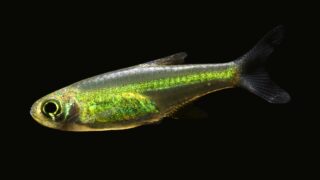
オステオガステル・メラノタエニアは、南米コロンビアの内陸部を流れるメタ川の流域だけに生息する小型のナマズです。長年「コリドラス・メラノタエニア」の名で親しまれてきましたが、2024年に発表されたコリドラス亜科の大規模な分類の見直しにより、現在はオステオガステル属に分類されています。体の上半分を覆う鮮やかなメタリックグリーン、両眼を横切るアイマスクのような緑の模様、そして各ヒレにうっすらと差す黄金色が本種ならではの魅力です。近縁種に比べてやや細長く引き締まった体型も相まって、上品な雰囲気を漂わせています。熱帯魚でありながら20〜25℃ほどのやや涼しい水を好むため、日本の暑い夏をどう乗り切るかが長期飼育のカギとなります。条件が整えば水槽内での繁殖も十分に狙え、細かな砂の上で群れが一斉にエサを探す姿は、何度見ても飽きることがありません。Osteogaster melanotaenia is a small catfish found only in the Rio Meta basin in the interior of Colombia, South America. Long known to aquarists as “Corydoras melanotaenia”, it has been placed in the genus Osteogaster since a major reclassification of the subfamily Corydoradinae published in 2024. Its vivid metallic green upper body, a green mask-like band running across the eyes, and the faint golden tinge on each fin are the hallmarks of this species. Combined with a body that is slightly more elongated and streamlined than its close relatives, these features give it a refined look. Although it is a tropical fish, it prefers relatively cool water of around 20–25°C, so getting through the hot Japanese summer is the key to keeping it long-term. Given the right conditions, breeding in the aquarium is quite achievable, and the sight of a group sifting through fine sand together for food is one that never grows old.
基本情報 / Basic Information
学名 / Scientific Name
Osteogaster melanotaenia (Regan, 1912)
通称 / Common Name
コリドラス・メラノタエニア(旧学名 Corydoras melanotaenia に由来する流通名)Corydoras melanotaenia (trade name derived from the former scientific name)
分類 / Family
ナマズ目 カリクティス科 コリドラス亜科 オステオガステル属Siluriformes, Callichthyidae, Corydoradinae, genus Osteogaster
英名 / English Name
Green Gold Cory / Green Gold Catfish
分布 / Distribution
コロンビア。オリノコ川の支流であるメタ川の流域(プエルト・ロペス周辺や支流のマナカシアス川など)に固有で、細流や氾濫林、砂州などに生息しています。Colombia. Endemic to the basin of the Rio Meta, a tributary of the Orinoco (including the Puerto López area and the Río Manacacías), where it lives in small streams, flooded forests and sandbanks.
最大体長 / Max Size
標準体長(尾ビレを除いた長さ)で約5.5〜6cm。コリドラスの仲間としては中型で、メスの方がやや大きく、体高も高くなります。About 5.5–6 cm standard length (excluding the tail fin). Medium-sized for a corydoras; females grow slightly larger and deeper-bodied.
寿命 / Lifespan
飼育下ではおおむね5年前後とされ、良好な環境ではそれ以上生きることもあると考えられています。Generally around 5 years in captivity, and it is thought that individuals kept in good conditions can live longer.
飼育環境 / Aquarium Environment
水槽サイズ / Tank Size
5〜6匹以上の群れで飼うことを前提に、60cm規格水槽(約57L)以上がおすすめです。少数であれば45cm規格水槽(約35L)でも飼育できますが、底面積が広いほど群れで泳ぐ自然な姿を楽しめ、水質も安定します。繁殖用には45〜60cm規格水槽で十分です。Since it should be kept in a group of at least 5–6, a 60 cm standard tank (about 57 L) or larger is recommended. A small group can be kept in a 45 cm standard tank (about 35 L), but a larger footprint lets you enjoy natural group behaviour and keeps water quality more stable. A 45–60 cm standard tank is sufficient for breeding.
水温 / Temperature
20〜25℃(22〜24℃前後が理想)。一般的な熱帯魚よりやや低めの水温を好みます。28℃を超えると目に見えて元気がなくなり、30℃以上は生存の限界に近いと考えられているため、夏場は水槽用クーラーを導入するか、エアコンで室温ごと管理するのが最も確実です。冷却ファンは湿度の高い日本の夏では2〜3℃程度しか水温が下がらないことが多く、蒸発で水位も下がりやすいため、こまめな足し水が欠かせません。20–25°C (around 22–24°C is ideal). It prefers slightly cooler water than most tropical fish. It becomes visibly sluggish above 28°C, and temperatures over 30°C are thought to approach its survival limit, so in summer an aquarium chiller or air-conditioning the whole room is the most reliable approach. In Japan’s humid summers, cooling fans often lower the water temperature by only 2–3°C, and evaporation lowers the water level, so frequent top-ups are essential.
水質 / Water Quality
pH6.0〜8.0の範囲に適応しますが、飼育ではpH6.0〜7.2の弱酸性〜中性が理想です。硬度は2〜15dGH程度の軟水〜中硬水が適しており、日本の水道水にもよく馴染みます。底で暮らす魚のため、底床の汚れから生じるアンモニアや亜硝酸の影響を受けやすく、硝酸塩は20mg/L以下を目安に、こまめな換水で清浄な水を保ちましょう。流木やヤシャブシの実を入れて水を弱酸性に傾けると、発色が良くなるといわれています。It adapts to pH 6.0–8.0, but slightly acidic to neutral water of pH 6.0–7.2 is ideal. Soft to moderately hard water of about 2–15 dGH suits it well, and it adapts easily to Japanese tap water. As a bottom dweller it is easily affected by ammonia and nitrite produced by a dirty substrate, so keep nitrate below about 20 mg/L with regular water changes. Adding driftwood or alder cones to tilt the water slightly acidic is said to improve coloration.
レイアウト / Layout
底床には、粒径1mm前後で角の丸い田砂やコリドラス用の細かい砂を、1〜2cm程度に薄く敷くのが最適です。厚く敷くと砂の内部に酸素が届かなくなり、水質悪化の原因になります。大磯砂は角が立っていてヒゲを傷めやすいため、使う場合は角の取れた極細目に限りましょう。ソイルは崩れて泥状になると不衛生になりやすく、底に何も敷かないベアタンクは掃除が楽な反面、砂を探る本来の採餌行動ができず、体色も白っぽくなりがちです。流木を組んでアヌビアス・ナナやミクロソリウムなどの陰性水草を活着させ、光の当たりにくい日陰を作ると、落ち着いて過ごせるようになります。ろ過には生物ろ過能力の高い外部式や上部式フィルターが向いており、砂の吸い込みを防ぐため、吸水口にはストレーナースポンジを付けてください。The best substrate is fine, round-grained sand of about 1 mm, such as Tasuna or sand made for corydoras, laid thinly at 1–2 cm. A deep bed prevents oxygen from reaching the inside and leads to poor water quality. Ōiso gravel has sharp edges that can damage the barbels, so if used it should be limited to the finest, well-rounded grade. Soil can break down into mud and become unhygienic, while a bare-bottom tank is easy to clean but prevents natural sand-sifting behaviour and tends to make the fish look pale. Arrange driftwood with shade-tolerant plants such as Anubias nana or Java fern attached to it to create shaded areas where the fish can settle. Canister or top-mounted filters with strong biological filtration are suitable; fit a sponge prefilter on the intake to stop sand being drawn in.
注意点 / Precautions
背ビレと胸ビレの先頭には鋭い棘があり、驚くとこれを広げて固定します。網に絡みやすく、素手で触ると刺さって強い痛みを伴うことがあるため、扱いは慎重に行いましょう。また、強いストレスを受けると胸ビレの付け根付近にある腺から乳白色の分泌液を出すことがあり、袋の中のような少量の水では、これが自分自身に害を及ぼす場合があります。届いた袋の水が白く濁っていたり、異常に泡立っていたりするときは、袋の水を水槽に入れず、魚だけを網ですくって速やかに清浄な水へ移してください。水面へ空気を吸いに上がる行動自体は正常ですが、複数の個体が頻繁に繰り返す場合は、酸欠や水質悪化のサインです。The leading rays of the dorsal and pectoral fins are sharp spines that the fish extends and locks when alarmed. They easily tangle in nets and can cause sharp pain if they pierce bare skin, so handle the fish with care. Under severe stress it may also release a milky secretion from glands near the base of the pectoral fins, which in a small volume of water such as a shipping bag can harm the fish itself. If the water in a delivered bag is cloudy white or unusually foamy, do not add the bag water to the tank; net the fish out and move them into clean water promptly. Rising to the surface to gulp air is normal in itself, but if several fish do it frequently, it signals low oxygen or deteriorating water quality.
餌と給餌 / Feeding
餌の種類 / Diet
雑食性で、自然下では砂泥や落ち葉の間に潜む小さな甲殻類や昆虫の幼虫、ミミズの仲間、植物質などを食べています。飼育下ではコリドラス用の沈下性タブレットやペレットを主食とし、冷凍赤虫やイトミミズ、ミジンコなどを定期的に加えると栄養バランスが整います。An omnivore that in the wild feeds on small crustaceans, insect larvae, worms and plant matter hidden among sand, mud and leaf litter. In the aquarium, use sinking tablets or pellets made for corydoras as the staple, and add frozen bloodworms, tubifex worms and daphnia regularly for a balanced diet.
給餌のポイント / Feeding Tips
1日1〜2回、数分で食べきれる量を与えます。テトラやラスボラなど中層を泳ぐ魚と混泳していると、エサが底に届く前に食べられてしまい、本種が十分に食べられないことがあります。水流を利用して素早く沈めたり、消灯後に沈下性のエサを与えたりする工夫が有効です。食べ残しは底床を汚す原因になるため、早めに取り除きましょう。Feed once or twice a day, only as much as is eaten within a few minutes. When kept with midwater fish such as tetras or rasboras, food may be eaten before it reaches the bottom, leaving this species underfed. Using the current to sink food quickly or offering sinking food after lights-out helps. Remove leftovers promptly, as they foul the substrate.
性格と混泳 / Temperament and Tank Mates
性格 / Temperament
非常に温和で、他の魚を攻撃することはありません。一方でやや臆病な面があり、単独や少数で飼うと物陰に隠れがちです。同種を最低でも5〜6匹以上の群れで飼うと落ち着き、活発に底を探る姿を見せてくれます。Very peaceful and does not attack other fish. It is somewhat timid, however, and tends to hide when kept alone or in small numbers. Kept in a group of at least 5–6 of its own kind, it settles down and actively forages across the bottom.
混泳の相性 / Compatibility
同じくやや低めの水温に対応できる、小型で温和な魚との相性が良好です。口に入るサイズの魚を狙う大型魚や、底を占有する気の強い魚との混泳は避けましょう。特に注意したいのが同じオステオガステル属の仲間で、赤コリの原種として知られるオステオガステル・アエネア(コリドラス・アエネウス)や、その近縁として「ベネズエラ」の名で流通するコリドラスなどとは、交雑する可能性が指摘されています。種の純粋性を保つためにも、同属の別種との混泳は避けるのが無難です。It does well with small, peaceful fish that also tolerate slightly cooler water. Avoid large fish that can swallow it and assertive fish that dominate the bottom. Particular care is needed with other members of Osteogaster: it has been pointed out that it may hybridise with Osteogaster aenea (Corydoras aeneus, the wild form of the bronze cory) and related corydoras sold under “Venezuela” names. To preserve species purity, it is best not to keep it with other species of the same genus.
病気と対策 / Diseases and Prevention
かかりやすい病気 / Common Diseases
代表的なのは「ヒゲ溶け」で、汚れた底床や角のある砂でヒゲが傷つき、そこから細菌に感染して短くなったり溶けたりします。底床内が酸欠状態になると、エロモナス菌などによる感染症のリスクも高まります。また、高水温による酸欠や水質悪化はエラを傷め、水面へ頻繁に浮上する行動として表れます。導入直後には、輸送中の強いストレスによる自家中毒も大きな死因となります。The most typical problem is barbel erosion, in which barbels damaged by a dirty substrate or sharp-edged gravel become infected with bacteria and shorten or rot away. If the substrate becomes oxygen-depleted, the risk of infections such as Aeromonas also rises. High temperatures cause oxygen shortage and poor water quality that damage the gills, showing up as frequent trips to the surface. Shortly after purchase, self-poisoning caused by severe stress during transport is also a major cause of death.
対策と予防 / Prevention
角の丸い細かい砂を薄く敷き、プロホースなどで定期的に底床を掃除することが基本です。夏場はクーラーやエアコンで水温を25℃以下に抑え、エアレーションを強めて水中の酸素を確保しましょう。導入時は袋の状態を必ず確認し、異常があればすぐに清浄な水へ移します。日頃から週1回程度の部分換水を続け、エサを与えすぎないことが、病気を遠ざける何よりの近道です。The basics are a thin layer of fine, rounded sand and regular substrate cleaning with a gravel siphon. In summer, keep the water below 25°C with a chiller or air-conditioning and increase aeration to keep oxygen levels up. Always check the bag on arrival and move the fish into clean water immediately if anything looks wrong. Routine weekly partial water changes and avoiding overfeeding are the surest ways to keep disease away.
増やし方(繁殖) / Breeding
雌雄の判別 / Sexing
成魚であれば上から見ると判別しやすく、メスは卵を抱えるためにお腹が丸く横へ張り出し、体高もある幅広の体つきになります。オスは細身で直線的な体型です。腹ビレの形にも違いがあり、メスは丸く扇状に広がるのに対し、オスは細く尖っています。Adults are easy to sex when viewed from above: females carry eggs and have a rounded, broader belly and deeper body, while males are slimmer and more streamlined. The pelvic fins also differ, being rounded and fan-shaped in females and narrow and pointed in males.
繁殖形態 / Reproduction
卵生で、ガラス面や水草の葉などに卵を産み付けます。受精は、オスがメスの口元に体の側面を押し当てる「Tポジション」と呼ばれる独特の姿勢で行われます。メスは腹ビレをかごのように丸めて数個の卵を抱え、気に入った場所へ一つずつ貼り付けていきます。これを何度も繰り返し、1回の産卵で100個を超える卵を産むこともあります。親には卵を守る習性がなく、自分たちの卵を食べてしまうこともよくあります。An egg-layer that attaches its eggs to the glass, plant leaves and similar surfaces. Fertilisation takes place in a distinctive posture called the “T-position”, in which the male presses the side of his body against the female’s mouth. The female then cups her pelvic fins into a basket holding a few eggs and sticks them one by one in places she chooses. This is repeated many times, and a single spawning can exceed 100 eggs. The parents do not guard the eggs and often eat them.
繁殖のポイント / Breeding Tips
まずは冷凍赤虫やミジンコなどを多めに与えて親魚の体調を整え、メスのお腹が卵で膨らむまで育てます。オス2〜3匹に対してメス1匹の割合にすると、受精率が上がるとされています。産卵のきっかけになるのは、自然界の「乾季から雨季への移り変わり」の再現です。水位を半分ほどに下げ、水流とエサを控えた状態を数日続けた後、水槽より2〜3℃低い新しい水で50〜70%の大換水を行い、エアレーションと水流を強めます。急激すぎる温度差は魚の負担になるため、2〜3℃の範囲にとどめましょう。産卵が終わったら親魚を戻すか卵を別の容器に移し、白くカビた卵はスポイトでこまめに取り除きます。メチレンブルーやヤシャブシの実は、カビの予防に役立ちます。水温24〜26℃であれば3〜5日ほどで孵化しますが、稚魚はお腹の栄養袋(ヨークサック)を吸収し終えて泳ぎ始めるまで、エサを与えてはいけません。最初のエサはインフゾリアやマイクロワームから始め、成長に合わせてブラインシュリンプの幼生に切り替えます。給餌後は食べ残しを吸い出し、親水槽の水を使って10〜20%のこまめな換水を続けましょう。約1ヶ月で体長1cmを超え、成魚らしい緑色が現れ始めます。First condition the adults with generous feedings of frozen bloodworms and daphnia until the females’ bellies swell with eggs. A ratio of 2–3 males per female is said to improve fertilisation. Spawning is triggered by recreating the natural shift from dry to rainy season: lower the water level by about half and reduce current and feeding for several days, then perform a 50–70% water change with fresh water 2–3°C cooler than the tank while increasing aeration and flow. Keep the temperature drop within 2–3°C, as a sharper change can stress the fish. After spawning, return the adults or move the eggs to a separate container, and remove white, fungused eggs with a pipette. Methylene blue or alder cones help prevent fungus. At 24–26°C the eggs hatch in about 3–5 days, but do not feed the fry until they have absorbed their yolk sacs and begin swimming. Start with infusoria or microworms, then switch to newly hatched brine shrimp as they grow. Siphon out leftovers after each feeding and carry out frequent 10–20% water changes using water from the parent tank. Within about a month the fry exceed 1 cm and begin to show adult green coloration.
雑学と豆知識 / Trivia and Fun Facts
1. 「黒い帯」という名前と、謎めいた模式産地 / 1. A Name Meaning “Black Band” and a Puzzling Type Locality
本種は1912年、イギリスの魚類学者チャールズ・テイト・リーガンによって新種として記載されました。種小名のメラノタエニアは、ギリシャ語で「黒い」を意味するメランと、ラテン語で「帯」を意味するタエニアを組み合わせた言葉で、体の側面にうっすらと現れる暗色の縦帯に由来しています。興味深いのは、記載の基準となった標本の採集地が「メタ川水系のホンダ」とされていたことです。ところがホンダという町は実際にはマグダレナ川の流域にあり、メタ川とは別の水系です。その後も採集家たちがこの周辺で本種を見つけられなかったことから、初期の標本の採集記録に地名の取り違えがあったのではないかと考えられています。現在では、本種が実際に暮らしているのはオリノコ川の支流であるメタ川の流域であることが確認されています。The species was described in 1912 by the British ichthyologist Charles Tate Regan. The name melanotaenia combines the Greek melan, “black”, with the Latin taenia, “band”, referring to the faint dark band along the sides of the body. Interestingly, the locality of the original specimens was recorded as “Honda, Rio Meta system”. The town of Honda, however, actually lies in the Magdalena basin, a separate river system from the Meta. Because collectors repeatedly failed to find the fish there, it is thought that the early collection records contained a mix-up of place names. Today it is confirmed that the species actually lives in the basin of the Rio Meta, a tributary of the Orinoco.
2. コリドラスからオステオガステルへ / 2. From Corydoras to Osteogaster
長い間、本種はコリドラス属の一員とされてきました。しかし2011年に発表された研究で、従来のコリドラス属は一つの祖先から分かれたまとまりではなく、複数の系統が混ざり合ったグループである可能性が示されていました。つまり「コリドラス」という一つの名前の中に、実は別々の道を歩んできた仲間たちがまとめて入っていたということです。そして2024年、遺伝子の大規模な比較と体のつくりの再検討によって、コリドラス属は複数の属に分けられることになりました。本種を含むアエネウス・グループには、1894年にアメリカの研究者エドワード・ドリンカー・コープが名付けていたオステオガステル属の名が再び使われることになります。属名はギリシャ語の「骨」と「腹」を組み合わせたもので、腹側に発達する骨の構造にちなんでいます。学名は変わりましたが、ショップや愛好家の間では今も「コリドラス・メラノタエニア」の名で呼ばれることが多く、新旧の名前が並び立つ過渡期にあるといえるでしょう。For a long time this species was treated as a member of Corydoras. A study published in 2011, however, indicated that the traditional genus might not be a single group descended from one ancestor, but a mixture of several lineages. In other words, the single name “Corydoras” was covering fish that had actually followed separate evolutionary paths. In 2024, a large-scale genetic comparison together with a re-examination of body structure led to Corydoras being divided into several genera. For the aeneus group, which includes this species, the name Osteogaster, coined in 1894 by the American scientist Edward Drinker Cope, was brought back into use. The name combines the Greek words for “bone” and “belly”, referring to bony structures that develop on the underside. Despite the change, shops and hobbyists still often call it Corydoras melanotaenia, so we are in a transitional period in which the old and new names coexist.
3. 水面へのダッシュは腸で息をするため / 3. Dashing to the Surface to Breathe Through the Gut
メタ川はリャノと呼ばれる広大な熱帯サバンナを流れており、雨季には水が周囲の平原にあふれ出す一方、乾季には細い流れが途切れて浅い水たまりになります。落ち葉が分解されるそうした水では酸素が極端に少なくなるため、コリドラスの仲間は腸で空気から酸素を取り込む能力を身につけました。水面へ一気に泳ぎ上がって一瞬で空気を飲み込むと、その空気は毛細血管が密集した腸の後半部分で血液に取り込まれ、残った気体は肛門から泡として出されます。呼吸の中心はあくまでエラで、腸での空気呼吸はそれを補うしくみです。水槽でときどき見られる水面へのダッシュは正常な行動ですが、回数が目立って増えたときは、水が「息苦しい」状態になっているサインと受け止めてください。The Rio Meta flows through the vast tropical savanna known as the Llanos; in the rainy season water spills out over the surrounding plains, while in the dry season small streams break up into shallow pools. In such water, where decaying leaves use up the oxygen, corydoras catfish evolved the ability to take oxygen from air through the gut. The fish darts to the surface and gulps air in an instant; the air is absorbed into the blood in the rear part of the intestine, which is packed with capillaries, and the remaining gas is expelled as a bubble from the vent. The gills remain the main breathing organ, with gut breathing serving as a supplement. Occasional surface dashes in the aquarium are normal, but a noticeable increase should be taken as a sign that the water has become hard to breathe in.
4. 棘のロックと、身を守る分泌液 / 4. Locking Spines and a Protective Secretion
小さな底生魚である本種は、鳥や大型魚に常に狙われています。そこで備わったのが二重の防御です。一つ目は胸ビレと背ビレの鋭い棘で、胸ビレの棘の付け根は肩の骨のくぼみにはまり込み、筋肉の力に頼らず骨の構造そのもので固定されます。広げた棘は捕食者の口や喉に引っかかり、飲み込むのを難しくすると考えられています。二つ目は化学的な防御で、胸ビレの付け根の後ろにある腺から、強いストレスを受けると乳白色の分泌液を出します。研究では、この分泌液に細菌の働きを抑える作用や、細胞にダメージを与える性質があることが示されています。広い川の中ならすぐに薄まりますが、輸送袋のような限られた水の中では濃度が高まり、自分自身に害が及ぶことがあります。これが「自家中毒」と呼ばれる現象で、一部の販売店が袋に活性炭を入れて発送するのは、こうした物質を吸着させるための工夫です。As a small bottom-dwelling fish, this species is constantly targeted by birds and larger fish, and it is equipped with a twofold defence. The first is its sharp pectoral and dorsal spines: the base of each pectoral spine fits into a hollow in the shoulder bone and is held in place by the skeleton itself rather than by muscle. The extended spines are thought to catch in a predator’s mouth or throat and make swallowing difficult. The second is chemical: when severely stressed, it releases a milky secretion from a gland just behind the pectoral fin base. Research has shown that this secretion suppresses bacterial activity and can damage cells. In a wide river it is quickly diluted, but in a limited volume of water such as a shipping bag it becomes concentrated and can harm the fish itself. This is the phenomenon known as self-poisoning, and some sellers add activated carbon to their bags to absorb such substances.
5. よく似た顔ぶれが集まるメタ川 / 5. The Look-Alikes of the Rio Meta
メタ川には、系統がまったく異なるのに驚くほどよく似た模様をもつコリドラスの仲間がいくつも暮らしています。たとえばホプリソマ・メタエとコリドラス・シミュラトゥスは別々の系統に属しながら、似たアイマスクと背中の黒いラインを共有しています。こうした例は、身を守る力をもつ種同士が同じ模様をまとうことで、捕食者に「この模様は食べにくい」と覚えさせる擬態の一種と考えられています。本種のメタリックグリーンと黄金色の装いも、捕食者への警告や、周囲の種との擬態の関係の中で何らかの役割を果たしている可能性が指摘されています。美しい色彩の裏には、生き残りをかけた進化の物語が隠れているのかもしれません。The Rio Meta is home to several corydoras species that belong to entirely different lineages yet share strikingly similar patterns. Hoplisoma metae and Corydoras simulatus, for example, come from separate lineages but share a similar eye mask and a black stripe along the back. Such cases are thought to be a form of mimicry in which species with defences wear the same pattern, teaching predators that “this pattern is hard to eat”. It has been suggested that this species’ metallic green and gold colours may also play some role as a warning to predators or within mimicry relationships with neighbouring species. Behind its beautiful colours may lie an evolutionary story of survival.
6. 手網で一匹ずつ、コロンビアから届く / 6. Caught by Hand Net, Shipped from Colombia
日本で見かける本種の多くは、コロンビアから輸入される野生採集個体です。現地ではメタ川流域の漁師たちが、大がかりな網や機械を使わず、小さな手網で目当ての種だけを選んで採集しています。こうした小規模な採集は乱獲を防ぎながら地域の大切な収入源となり、森林伐採などに頼らない暮らしを支える役割も担っていると考えられています。集められた魚は首都ボゴタの輸出業者のもとで状態を整えられ、酸素を詰めた袋で空輸されます。雨季は水かさが増して採集が難しくなるため、日本への入荷は秋から冬にかけてまとまって届く傾向があります。ショップの水槽に並ぶ一匹一匹が、遠い川から多くの人の手を経て旅してきたと思うと、その輝きがいっそう特別なものに感じられます。Most specimens seen in Japan are wild-caught fish imported from Colombia. Locally, fishermen in the Meta basin use small hand nets rather than large nets or machinery, selecting only the species they are after. This small-scale collecting is thought to prevent overharvesting while providing an important source of income for local communities, helping support livelihoods that do not depend on activities such as logging. The fish are gathered and conditioned at exporters’ facilities in the capital, Bogotá, then flown out in oxygen-filled bags. Because rising water makes collecting difficult in the rainy season, shipments to Japan tend to arrive together from autumn into winter. Knowing that each fish in a shop tank has travelled from a distant river through many hands makes its shine feel all the more special.
まとめ / Conclusion
オステオガステル・メラノタエニアは、コロンビアのサバンナを流れるメタ川に暮らす、緑と金の輝きをまとった小さなナマズです。腸で空気を吸う呼吸法や、骨で固定される棘、身を守る分泌液など、愛らしい姿の内側には厳しい環境を生き抜くためのしくみが備わっています。涼しい水を好む性質を理解して夏の暑さから守ること、そして細かな砂を薄く敷いて大切なヒゲを守ることが、長く付き合っていくための何よりの秘訣です。Osteogaster melanotaenia is a small catfish clad in green and gold that lives in the Rio Meta as it flows through the Colombian savanna. Behind its charming appearance lie mechanisms for surviving a harsh environment: breathing air through the gut, spines locked in place by bone, and a protective secretion. Understanding its preference for cool water and shielding it from summer heat, along with laying a thin bed of fine sand to protect its precious barbels, is the surest path to a long companionship.
環境が整えば、群れで砂に顔をうずめて一心にエサを探す姿や、換水をきっかけに始まるTポジションでの産卵行動を、目の前で見せてくれることでしょう。水槽の底できらりと光るメタリックグリーンは、遠い南米の川の息吹を静かに感じさせてくれる、かけがえのない存在です。With the right conditions, it will show you a group burying their faces in the sand in eager search of food, and spawning in the T-position set off by a water change. The metallic green glinting on the tank floor quietly evokes the breath of a distant South American river, making it a truly irreplaceable presence.
Tencatt, L. F. C., Gomes, V. C. & Evers, H.-G. (2023). A new species of Corydoras (Siluriformes: Callichthyidae) from the rio Madre de Dios basin, Peruvian Amazon, with comments on Corydoras aeneus identity. Neotropical Ichthyology, 21(2): e230023. https://www.scielo.br/j/ni/a/ZtqRKq4rWx868jSWCRcSSgF/?lang=en
Dias, A. C., Tencatt, L. F. C., Roxo, F. F., Silva, G. S. C., Santos, S. A., Britto, M. R., Taylor, M. I. & Oliveira, C. (2024). Phylogenomic analyses in the complex Neotropical subfamily Corydoradinae (Siluriformes: Callichthyidae) with a new classification based on morphological and molecular data. Zoological Journal of the Linnean Society, 203(3). https://doi.org/10.1093/zoolinnean/zlae053
Alexandrou, M. A., Oliveira, C., Maillard, M., McGill, R. A. R., Newton, J., Creer, S. & Taylor, M. I. (2011). Competition and phylogeny determine community structure in Müllerian co-mimics. Nature, 469: 84–88. https://doi.org/10.1038/nature09660






コメント