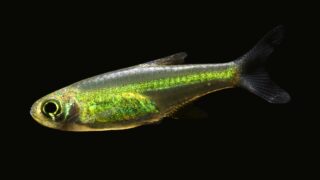
コリドラス・イルミナティ オレンジは、南米ペルーのウカヤリ川流域、プカルパ周辺から知られる小型のナマズの仲間です。頭の後ろから尾の付け根まで、背中にまっすぐ走る明るいオレンジ〜金色のラインが最大の特徴で、海外では主に「ゴールドレーザー」の名で呼ばれています。このラインは色素で色が付いているのではなく、皮膚の中に並んだ微細な結晶が光を反射して生まれる「構造色」によるもので、光の当たり方や魚の調子によって金属のような輝きを見せます。まだ正式な学名が付けられていない未記載種で、国際的には「CW010」という識別番号で呼ばれています。2024年に発表された大規模な系統解析によってコリドラスの仲間は7つの属に整理し直され、本種はアカコリドラスと同じオステオガスター属のグループに含まれることになりました。性質は温和で、群れで底砂をヒゲで探りながら動き回る愛らしい姿は、水槽に穏やかな活気をもたらしてくれます。The Corydoras Illuminati Orange is a small catfish known from around Pucallpa in the Rio Ucayali basin of Peru, South America. Its most striking feature is the bright orange-to-gold line running straight along its back from behind the head to the base of the tail, and outside Japan it is mainly known as the “Gold Laser.” This line is not colored by pigment; it is a “structural color” produced when microscopic crystals arranged in the skin reflect light, giving a metallic shimmer that shifts with lighting and the fish’s condition. It is an undescribed species without a formal scientific name and is internationally referred to by the identification code “CW010.” A large-scale phylogenetic study published in 2024 reorganized the corydoras group into seven genera, placing this species in the same Osteogaster group as the bronze corydoras. Peaceful by nature, it forages through the substrate with its barbels in small groups, bringing a gentle liveliness to the aquarium.
基本情報 / Basic Information
学名 / Scientific Name
Osteogaster sp. CW010(旧 Corydoras sp. CW010)
通称 / Common Name
コリドラス・イルミナティ オレンジ、ゴールドレーザー・コリドラス、オレンジレーザー・コリドラス(「オレンジレーザー」の名は別のレーザー系コリドラスに使われることもある)Corydoras Illuminati Orange, Gold Laser Cory, Orange Laser Cory (the name “Orange Laser” is sometimes applied to other laser-type corydoras as well)
分類 / Family
ナマズ目 カリクティス科 コリドラス亜科 オステオガスター属Siluriformes, Callichthyidae, Corydoradinae, genus Osteogaster
英名 / English Name
Gold Laser Cory
分布 / Distribution
南米ペルー、ウカヤリ川流域のプカルパ周辺Around Pucallpa in the Rio Ucayali basin, Peru, South America
最大体長 / Max Size
約6cm(オスは5.5cm前後で、メスのほうがやや大きくなる)About 6 cm (males reach around 5.5 cm, and females grow slightly larger)
寿命 / Lifespan
5年前後。良好な環境では10年近く生きることもあると考えられている。Around 5 years. In good conditions, it is thought that some individuals may live close to 10 years.
飼育環境 / Aquarium Environment
水槽サイズ / Tank Size
5〜6匹以上の群れで飼うことを前提に、60cm規格水槽(約57L)以上がおすすめ。少数なら45cm水槽(約35L)でも飼育できるが、底面積が広いほど落ち着いて過ごせる。Assuming a group of five to six or more, a standard 60 cm tank (about 57 L) or larger is recommended. A small group can be kept in a 45 cm tank (about 35 L), but the larger the bottom area, the more settled the fish will be.
水温 / Temperature
22〜26℃。熱帯魚ではあるが高水温に弱く、30℃を超える状態が続くと命に関わる。日本の夏は、室内エアコンの常時稼働や水槽用クーラーで水温を管理することが欠かせない。22–26°C. Although it is a tropical fish, it does not tolerate heat well, and prolonged temperatures above 30°C can be fatal. In Japanese summers, keeping the room air-conditioned around the clock or using an aquarium chiller is essential.
水質 / Water Quality
pH6.0〜7.2の弱酸性〜中性、総硬度2〜10dGH程度の軟水が理想。アンモニアと亜硝酸塩は常に検出されない状態を保ち、硝酸塩は20ppm以下を目安にする。週1回、全水量の25〜30%程度を換水し、あわせて底砂にたまったフンや食べ残しを掃除する。Ideally slightly acidic to neutral (pH 6.0–7.2) soft water with a general hardness of about 2–10 dGH. Ammonia and nitrite should always be undetectable, and nitrate kept below about 20 ppm. Change about 25–30% of the water once a week, cleaning waste and leftover food out of the substrate at the same time.
レイアウト / Layout
底砂は、田砂のように粒が細かく角の丸い砂を1〜2cm程度に薄く敷くのが最適。大磯砂や溶岩石など角のある底床は、砂を掘るときにヒゲを傷める原因になる。ソイルは掘り返されて粒が崩れやすく、底床の通水性が落ちやすいので注意が必要。流木や水草で隠れ家を作り、同時に餌を探せる開けた砂地も残しておくと落ち着きやすい。The best substrate is a thin layer (about 1–2 cm) of fine sand with rounded grains. Angular substrates such as gravel or lava rock can damage the barbels as the fish dig. Aquasoil tends to crumble under constant digging and lose water flow, so care is needed. Providing hiding places with driftwood and plants while leaving open sand for foraging helps the fish feel secure.
注意点 / Precautions
胸びれの棘には毒腺があり、刺さると強い痛みや腫れが出ることがあるため、素手で扱うのは避ける。棘が網に引っかかりやすいので、すくうときはカップなどを使うと安全。ときどき水面まで泳ぎ上がるのは腸で空気を取り込む正常な行動だが、頻度が極端に多い場合は酸素不足や水質悪化のサインと考えられる。The pectoral fin spines have venom glands and can cause sharp pain and swelling if they puncture the skin, so avoid handling the fish with bare hands. The spines catch easily in nets, so using a cup to scoop the fish is safer. Occasional trips to the surface are a normal behavior for taking in air through the gut, but extremely frequent trips may signal low oxygen or poor water quality.
餌と給餌 / Feeding
餌の種類 / Diet
主食はコリドラス用などの沈下性タブレットフード。週に数回、冷凍赤虫やイトミミズ、ブラインシュリンプなどを補助的に与えると肉付きが良くなり、メスの抱卵も促される。The staple diet should be sinking tablets designed for bottom-dwellers such as corydoras. Supplementing several times a week with frozen bloodworms, tubifex worms, or brine shrimp improves body condition and encourages females to develop eggs.
給餌のポイント / Feeding Tips
他の魚の食べ残しだけで育つわけではなく、フンを食べることもないため、本種のための餌を必ず与える。やや夜行性の傾向があるので、混泳水槽では消灯直前に沈下性の餌を入れると、中層や上層を泳ぐ魚に横取りされにくい。It cannot thrive on other fish’s leftovers alone and does not eat waste, so always provide food specifically for it. Because it tends to be somewhat nocturnal, adding sinking food just before lights-out in a community tank keeps it from being taken by mid- and upper-level swimmers.
性格と混泳 / Temperament and Tank Mates
性格 / Temperament
とても温和で、他の魚を攻撃することはほとんどない。群れで行動する習性が強く、5〜6匹以上で飼うと本来ののびのびとした姿が見られる。Very peaceful and rarely aggressive toward other fish. It has a strong schooling instinct, and keeping five to six or more brings out its natural, relaxed behavior.
混泳の相性 / Compatibility
カラシン類やラスボラ類、ダニオ類など温和な小型魚との混泳に向いており、他のコリドラス類とも一緒に飼える。本種を食べてしまうほどの大型魚や、底層を占領する気の強い魚との組み合わせは避ける。Well suited to peaceful small fish such as tetras, rasboras, and danios, and can be kept with other corydoras. Avoid large fish that could eat it and aggressive species that dominate the bottom.
病気と対策 / Diseases and Prevention
かかりやすい病気 / Common Diseases
白点病、エロモナス感染症(体表の充血、松かさ病、眼球突出など)、カラムナリス病(尾ぐされ病、口ぐされ病)。粗い底砂でヒゲが傷つくと、そこから細菌に感染しやすくなる。White spot disease (ich), Aeromonas infections (red patches, dropsy, popeye), and columnaris disease (fin rot, mouth rot). Barbels injured by coarse substrate become an entry point for bacterial infection.
対策と予防 / Prevention
コリドラス類は薬の影響を受けやすいため、魚病薬は規定量の半量から始めるのが基本とされる。白点病にはマラカイトグリーン系の薬(アグテンなど)やメチレンブルーを使うが、高水温に弱いので、水温を上げる場合も27℃程度までに留める。エロモナス症には観パラD、カラムナリス病にはグリーンFゴールド顆粒やエルバージュエースが使われる。治療は本水槽ではなく隔離水槽で行い、活性炭などの吸着ろ材は外しておく。隔離水槽では毎日1/3〜1/2を換水し、入れ替えた水の分だけ薬を足して濃度を保つ。塩水浴を併用する場合も、0.3%を超えないよう正確に計量する。日頃から細かい砂、きれいな水、十分な栄養を保つことが何よりの予防になる。Corydoras are easily affected by medications, so treatment generally starts at half the recommended dose. White spot can be treated with malachite green products or methylene blue, but because the fish is heat-sensitive, raise the temperature no higher than about 27°C. Oxolinic acid products are used for Aeromonas infections, and nifurstyrenate-based products for columnaris. Treat in a separate hospital tank rather than the main tank, and remove activated carbon or other adsorptive media. In the hospital tank, change 1/3 to 1/2 of the water daily, adding medication only for the replaced water to maintain the concentration. If combining with a salt bath, measure precisely so it never exceeds 0.3%. Fine sand, clean water, and good nutrition are the best everyday prevention.
増やし方(繁殖) / Breeding
雌雄の判別 / Sexing
メスはオスより大きく育ち、上から見ると腹部が横に張り出している。オスは小ぶりでスリムな体つきをしており、腹びれの先がやや尖っている。Females grow larger than males and, viewed from above, have a noticeably wider belly. Males are smaller and slimmer, with slightly pointed pelvic fins.
繁殖形態 / Reproduction
卵生。メスがオスの腹部に口先を押し当てる「Tポジション」と呼ばれる独特の姿勢で受精が行われ、メスは腹びれで抱えた卵をガラス面や水草の葉などに産み付ける。1回の産卵数は数十個ほどで、大きなメスでは100個を超えることもある。親は卵を守らず、むしろ食べてしまう。Egg-laying. Fertilization takes place in a distinctive posture called the “T-position,” in which the female presses her mouth against the male’s belly. The female then carries the eggs in her pelvic fins and sticks them onto the glass or plant leaves. A single spawning produces dozens of eggs, sometimes more than 100 from a large female. The parents do not guard the eggs and may even eat them.
繁殖のポイント / Breeding Tips
オス2匹に対してメス1匹程度の割合で複数匹を飼い、冷凍赤虫などで十分に栄養を付けさせる。メスのお腹がふくらんできたら、飼育水より2〜3℃低い水で全体の30〜50%を換水すると、雨季を思わせる刺激となって産卵が始まりやすい。低気圧が近づくタイミングと重なると、さらに産卵しやすいともいわれる。産卵後は卵を指の腹などでそっと剥がして別の容器に移し、メチレンブルーをごく薄く加えてエアレーションで水を動かしておくと、水カビが生えにくくなる。24〜25℃なら3〜5日ほどで孵化し、お腹の栄養(ヨークサック)を吸収し終えたら、ブラインシュリンプの幼生やマイクロワームを1日2〜3回与える。稚魚は水質の悪化に弱いため、食べ残しは毎日スポイトで取り除く。ブリード個体は1年ほどで繁殖できるまでに育つとされ、比較的挑戦しやすい。Keep several fish at a ratio of about two males per female and condition them well with foods such as frozen bloodworms. When the females’ bellies fill out, changing 30–50% of the water with water 2–3°C cooler than the tank mimics the rainy season and often triggers spawning, and spawning is said to be even more likely when it coincides with an approaching low-pressure system. After spawning, gently remove the eggs with a fingertip and move them to a separate container; adding a very small amount of methylene blue and keeping the water moving with aeration helps prevent fungus. The eggs hatch in about 3–5 days at 24–25°C. Once the fry have absorbed their yolk sacs, feed newly hatched brine shrimp or microworms two to three times a day. Fry are vulnerable to poor water quality, so remove leftovers daily with a pipette. Captive-bred fish are said to reach breeding age in about a year, making breeding relatively approachable.
雑学と豆知識 / Trivia and Fun Facts
1. 2024年の大再編と「骨の腹」という名前 / 1. The 2024 Reorganization and the “Bony Belly”
長いあいだ、コリドラスの仲間はほとんどが「コリドラス属」という一つの大きなグループにまとめられてきました。しかし研究が進むにつれ、その中には見た目が似ているだけで、実は系統の異なる種が混ざっていることが分かってきます。そこで2024年、Diasらの研究チームがゲノム情報を使った大規模な解析を行い、コリドラス亜科をコリドラス、アスピドラス、スクレロミスタックス、ガストロデルムス、オステオガスター、ブロキス、ホプリソマの7つの属に整理し直しました。つまり、それまでの「コリドラス」という名前は、血縁関係の実態に合わせて分け直されたのです。このとき、アカコリドラスを中心とするグループに当てられたのが、19世紀にCopeが提唱していた古い属名オステオガスターでした。ギリシャ語の「骨」と「腹」を組み合わせた名前で、腹部を覆う骨板にちなんでいます。本種もこのグループに含まれるため、現在は「Osteogaster sp. CW010」と表記されます。ショップでは今も「コリドラス」として親しまれていますが、その名前の背後では分類の大きな見直しが起きていたのです。For a long time, most corydoras were placed together in one large genus, Corydoras. As research progressed, however, it became clear that the group contained species that merely looked alike but actually belonged to different lineages. In 2024, a research team led by Dias carried out a large-scale genomic analysis and reorganized the subfamily Corydoradinae into seven genera: Corydoras, Aspidoras, Scleromystax, Gastrodermus, Osteogaster, Brochis, and Hoplisoma. In other words, the old name “Corydoras” was divided up to reflect the fishes’ true relationships. The group centered on the bronze corydoras received Osteogaster, an old genus name proposed by Cope in the nineteenth century. It combines the Greek words for “bone” and “belly,” referring to the bony plates covering the abdomen. Because this species belongs to the same group, it is now written as “Osteogaster sp. CW010.” Shops still sell it as a “corydoras,” but behind that familiar name lies a major revision of the classification.
2. 学名の代わりに付けられた「CWナンバー」 / 2. The “CW Number” in Place of a Scientific Name
新しいコリドラスは次々と観賞魚として輸入されますが、正式に新種として記載されるまでには長い時間がかかります。そのあいだ、愛好家や研究者が同じ魚について混乱なく話せるように使われているのが識別番号です。CWナンバーはIan Fullerが運営するCorydoras Worldが割り当てている番号で、ドイツの観賞魚雑誌DATZが始めた「Cナンバー」の役割を引き継ぐ形で広まりました。本種はCW010、背中のラインが緑色に輝くよく似たグリーンレーザーはCW009とされています。ただし、こうした「レーザー」と呼ばれるコリドラスが独立した種なのか、アカコリドラスの地域的な色彩変異なのか、あるいは別の近縁種に近いのかはまだ結論が出ていません。流通名も「ゴールド」「オレンジ」などと揺れがあり、番号で呼ばれる魚は、まさに研究の途上にある存在だといえるでしょう。New corydoras are imported for the aquarium trade one after another, but formal description as new species takes a long time. In the meantime, identification numbers allow hobbyists and researchers to talk about the same fish without confusion. CW numbers are assigned by Corydoras World, run by Ian Fuller, and spread as a successor to the “C numbers” begun by the German aquarium magazine DATZ. This species is CW010, while the very similar Green Laser, whose back stripe shines green, is CW009. However, it has not yet been settled whether these “laser” corydoras are distinct species, regional color forms of the bronze corydoras, or closer to another related species. Trade names such as “Gold” and “Orange” also vary, and a fish known by a number is, in a sense, one still in the middle of being studied.
3. 色素ではなく「光」でつくる輝き / 3. A Shine Made of Light, Not Pigment
背中のラインは、絵の具のような色素で塗られているわけではありません。虹色素胞と呼ばれる細胞の中に、グアニンという物質の結晶が薄い板のように何層も重なっていて、そこに当たった光が反射し合うことで、オレンジから金色にかけての光が強く返ってくるのです。シャボン玉やCDの表面が虹色に見えるのと同じ原理で、これを構造色と呼びます。そのため、照明の種類や見る角度、魚の体調やストレス、さらには底砂の色によっても輝き方が変わって見えます。この仕組みがよく分かるのが、レーザー系コリドラスの改良品種として流通するアルビノ個体です。アルビノは黒い色素を作れませんが、結晶による輝きは失われないため、白く透き通った体に淡い金色の光沢だけが浮かぶ、幻想的な姿になります。The stripe on the back is not painted on with pigment. Inside cells called iridophores, crystals of a substance called guanine are stacked in many thin, plate-like layers, and light striking them is reflected back in a way that strongly returns wavelengths from orange to gold. This is the same principle that makes soap bubbles and CDs look iridescent, and it is called structural color. As a result, the shine appears to change with the type of lighting, viewing angle, the fish’s health and stress, and even the color of the substrate. Albino forms sold as improved varieties of laser corydoras show this mechanism clearly: albinos cannot produce dark pigment, but the crystal-based shine remains, leaving a pale golden sheen floating over a translucent white body.
4. 小さな体に備わった二つの防御 / 4. Two Defenses in a Small Body
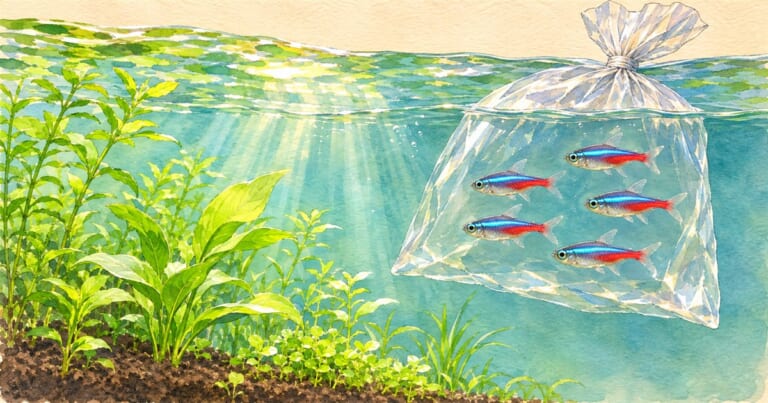
コリドラスは鱗の代わりに骨板の鎧をまとっていますが、身の守り方はそれだけではありません。胸びれの棘には毒腺があり、敵に襲われると棘をまっすぐ立てて固定し、刺さった傷口から毒が入る仕組みになっていると考えられています。さらに、胸びれの付け根の皮膚の下には腋窩腺と呼ばれる別の分泌器官もあることが報告されています。人が刺されても強い痛みや腫れが出ることがあるため、扱うときには注意が必要です。こうした「食べると痛い目に遭う」性質は、同じ場所に暮らすコリドラス同士が互いの模様に似ていく擬態の進化を後押ししたと考えられています。また、輸送中の狭い袋の中で強いストレスを受けると、体から出た物質で水が急速に悪化し、魚自身が弱ってしまうことがあるともいわれます。入荷したばかりの個体が丁寧に水合わせやトリートメントをされる背景には、こうした事情もあるのです。Corydoras wear armor of bony plates instead of scales, but that is not their only defense. The pectoral fin spines have venom glands, and when attacked the fish is thought to lock the spines upright so that venom enters through any puncture wound. A separate secretory organ, called the axillary gland, has also been reported beneath the skin at the base of the pectoral fins. Because a sting can cause sharp pain and swelling in humans, care is needed when handling. This “painful to eat” quality is thought to have encouraged the evolution of mimicry, in which corydoras sharing the same habitat come to resemble each other’s patterns. It is also said that when the fish are severely stressed in a cramped shipping bag, substances released from their bodies can rapidly foul the water and weaken the fish themselves. This is part of the reason newly arrived fish are acclimated and quarantined with such care.
5. 腸で息をする魚 / 5. A Fish That Breathes with Its Gut
水槽の底にいたコリドラスが、突然すっと水面まで泳ぎ上がり、すぐにまた底へ戻っていく姿を見たことがあるかもしれません。これは空気を一口飲み込み、毛細血管の多い腸の壁から酸素を取り込む「腸呼吸」です。乾季のアマゾンでは、水たまりのように取り残された場所で水中の酸素が乏しくなるため、エラだけに頼らない呼吸の方法を身につけたと考えられています。ときどき見られる程度なら健康な証拠ですが、何度も繰り返す場合は酸素不足や水質悪化のサインです。小さな魚のしぐさが、そのまま水槽の状態を教えてくれるのです。You may have seen a corydoras suddenly dart up to the surface from the bottom and quickly return. It is taking a gulp of air and absorbing oxygen through its gut wall, which is rich in capillaries, a behavior known as intestinal breathing. In the Amazon dry season, oxygen becomes scarce in stranded pools, so it is thought to have developed a way of breathing that does not rely on gills alone. Occasional trips are a sign of health, but repeated ones warn of low oxygen or deteriorating water. The little fish’s behavior tells you directly how the tank is doing.
6. Tポジションに隠された不思議な受精 / 6. The Curious Fertilization Behind the T-Position
コリドラスの繁殖でよく話題になるのが、メスがオスのお腹に口を押し当てて「T」の字を作る独特の姿勢です。本種と同じグループに属するアカコリドラスを調べた1995年の日本の研究では、このときメスがオスの精子を口から取り込み、腸を通して腹びれに抱えた卵へ届けている可能性が示されました。いわば「精子を飲んで受精させる」という、魚の世界でもほとんど例のない方法です。すべてのコリドラスに当てはまるかはまだ分かっていませんが、家庭の水槽の中でこうした生き物の謎がひっそりと繰り広げられていると思うと、産卵の場面がいっそう興味深く見えてくるのではないでしょうか。One of the most talked-about features of corydoras breeding is the distinctive posture in which the female presses her mouth to the male’s belly, forming a “T.” A 1995 Japanese study of the bronze corydoras, which belongs to the same group as this species, suggested that the female may take in the male’s sperm through her mouth and pass it through her gut to the eggs held in her pelvic fins. In other words, fertilization by “drinking sperm,” a method with almost no parallel among fish. Whether this applies to all corydoras is not yet known, but knowing that such a biological mystery may be unfolding quietly in a home aquarium makes watching a spawning all the more fascinating.
7. ワイルドとブリード、二つの顔 / 7. Wild and Captive-Bred: Two Faces
国内では、ペルーで採集されたワイルド個体と、東南アジアなどで繁殖されたブリード個体の両方が流通しています。ワイルド個体は流通量が少なく比較的高価で、長い輸送の負担があるぶん導入には気を遣いますが、ラインの太さや色合いの個体差を楽しめる魅力があります。一方、ブリード個体は日本の水道水にもなじみやすく、サイズや状態が安定しているため、初めて飼う人にも向いています。さらに繁殖を重ねる中で、アルビノや各ひれが長く伸びるロングフィンといった改良品種も生まれました。同じ名前の魚でも、出自によって表情や付き合い方が変わるのは、観賞魚ならではの奥深さといえるでしょう。In Japan, both wild-caught fish from Peru and captive-bred fish from places such as Southeast Asia are available. Wild fish are less common and relatively expensive, and the strain of long shipping means extra care when introducing them, but they offer the appeal of individual variation in stripe width and coloration. Captive-bred fish, on the other hand, adapt easily to Japanese tap water and are consistent in size and condition, making them a good choice for first-time keepers. Continued breeding has also produced improved varieties such as albinos and long-finned forms. That a fish with one name can differ in character and care depending on its origin is part of the depth of the aquarium hobby.
まとめ / Conclusion
コリドラス・イルミナティ オレンジは、背中に光のラインを宿した小さなナマズです。その輝きは色素ではなく結晶が光を反射して生まれるもので、骨板の鎧や胸びれの毒腺で身を守り、腸で空気を取り込むこともできます。まだ正式な学名を持たず、分類の研究が続いている点も含めて、知るほどに奥行きを感じさせる魚です。The Corydoras Illuminati Orange is a small catfish carrying a line of light along its back. Its shine comes not from pigment but from crystals reflecting light, and it protects itself with bony armor and venomous fin spines while also being able to take in air through its gut. Still without a formal scientific name and the subject of ongoing taxonomic study, it is a fish that reveals more depth the more you learn about it.
夏の高水温から守り、細かな砂でヒゲをいたわり、きれいな水を保ってあげれば、群れで底を探り回る愛らしい姿と、照明の下できらめくラインを長く楽しませてくれます。日々の小さな気配りに応えて元気に過ごすその姿は、水槽の底に穏やかな彩りを添えてくれることでしょう。Protect it from summer heat, cushion its barbels with fine sand, and keep the water clean, and it will reward you for years with the charming sight of a group foraging along the bottom and stripes glimmering under the light. Thriving in response to small daily care, it brings a gentle touch of color to the bottom of the aquarium.
Dias, A. C., Tencatt, L. F. C., Roxo, F. F., Silva, G. S. C., Santos, S. A., Britto, M. R., Taylor, M. I. & Oliveira, C. (2024). Phylogenomic analyses in the complex Neotropical subfamily Corydoradinae (Siluriformes: Callichthyidae) with a new classification based on morphological and molecular data. Zoological Journal of the Linnean Society. https://doi.org/10.1093/zoolinnean/zlae053
Alexandrou, M. A., Oliveira, C., Maillard, M., McGill, R. A. R., Newton, J., Creer, S. & Taylor, M. I. (2011). Competition and phylogeny determine community structure in Müllerian co-mimics. Nature, 469, 84–88. https://doi.org/10.1038/nature09660
Wright, J. J. (2009). Diversity, phylogenetic distribution, and origins of venomous catfishes. BMC Evolutionary Biology, 9, 282. https://doi.org/10.1186/1471-2148-9-282
Kramer, D. L. & McClure, M. (1980). Aerial respiration in the catfish, Corydoras aeneus (Callichthyidae). Canadian Journal of Zoology, 58(11), 1984–1991. https://doi.org/10.1139/z80-273
繁殖
Kohda, M., Tanimura, M., Kikue-Nakamura, M. & Yamagishi, S. (1995). Sperm drinking by female catfishes: a novel mode of insemination. Environmental Biology of Fishes, 42, 1–6. https://doi.org/10.1007/BF00002344






コメント