
解説 / Description
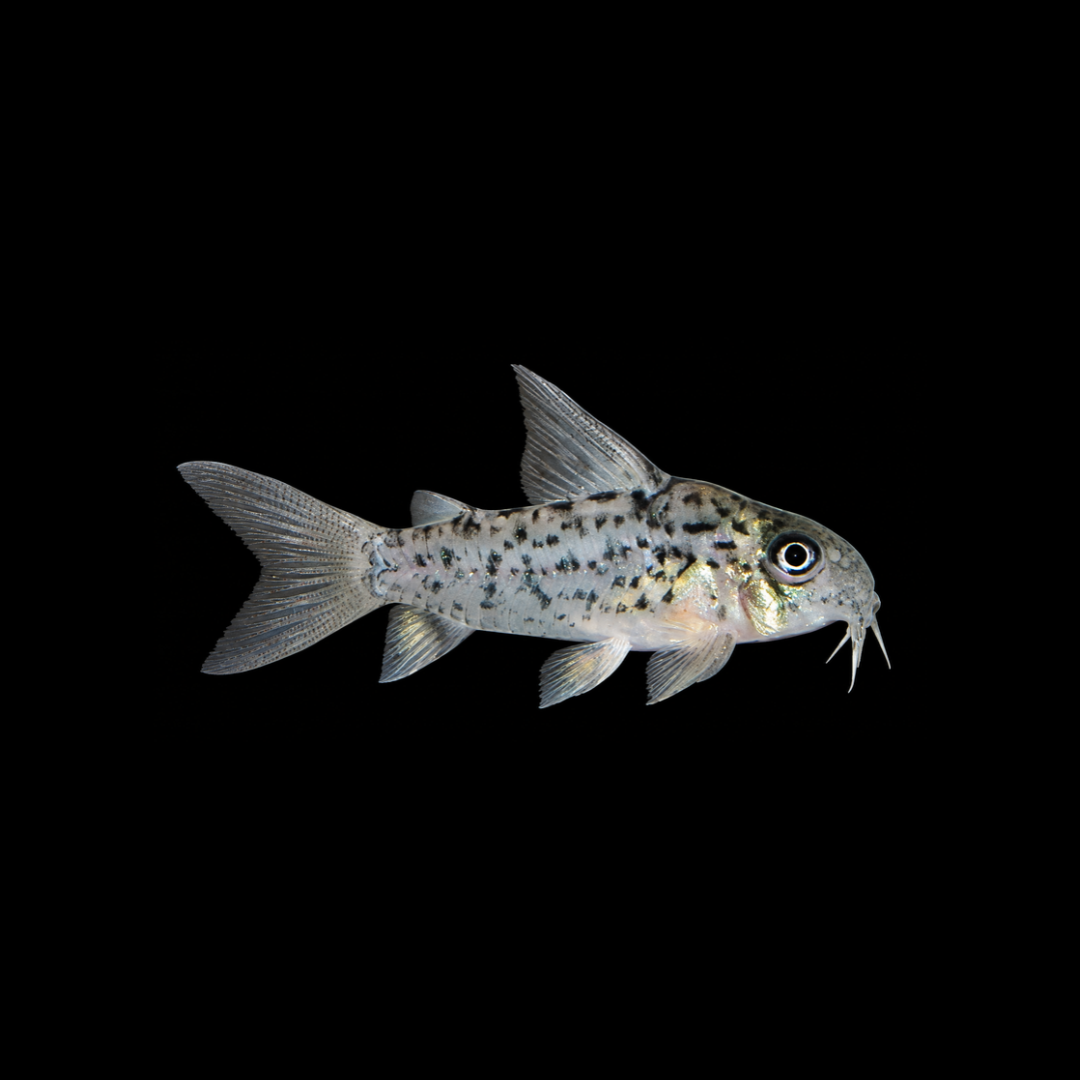
コリドラス・ロレトエンシスは、ペルーからエクアドルにかけてのアマゾン川上流域に分布する小型のコリドラスで、最初に発見されたのはペルー北東部ロレト県を流れるナナイ川です。淡い銀色から灰褐色の地色に細かな暗色の斑点が散る「ごま塩模様」が特徴で、背ビレはとくにオスで高く伸び、体長の半分ほどに達することもあります。控えめな色合いと伸びやかな背ビレが合わさった、上品な佇まいが魅力です。2024年に発表されたコリドラスの仲間の大規模な分類の見直しにより、現在はHoplisoma(ホプリソマ)属に移され、学名はHoplisoma loretoenseとなりました。ただし国内では、今も「ロレトエンシス」の名で親しまれています。いつでも店頭に並ぶ種類ではなく、南米産の小型魚を得意とする専門店で見かけることが多い、やや珍しい存在です。輸入直後は長旅の疲れからヒゲや体表を傷めていることが多いものの、環境に慣れれば丈夫になり、細かい砂の上を群れで探り歩く愛らしい姿を長く見せてくれます。 Corydoras loretoensis is a small Corydoras distributed in the upper Amazon basin from Peru to Ecuador, first discovered in the Río Nanay in the Loreto Department of northeastern Peru. It is characterized by a pale silvery to grey-tan base color sprinkled with fine dark spots in a “salt-and-pepper” pattern, and its dorsal fin grows tall, especially in males, sometimes reaching about half the body length. The combination of subdued coloring and a graceful dorsal fin gives it an elegant appearance. Following a large-scale reclassification of the Corydoras group published in 2024, the species was moved to the genus Hoplisoma and is now known as Hoplisoma loretoense, although in Japan it is still widely called “Loretoensis.” It is not always available in shops and is most often found at specialist stores that focus on small South American fish. Newly imported fish frequently arrive with damaged barbels or skin from the long journey, but once acclimated they become hardy and will charm their keepers for years as a group foraging across fine sand.
基本情報 / Basic Information
| 学名 / Scientific Name | Hoplisoma loretoense (Nijssen & Isbrücker, 1986)(旧学名:Corydoras loretoensis) (formerly Corydoras loretoensis) |
|---|---|
| 通称 / Common Name | コリドラス・ロレトエンシス、ロレトエンシス、ホプリソマ・ロレトエンセ(新学名の読み)Loreto Cory, Loretoensis, Hoplisoma loretoense |
| 分類 / Family | ナマズ目 カリクティス科 コリドラス亜科 ホプリソマ属Siluriformes, Callichthyidae, Corydoradinae, genus Hoplisoma |
| 英名 / English Name | Loreto Cory, Loreto Corydoras |
| 分布 / Distribution | 南米、ペルーおよびエクアドルのアマゾン川上流域。基準産地はペルー北東部ロレト県のナナイ川です。砂底の浅瀬や、砂浜状になった岸辺などで見られます。South America: the upper Amazon basin in Peru and Ecuador. The type locality is the Río Nanay in the Loreto Department of northeastern Peru. It is found in shallows with sandy bottoms and along sandy, beach-like banks. |
| 最大体長 / Max Size | およそ4.5〜5cm。オスで約4.5cm、メスで約5cmとされ、メスの方がやや大きくなります。About 4.5–5 cm. Males reach about 4.5 cm and females about 5 cm, with females growing slightly larger. |
| 寿命 / Lifespan | 本種に限った詳しい記録は多くありませんが、ほかの小型コリドラスと同様に、飼育下では5年前後、環境が良ければそれ以上生きると考えられています。There are few detailed records specific to this species, but like other small Corydoras, it is thought to live around five years in captivity, and longer under good conditions. |
飼育環境 / Aquarium Environment
| 水槽サイズ / Tank Size | 群れで暮らす魚なので、6〜10匹ほどで飼うことを前提に、60cm規格水槽(約57L)以上がおすすめです。水量に余裕があるほど水質が安定し、本種が苦手とする老廃物もたまりにくくなります。繁殖専用の水槽であれば、45cm規格水槽(約35L)程度でも対応できます。As a schooling fish, it should be kept in groups of about 6–10, so a 60 cm standard tank (about 57 L) or larger is recommended. The more water volume, the more stable the water quality and the more slowly the waste products this species dislikes build up. For a dedicated breeding tank, a 45 cm standard tank (about 35 L) can work. |
|---|---|
| 水温 / Temperature | 22〜26℃。水温が高いと水中の酸素が減りやすいため、夏場は冷却ファンなどで上がりすぎを防ぎましょう。 22–26°C (72–79°F). Higher temperatures reduce dissolved oxygen, so use a cooling fan or similar to prevent overheating in summer. |
| 水質 / Water Quality | pH5.5〜7.5の弱酸性〜中性、総硬度(GH)2〜18程度が目安です。日本の水道水は、カルキ抜きをすればおおむね適しています。本種でとくに大切なのは、pHの数値よりも、硝酸塩の少ない新しい水を保つことです。硝酸塩濃度は50mg/L以下を目安に、できるだけ低く抑えましょう。長く換えずに熟成させた水を好む魚ではない点を覚えておくと安心です。Aim for slightly acidic to neutral water, pH 5.5–7.5, with a general hardness (GH) of about 2–18 dH. Dechlorinated Japanese tap water is generally suitable. What matters most for this species is not the pH value but keeping fresh water low in nitrate. Aim for nitrate below 50 mg/L and keep it as low as possible. It helps to remember that this is not a fish that prefers long-aged water. |
| レイアウト / Layout | 底床には、田砂のような角のない細かい砂が欠かせません。大磯砂や角のある砂利、ソイルは、砂に顔を差し込んで餌を探す際にヒゲを傷める原因になります。前景には自由に砂を掘れる広いスペースを空け、後景に流木やマジックリーフなどの落ち葉、水草を配置して薄暗い隠れ家を作ると、落ち着いて過ごしてくれます。根を張る水草は掘り返されやすいため、流木に活着させたミクロソリウムやアヌビアス、成長の早いマツモなどが扱いやすいでしょう。マツモは水中の余分な栄養を吸収するので、水質の安定にも役立ちます。Fine, rounded sand such as Japanese “tasuna” river sand is essential. Coarse gravel, sharp-edged substrates, and aqua soil can damage the barbels when the fish push their faces into the substrate to search for food. Leave a wide open area of sand in the foreground for digging, and place driftwood, dried leaves such as catappa leaves, and plants in the background to create shaded hiding spots where the fish can settle. Rooted plants are easily uprooted, so Java fern or Anubias attached to driftwood, or fast-growing hornwort, are easier to manage. Hornwort also absorbs excess nutrients from the water, helping to keep water quality stable. |
| 注意点 / Precautions | 硝酸塩がたまった水に弱く、水換えを怠るとヒゲが溶けたり体表が荒れたりしやすい種類です。週に1回、20〜30%程度の水換えを習慣にしましょう。輸入直後の個体はとても繊細なので、販売店で1〜2週間以上かけて状態を整えられ、ヒゲや体表の傷が治り、人工飼料をよく食べている個体を選ぶのが成功への近道です。また、背ビレと胸ビレの先頭にある硬い棘には弱い毒があり、刺さると痛みや腫れが出ることがあります。素手で触るときは注意し、網に棘が引っかかりやすいので、すくう際はカップなどの容器を使うと安全です。This species is sensitive to nitrate buildup, and if water changes are neglected its barbels may erode and its skin may deteriorate. Make a habit of changing about 20–30% of the water once a week. Newly imported fish are very delicate, so the surest path to success is choosing fish that a shop has conditioned for at least one to two weeks, whose barbel and skin damage has healed, and that are eating prepared foods well. The stiff spines at the front of the dorsal and pectoral fins carry a mild venom and can cause pain or swelling if they puncture the skin. Take care when handling the fish by hand, and since the spines easily catch in nets, scooping with a cup or other container is safer. |
餌と給餌 / Feeding
| 餌の種類 / Diet | 底に落ちた有機物や小さな生き物を幅広く食べる雑食性です。飼育下ではコリドラス用の沈下性タブレットや顆粒飼料にすぐ慣れ、冷凍アカムシ、冷凍ミジンコ、ブラインシュリンプなども好んで食べます。An omnivore that eats a wide range of organic matter and small organisms on the bottom. In captivity it quickly accepts sinking tablets and granules made for Corydoras, and it also relishes frozen bloodworms, frozen daphnia, and brine shrimp. |
|---|---|
| 給餌のポイント / Feeding Tips | やや臆病なため、泳ぎの得意なテトラなどと一緒に飼うと、餌が底に届く前に食べられてしまうことがあります。素早く沈む専用飼料を使ったり、消灯前後に与えたりして、本種の口にも確実に入るよう工夫しましょう。底の残り餌を片付ける役目を期待されがちですが、それだけに頼らず、本種のための餌をきちんと与えることが大切です。食べ残しは硝酸塩の増加につながるため、数分で食べきれる量を目安にしてください。Because it is somewhat shy, food may be eaten by fast-swimming fish such as tetras before it reaches the bottom. Use fast-sinking foods or feed around lights-out so that this species reliably gets its share. Although it is often expected to clean up leftovers, do not rely on that alone; make sure to feed it properly. Uneaten food raises nitrate levels, so offer only what can be finished within a few minutes. |
性格と混泳 / Temperament and Tank Mates
| 性格 / Temperament | とても温和で、ほかの魚を攻撃したり縄張りを主張したりすることはありません。仲間と一緒にいることで安心する群れ魚なので、少数で飼うと物陰に隠れがちになります。6匹以上の群れで飼うと、底砂の上を並んで探り歩く、本来の活発な姿が見られます。Very peaceful; it does not attack other fish or claim territory. As a schooling fish that feels secure among its own kind, it tends to hide when kept in small numbers. In a group of six or more, it shows its natural, lively behavior, foraging side by side across the sand. |
|---|---|
| 混泳の相性 / Compatibility | 小型カラシン、ラスボラ、アピストグラマなどの小型シクリッド、温和な小型ナマズ類とよく合います。ナナイ川の環境を再現したバイオトープ水槽では、エンゼルフィッシュやペンシルフィッシュの仲間、ラミーノーズテトラなどと組み合わせた例もあり、南米をテーマにした水槽づくりの参考になります。一方、スマトラのようにヒレをかじる魚は、伸びた背ビレが狙われるため避けましょう。本種を口に入れられる大型魚や、底で暮らすザリガニ、気の強いプレコとの同居も向きません。ほかのコリドラスとの混泳は基本的に問題ありませんが、アドルフォイのように、より酸性に傾いた水を好むとされる種類とは理想の水質が少し異なる点を意識しておくと安心です。It pairs well with small characins, rasboras, dwarf cichlids such as Apistogramma, and peaceful small catfish. Biotope aquariums recreating the Río Nanay have combined it with angelfish, pencilfish, and rummy-nose tetras, offering a useful model for a South American-themed tank. Avoid fin-nipping fish such as tiger barbs, as its tall dorsal fin will become a target. It is also unsuitable with large fish that can swallow it, bottom-dwelling crayfish, or aggressive plecos. Mixing with other Corydoras is generally fine, but keep in mind that species such as C. adolfoi are said to prefer more acidic water, so their ideal conditions differ slightly. |
病気と対策 / Diseases and Prevention
| かかりやすい病気 / Common Diseases | 最も多いのは、底床や水質の悪化によるヒゲのすり減りや溶けと、そこから広がる細菌感染です。硝酸塩がたまった水では、体表が白っぽく荒れる「肌荒れ」やヒレの溶けも起こりやすくなります。輸入直後や環境の変化で弱っているときは、白点病にも注意が必要です。The most common problems are worn or eroded barbels caused by poor substrate or water quality, and bacterial infections that spread from them. In nitrate-laden water, the skin may become cloudy and rough, and fin rot is also more likely. White spot disease (ich) is also a concern when fish are weakened after import or by changes in their environment. |
|---|---|
| 対策と予防 / Prevention | 予防の基本は、角のない細かい砂を使うことと、定期的な水換えで硝酸塩の少ない水を保つことです。水換えだけで追いつかない場合は、硝酸塩を減らす市販の水質調整剤を補助的に使う方法もあります。水面へ空気を吸いに上がる行動自体は正常ですが、数分おきなど回数が極端に増えたときは、酸欠や水質悪化のサインと考えて、水換えやエアレーションを見直しましょう。ナマズの仲間は薬に敏感な傾向があるとされるため、薬浴をする場合は規定量より少なめから始め、様子を見ながら調整すると安心です。The foundations of prevention are using fine, rounded sand and keeping nitrate low with regular water changes. If water changes alone cannot keep up, commercial nitrate-reducing conditioners can be used as a supplement. Surfacing to gulp air is normal in itself, but if it becomes extremely frequent, such as every few minutes, treat it as a sign of low oxygen or deteriorating water and review your water changes and aeration. Catfish are said to be sensitive to medications, so when treating, start with less than the recommended dose and adjust while observing the fish. |
増やし方(繁殖) / Breeding
| 雌雄の判別 / Sexing | 成熟した個体を真上から見ると、メスは体の幅が広く腹部が丸みを帯びており、卵を抱えるとふくらみがはっきりします。体長もメスの方がやや大きめです。オスはスリムで直線的な体つきをしており、背ビレがより高く伸びる傾向があります。Viewed from above, mature females are broader with a rounded belly that swells noticeably when carrying eggs, and they are slightly longer. Males are slimmer and more streamlined, and tend to have a taller dorsal fin. |
|---|---|
| 繁殖形態 / Reproduction | 粘着性のある卵を産む卵生魚です。受精は、オスがメスの口元に体を直角に寄せる「Tポジション」と呼ばれるコリドラス特有の姿勢で行われます。メスは腹ビレで抱えた数個の卵を、ガラス面や水草の葉の裏、スポンジフィルターの陰などに産み付けます。親は卵を守らず、産卵後に自分たちの卵を食べてしまうことがあります。An egg-laying fish that produces adhesive eggs. Fertilization takes place in the “T-position,” a posture characteristic of Corydoras in which the male positions his body at a right angle to the female’s mouth. The female holds a few eggs between her pelvic fins and attaches them to the glass, the underside of plant leaves, or behind a sponge filter. The parents do not guard the eggs and may eat them after spawning. |
| 繁殖のポイント / Breeding Tips | 繁殖例はあまり多くなく、コリドラスの中ではやや難しい部類とされます。本種だけを入れた45〜60cm程度の繁殖用水槽を用意すると、成功しやすくなるでしょう。オス2〜3匹にメス1匹の割合が目安で、産卵場所としてアマゾンソードのような幅広の葉や産卵モップを入れておきます。冷凍アカムシなどで親魚を十分に太らせてから、普段より数度低い水で30〜50%ほど水換えをすると、雨季の訪れを思わせる刺激となり、産卵が促されることがあります。産卵後は卵を指の腹などで丁寧にはがして別の容器へ移し、カビを防ぐためにメチレンブルーをごく少量加え、エアレーションで水を動かしましょう。一般的なコリドラスと同様、水温24℃前後なら3〜5日ほどで孵化すると考えられます。稚魚がお腹の栄養袋(ヨークサック)を吸収して泳ぎ始めたら、インフゾリアやマイクロワームを与え、その後、孵化したてのブラインシュリンプへ切り替えます。稚魚の水槽は何も敷かないより、田砂などをごく薄く敷いた方が育ちやすいという経験談も、海外のブリーダーから報告されています。Breeding reports are few, and it is considered somewhat difficult among Corydoras. A breeding tank of about 45–60 cm housing only this species improves the odds of success. A ratio of two to three males per female is a good guideline, and broad-leaved plants such as Amazon sword or a spawning mop can serve as spawning sites. After conditioning the adults well with foods such as frozen bloodworms, a 30–50% water change with water a few degrees cooler than usual can mimic the arrival of the rainy season and trigger spawning. After spawning, gently remove the eggs with a fingertip and move them to a separate container, adding a very small amount of methylene blue to prevent fungus and using aeration to keep the water moving. As with Corydoras in general, the eggs are expected to hatch in about three to five days at around 24°C. Once the fry absorb their yolk sacs and start swimming, feed infusoria or microworms, then switch to newly hatched brine shrimp. Breeders overseas also report that fry tend to do better with a very thin layer of fine sand than on a completely bare bottom. |
雑学と豆知識 / Trivia and Fun Facts
| 1. 名前に刻まれた故郷「ロレト」 / 1. A Homeland Engraved in Its Name: Loreto | 本種は1986年、オランダの魚類学者ハン・ネイセンとアイザック・イスブリュッカーによって新種として記載されました。二人は数多くのコリドラスの命名や分類に携わったことで知られる研究者です。記載の基準となった標本はペルー北東部ロレト県のナナイ川の岸辺で採集されたもので、種小名の「ロレトエンシス」は、この土地の名に由来しています。ロレト県にはアマゾン上流域の主要都市イキトスがあり、この地域からは昔から多くの観賞魚が世界へ送り出されてきました。名前を口にするたび、遠いアマゾン上流の川辺に思いを馳せられるのも、この魚のささやかな楽しみの一つです。This species was described in 1986 by the Dutch ichthyologists Han Nijssen and Isaäc Isbrücker, researchers known for naming and classifying a great many Corydoras. The specimens on which the description was based were collected on the banks of the Río Nanay in the Loreto Department of northeastern Peru, and the species name “loretoensis” comes from this region. Loreto is home to Iquitos, a major city of the upper Amazon, and many aquarium fish have long been shipped from this area to the rest of the world. Being able to picture the riverbanks of the distant upper Amazon each time you say its name is one of the small pleasures this fish offers. |
|---|---|
| 2. 「盾の体」を意味するHoplisoma属への引っ越し / 2. A Move to Hoplisoma, the “Shielded Body” | 長年、コリドラス属は170種を超える巨大なグループでした。しかし遺伝子を使った研究が進むにつれ、このグループが一つの祖先から枝分かれした、まとまりのある仲間ではないことがわかってきました。そこで2024年、ディアスやテンカットらの研究チームがコリドラスの仲間の系統と分類を見直した論文を発表し、旧コリドラス属はいくつもの属に分けられました。つまり、見た目が似ていても、進化の道筋が異なる魚どうしは別の属として扱われることになったのです。その中で、古くから存在していた属名Hoplisomaが復活し、本種もこの属に移されて、学名はHoplisoma loretoense(ホプリソマ・ロレトエンセ)となりました。属名が文法上の中性名詞であるため、種小名の語尾も「-ensis」から「-ense」に変わっています。Hoplisomaは、ギリシャ語で盾や武具を意味する「ホプロン」と、体を意味する「ソーマ」を組み合わせた言葉で、体の側面を覆う骨質の板をよく表した名前です。とはいえ、店頭では今も「コリドラス・ロレトエンシス」の名が一般的で、新しい学名と馴染みの呼び名が並び立つ、移行期ならではの光景が見られます。For many years, the genus Corydoras was a huge group of more than 170 species. As genetic research advanced, however, it became clear that this group was not a cohesive set of fish descended from a single ancestor. In 2024, a research team including Dias and Tencatt published a revised phylogeny and classification of the Corydoras group, splitting the old genus into several genera. In other words, fish that look alike but followed different evolutionary paths are now treated as separate genera. The long-standing genus name Hoplisoma was revived, this species was placed in it, and its scientific name became Hoplisoma loretoense. Because the genus name is grammatically neuter, the species ending also changed from “-ensis” to “-ense.” Hoplisoma combines the Greek “hoplon” (shield or armor) and “soma” (body), aptly describing the bony plates covering its flanks. Even so, shops still commonly use the name “Corydoras loretoensis,” a scene typical of a transitional period when the new scientific name and the familiar one exist side by side. |
| 3. 短い吻が語る暮らし方 / 3. What a Short Snout Says About Its Lifestyle | コリドラスの仲間は、遺伝子の研究をもとにいくつかの系統に分けて整理されており、本種はコリドラス・プンクタートゥスを代表とする「ショートノーズ(短い吻)」の系統に属しています。この系統の仲間は丸みのある頭と短い口先を持ち、砂の表面から浅い層にかけて餌を探す暮らしに適応していると考えられています。長い吻で砂を深く掘るロングノーズ系のコリドラスとは異なり、細かい砂の上をちょこちょこと探り歩く姿は、この体のつくりから生まれた習性といえるでしょう。飼育で細かい砂が欠かせない理由も、こうした背景を知るといっそう納得できます。Corydoras and their relatives are organized into several lineages based on genetic research, and this species belongs to the “short-nosed” lineage typified by Corydoras punctatus. Members of this lineage have rounded heads and short snouts, and are thought to be adapted to searching for food from the sand surface down into shallow layers. Unlike long-nosed Corydoras that dig deeply with their elongated snouts, its habit of nimbly probing across fine sand can be seen as a product of this body plan. Knowing this background makes it even clearer why fine sand is so important in captivity. |
| 4. 腸で息をする魚 / 4. A Fish That Breathes with Its Gut | 水槽を眺めていると、コリドラスが急に水面へ駆け上がり、すぐにまた底へ戻っていく姿を見かけることがあります。これは空気を飲み込みに行く行動です。飲み込んだ空気は、細い血管が張り巡らされた腸の後ろの部分で酸素として取り込まれ、残りは肛門から泡となって出ていきます。アマゾンでは乾季に水位が下がり、取り残された水たまりの酸素が乏しくなることがあるため、こうした環境を生き抜く中で身につけた能力だと考えられています。ときどき見られる程度なら健康な証拠ですが、回数が多すぎる場合は、水中の酸素不足や水質悪化を知らせるサインにもなります。飼育者にとっては、水槽の状態を読み取る小さな手がかりです。While watching an aquarium, you may see a Corydoras suddenly dart to the surface and quickly return to the bottom. It is going up to gulp air. The swallowed air is absorbed as oxygen in the rear part of the intestine, which is laced with fine blood vessels, and the rest is released from the vent as bubbles. In the Amazon, water levels fall in the dry season and isolated pools can become low in oxygen, so this ability is thought to have developed as a way to survive such conditions. An occasional trip is a sign of good health, but very frequent trips can signal a lack of oxygen or deteriorating water quality, giving keepers a small clue to the condition of their tank. |
| 5. ヒレの棘に秘めた護身術 / 5. Self-Defense Hidden in Its Fin Spines | 穏やかな見た目からは想像しにくいものの、本種の背ビレと胸ビレの先頭には硬い棘があり、そこには弱い毒があります。鳥や大きな魚に飲み込まれそうになると棘をピンと立てて相手の喉に引っかけ、痛みを与えて吐き出させる仕組みだと考えられています。人にとって危険なものではありませんが、刺さればチクリとした痛みや腫れが出ることもあります。小さな体で厳しい自然を生き抜くための備えであり、「盾の体」という属名の意味とあわせて考えると、見かけによらずしっかり武装した魚であることがわかります。Though hard to imagine from its gentle appearance, this fish has stiff spines at the front of its dorsal and pectoral fins, which carry a mild venom. When a bird or large fish tries to swallow it, it is thought to lock these spines upright so they catch in the predator’s throat, causing pain and making the predator spit it out. The venom is not dangerous to people, but a puncture can cause a sharp sting and swelling. It is a defense for surviving a harsh natural world with a small body, and together with a genus name meaning “shielded body,” it shows that this little fish is far better armed than it looks. |
| 6. 目を横切る帯模様の謎 / 6. The Mystery of the Band Across the Eyes | 本種に似た魚の中には、目を横切る帯模様、いわゆる「アイマスク」を持つタイプが知られています。この模様は本種の幼魚期にだけ現れ、成長とともに消えていくものではないかと考えられていますが、はっきりとは確かめられていません。小さな個体を迎えたときは、その顔つきが成長とともにどう変わっていくのかを見守ってみるのも、飼育ならではの楽しみといえるでしょう。Among fish resembling this species, a type with a band across the eyes, a so-called “eye mask,” is known. It has been suggested that this marking may appear only in juveniles of this species and fade as they grow, but this has not been clearly confirmed. When you bring home young fish, watching how their faces change as they grow is one of the special pleasures of keeping them. |
| 7. 「古い水」が合わない理由 / 7. Why “Old Water” Doesn’t Suit It | アクアリウムの世界では、ろ過がよく働いて落ち着いた「こなれた水」が魚に良いとよく言われます。ところが本種の場合、こうした水にたまりやすい硝酸塩が大きな負担になることが、飼育者の経験から知られています。原産地のアマゾン上流域では、豊かな水量のおかげで生き物の老廃物が薄められ、水が常に入れ替わっています。そのような環境で暮らしてきたため、硝酸塩の多い水に慣れていないのではないかと考えられています。実際、水換えの回数を増やすだけでヒゲや体表の状態が見違えるように良くなることも多く、故郷の川の姿を思い描くことが、そのまま飼育のヒントになる魚です。In the aquarium world, it is often said that well-matured, “seasoned” water with an established filter is good for fish. With this species, however, keepers have found that the nitrate that tends to build up in such water is a significant burden. In its native upper Amazon, the abundant volume of water dilutes waste products and keeps the water constantly renewed. Having lived in such an environment, it is thought not to be accustomed to nitrate-rich water. In practice, simply changing the water more often frequently brings a dramatic improvement in the condition of its barbels and skin, making it a fish whose home river itself offers the best keeping advice. |
まとめ / Conclusion
コリドラス・ロレトエンシスは、ごま塩模様の落ち着いた体色と、オスで高く伸びる背ビレが印象的な、アマゾン上流生まれの小さなナマズです。Hoplisoma属という新しい居場所を得ても、その控えめで上品な美しさは変わりません。底砂の上で群れが寄り添い、ヒゲを揺らしながら餌を探す姿には、思わず見入ってしまう魅力があります。 Corydoras loretoensis is a small catfish from the upper Amazon, striking for its subdued salt-and-pepper coloring and the tall dorsal fin of the males. Even with its new place in the genus Hoplisoma, its understated elegance remains unchanged. A group gathered close together, barbels twitching as they search the sand for food, is a sight that is hard to look away from.
迎えたばかりのころは繊細ですが、角のない細かい砂と、こまめな水換えで保つ新しい水があれば、丈夫で長く付き合える仲間になってくれます。手をかけて環境を整えるほど、伸びやかな背ビレと落ち着いた群れの姿で、水槽の底を静かに彩ってくれることでしょう。 Though delicate when first brought home, it becomes a hardy, long-lived companion given fine, rounded sand and fresh water maintained through regular changes. The more care that goes into its environment, the more it will quietly grace the bottom of the tank with its flowing dorsal fins and calm, close-knit group.
気になる道具や飼い方を見つけてみませんか?
 アイのアクアグッズ案内ラスボラ・ボララスの群泳を楽しむ飼育用品|水槽・ろ過・ヒーター・餌・水草道具の特徴や使い方、選ぶときのポイントをアイが紹介します。記事はコチラ →
 アイのアクアグッズ案内コケを食べるコイの仲間に合わせる飼育用品|フライングフォックス・アルジイーター・ガラ道具の特徴や使い方、選ぶときのポイントをアイが紹介します。記事はコチラ →
さまざまな飼育テーマをご紹介。リンク先の記事には広告・商品紹介が含まれます。
案内・紹介記事一覧へ →分布マップ
Hoplisoma loretoense(コリドラス・ロレトエンシス)は、南米ペルーおよびエクアドルのアマゾン川上流域に分布しています。基準産地は、ペルー北東部ロレト県を流れるナナイ川です。
※この地図は分布地域のおおよその範囲を示す概略表示です。正確な生息範囲を表すものではありません。
※マーカーは基準産地であるナナイ川付近を示す代表地点で、実際の採集地点ではありません。
地図データ © OpenStreetMap contributors
参考文献 / References
- Weitzman, S. H. & Nijssen, H. (1970). Four new species and one new subspecies of the catfish genus Corydoras from Ecuador, Colombia and Brazil (Pisces, Siluriformes, Callichthyidae). Beaufortia, 18(233), 119–132.
https://repository.naturalis.nl/pub/504794
原記載・学名の由来・基準産地 - Dias, A. C., Tencatt, L. F. C., Roxo, F. F., Silva, G. S. C., Santos, S. A., Britto, M. R., Taylor, M. I. & Oliveira, C. (2024). Phylogenomic analyses in the complex Neotropical subfamily Corydoradinae (Siluriformes: Callichthyidae) with a new classification based on morphological and molecular data. Zoological Journal of the Linnean Society, zlae053.
https://doi.org/10.1093/zoolinnean/zlae053
分類・ホプリソマ属への移行 - Fricke, R., Eschmeyer, W. N. & Van der Laan, R. (eds.). Eschmeyer’s Catalog of Fishes: Genera, Species, References. California Academy of Sciences. Electronic version (Corydoras atropersonatus).
https://researcharchive.calacademy.org/research/ichthyology/catalog/fishcatget.asp?spid=4822
有効学名・基準産地・分布 - Fricke, R., Eschmeyer, W. N. & Van der Laan, R. (eds.). Eschmeyer’s Catalog of Fishes: Genera, Species, References. California Academy of Sciences. Electronic version (Corydoras kanei).
https://researcharchive.calacademy.org/research/ichthyology/catalog/fishcatget.asp?spid=64961
類似種カネイの学名・分布 - Grant, S. (1997). Descriptions of two new species of Corydoras Lacepède, 1803 (Pisces, Siluriformes, Callichthyidae). The Aquarist and Pondkeeper, 62(10), 41–45.
類似種カネイの原記載 - Froese, R. & Pauly, D. (eds.). FishBase. World Wide Web electronic publication (Corydoras atropersonatus).
https://www.fishbase.se/summary/SpeciesSummary.php?genusname=Corydoras&speciesname=atropersonatus
体長・生息環境・水質 - Wright, J. J. (2009). Diversity, phylogenetic distribution, and origins of venomous catfishes. BMC Evolutionary Biology, 9, 282.
https://doi.org/10.1186/1471-2148-9-282
胸ビレ棘の毒腺 - Alexandrou, M. A., Oliveira, C., Maillard, M., McGill, R. A. R., Newton, J., Creer, S. & Taylor, M. I. (2011). Competition and phylogeny determine community structure in Müllerian co-mimics. Nature, 469, 84–88.
https://doi.org/10.1038/nature09660
ミュラー型擬態 - Plaul, S. E., Pastor, R., Díaz, A. O. & Barbeito, C. G. (2016). Immunohistochemical and ultrastructural evidence of functional organization along the Corydoras paleatus intestine. Microscopy Research and Technique, 79(3), 140–148.
https://ri.conicet.gov.ar/handle/11336/54300
腸呼吸 - Kohda, M., Tanimura, M., Kikue-Nakamura, M. & Yamagishi, S. (1995). Sperm drinking by female catfishes: a novel mode of insemination. Environmental Biology of Fishes, 42, 1–6.
繁殖行動(Tポジション) - Noga, E. J. (2010). Fish Disease: Diagnosis and Treatment (2nd ed.). Wiley-Blackwell.
病気と対策




コメント