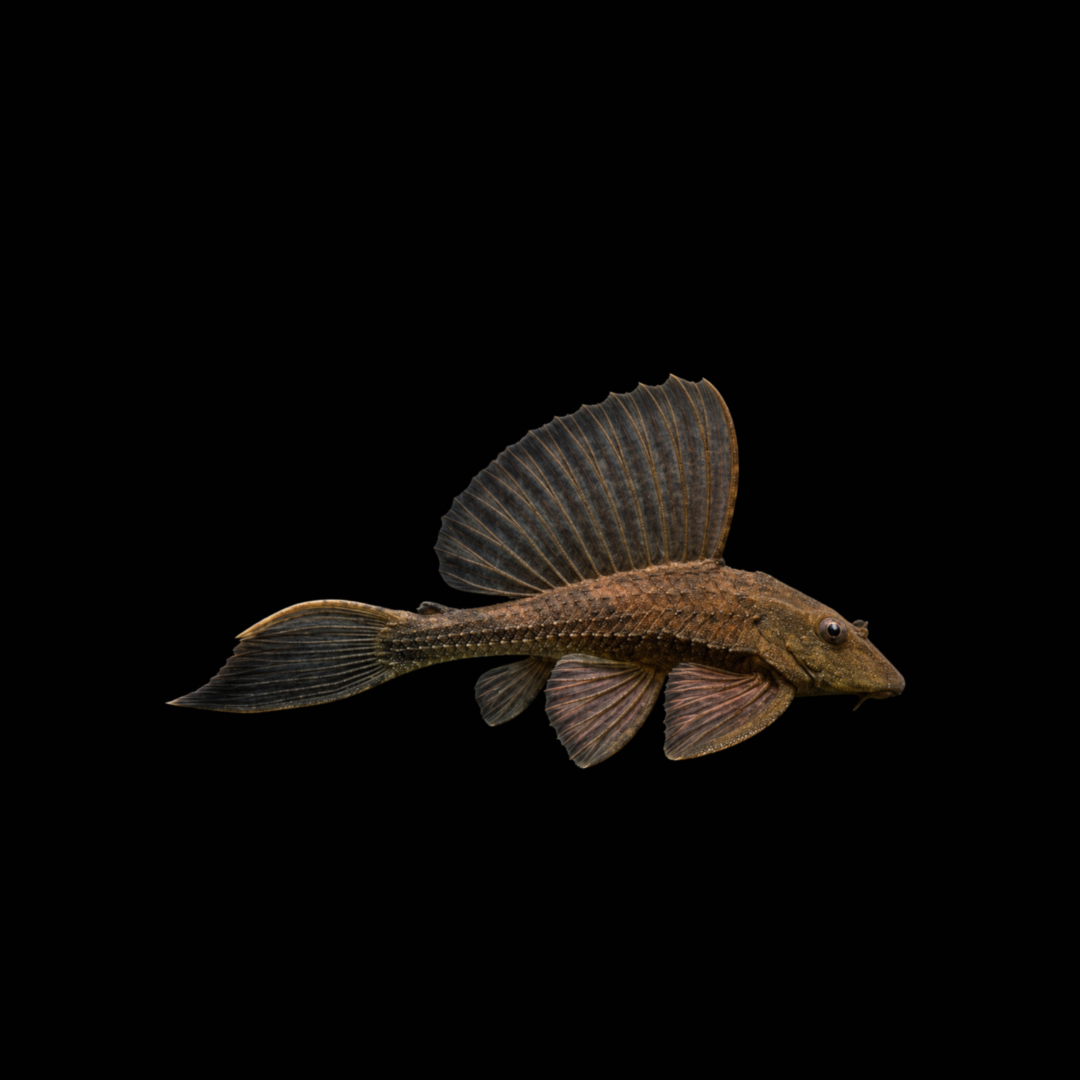
サタンプレコは、ペルーのアマゾン川上流域、マラニョン川とウカヤリ川の水系を中心に分布するロリカリア科のナマズで、学名をプテリゴプリクティス・スクロフス(Pterygoplichthys scrophus)といいます。セルフィンプレコやコモンプレコと同じプテリゴプリクティス属の仲間ですが、その姿はひときわ無骨です。体の側面には小さな棘の並んだ4本の隆起線が頭から尾まで走り、頭の後方には高く盛り上がった稜線がそびえ、鼻孔のあいだからは2本の鼻管が角のように突き出しています。そこに12本の軟条を持つ帆のような背ビレが加わることで、甲冑をまとった古代の生き物を思わせるシルエットが生まれています。英語圏で「ライノ(サイ)プレコ」や「アリゲーター(ワニ)プレコ」と呼ばれ、原産地ペルーでもスペイン語でワニやトカゲを指す「ラガルト」を冠した「ラガルト・カラチャマ」の名で流通しているのは、この爬虫類のような外観に由来します。体色は一様なチョコレートブラウンから砂褐色を基調とし、背から体側にかけて3本の太い暗褐色の鞍状斑が入るだけという渋い配色です。斑点や虫食い模様を持つ同属の仲間とは、この点でもはっきりと異なります。同属の大型種が全長50〜60cm級に達するのに対し、本種は全長おおむね33〜35cm前後に収まるとされ、迫力と飼育の現実性を両立した大型プレコとして根強い支持を集めています。国内に流通する個体の多くは、現在もペルーから届く野生採集の幼魚で、店頭では体長4〜11cmほどの個体を目にすることが多いでしょう。小さな幼魚が年月をかけて貫禄ある甲冑の主へと育っていく過程こそが、この魚と暮らす醍醐味です。The Satan Pleco is a loricariid catfish native to the upper Amazon basin of Peru, centered on the Marañón and Ucayali river systems. Its scientific name is Pterygoplichthys scrophus. Although it belongs to the same genus, Pterygoplichthys, as the Sailfin Pleco and the Common Pleco, its appearance is strikingly rugged. Four ridges lined with small spines run along its sides from head to tail, a tall crest rises at the back of the head, and two nasal tubes project like horns from between the nostrils. Add a sail-like dorsal fin with twelve soft rays, and the result is a silhouette reminiscent of an armored prehistoric creature. This reptilian look is why English-speaking hobbyists call it the “Rhino Pleco” or “Alligator Pleco,” and why it is traded in Peru as “lagarto carachama,” using the Spanish word lagarto, which refers to caimans or lizards. Its coloration is understated: a uniform chocolate to sandy brown with only three broad dark-brown saddles running from the back down the flanks. In this respect, too, it clearly differs from congeners with spots or vermiculated patterns. While larger members of the genus reach 50 to 60 cm in total length, this species is reported to stay at roughly 33 to 35 cm, earning it steady popularity as a large pleco that balances impressive presence with practical care. Most specimens in the Japanese trade are still wild-caught juveniles shipped from Peru, typically 4 to 11 cm long. Watching a small juvenile grow over the years into a dignified, armored master of the aquarium is the true joy of keeping this fish.
基本情報 / Basic Information
学名 / Scientific Name
Pterygoplichthys scrophus (Cope, 1874)
通称 / Common Name
サタンプレコ(旧学名のグリプトペリクティス・スクロフス Glyptoperichthys scrophus や、記載時の学名リポサルクス・スクロフス Liposarcus scrophus で紹介されることもあります。Lナンバーは付与されていません)Satan Pleco (sometimes listed under the former name Glyptoperichthys scrophus or the original name Liposarcus scrophus; no L-number has been assigned)
分類 / Family
ナマズ目 ロリカリア科 ヒポストムス亜科 プテリゴプリクティス属Siluriformes, Loricariidae, Hypostominae, genus Pterygoplichthys
英名 / English Name
Rhino Pleco, Alligator Pleco, Chocolate Pleco
分布 / Distribution
南米ペルーのアマゾン川上流域。マラニョン川とウカヤリ川の水系を中心に、周辺のアマゾン本流上流域からも記録されています。アンデス山脈から流れ出た土砂を多く含む白濁した河川(ホワイトウォーター)に暮らし、泥底や砂底の、水深0.2〜5mほどの場所に生息します。The upper Amazon basin of Peru, South America. It is found mainly in the Marañón and Ucayali river systems, with records from nearby stretches of the upper Amazon main stem. It lives in turbid whitewater rivers carrying large amounts of Andean sediment, over mud or sand bottoms at depths of about 0.2 to 5 m.
最大体長 / Max Size
尾ビレを除いた標準体長で最大27.5cmとされ、尾ビレを含む全長に換算するとおおむね33〜35cm前後です。The maximum standard length (excluding the tail fin) is reported as 27.5 cm, which corresponds to roughly 33 to 35 cm in total length including the tail.
寿命 / Lifespan
プテリゴプリクティス属としては5年以上とされ、十分な大きさの水槽で適切に管理すれば長期飼育が可能です。Members of the genus are reported to live more than 5 years, and long-term keeping is possible with a sufficiently large tank and proper care.
飼育環境 / Aquarium Environment
水槽サイズ / Tank Size
幼魚のうちは60cm規格水槽(約55〜65L)で育てられますが、成長は着実で、最終的には全長30cmを超えます。成魚を単独で飼うなら90cm規格水槽(90×45×45cm、約160〜180L)が最低ラインで、理想は120cm水槽(120×45×45cm〜120×60×60cm、約240〜430L)です。複数で飼う場合は縄張り争いを避けるため、さらに広い底面積と豊富な隠れ家が必要になります。設置場所にも注意が必要です。90cm規格水槽でも、水槽台やろ過器を含めた総重量は200kgを超えることがあり、120×60×60cmクラスでは水槽と水だけで400kgを超えます。建築基準法施行令では、住宅の居室の床の強度を計算する際に想定する荷重を1㎡あたり約180kgとしています。これを超えたらすぐに床が抜けるという数値ではありませんが、重い水槽を長年置き続けると、床のたわみや傾きにつながるおそれがあります。幼魚を迎える前に設置場所の構造を確認し、床を支える梁の上や壁際に置けるか、床の補強が必要かを検討しておくことが、最後まで飼い続けるための第一歩です。Juveniles can be raised in a standard 60 cm tank (about 55 to 65 L), but growth is steady and adults eventually exceed 30 cm. For a single adult, a standard 90 cm tank (90×45×45 cm, about 160 to 180 L) is the minimum, and a 120 cm tank (120×45×45 cm to 120×60×60 cm, about 240 to 430 L) is ideal. Keeping several requires an even larger footprint and plenty of hiding places to prevent territorial fights. The installation site also needs attention. Even a 90 cm tank can exceed 200 kg in total once the stand and filtration are included, and a 120×60×60 cm tank weighs over 400 kg with water alone. Japan’s Building Standards Act Enforcement Order sets the load assumed when calculating floor strength in residential living rooms at about 180 kg per square meter. This is not a figure at which the floor immediately gives way, but keeping a heavy tank in place for years can cause the floor to sag or tilt. Before bringing a juvenile home, check the structure of the site and consider whether the tank can stand over the supporting beams or near a wall, or whether the floor needs reinforcement. This is the first step toward caring for the fish for its whole life.
水温 / Temperature
22〜28℃(推奨24〜27℃)。日本の熱帯魚水槽で一般的な設定温度とよく重なります。20℃を下回らないようヒーターで加温し、夏場に30℃を超えそうなときは冷却ファンやエアコンで対策してください。22 to 28°C (24 to 27°C recommended), which overlaps well with typical tropical aquarium settings in Japan. Use a heater to keep it from dropping below 20°C, and use cooling fans or air conditioning when summer temperatures threaten to exceed 30°C.
水質 / Water Quality
pH6.0〜7.6の弱酸性〜中性で、軟水〜中硬水(15°dH程度まで)に対応します。原産地の河川は年間を通じて水質の変動が小さく中性付近であるため、カルキを抜いた日本の水道水によくなじみます。植物質を大量に食べてフンが非常に多い魚なので、強力な外部フィルターや上部フィルターの併用、強めのエアレーション、物理ろ過材のこまめな清掃、そして定期的な換水によって水質を保つことが飼育の鍵となります。Slightly acidic to neutral water, pH 6.0 to 7.6, and soft to moderately hard water (up to about 15°dH) are suitable. The rivers of its homeland stay near neutral with little seasonal fluctuation, so it adapts well to dechlorinated Japanese tap water. Because it eats large amounts of plant matter and produces a great deal of waste, the keys to success are powerful canister or overhead filters (or both), strong aeration, frequent cleaning of mechanical filter media, and regular water changes.
レイアウト / Layout
夜行性で日中は物陰に隠れて過ごすため、流木や大型の塩ビ管、素焼きのプレコ土管、石組などでシェルターを複数用意すると落ち着きます。底砂には細かい砂や大磯砂を敷くと自然な採餌行動を引き出せますが、大量のフンを吸い出しやすいベアタンク(底砂なし)も合理的な選択です。繊細な水草は食べられたり引き抜かれたりするため向きません。緑を添えたい場合は、アヌビアス類やミクロソリウムを流木に活着させる方法が適しています。天然の流木は表面の微生物膜(バイオフィルム)や繊維質の補給源にもなるため、常に入れておくことをおすすめします。As a nocturnal fish that hides during the day, it settles best when given several shelters such as driftwood, large PVC pipes, clay pleco caves, or rockwork. Fine sand or smooth gravel encourages natural foraging, but a bare-bottom tank is also a sensible choice because it makes removing the abundant waste easier. Delicate plants are unsuitable because they will be eaten or uprooted. If you want greenery, attaching hardy epiphytes such as Anubias or Java fern to driftwood works well. Natural driftwood also supplies surface biofilm and fiber, so keeping some in the tank at all times is recommended.
注意点 / Precautions
まず、購入時の名前の混同に注意しましょう。「タイガーフィンサタンプレコ(L091)」は名前に「サタン」を含みますが、背ビレや尾ビレにオレンジ色が入るベネズエラ産のレポラカンティクス属(Leporacanthicus triactis)で、まったくの別種です。また、本種に Glyptoperichthys lituratus という学名が添えられている場合は別種との取り違えなので、現行の学名 Pterygoplichthys scrophus を基準に確認してください。飼育中の事故としては、ヒーターに張り付いて低温やけどを負ったり、大型個体がヒーターのガラス管を割ってしまったりする例があります。ヒーターにはカバーを付けるか、ろ過槽の中に隔離して設置しましょう。アクリル水槽は軽量で大型水槽に向きますが、長年コケを舐め続けることで内面に細かな擦り傷が蓄積する点も覚えておくとよいでしょう。魚を取り上げる際は網を使わず、プラケースやバケツへ誘導して水ごとすくい上げてください。体表の小棘や、危険を感じると固くロックされる胸ビレの棘が網目に絡み、ヒレが裂けるおそれがあるためです。やむを得ず手で持つ場合は厚手の軍手を着け、棘を避けて頭の後ろから体の両側を支えます。万一網に絡んでしまったら、無理に引っ張らず、網目の方をハサミで切って外してください。そして何より大切なのが、野外へ放さないことです。同じ属のマダラロリカリアは、捨てられたペットが原因で沖縄本島の複数の河川に定着し、生態系被害防止外来種に選定されています。本種も飼いきれなくなった場合は、専門店などの引き取り先に相談してください。First, beware of name confusion when purchasing. The “Tiger Fin Satan Pleco (L091)” includes “Satan” in its trade name, but it is an entirely different fish: Leporacanthicus triactis from Venezuela, with orange in its dorsal and caudal fins. If this species is labeled Glyptoperichthys lituratus, it has been confused with a different species, so always check against the current valid name, Pterygoplichthys scrophus. As for accidents during care, plecos may cling to heaters and suffer low-temperature burns, and large individuals can break a heater’s glass tube. Fit a guard on the heater or place it separately in the sump. Acrylic tanks are light and suit large setups, but keep in mind that years of rasping algae will leave fine scratches on the inner surface. When moving the fish, do not use a net; instead, guide it into a plastic container or bucket and lift it out together with water. The small spines on its skin and the pectoral spines, which lock firmly when the fish feels threatened, easily snag in mesh and can tear the fins. If you must handle it, wear thick work gloves and support both sides of the body from behind the head, avoiding the spines. If it does become tangled, do not pull; cut the net mesh with scissors instead. Most important of all, never release it into the wild. Its congener, the Vermiculated Sailfin Catfish, has become established in several rivers on Okinawa Island because of abandoned pets and has been designated an invasive species of ecological concern in Japan. If you can no longer keep this species, consult a specialist shop or another rehoming option.
餌と給餌 / Feeding
餌の種類 / Diet
植物質寄りの雑食性です。主食にはキョーリン「ひかりクレスト プレコ」やテトラ「テトラ プレコ」などの植物性沈下タブレットが定番で、スピルリナ系のフードや底層魚用のペレットを組み合わせて与えます。副食としては、皮を剥いたり軽く湯通ししたりしたキュウリ、ズッキーニ、ホウレンソウ、カボチャなどの野菜をよく食べます。成魚になるにつれて、沈んだ食べ残しなどをあさる性質も強まるため、冷凍赤虫や刻んだエビ、大型魚用の沈下性フードを時折少量与えるのも有効です。An omnivore that leans toward plant matter. Plant-based sinking tablets such as Kyorin Hikari Crest Pleco or Tetra Pleco are standard staples, combined with spirulina-based foods and pellets for bottom dwellers. As supplements, it readily eats vegetables such as cucumber, zucchini, spinach, and pumpkin, peeled or lightly blanched. As it matures, it increasingly scavenges sunken leftovers, so occasional small portions of frozen bloodworms, chopped shrimp, or sinking foods for large fish are also useful.
給餌のポイント / Feeding Tips
輸入されたばかりの体長4〜7cmほどの幼魚は、水槽内のコケだけでは栄養がまったく足りず、お腹がへこんで痩せ細り、そのまま衰弱してしまうことがあります。導入初日から消灯前後に沈下性の専用餌を与え、きちんと食べているかを観察することが何より大切です。購入時に、すでに人工飼料を食べている個体を選ぶと安心でしょう。野菜は重りや流木に固定して沈め、水質の悪化を防ぐため、食べ残しは半日から1日で回収します。動物質に偏ると水質悪化や肥満を招きやすいため、植物質を中心にした献立を崩さないことが長く健康に育てるコツです。Newly imported juveniles of about 4 to 7 cm cannot get nearly enough nutrition from tank algae alone; their bellies can become sunken and they may waste away and weaken. Above all, offer sinking pleco food around lights-out from the very first day and confirm that the fish is actually eating. Choosing an individual that already accepts prepared foods offers peace of mind. Weigh down vegetables or fix them to driftwood, and remove leftovers within half a day to a day to protect water quality. Because a diet heavy in animal protein tends to cause water quality problems and obesity, keeping plant matter at the center of the menu is the secret to raising a healthy fish over the long term.
性格と混泳 / Temperament and Tank Mates
性格 / Temperament
他の魚種に対しては比較的穏やかです。ただし、同種や他の底層性プレコとは、隠れ家をめぐって激しい縄張り争いを起こしやすい傾向があります。日中は物陰でじっとしていることが多く、消灯後に活発に動き回ります。Relatively peaceful toward other kinds of fish. However, it tends to fight fiercely over hiding places with its own kind and other bottom-dwelling plecos. It usually rests in cover during the day and becomes active after the lights go out.
混泳の相性 / Compatibility
中層から上層を泳ぐ、同じくらいかそれ以上の大きさの丈夫な魚とは相性が良好です。オスカーやアイスポットシクリッド、大型のゲオファーガスといった南米産シクリッドや中型のカラシン類とは、食べ残しを片付けてくれる点でも好相性です。ヒレの柔らかいセルフィンプレコを傷つけがちなパクー類と同居させた場合でも、体表とヒレが頑丈な本種の方が耐えやすいという飼育例も伝えられています。一方、同種や他の大型プレコと同居させるなら隠れ家を十分に増やすか、単独で飼う方が安全です。ディスカスやエンゼルフィッシュ、ポリプテルス、淡水エイなど、体表の粘膜が多く動きのゆっくりした魚は、空腹時や夜間に体表を舐められて傷つくおそれがあるため注意が必要です。小型で繊細な熱帯魚との混泳もおすすめできません。It does well with sturdy fish of equal or larger size that occupy the middle and upper water column. South American cichlids such as Oscars, Cichla species, and large Geophagus, as well as medium-sized characins, are good companions, and the pleco helps by cleaning up their leftovers. Some keepers also report that when housed with pacu, which often damage the soft fins of Sailfin Plecos, this species copes better thanks to its tough body and fins. On the other hand, if kept with its own kind or other large plecos, either provide many extra hiding places or keep it alone for safety. Caution is needed with slow-moving, heavily slimed fish such as discus, angelfish, bichirs, and freshwater stingrays, as the pleco may rasp at their skin when hungry or at night. Small, delicate tropical fish are not recommended as tank mates either.
病気と対策 / Diseases and Prevention
かかりやすい病気 / Common Diseases
環境が安定していれば非常に丈夫な魚ですが、導入直後の水温低下などをきっかけに白点病や水カビ病を発症することがあります。また水質が悪化すると、ヒレの膜に小さな穴が開いたり、底からヒレをわずかに浮かせて水中で静止する、ぶら下がったような姿勢を見せたりすることが知られています。そのほか、幼魚期の痩せやヒーターによるやけども代表的なトラブルです。It is very hardy in a stable environment, but white spot disease or fungal infections may appear after events such as a temperature drop right after introduction. Poor water quality is known to cause small holes in the fin membranes and a “hanging” posture in which the fish hovers motionless with its fins slightly lifted off the bottom. Emaciation in juveniles and heater burns are other typical problems.
対策と予防 / Prevention
予防の基本は、強力なろ過と十分なエアレーション、定期的な換水によって水質を安定させることです。不調のサインが見られたら、すぐに硝酸塩の濃度とフィルターの目詰まりを点検し、エアレーションを強めたうえで部分換水を行いましょう。薬の使用には特に注意が必要です。プレコやコリドラスなどのナマズ類は、マラカイトグリーン系をはじめとする色素系の魚病薬に弱いとされ、製品によってはナマズ類への使用不可が明記されています。薬浴を検討する際は必ず添付文書で対象魚種と用法・用量を確認し、ろ過材から活性炭やゼオライトを取り除き、エアレーションを強化してください。まずは水温管理と換水による初期対処を優先し、判断に迷う場合は観賞魚を診察できる獣医師に相談すると安心です。また、ヒーターは1〜3年、サーモスタットは2〜5年を目安に交換すると、冬場の故障による事故を防げます。The foundation of prevention is stable water quality maintained through strong filtration, ample aeration, and regular water changes. If warning signs appear, immediately check nitrate levels and filter clogging, increase aeration, and perform a partial water change. Medication requires special care. Plecos, corydoras, and other catfish are said to be sensitive to dye-based remedies, especially those containing malachite green, and some products explicitly prohibit use with catfish. Before any medicated bath, always check the package insert for target species, dosage, and directions, remove activated carbon and zeolite from the filter, and strengthen aeration. Prioritize initial measures such as temperature control and water changes, and if in doubt, consult a veterinarian who treats ornamental fish. Replacing heaters every 1 to 3 years and thermostats every 2 to 5 years also helps prevent accidents caused by equipment failure in winter.
増やし方(繁殖) / Breeding
雌雄の判別 / Sexing
外見からの判別は難しく、成熟した個体では腹側の肛門の後ろにある生殖突起の形で見分けます。オスは太く短い突起が外へ突き出し、メスの突起は引っ込んでいるか、体表に沿って平らです。属全体の傾向として、オスの方が背ビレが大きく、頭の幅が広いとされています。Sexing by external appearance is difficult; in mature fish it is done by examining the shape of the genital papilla located just behind the anus on the underside. Males have a thick, short papilla that protrudes, whereas in females it is recessed or lies flat against the body. Across the genus, males are generally said to have a larger dorsal fin and a broader head.
繁殖形態 / Reproduction
巣穴の中に産卵し、オスが卵を守るタイプの繁殖を行います。プテリゴプリクティス属では、雨季の増水期になると成熟したオスが川岸の柔らかい泥や粘土の土手に奥行き1mほどにもなる横穴を掘り、メスがその奥に数百から数千粒のオレンジ色の粘着卵を産み付けます。オスは巣穴に留まって卵を外敵から守り、ヒレで新鮮な水を送り続けます。卵は6〜10日ほどで孵化すると考えられています(属全体の知見を含みます)。It spawns inside burrows, and the male guards the eggs. In the genus Pterygoplichthys, mature males dig tunnels up to about 1 m deep into soft mud or clay riverbanks during the rainy-season flood, and the female lays hundreds to thousands of sticky orange eggs at the far end. The male stays in the burrow to protect the eggs from predators while fanning fresh water over them. The eggs are thought to hatch in about 6 to 10 days (partly based on knowledge of the genus as a whole).
繁殖のポイント / Breeding Tips
国内外のアクアリウム文献や主要なデータベースのいずれにも、家庭の水槽での繁殖成功例は報告されていません。奥行き1mに及ぶ粘土質の土手や、雨季の増水という季節のリズムを家庭で再現することは極めて難しく、繁殖個体の生産はペルー現地の養殖場や東南アジアなどの屋外池、大型施設に限られています。家庭では繁殖を目指すよりも、一匹を大切に長く育て上げることに飼育の楽しみを見いだすのが現実的でしょう。No successful breeding in a home aquarium has been reported in either Japanese or international aquarium literature or the major databases. Reproducing a clay bank up to 1 m deep and the seasonal rhythm of rainy-season flooding at home is extremely difficult, so the production of captive-bred fish is limited to fish farms in Peru and outdoor ponds or large facilities in places such as Southeast Asia. For home aquarists, the realistic pleasure lies not in breeding but in carefully raising a single fish over many years.
雑学と豆知識 / Trivia and Fun Facts
1. 150年の分類史と「復活」した種 / 1. A 150-Year Taxonomic History and a “Resurrected” Species
サタンプレコの物語は、19世紀のアマゾン探検にさかのぼります。1873年、アメリカの博物学者ジェームズ・オートンが、マラニョン川とウカヤリ川の合流点に近いペルーの町ナウタで標本を採集しました。この標本をもとに、古生物学者であり魚類学者でもあったエドワード・ドリンカー・コープが、1874年に Liposarcus scrophus として新種記載したのが始まりです。ところが1992年、プテリゴプリクティスの仲間を大規模に見直したスイスの魚類学者クロード・ヴェーバーは、本種をセルフィンプレコと同じ種だとみなしました。この扱いを覆したのが、1996年にペイジ、アームブラスター、サバイの3人が発表した再記載です。彼らはペルー産の標本を詳しく調べ、極端に盛り上がった後頭部の稜線、斑点がなく3本の鞍状斑だけを持つ体色、尾ビレ上縁の淡い色、両目のあいだを横切る淡色の帯といった本種だけの特徴を示し、独立した種として復権させました。その後、遺伝子や形態を用いた系統の研究から、グリプトペリクティス属やリポサルクス属を別の属として扱うと、本来ひとつのまとまりである仲間を不自然に分けてしまうことが分かりました。こうして両属はプテリゴプリクティス属に統合され、現在の学名 Pterygoplichthys scrophus が定まったのです。国内の一部で今も見かける Glyptoperichthys scrophus という表記は、この歴史の名残といえます。The Satan Pleco’s story begins with 19th-century Amazon exploration. In 1873 the American naturalist James Orton collected specimens at Nauta, a Peruvian town near the confluence of the Marañón and Ucayali rivers. Based on this material, Edward Drinker Cope, a paleontologist and ichthyologist, described the species as new in 1874 under the name Liposarcus scrophus. In 1992, however, the Swiss ichthyologist Claude Weber, during a major review of the pterygoplichthyine catfishes, treated it as the same species as the Sailfin Pleco. This view was overturned by a redescription published in 1996 by Page, Armbruster, and Sabaj. Examining Peruvian specimens in detail, they identified traits unique to this species, including an extremely raised crest at the back of the head, a coloration lacking spots and bearing only three saddles, a pale upper edge to the caudal fin, and a pale band across the space between the eyes, and reinstated it as a valid species. Later phylogenetic studies using genetic and morphological data showed that treating Glyptoperichthys and Liposarcus as separate genera unnaturally split what is really a single group of relatives. Both genera were therefore merged into Pterygoplichthys, and the current name Pterygoplichthys scrophus was settled. The label Glyptoperichthys scrophus, still seen in some Japanese shops, is a remnant of this history.
2. Lナンバーを持たない古参種 / 2. A Veteran Species Without an L-Number
プレコ愛好家のあいだでは、「L001」や「L091」のようにLナンバーで種を呼び分けるのが一般的になっています。しかしサタンプレコには、Lナンバーも、同様の目的で使われるLDAナンバーもありません。Lナンバーは、1980年代後半から次々と輸入されるようになった、学名の定まっていないプレコを仮に整理するためにドイツのアクアリウム誌が始めた番号です。1874年に正式に記載され、この制度が始まる前から学名付きで取引されていた本種には、番号を振る必要がなかったのです。国内では輸入当初は非常に高価だったといわれますが、ペルーのイキトスを拠点とする輸出の仕組みが安定し、幼魚が定期的に届くようになると価格は落ち着きました。派手さはなくとも、甲冑のような体と堂々とした背ビレが癖になる通好みの定番種として、今も愛され続けています。番号ではなく学名と独特の造形だけで知られてきた点に、古参プレコならではの重みが感じられます。Among pleco enthusiasts it has become common to distinguish species by L-numbers such as “L001” or “L091.” The Satan Pleco, however, has neither an L-number nor an LDA number, a similar code used for the same purpose. L-numbers were started by a German aquarium magazine as provisional labels for the many plecos without settled scientific names that began arriving in quick succession from the late 1980s. Since this species had been formally described in 1874 and was already traded under its scientific name before the system began, there was no need to give it a number. It is said to have been very expensive when first imported into Japan, but once the export network based in Iquitos, Peru, stabilized and juveniles arrived regularly, prices settled. It remains loved as a connoisseur’s staple whose armor-like body and imposing dorsal fin grow on you despite its lack of flashy colors. Having been known only by its scientific name and unique form rather than a number, it carries the dignity of a true veteran pleco.
3. 種小名 scrophus に隠された意外な由来 / 3. The Surprising Origin of the Name scrophus
日本では「サタン(悪魔)」、英語圏では「サイ」や「ワニ」と、勇ましい呼び名ばかりが並ぶ本種ですが、種小名 scrophus の由来は意外にも愛嬌のあるものです。記載者のコープは語源を書き残していませんが、魚の学名の語源を扱う専門資料では、ラテン語で繁殖用の雌豚を意味する scrofa に由来する可能性が高いと解釈されており、ずんぐりとした頑丈な体つきにちなんだ命名ではないかと推測されています。一方、属名の Pterygoplichthys は、ギリシャ語の pterygion(翼、ヒレ)、hoplon(武具)、ichthys(魚)を組み合わせた言葉で、「武装した翼ビレの魚」という堂々とした意味を持ちます。武装した翼ビレの魚でありながら豚の名を持つという取り合わせには、どこか微笑ましさも感じられます。In Japan it is called “Satan,” and in English “rhino” or “alligator,” all fearsome names, yet the origin of its species name, scrophus, is surprisingly endearing. Cope did not record the etymology, but specialist sources on the origins of fish names interpret it as most likely derived from the Latin scrofa, meaning a breeding sow, and the name is thought to allude to its stocky, robust build. The genus name Pterygoplichthys, by contrast, combines the Greek pterygion (wing or fin), hoplon (armor or weapon), and ichthys (fish), giving the grand meaning “armed fish with winged fins.” That an armed, wing-finned fish should also bear the name of a pig is a combination with a certain charm.
4. 空気を吸う胃袋と陸上での生存力 / 4. An Air-Breathing Stomach and Survival Out of Water
サタンプレコを含むプテリゴプリクティス属の魚は、エラ呼吸に加えて、必要に応じて空気中の酸素も利用できます。その秘密は、毛細血管が張り巡らされた大きな胃にあります。酸素が乏しくなりやすい雨季の氾濫原や、干上がりかけた水たまりでは、水面へ素早く浮上して空気を飲み込み、胃の壁から酸素を取り込むのです。つまり胃が、予備の肺のような働きをしているわけです。この能力のおかげで、同属の魚は水から出されても最大30時間ほど生き延びられることが研究で報告されており、南米の市場では水のない状態で生きたまま売られることも珍しくありません。水槽の中で時折すっと水面へ上がり、空気を吸って底へ戻っていく行動は、この空気呼吸によるものです。ただし、あまりに頻繁に水面へ上がる場合は、酸欠や水質悪化のサインかもしれないので、エアレーションの強化を検討しましょう。Fish of the genus Pterygoplichthys, including the Satan Pleco, can use oxygen from the air when needed, in addition to breathing through their gills. The secret is a large stomach laced with capillaries. In rainy-season floodplains or drying pools where oxygen runs low, the fish darts to the surface, gulps air, and absorbs oxygen through the stomach wall. In other words, the stomach works as a kind of backup lung. Thanks to this ability, research has reported that members of the genus can survive up to about 30 hours out of water, and in South American markets they are often sold alive without water. When your pleco occasionally darts to the surface, takes a breath, and returns to the bottom, it is breathing air in this way. If it surfaces very frequently, however, that may signal low oxygen or poor water quality, so consider increasing aeration.
5. 胸ビレをロックして「鳴く」防御のしくみ / 5. Locking Pectoral Spines That “Sing” in Defense
多くのナマズは、捕食者から身を守るために胸ビレの太い棘を横に張り出し、肩の骨に固定して動かなくするしくみを備えています。プテリゴプリクティス属ではさらに、この棘の付け根を肩の骨とこすり合わせて音を出すことが知られています。近縁のセルフィンプレコを使った研究では、棘の付け根に並ぶ細かな畝が肩の骨の溝とこすれ合うことで、0.02〜0.2秒ほどのクリック音や唸るような音が生まれることが明らかにされました。こうした音は特に空気中に持ち上げられたときに出やすく、鋭い棘を持っていることを外敵に知らせる警告として働いていると考えられています。同じ属の本種でも同様の音が出る可能性があり、手で移動させるときにギィギィ、グゥグゥという微かな振動を感じたら、それはこの骨格が奏でる防御の音なのかもしれません。Many catfish defend themselves against predators by extending the thick spines of their pectoral fins sideways and locking them against the shoulder bones. In Pterygoplichthys, the base of these spines is also known to produce sound by rubbing against the shoulder bones. A study using the closely related Sailfin Pleco revealed that fine ridges at the base of the spine rub against a groove in the shoulder girdle, producing clicks and grunt-like sounds lasting about 0.02 to 0.2 seconds. These sounds are produced especially when the fish is lifted into the air and are thought to act as a warning that tells predators it is armed with sharp spines. This species, a member of the same genus, may produce similar sounds, so if you feel a faint creaking or grunting vibration while moving it by hand, you may be feeling this skeletal defense call.
6. 瞳を覆う内蔵サングラス「オメガ虹彩」 / 6. The “Omega Iris,” a Built-In Pair of Sunglasses
明るい照明の下でサタンプレコの目をよく観察すると、瞳の上側からカーテンのような弁が垂れ下がり、瞳がギリシャ文字のΩ(オメガ)のような形になっていることに気づきます。これは魚の仲間では珍しい「オメガ虹彩」と呼ばれる構造です。夜や薄暗い時間帯に活動するロリカリア科の魚にとって、昼間の強い光は目への負担になります。そこで明るい場所ではこの弁が広がって目に入る光の量を絞り、暗くなると縮んで瞳を大きく開くことで、暗闇でもよく見えるようにしていると考えられています。消灯前後に弱い明かりでそっと観察すると、昼間とは違う丸い瞳に出会えるかもしれません。Look closely at a Satan Pleco’s eye under bright light, and you will notice a curtain-like flap hanging down over the top of the pupil, giving it the shape of the Greek letter Ω (omega). This structure, called the omega iris, is unusual among fishes. For loricariids, which are active at night or in dim light, strong daylight places a burden on the eyes. In bright conditions the flap expands to reduce the amount of light entering the eye, and in darkness it retracts to open the pupil wide, which is thought to help the fish see well in the dark. If you gently observe it with a dim light around lights-out, you may see a rounder pupil than during the day.
7. トゲトゲの装甲は「生え変わる歯」 / 7. Spiny Armor Made of “Replaceable Teeth”
サタンプレコの体に触れると紙やすりのようにザラザラとしており、体側の隆起線には鋭い小棘が並んでいます。これらは単なる骨の突起ではなく、オドントード(皮歯)と呼ばれる構造で、象牙質とエナメル質に似た組織からできています。つまり、私たちの歯と同じ起源を持つ、いわば「皮膚に生えた歯」なのです。ロリカリア科のオドントードは、サメの皮膚を覆う小さな歯状の鱗と同じように、生涯を通じて抜け落ちては新しく生え変わることが、組織の研究で確かめられています。全身の甲冑は、体の表面を覆う無数の小さな歯によってできているといえるでしょう。Touch a Satan Pleco and its body feels rough like sandpaper, with sharp little spines lining the ridges on its flanks. These are not mere bony bumps but structures called odontodes, made of dentine and an enamel-like tissue. In other words, they share their origin with our own teeth; they are essentially “teeth growing from the skin.” Histological studies have confirmed that loricariid odontodes, like the tiny tooth-like scales covering shark skin, are shed and replaced throughout life. Its full-body armor can be said to be made of countless tiny teeth covering its surface.
8. 原産地ペルーでは名物スープの食材 / 8. A Soup Ingredient in Its Peruvian Homeland
日本では観賞魚として大切に飼われる本種ですが、原産地ペルーのアマゾン地方の都市イキトスでは、ロリカリア科の鎧ナマズ類は「カラチャマ」と総称される身近な食用魚です。活気あふれるベレン市場などに並ぶカラチャマは、硬い装甲ごと煮込んで出汁をとる「カルド・デ・カラチャマ」などの伝統的なスープに調理され、調理用バナナを添えて食べられています。また、イキトスとナウタを結ぶ道路沿いには認可を受けた現地の養殖場があり、サタンプレコの稚魚を育てて輸出業者へ出荷する小規模な生産も行われていると報告されています。観賞魚としての輸出と地域の食料という二つの顔を持つことが、現地での資源管理や養殖研究を後押ししていると考えられています。水槽で暮らす一匹も、遠くアマゾンの人々の暮らしと静かにつながっているのです。In Japan this species is cherished as an aquarium fish, but in Iquitos, a city in the Peruvian Amazon, armored loricariid catfish are collectively called “carachama” and are a familiar food fish. Carachama sold at lively markets such as the Belén Market are simmered armor and all to make broth for traditional soups such as caldo de carachama, served with cooking bananas. Along the road linking Iquitos and Nauta, licensed local fish farms are also reported to raise Satan Pleco fry on a small scale for shipment to exporters. Its dual role as an ornamental export and a local food source is thought to support resource management and aquaculture research in the region. Even the fish living in our aquariums is quietly connected to the lives of people in the distant Amazon.
まとめ / Conclusion
サタンプレコは、鮮やかな色彩や華やかな模様ではなく、棘の並ぶ4本の隆起線、角のような鼻管、高く盛り上がった後頭部の稜線、帆のような背ビレといった、造形そのものの迫力で見る人を惹きつける大型プレコです。セルフィンプレコやコモンプレコよりひと回り小さな体に収まり、日本の水道水にもなじみやすい丈夫さを備えているため、大型プレコとの暮らしに挑戦したい人にとって心強い存在です。The Satan Pleco is a large pleco that captivates not with bright colors or showy patterns but with the sheer power of its form: four spine-lined ridges, horn-like nasal tubes, a tall crest at the back of the head, and a sail-like dorsal fin. It stays a size smaller than the Sailfin or Common Pleco and is hardy enough to adapt readily to Japanese tap water, making it a reassuring companion for anyone ready to take on life with a large pleco.
その一方で、名前の似た別種と取り違えないこと、幼魚を痩せさせないこと、成長を見越して水槽と床を備えること、網を使わずに優しく扱うこと、そして決して野外へ放さないことは欠かせない心得です。こうした準備と心配りをもって迎えれば、年を重ねるごとに甲冑の貫禄を増していくその姿が、水槽の主役として長く静かな存在感を放ち続けてくれるでしょう。At the same time, certain principles are essential: not confusing it with similarly named species, keeping juveniles from wasting away, preparing a tank and floor in anticipation of its adult size, handling it gently without a net, and never releasing it into the wild. Welcomed with such preparation and care, it will grow more dignified in its armor with each passing year and continue to hold its quiet presence as the centerpiece of the aquarium for a long time to come.
Cope, E. D. (1874). On some Batrachia and Nematognathi brought from the upper Amazon by Prof. Orton. Proceedings of the Academy of Natural Sciences of Philadelphia, 26, 120–137.
Weber, C. (1992). Révision du genre Pterygoplichthys sensu lato (Pisces, Siluriformes, Loricariidae). Revue française d’Aquariologie Herpétologie, 19(1–2), 1–36.
Page, L. M., Armbruster, J. W., & Sabaj, M. H. (1996). Redescription of Glyptoperichthys scrophus, a loricariid catfish from Peru. Ichthyological Exploration of Freshwaters, 7(2), 185–191.
Armbruster, J. W. (2004). Phylogenetic relationships of the suckermouth armoured catfishes (Loricariidae) with emphasis on the Hypostominae and the Ancistrinae. Zoological Journal of the Linnean Society, 141(1), 1–80.
Armbruster, J. W., & Page, L. M. (2006). Redescription of Pterygoplichthys punctatus and description of a new species of Pterygoplichthys (Siluriformes: Loricariidae). Neotropical Ichthyology, 4(4), 401–409.
Ferraris, C. J., Jr. (2007). Checklist of catfishes, recent and fossil (Osteichthyes: Siluriformes), and catalogue of siluriform primary types. Zootaxa, 1418, 1–628.
Fricke, R., Eschmeyer, W. N., & Van der Laan, R. (Eds.). Eschmeyer’s Catalog of Fishes: Genera, Species, References. California Academy of Sciences.(Liposarcus scrophus の項)
形態・生理・生態
Armbruster, J. W. (1998). Modifications of the digestive tract for holding air in loricariid and scoloplacid catfishes. Copeia, 1998(3), 663–675.
Douglas, R. H., Collin, S. P., & Corrigan, J. (2002). The eyes of suckermouth armoured catfish (Loricariidae, subfamily Hypostomus): pupil response, lenticular longitudinal spherical aberration and retinal topography. Journal of Experimental Biology, 205(22), 3425–3433.
Webb, A. L. (2011). Sound Production in Two Loricariid Catfishes (Master’s thesis). Western Kentucky University.
Mori, S., & Nakamura, T. (2022). Redeployment of odontode gene regulatory network underlies dermal denticle formation and evolution in suckermouth armored catfish. Scientific Reports, 12, 6172.
Nico, L. G., Jelks, H. L., & Tuten, T. (2009). Non-native suckermouth armored catfishes in Florida: description of nest burrows and burrow colonies with assessment of shoreline conditions. ANSRP Bulletin, 9(1), 1–30.
García Dávila, C. R., et al. (2018). Peces de consumo de la Amazonía peruana. Instituto de Investigaciones de la Amazonía Peruana (IIAP), Iquitos.
外来種問題・保全・法令
Orfinger, A. B., & Goodding, D. D. (2018). The global invasion of the suckermouth armored catfish genus Pterygoplichthys (Siluriformes: Loricariidae): annotated list of species, distributional summary, and assessment of impacts. Zoological Studies, 57, 7.


コメント