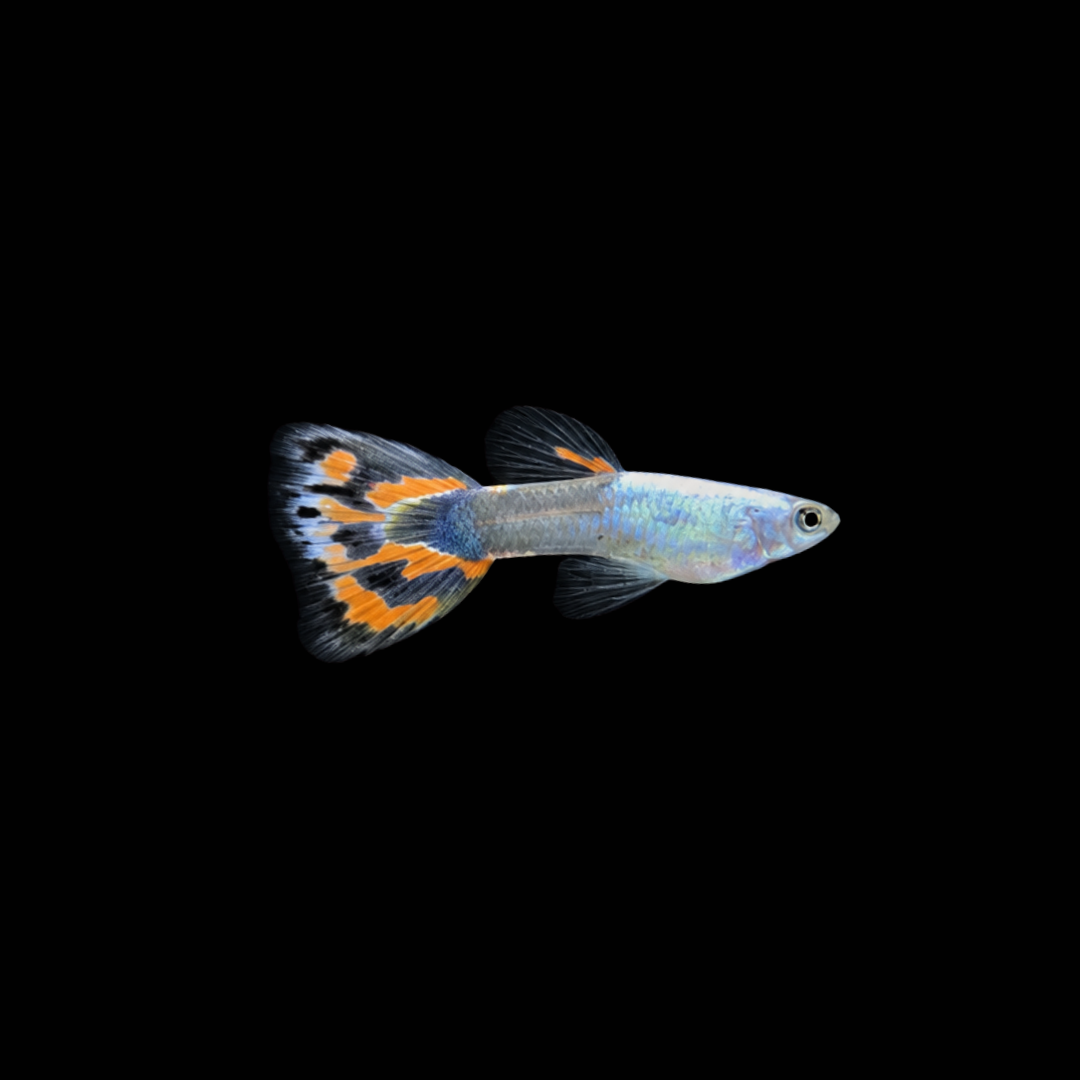
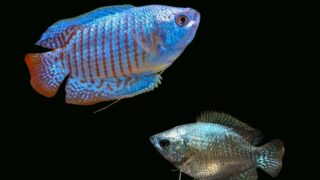
エルシルバラドモザイクグッピーは、ベネズエラ原産のエンドラーズ・ライブベアラー(Poecilia wingei)の一系統「エルシルバラド」が持つ澄んだ銀白色の金属光沢を、グッピーの伝統的な尾ビレ模様である「モザイク」に取り入れて作出された改良品種です。オスの体の前半部は、背側から胸、腹にかけて、幹之(ミユキ)メダカの背中を思わせる強い白銀の輝きに覆われます。その後ろに広がる大きなデルタ型の尾ビレには、赤や橙、黄色を基調とした地色の上に、大柄で不規則な黒斑がパッチワークのように散りばめられます。冷たい銀色と温かみのある赤黒が1尾の中でくっきりと対比する姿は、それまでの改良グッピーには見られなかった新しい表情です。従来のグッピーの光沢は黄色・緑・青系が中心で、純粋な銀白色に近い色合いはほとんどありませんでした。この色をショーグッピーに持ち込んだことが、品種としての大きな意義と考えられています。日本国内では主に国産グッピーとして1ペア単位で流通しており、日本の水道水で代々繁殖されてきた個体は水質になじみやすいため、初めてグッピーを飼う方からブリーダーまで幅広く親しまれています。なお、モザイク模様は成長とともに完成していく大器晩成型の性質を持ちます。若魚のうちは柄が粗く薄く見えても、成熟して尾ビレが広がるにつれて見栄えが増していきます。The El Silverado Mosaic Guppy is a fancy strain created by bringing the clear, silvery-white metallic sheen of “El Silverado,” a population of Endler’s livebearer (Poecilia wingei) from Venezuela, into the “Mosaic,” a traditional guppy tail pattern. In males, the front half of the body, from the back through the chest and belly, is covered in a strong silver-white glow reminiscent of the back of a Miyuki medaka. Behind it spreads a large delta-shaped tail fin, where big, irregular black blotches are scattered like patchwork over a red, orange, or yellow base. The sharp contrast between cool silver and warm red-and-black within a single fish is a look not seen in earlier fancy guppies. The sheen of conventional guppies was mostly yellow, green, or blue, and tones close to pure silver-white were nearly absent, so bringing this color into show guppies is considered the strain’s main significance. In Japan it is sold mainly as a domestically bred guppy in single pairs, and because fish bred for generations in Japanese tap water adapt readily, the strain is popular with everyone from first-time guppy keepers to breeders. Mosaic patterns are late bloomers that develop as the fish grows: even if a young fish’s pattern looks coarse and faint, it gains impact as the fish matures and the tail fin expands.
基本情報 / Basic Information
学名 / Scientific Name
Poecilia reticulata × Poecilia wingei
通称 / Common Name
エルシルバラドモザイク、エルシルバラードモザイク、国産エルシルバラドモザイク(派生系統にアイボリーモザイク、RREAエルシルバラードモザイク、シルバラド・サンセットレッドモザイクなど)El Silverado Mosaic, Silverado Mosaic (derived lines include Ivory Mosaic, RREA El Silverado Mosaic, and Silverado Sunset Red Mosaic)
分類 / Family
カダヤシ目 カダヤシ科 ポエキリア属(グッピーとエンドラーズの交配に由来する改良品種)Order Cyprinodontiformes, Family Poeciliidae, Genus Poecilia (a fancy strain derived from crossing guppies with Endler’s livebearers)
英名 / English Name
El Silverado Mosaic Guppy
分布 / Distribution
人の手で作出された改良品種のため、自然分布はありません。ルーツとなったグッピーは南米北部(ベネズエラ、トリニダード島など)に、エンドラーズはベネズエラ北東部の沿岸ラグーンや水路に分布しています。原種のエルシルバラドは、ベネズエラ北東部クマナ市周辺の排水路で採集された個体群とされています。As a man-made fancy strain, it has no natural range. Its ancestral guppy is native to northern South America (Venezuela, Trinidad, and nearby areas), while Endler’s livebearer inhabits coastal lagoons and waterways in northeastern Venezuela. The original El Silverado is said to be a population collected from drainage ditches around the city of Cumaná in northeastern Venezuela.
最大体長 / Max Size
オス約3〜4cm、メス約4〜6cm(原種エルシルバラドのオスは約2cm前後)Males about 3–4 cm, females about 4–6 cm (males of the wild-type El Silverado are only about 2 cm)
寿命 / Lifespan
一般的なグッピーと同様に2〜3年程度とされています。高水温での飼育が続くと短くなる傾向があります。Like other guppies, generally considered to be about 2–3 years. Lifespan tends to be shorter when the fish are kept at high temperatures for long periods.
飼育環境 / Aquarium Environment
水槽サイズ / Tank Size
ペアや少数での飼育なら30cm規格水槽(約12L)から可能ですが、水質の安定や繁殖を考えると45cm規格水槽(約35L)から60cm規格水槽(約57L)がおすすめです。繁殖に取り組む場合は、30〜45Lの繁殖専用水槽と、稚魚を育てる20〜30Lの水槽を別に用意すると管理しやすくなります。A pair or a small group can be kept in a 30 cm standard tank (about 12 L), but for stable water and breeding, a 45 cm standard tank (about 35 L) to a 60 cm standard tank (about 57 L) is recommended. If you plan to breed, separate tanks for breeding (30–45 L) and for raising fry (20–30 L) make management easier.
水温 / Temperature
23〜26℃(繁殖を狙う場合は26〜27℃、稚魚の育成は26〜28℃)。20℃を下回ると免疫力が落ち、冬を越せなくなるため、秋から春にかけてはサーモスタット付きヒーターと水温計が欠かせません。夏場は室内でも水温が30℃を超えることがあるので、冷却ファンやエアコンによる対策も必要です。23–26°C (26–27°C for breeding, 26–28°C for raising fry). Below 20°C their immunity drops and they cannot survive the winter, so a heater with a thermostat and a thermometer are essential from autumn to spring. In summer, water in indoor tanks can exceed 30°C, so cooling fans or air conditioning are also needed.
水質 / Water Quality
中性〜弱アルカリ性(pH 7.0〜8.0)、中硬水〜硬水(GH 8〜20)を好みます。日本の水道水は軟水寄りの地域が多いものの、pHはおおむね中性付近です。そのため、日本の水に慣れた国産個体であれば、カルキ抜きを確実に行うだけで、特別な調整剤を使わなくても飼育できます。ただし、極端な酸性や軟水が強すぎる環境では尾ビレが傷みやすくなる傾向があります。Prefers neutral to slightly alkaline water (pH 7.0–8.0) of medium to high hardness (GH 8–20). Tap water in much of Japan is on the soft side, but its pH is generally near neutral. As a result, domestically bred fish used to Japanese water can be kept without special conditioners as long as chlorine is reliably removed. However, strongly acidic or very soft water tends to damage the tail fins.
レイアウト / Layout
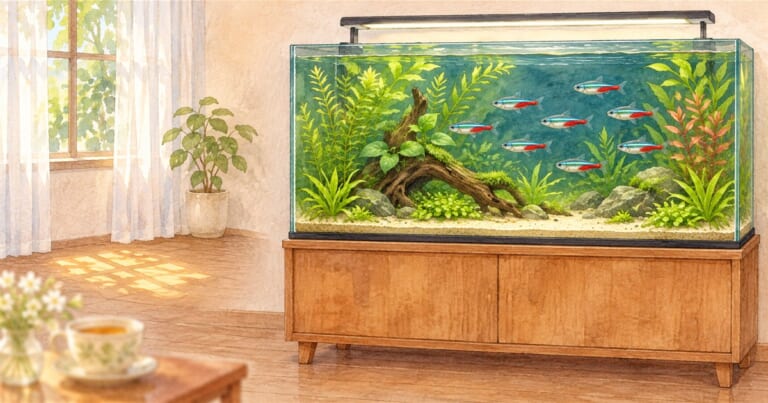
底床には、水質を中性〜弱アルカリ性に保ちやすく、手入れもしやすい大磯砂が向いています。水草用ソイルは水を弱酸性の軟水に傾けやすいため、使う場合は注意が必要です。尾ビレを引っ掛けて傷つけやすい鋭い流木や岩は避け、ウィローモスやアマゾンフロッグピットなどの柔らかい水草で隠れ場所を作ると魚が落ち着きます。照明は、太陽光に近い色温度6,500〜8,000Kの高演色LEDが最もバランスがよく、体前半部の銀白色と尾ビレの赤黒、水草の緑を同時に美しく見せてくれます。青すぎる光や赤すぎる光は、銀白色の透明感を損ないやすくなります。Oyaizu gravel (a classic Japanese aquarium gravel) suits this fish well, as it helps keep the water neutral to slightly alkaline and is easy to maintain. Plant soils tend to make water slightly acidic and soft, so use them with care. Avoid sharp driftwood or rocks that can snag and tear the tail fin, and create cover with soft plants such as Java moss or Amazon frogbit to help the fish settle. For lighting, high color-rendering LEDs of 6,500–8,000 K, close to daylight, offer the best balance, showing off the silver-white front body, the red-and-black tail, and green plants together. Light that is too blue or too red tends to dull the clarity of the silver-white.
注意点 / Precautions
大きなデルタ型の尾ビレを持つため、強い水流にさらされ続けると泳ぎ疲れてしまい、ヒレ裂けや尾ぐされ病の原因になります。水流の穏やかなスポンジフィルターを使うか、外掛け式・外部式フィルターの排水口を工夫して流れを弱めてください。また、日本のグッピー飼育で最も大切なのは、国産グッピーと外国産グッピー(および検疫していない輸入プラティなどの卵胎生メダカ)を同じ水槽で飼わないことです。水槽だけでなく、ろ過装置、網、水換え用のホースやバケツも分けて使いましょう。同じ国産同士でも、別のブリーダーの個体をいきなり混ぜると調子を崩すことがあるため、新しく迎えた個体はしばらく別の水槽で様子を見ると安心です。Because of its large delta tail, constant exposure to strong currents tires the fish out and can lead to torn fins and fin rot. Use a gentle sponge filter, or adjust the outlet of a hang-on or canister filter to soften the flow. The most important rule in Japanese guppy keeping is never to house domestically bred guppies with imported guppies (or with unquarantined imported livebearers such as platies). Keep not only the tanks but also filters, nets, siphon hoses, and buckets separate. Even among domestic fish, suddenly mixing fish from different breeders can upset their health, so it is safest to keep newcomers in a separate tank for a while and watch how they do.
餌と給餌 / Feeding
餌の種類 / Diet
雑食性で、グッピー用の顆粒やフレークなどの人工飼料をよく食べます。冷凍アカムシや冷凍ブラインシュリンプ、生きたブラインシュリンプ幼生などを補助的に与えると、体格や発色がより充実すると期待できます。稚魚には孵化したてのブラインシュリンプ幼生が最適です。Omnivorous; readily eats prepared foods such as guppy granules and flakes. Supplementing with frozen bloodworms, frozen brine shrimp, or live baby brine shrimp can be expected to improve body build and coloration. Newly hatched brine shrimp are ideal for fry.
給餌のポイント / Feeding Tips
成魚には1日2〜3回、数分で食べきれる量を少しずつ与えます。食べ残しは水質悪化や病気の原因になるため、早めに取り除きましょう。稚魚には生まれた直後から孵化したてのブラインシュリンプ幼生を1日3〜5回、少量ずつ与えます。人工飼料だけで育てるよりも成長が早く、骨格やヒレもしっかりしやすいとされています。生後1ヶ月頃からは、細かく砕いた人工飼料へ少しずつ切り替えていきます。Feed adults 2–3 times a day, a little at a time, in amounts they can finish within a few minutes. Leftover food fouls the water and invites disease, so remove it promptly. Give fry small amounts of freshly hatched brine shrimp 3–5 times a day from birth; compared with prepared food alone, this is said to speed growth and help develop a sturdier skeleton and fins. From about one month of age, gradually switch to finely crushed prepared food.
性格と混泳 / Temperament and Tank Mates
性格 / Temperament
温和で、他の魚を攻撃することはほとんどありません。オスには常にメスを追いかけて求愛する習性があるため、オスの数が多すぎるとメスがストレスを受けやすくなります。大きな尾ビレを持つため、泳ぎはゆったりとしています。Peaceful and rarely attacks other fish. Males habitually chase and court females, so too many males can stress the females. With their large tail fins, they swim at a relaxed pace.
混泳の相性 / Compatibility
観賞を目的とするなら、中性付近の水質に適応し、おとなしくてヒレをかじらないコリドラスやオトシンクルス、コケ取り役のヤマトヌマエビやミナミヌマエビなどが良い相手になります。ただし、グッピーの親魚は稚エビを食べることがあり、逆にグッピーの稚魚は他の魚に食べられやすいため、計画的に増やしたい場合はこの品種だけで飼うのが基本です。ヒレをかじる魚や動きの激しい魚との混泳は避けてください。また、前述のとおり外国産グッピーや検疫していない卵胎生メダカとの混泳は、性格ではなく病気の面から厳禁です。For display tanks, good companions are gentle, non-fin-nipping species that adapt to near-neutral water, such as Corydoras and Otocinclus, along with algae-eating Yamato shrimp (Amano shrimp) or cherry-type shrimp. However, adult guppies may eat baby shrimp, and guppy fry are easily eaten by other fish, so a species-only tank is best if you want planned breeding. Avoid fin-nippers and very active fish. As noted above, mixing with imported guppies or unquarantined livebearers is strictly off-limits, not because of temperament but because of disease risk.
病気と対策 / Diseases and Prevention
かかりやすい病気 / Common Diseases
白点病:体表やヒレに輪郭のはっきりした丸い白点が現れ、魚が体を底砂などに擦りつけるようになります。尾ぐされ病・口ぐされ病:カラムナリス菌という細菌によって、ヒレの先や口の周りが白く濁り、次第に溶けてボロボロになります。尾ビレの大きなオスや妊娠後期のメスは特に注意が必要です。グッピーエイズ:ヒレを閉じてふらふらと泳ぎ、短期間で次々と死んでしまう致死率の高い病気です。原因は細菌感染とする見方のほか、ウイルスや寄生虫などが重なって起こるという指摘もあり、発症してからの根治は非常に難しいとされています。テトラヒメナ症:通称「グッピーキラー」と呼ばれる繊毛虫による病気です。頭部や背ビレの前方に皮膚が剥けたような灰白色の斑点、目の突出、鱗の逆立ちなどが見られることもありますが、グッピーでは目立った症状がほとんど出ないまま数日で急死する例が多いとされます。寄生虫が体の奥まで入り込んだ後の有効な治療法は確立されていないと考えられています。Ich (white spot disease): sharply outlined round white spots appear on the body and fins, and the fish starts rubbing itself against the substrate. Fin rot and mouth rot: caused by the bacterium Flavobacterium columnare, the fin tips or the area around the mouth turn cloudy white and gradually disintegrate. Large-tailed males and late-pregnant females need special attention. “Guppy AIDS”: a highly lethal condition in which fish clamp their fins, swim unsteadily, and die one after another within a short time. Some regard it as a bacterial infection, while others suggest it arises from a combination of causes including viruses and parasites, and a cure after onset is considered very difficult. Tetrahymena infection: a disease caused by a ciliate and nicknamed the “guppy killer.” Grayish-white patches like peeled skin on the head or in front of the dorsal fin, bulging eyes, and raised scales may appear, but in guppies the fish often die within days with almost no visible symptoms. Once the parasite has invaded deep into the body, no effective treatment is thought to be established.
対策と予防 / Prevention
異変に気づいたら、すぐに薬を入れるのではなく、まず水温、アンモニアや亜硝酸の濃度、酸素が足りているかを確認し、飼育環境に原因がないかを確かめます。薬浴は、水草やろ過バクテリアへの影響を避けるため、エアレーションをした別の治療用容器で行い、魚病薬は必ず1種類だけを規定量で使ってください。白点病にはメチレンブルー系の薬やグリーンFリキッドなどによる薬浴が、尾ぐされ病にはグリーンFゴールド顆粒や観パラDなどの抗菌剤による薬浴と、0.3〜0.5%の塩水浴(水1Lに塩3〜5g)の組み合わせが一般的です。グッピーエイズとテトラヒメナ症は予防がすべてといえます。外国産グッピーや輸入卵胎生メダカとの完全な隔離、新しく迎える個体の事前のトリートメント、しっかりした生物ろ過の維持、底床のこまめな掃除が現実的な対策です。国産個体はこれらの病原体への抵抗力を持たないことが多いため、器具の使い回しにも気を配りましょう。When you notice something wrong, do not reach for medication right away; first check the temperature, ammonia and nitrite levels, and whether there is enough oxygen, to see whether the environment is the cause. Treat fish in a separate aerated container to protect plants and filter bacteria, and always use only one medication at the labeled dose. Ich is commonly treated with methylene blue-based remedies or Green F Liquid, while fin rot is usually treated with an antibacterial bath such as Green F Gold Granules or Kanpara D, combined with a 0.3–0.5% salt bath (3–5 g of salt per liter). For guppy AIDS and Tetrahymena, prevention is everything. Complete separation from imported guppies and livebearers, quarantine treatment of newcomers, robust biological filtration, and regular substrate cleaning are the practical defenses. Domestically bred fish often lack resistance to these pathogens, so take care not to share equipment between tanks.
増やし方(繁殖) / Breeding
雌雄の判別 / Sexing
オスは体が小さく(約3〜4cm)、尻ビレが棒状に変化した交接器(ゴノポディウム)を持ち、体前半部の銀白色光沢と赤黒のモザイク尾ビレがはっきり現れます。メスは体が大きく(約4〜6cm)、オスのような派手な銀光沢や鮮やかな模様は通常現れず、尾ビレにかすかなまだら模様が見える程度です。メスの模様の出方は系統によって異なるため、メスの見た目だけで品種の純度を見分けるのは難しく、信頼できる生産者からペアで迎えるのが基本です。Males are smaller (about 3–4 cm), have a gonopodium (an anal fin modified into a rod-like mating organ), and clearly show the silver-white front body and red-and-black mosaic tail. Females are larger (about 4–6 cm) and usually lack the flashy silver sheen and bold pattern, showing at most faint mottling on the tail. Because how much pattern females show varies by line, it is hard to judge purity from a female’s appearance alone, so the standard approach is to buy pairs from a trusted breeder.
繁殖形態 / Reproduction
卵ではなく稚魚を直接産む卵胎生です。水温26〜27℃での妊娠期間は約28日で、交配から2週間ほどたつと肛門付近の妊娠斑が黒く目立つようになります。出産が近づくとお腹が四角く張り、水槽の隅や水草の陰でじっとするようになります。メスは一度の交尾で精子を体内に蓄え、それを複数回の出産に使い続ける性質を持っています。生まれたばかりの稚魚は全長5〜6mmほどです。A livebearer that gives birth to young fish rather than laying eggs. Gestation is about 28 days at 26–27°C, and about two weeks after mating the gravid spot near the vent becomes dark and noticeable. As birth approaches, the belly takes on a boxy shape and the female stays still in a corner or among plants. Females store sperm from a single mating and keep using it for several broods. Newborn fry are about 5–6 mm long.
繁殖のポイント / Breeding Tips
系統を守るうえで最も重要なのは、生後6週齢以内に雌雄を見分けて別々に育てた、まだ交尾していないメスを使うことです。お店で売られている成魚のメスは、すでに別のオスと交尾している可能性が高いためです。繁殖水槽にはオス1匹に対しメス2〜3匹を入れます。出産は、水草を茂らせた水槽で自然に産ませて翌朝に稚魚を回収するか、幅20cm以上の大きめの産卵箱に出産直前だけ移して行います(早く移しすぎると、ストレスで早産や死産を招くことがあります)。出産後は、親が稚魚を食べてしまわないよう、すぐに親子を分けましょう。稚魚は生後2ヶ月で尾の形の歪みや極端な発色不良のある個体を除き、発色が出揃う生後3ヶ月で次の世代の親となる5〜10匹を選びます。エルシルバラドの遺伝子は小型のエンドラーズに由来するため、血縁の近い個体同士の交配を続けると、体が小さくなったり、体力や繁殖力が落ちたりしやすいとされています。3〜4世代ごとに別のブリーダーの同系統から新しい血を入れるか、複数のラインを並行して飼い、ライン同士を順番に掛け合わせると系統が安定します。銀白色の形質は主にY染色体を通じて父から息子へ受け継がれると考えられているため、体格がしっかりして尾ビレの大きな優良モザイクの未交尾メスに、発色の濃いエルシルバラドモザイクのオスを掛け合わせる方法が、体格を取り戻す有効な手段とされています。The most important step in maintaining the line is to use virgin females that were sexed and raised separately within six weeks of birth, since adult females sold in shops have likely already mated with other males. Place one male with two or three females in the breeding tank. Either let the female give birth naturally in a heavily planted tank and collect the fry the next morning, or move her into a large breeding box at least 20 cm wide only just before birth (moving her too early can cause stress-induced premature or stillbirths). After birth, separate parents and fry promptly so the parents do not eat the young. At two months, remove fry with misshapen tails or very poor color, and at three months, when color has largely developed, choose 5–10 fish as parents for the next generation. Because the El Silverado gene comes from the small Endler’s livebearer, continued breeding between close relatives is said to easily lead to smaller bodies and reduced vigor and fertility. Bringing in new blood from the same strain from another breeder every three to four generations, or keeping several lines and crossing them in rotation, helps keep the strain stable. Since the silver-white trait is thought to pass mainly from father to son via the Y chromosome, crossing a richly colored El Silverado Mosaic male with a robust, large-tailed virgin Mosaic female is considered an effective way to restore body size.
雑学と豆知識 / Trivia and Fun Facts
1. 「エルシルバラド」という名前の由来 / 1. Where the Name “El Silverado” Comes From
「Silverado」はスペイン語の一般的な単語ではなく、英語の「silver(銀)」を思わせる言葉です。黄金郷を意味する「エルドラド(El Dorado)」と響きが対になっていることから、金ではなく銀に輝く魚にちなんで名付けられたと考えられています。台湾でこの形質を改良グッピーに取り入れたブリーダーは、原種名の「El」の音と「銀」の意味を組み合わせ、中国語圏で「艾爾銀」という系統名を付けたと伝えられています。また、エンドラーズ愛好家の間で使われる産地コードでは、クマナで採集された個体群として「CU100」と呼ばれることもあるようです。日本では「エルシルバラド」と、長音の入った「エルシルバラード」の2つの表記が混在していますが、どちらも同じ魚を指しています。“Silverado” is not a common Spanish word; rather, it evokes the English word “silver.” Because it echoes “El Dorado,” the legendary city of gold, the name is thought to have been chosen for a fish that shines with silver instead of gold. The Taiwanese breeder who brought this trait into fancy guppies is said to have combined the sound of “El” with the meaning of “silver” to coin the Chinese strain name “艾爾銀.” In the locality code system used among Endler’s enthusiasts, the population collected at Cumaná also appears to be referred to as “CU100.” In Japan, two spellings, “エルシルバラド” and “エルシルバラード,” are both in use, but they refer to the same fish.
2. ベネズエラの排水路から台湾のブリーダーへ / 2. From a Venezuelan Ditch to Taiwanese Breeders
物語の始まりは南米ベネズエラです。エンドラーズ・ライブベアラーは1937年にパトス湖で初めて採集され、1975年にジョン・エンドラー博士が再発見したことで広く知られるようになりました。グッピーの地域的な変異なのか別の種なのかという議論が長く続いた末、2005年に独立した種 Poecilia wingei として記載されています。そのエンドラーズの新たな個体群として、2013年2月にフランスの採集家フィリップ・ボアザン氏が、ベネズエラ北東部クマナ市南部の幹線道路沿いの排水路で、胸から体前半部にかけて鮮やかな銀白色に輝く魚を採集したと伝えられています。この魚は欧州の愛好家の間で分けられ、ドイツの観賞魚輸入業者を通じて国際市場にも姿を見せるようになりました。その存在を知った台湾・台北のブリーダー、ゲイリー・リー氏は、改良グッピーに欠けていた気品ある銀白色をショーグッピーに取り入れられないかと考え、2015年に高雄の仲間キミン・ファン氏とともにドイツから数ペアを輸入しました。最初の交配で生まれた子は原種よりも大きく育ち、体側に銀色の光沢を見せたことで、ドイツのアクアリウム専門誌で紹介されるほどの注目を集めます。ところが、米国の研究者アラン・S・バイアス氏から「原種由来の小柄な体格を薄めるため、少なくとも3〜5世代は他の系統との交配を続けるべき」と助言されていたにもかかわらず、兄妹同士の交配を急いだ結果、体が小さくなり、尾ビレも原種のような形に戻ってしまうという苦い経験をしたといいます。この教訓から他の系統との交配に切り替えた2016年、モザイクのメスとの試験交配で良い結果が得られ、ここからエルシルバラドモザイクへの道が開けていきました。The story begins in Venezuela. Endler’s livebearer was first collected at Laguna de Patos in 1937 and became widely known after Dr. John Endler rediscovered it in 1975. After a long debate over whether it was a regional variant of the guppy or a separate species, it was described as the distinct species Poecilia wingei in 2005. As a new population of this species, French collector Philippe Voisin is reported to have collected, in February 2013, fish with a brilliant silver-white glow from the chest to the front body in a drainage ditch beside a highway south of Cumaná in northeastern Venezuela. These fish were shared among European hobbyists and also began to appear on the international market through a German ornamental fish importer. Learning of them, Taipei breeder Gary Lee wondered whether this elegant silver-white, missing from fancy guppies, could be brought into show lines, and in 2015 he imported several pairs from Germany together with his friend Kimin Huang of Kaohsiung. Offspring of the first cross grew larger than the wild type and showed silver flanks, attracting enough attention to be featured in a German aquarium magazine. However, although American researcher Alan S. Bias had advised him to keep outcrossing to other lines for at least three to five generations to dilute the small build inherited from the wild fish, he rushed into sibling crosses and reportedly ended up with smaller fish whose tails reverted to the wild-type shape. Having learned this lesson and switched to outcrossing, he obtained good results from test crosses with Mosaic females in 2016, opening the path toward the El Silverado Mosaic.
3. 赤い背ビレとの「切れない絆」がモザイクを助けた / 3. An “Unbreakable Bond” with the Red Dorsal That Helped the Mosaic
エルシルバラドの改良で大きな壁となったのは、Y染色体の上で「体前半部の銀白色」と「赤い背ビレ」の遺伝子が非常に強く結びついていたことでした。つまり、銀白色を受け継いだオスは、ほぼ必ず赤い背ビレも一緒に受け継いでしまうのです。黄色系の品種を作ろうとした際には、数千尾の稚魚の中から、偶然この結びつきが外れた1尾を探し出すという途方もない選別が必要だったといいます。ところが、赤を基調とするモザイクでは、この厄介な性質がむしろ長所に変わります。背ビレと尾ビレの色をそろえることは、グッピーの観賞価値やコンテストでの評価を左右する大切な要素です。赤い背ビレを伴う銀白色は、赤系のモザイク尾ビレと組み合わせると自然に色の調和が生まれます。モザイクとの交配が早くから良い結果を出し、日本でも広く定着した背景には、こうした遺伝的な相性の良さがあると考えられています。A major obstacle in developing El Silverado was that, on the Y chromosome, the genes for the silver-white front body and for a red dorsal fin were very tightly linked. In other words, a male that inherited the silver-white almost always inherited the red dorsal along with it. When breeders tried to create yellow strains, they reportedly had to search among thousands of fry for the rare single fish in which this link had happened to break. In red-based Mosaics, however, this troublesome trait becomes an advantage. Matching the colors of the dorsal and tail fins is an important factor in a guppy’s display value and show scores, and silver-white that comes with a red dorsal naturally harmonizes with a red mosaic tail. This genetic compatibility is thought to be why crosses with Mosaics produced good results early on and why the strain became firmly established in Japan.
4. 日本の名ブリーダーと「サンセット」の合流 / 4. Japan’s Master Breeder and the “Sunset” Connection
日本の愛好家にとって見逃せない転機は2018年に訪れました。国内のグッピーコンテストの常連で、独特のモザイク表現「サンセット」の生みの親として知られる日渡雅喜氏が、自身のモザイク系統にエルシルバラドの形質を取り入れ、「シルバラド・サンセットレッドモザイク」を作り出したのです。台湾のゲイリー・リー氏もこの系統を日渡氏から導入し、日本のマスターブリーダーから受けた影響として記録に残しているといわれます。翌2019年には、台湾で作出されたエルシルバラド系の魚がドイツやブルガリアの国際コンテストで上位に入り、ショーの舞台でも評価を得ました。日本には「秀島モザイク」をはじめとする国産グッピーの厚い育種文化があったこともあり、海外から届いたエルシルバラドの遺伝子は国内のブリーダーたちによって、デルタ型のモザイクやアイボリーモザイク、RREA系へと速やかに広がりました。そして2020年代には、一般の愛好家も手に入れられる国産品種として定着していきます。ベネズエラ、ヨーロッパ、台湾、アメリカ、そして日本という複数の地域の歴史が、この1尾の中で交わっているのです。A turning point that Japanese hobbyists should not overlook came in 2018. Masaki Hiwatari, a regular at Japanese guppy contests known as the creator of the distinctive “Sunset” mosaic, brought the El Silverado trait into his own mosaic line and produced the “Silverado Sunset Red Mosaic.” Gary Lee in Taiwan is said to have obtained this line from Hiwatari and recorded it as an influence from a Japanese master breeder. In 2019, El Silverado fish bred in Taiwan placed highly at international shows in Germany and Bulgaria, earning recognition on the show stage as well. Japan already had a rich breeding culture of domestic guppies, including the “Hideshima Mosaic,” so El Silverado genes from abroad were quickly developed by Japanese breeders into delta-tailed Mosaics, Ivory Mosaics, and RREA lines. By the 2020s, the strain had become established as a domestic variety available to ordinary hobbyists. The histories of Venezuela, Europe, Taiwan, the United States, and Japan all meet in this single fish.
5. すべてがメスになった「XXオス事件」 / 5. The “XX Male Incident,” When Every Fry Was Female
改良の歴史の中でもとりわけ劇的なのが、2019年に台湾で起きた出来事です。ゲイリー・リー氏が数年がかりでようやく手に入れた、立派な体格と黄色の背ビレを兼ね備えた理想の種親オスを交配したところ、生まれた稚魚が1尾残らずメスになってしまいました。原因は、そのオスが通常のXYではなく、きわめて珍しいXXの性染色体を持つオスだったことでした。父親がY染色体を持っていないため、オスが生まれなかったのです。計画は半年ほど止まり、最終的には仲間のキミン・ファン氏に預けていた正常なオスによって系統が救われたといいます。しかしこの出来事から、エルシルバラドの遺伝子がY染色体からX染色体へ移り、メスを通じて次の世代へ伝わることもある、という貴重な観察が得られました。グッピーのY染色体はX染色体との間で遺伝子の組み換えが起こり得ることが、分子遺伝学の研究でも確かめられています。この発見はX染色体に乗ったエルシルバラド系統という新しい表現への道を開きましたが、一般に流通している系統では、今もY染色体を通じて父から息子へ伝わる遺伝が基本と考えられています。なお、エルシルバラドの遺伝の仕組みに関するこうした知見は、厳密な実験ではなくブリーダーの交配の観察に基づくもので、今後見直される可能性もあるとされています。One of the most dramatic episodes in the strain’s history occurred in Taiwan in 2019. Gary Lee had finally obtained, after years of effort, an ideal breeding male with a fine build and a yellow dorsal fin, but when it was mated, every single fry turned out female. The cause was that the male carried an extremely rare XX set of sex chromosomes instead of the usual XY. Because the father had no Y chromosome, no sons could be born. The program stalled for about half a year and was reportedly rescued in the end by a normal male he had entrusted to Kimin Huang. Yet the incident yielded a valuable observation: the El Silverado gene can move from the Y to the X chromosome and pass to the next generation through females. Molecular genetic studies have confirmed that genetic recombination can occur between the guppy’s Y and X chromosomes. This discovery opened the way to X-linked El Silverado lines, though in commonly available strains, inheritance from father to son via the Y chromosome is still considered the norm. These findings on how El Silverado is inherited are based on breeders’ observations of crosses rather than rigorous experiments, and may be revised in the future.
6. 兄弟でも同じ柄は生まれないモザイクの不思議 / 6. The Mystery of Mosaics: No Two Siblings Alike
尾ビレに不規則な黒斑が入るモザイク模様は、X染色体にもY染色体にも乗ることができる、ひとつの優性の遺伝子によって決まることが、1999年にシンガポールの商業系統を使った研究で示されています。優性とは、両親のどちらか一方からその遺伝子を受け継ぐだけで模様が現れる性質のことです。実際に、模様のあるオスと模様のない野生型のメスを掛け合わせると、子の世代ではオスもメスもすべてに模様が現れ、その子同士から生まれた孫の世代では、オスの約97%、メスの約半数に模様が出たと報告されています。ところが興味深いことに、模様が出るかどうかは高い確率で受け継がれる一方で、斑の数や大きさ、位置には非常に大きな個体差があり、同じ両親から生まれた兄弟姉妹でもまったく同じ柄の個体は見られなかったといいます。つまりエルシルバラドモザイクは、血統さえ固定すればどの個体も同じ見た目になる魚ではありません。だからこそ水槽の中の1尾1尾が世界にひとつだけの柄を持ち、お気に入りの個体を選ぶ楽しみが生まれるのです。A 1999 study using a commercial Singaporean strain showed that the mosaic pattern, with its irregular black blotches on the tail, is controlled by a single dominant gene that can sit on either the X or the Y chromosome. “Dominant” means that inheriting the gene from just one parent is enough for the pattern to appear. In fact, when patterned males were crossed with unpatterned wild-type females, all male and female offspring showed the pattern, and in the next generation, bred from those offspring, about 97% of males and about half of females were reportedly patterned. Interestingly, while whether the pattern appears is inherited with high probability, the number, size, and placement of the blotches varied enormously, and no two siblings from the same parents were found with exactly the same pattern. In other words, the El Silverado Mosaic is not a fish that becomes uniform simply by fixing the bloodline. That is precisely why each fish in the tank carries a one-of-a-kind pattern, and why choosing a favorite is such a pleasure.
7. かつての和名は「ニジメダカ」 / 7. Its Former Japanese Name Was “Niji-medaka”
グッピーという名前は、トリニダード島で暮らしていた英国生まれの博物学者ロバート・ジョン・レクメア・グッピー氏に由来します。1866年に氏が島の川で採集した魚を大英博物館へ送ったところ、その名にちなむ学名が付けられました。後にこの魚は、すでにベネズエラの標本から記載されていた種と同じだと分かり、学名としての「guppii」は使われなくなりましたが、呼び名として「グッピー」が世界に広まりました。日本には1920年(大正9年)頃に伝わったといわれ、その虹のような美しさから「ニジメダカ(虹メダカ)」という和名が与えられました。1930年頃には日本橋三越や銀座千疋屋に高級熱帯魚として並べられ、一般の人々には手の届かない憧れの存在だったと伝えられています。広く普及したのは第二次世界大戦後の1948年頃で、米軍兵士が持ち込んだ個体などがきっかけになったという記録もあります。いまエルシルバラドモザイクのような最新の改良品種を身近に楽しめるのは、日本で約1世紀にわたって積み重ねられてきたグッピー文化があってこそといえるでしょう。The name “guppy” comes from Robert John Lechmere Guppy, a British-born naturalist who lived in Trinidad. In 1866 he sent fish he had caught in a river on the island to the British Museum, where they were given a scientific name in his honor. It was later found that the same species had already been described from Venezuelan specimens, so “guppii” fell out of use as a scientific name, but “guppy” spread around the world as the fish’s common name. The fish is said to have reached Japan around 1920, where its rainbow-like beauty earned it the Japanese name “Niji-medaka” (rainbow medaka). Around 1930 it was reportedly displayed as a luxury tropical fish at Mitsukoshi in Nihonbashi and Sembikiya in Ginza, an object of admiration beyond the reach of ordinary people. It became widespread only around 1948, after World War II, with records suggesting that fish brought in by U.S. soldiers played a role. That cutting-edge strains like the El Silverado Mosaic can be enjoyed so easily today owes much to nearly a century of guppy culture built up in Japan.
8. 原種採集家の意外な飼育スタイル / 8. The Surprising Fishkeeping Style of the Original Collector
原種のエルシルバラドを採集し、維持してきたフィリップ・ボアザン氏の飼育法は、高性能なろ過設備を当然のように使う日本の飼育スタイルから見ると、なかなか興味深いものです。紹介されている話によれば、氏の水槽はすべてにフィルターが付いているわけではなく、底砂も敷かないベアタンクで、お気に入りのミクロソリウムや、小瓶に植えたクリプトコリネを置いているといいます。水はやや軟水寄りですが魚たちはよく順応しており、水換えは月に1回ほど約半量、夏は屋外の大きな水槽で育てているそうです。大きな尾ビレを持つ改良品種のエルシルバラドモザイクには、安定したろ過と水流の管理が欠かせません。それでもこのエピソードは、ルーツとなった原種がいかにたくましく、環境に適応する力を持っているかをよく物語っています。The methods of Philippe Voisin, who collected and has maintained the original El Silverado, are fascinating compared with Japanese practice, where high-performance filtration is taken for granted. According to accounts of his setup, not all of his tanks have filters; they are bare-bottomed with no substrate and furnished with his favorite plant, Java fern (Microsorum), and Cryptocorynes planted in small jars. His water is somewhat soft, yet the fish adapt well; he changes about half the water roughly once a month and raises fish in large outdoor tanks in summer. The fancy El Silverado Mosaic, with its large tail, still needs stable filtration and controlled water flow. Even so, this episode shows just how hardy and adaptable its wild ancestor is.
9. 水槽で栄える一方、故郷では危機に / 9. Thriving in Aquariums, Endangered at Home
エルシルバラドモザイクをはじめとする改良系統が世界中の水槽で栄える一方で、その銀白色をもたらした野生のエンドラーズは厳しい状況に置かれています。エンドラーズは国際自然保護連合(IUCN)のレッドリストで絶滅危惧種(EN)と評価されており、原産地のベネズエラ北東部では、生息地への人の進出や汚染、外来種の侵入、さらに放流された一般のグッピーとの交雑によって純粋な野生の血統が失われていくことが問題になっていると指摘されています。エンドラーズの愛好家の間では、ベネズエラ原産の血統記録がある純血の個体を「Class N」、グッピーとの交雑系統を「Class K」などと区別する考え方があり、エルシルバラドモザイクはグッピーとの交配によって作られた改良品種にあたります。改良品種の美しさを楽しむ一方で、野生由来の純血のエンドラーズを交雑させず、別の系統として守っていく姿勢が、これからますます大切になっていくでしょう。While the El Silverado Mosaic and other fancy strains flourish in aquariums worldwide, the wild Endler’s livebearer that gave them their silver-white faces serious threats. It is assessed as Endangered (EN) on the IUCN Red List, and in its native northeastern Venezuela, human encroachment and pollution of its habitat, invasive species, and hybridization with released common guppies are said to be eroding pure wild bloodlines. Among Endler’s enthusiasts, purebred fish with documented Venezuelan lineage are classed as “Class N” and guppy hybrids as “Class K,” and the El Silverado Mosaic is a fancy strain created by crossing with guppies. Alongside enjoying the beauty of fancy strains, keeping wild-derived pure Endler’s as a separate, unhybridized line will become ever more important.
まとめ / Conclusion
エルシルバラドモザイクグッピーは、ベネズエラの小さな原種がもたらした澄んだ銀白色と、日本で磨かれてきたモザイクの尾ビレが出会って生まれた、国境を越えた育種の結晶です。日本の水に慣れた国産個体は丈夫で飼いやすく、水温を安定させること、穏やかな水流と清潔な水を保つこと、外国産グッピーと分けて飼うことという基本を守れば、初めての方でもその輝きを長く楽しめます。The El Silverado Mosaic Guppy is a product of cross-border breeding, born when the clear silver-white of a small wild fish from Venezuela met the mosaic tail refined in Japan. Domestically bred fish accustomed to Japanese water are hardy and easy to keep, and as long as you follow the basics of keeping the temperature stable, maintaining gentle flow and clean water, and housing them apart from imported guppies, even beginners can enjoy their shine for a long time.
兄弟でも同じ柄が生まれないモザイクは、1尾ごとに違う表情を見せてくれます。若魚の尾ビレが少しずつ広がり、模様が仕上がっていく様子を見守る時間や、お気に入りの個体を選んで次の世代へ命をつないでいく喜びは、この魚ならではの醍醐味です。銀色と赤黒がきらめく姿は、水槽の中でひときわ印象的な存在感を放ってくれることでしょう。Because no two Mosaic siblings share the same pattern, each fish shows its own face. Watching a young fish’s tail gradually spread and its pattern take shape, and the joy of choosing a favorite and carrying its life on to the next generation, are pleasures unique to this fish. Glinting with silver and red-and-black, it is sure to stand out with a striking presence in the aquarium.
Poeser, F. N., Kempkes, M. & Isbrücker, I. J. H. (2005). Description of Poecilia (Acanthophacelus) wingei n. sp. from the Paría Peninsula, Venezuela, including notes on Acanthophacelus Eigenmann, 1907 and other subgenera of Poecilia Bloch and Schneider, 1801 (Teleostei, Cyprinodontiformes, Poeciliidae). Contributions to Zoology (Bijdragen tot de Dierkunde), 74(1/2): 97–115.
Schories, S., Meyer, M. K. & Schartl, M. (2009). Description of Poecilia (Acanthophacelus) obscura n. sp. (Teleostei: Poeciliidae), a new guppy species from western Trinidad, with remarks on P. wingei and the status of the “Endler’s guppy”. Zootaxa, 2266: 35–50.
Günther, A. (1866). Catalogue of the Fishes in the British Museum. Vol. 6. London: Trustees of the British Museum. p. 353(Girardinus guppii の記載).
IUCN. The IUCN Red List of Threatened Species: Poecilia wingei(Endangered, 2021年評価). https://www.iucnredlist.org/
生態・繁殖・遺伝
Magurran, A. E. (2005). Evolutionary Ecology: The Trinidadian Guppy. Oxford: Oxford University Press.
Khoo, G., Lim, T. M., Chan, W.-K. & Phang, V. P. E. (1999). Genetic basis of the variegated tail pattern in the guppy, Poecilia reticulata. Zoological Science, 16(3): 431–437. https://doi.org/10.2108/zsj.16.431
Khoo, G., Lim, T. M., Chan, W.-K. & Phang, V. P. E. (1999). Linkage analysis and mapping of three sex-linked color pattern genes in the guppy, Poecilia reticulata. Zoological Science, 16(6): 893–903. https://doi.org/10.2108/zsj.16.893
Bergero, R., Gardner, J., Bader, B., Yong, L. & Charlesworth, D. (2019). Exaggerated heterochiasmy in a fish with sex-linked male coloration polymorphisms. Proceedings of the National Academy of Sciences of the USA, 116(14): 6924–6931.
病気・飼育上の注意点
Leibowitz, M. P. & Zilberg, D. (2009). Tetrahymena sp. infection in guppies, Poecilia reticulata Peters: parasite characterization and pathology of infected fish. Journal of Fish Diseases, 32(10): 845–855.
Pimenta Leibowitz, M., Ariav, R. & Zilberg, D. (2005). Environmental and physiological conditions affecting Tetrahymena sp. infection in guppies, Poecilia reticulata Peters. Journal of Fish Diseases, 28(9): 539–547.
Declercq, A. M., Haesebrouck, F., Van den Broeck, W., Bossier, P. & Decostere, A. (2013). Columnaris disease in fish: a review with emphasis on bacterium-host interactions. Veterinary Research, 44: 27.
Matthews, R. A. (2005). Ichthyophthirius multifiliis Fouquet and ichthyophthiriosis in freshwater teleosts. Advances in Parasitology, 59: 159–241.




コメント