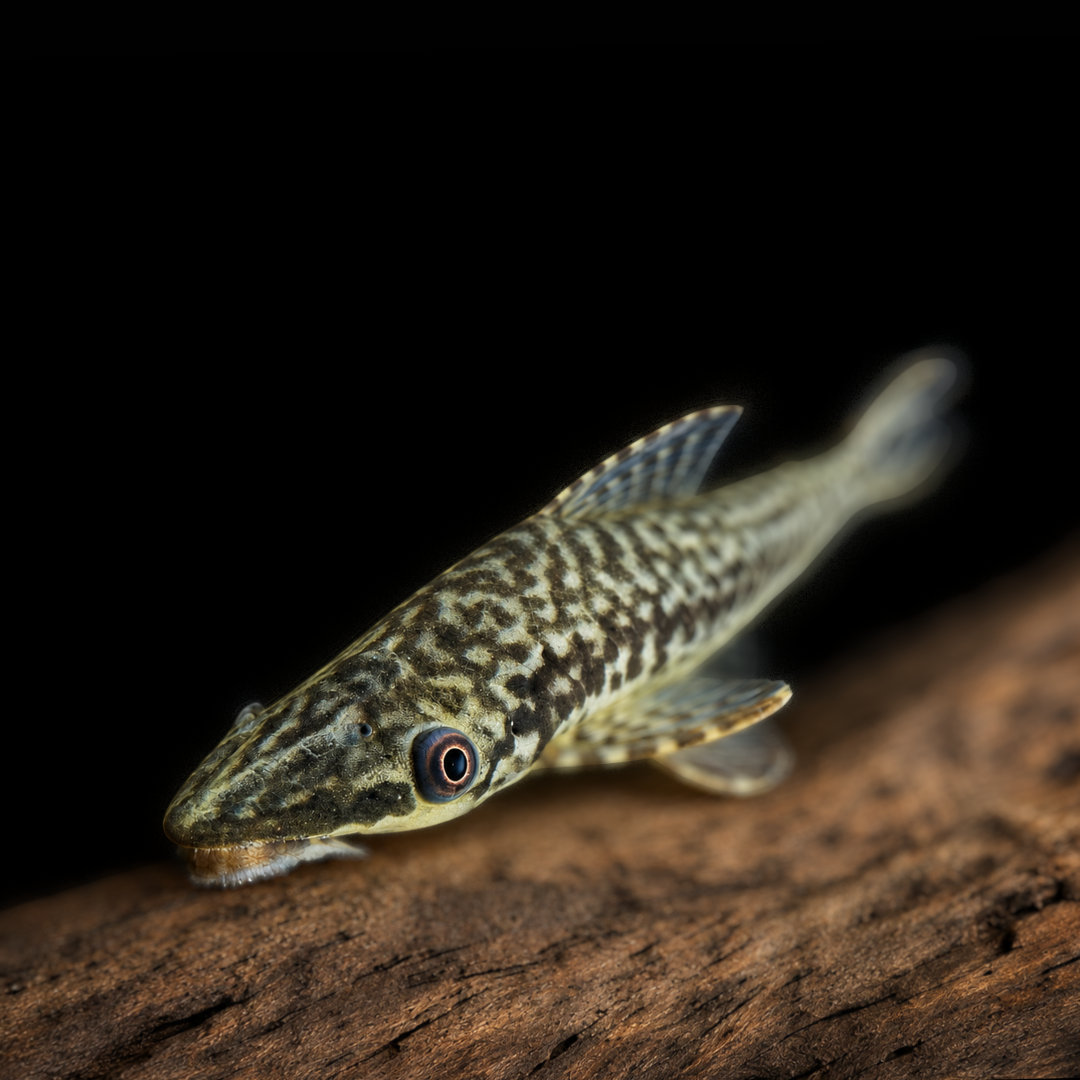
ジャイアントオトシン・グラレは、南米アマゾン川水系の中流から上流域に広く分布する、ロリカリア科ヒポプトポマ属のナマズです。「ジャイアントオトシン」という名前のとおり、おなじみの小型オトシンクルスをそのまま大きくしたような姿をしていますが、オトシンクルス属とは別の属に分類されます。所属するヒポプトポマ属は、ヒポプトポマ亜科という分類群の名前のもとになった属でもあります。全長は最大13.5cmに達し、飼育下でも10cm前後まで育つ同属最大級の種です。平たく押しつぶしたような頭の左右の下端に大きな眼が張り出しているため、お腹側から見上げても眼球が見える、ユニークな顔つきをしています。状態よく育った個体では、各ヒレにオレンジ色を帯びた地色と黒い帯模様が浮かび上がり、地味な並オトシンとはひと味違う存在感を放ちます。日本に入ってくるのはほとんどがペルーやコロンビアからの野生採集個体で、よく似た近縁種と混ざったまま「ジャイアントオトシン」や「シャークヘッド」といった総称で売られることも少なくありません。そのため、購入時には背ビレの模様などで種類を見分ける目が必要になります。大型のコケ取り役として紹介されることもありますが、体の大きさに似合わず非常に臆病で、驚いた拍子にガラス面へ口先をぶつけてしまったり、水槽内のコケだけでは栄養が足りずにやせ細ってしまったりする失敗が起こりやすい魚です。広い水槽と隠れ家を用意し、消灯前後に計画的に餌を与えるという本種ならではの管理を押さえれば、穏やかでどこか愛嬌のある姿を長く楽しむことができます。The Giant Otocinclus Hypoptopoma gulare is a loricariid catfish of the genus Hypoptopoma, widely distributed across the middle and upper Amazon basin of South America. As its common name suggests, it looks like an enlarged version of the familiar dwarf Otocinclus, yet it belongs to a different genus. Its genus Hypoptopoma is also the one from which the subfamily Hypoptopomatinae takes its name. Reaching up to 13.5 cm in total length and around 10 cm in aquariums, it is one of the largest species in its genus. Large eyes sit at the lower sides of its strongly flattened head, so the eyeballs can be seen even when the fish is viewed from below, giving it a distinctive face. Well-conditioned specimens develop an orange-tinted ground color with black bands on the fins, giving them far more presence than the plain common Otocinclus. Nearly all fish reaching Japan are wild-caught specimens from Peru and Colombia, and they are often sold mixed with closely related species under umbrella names such as “Giant Otocinclus” or “Shark Head,” so buyers need to tell the species apart by features such as the dorsal fin pattern. Although sometimes introduced as a large algae eater, it is extremely timid for its size; it may crash its snout into the glass when startled, and the algae in a typical tank cannot sustain it, so wasting away is a common failure. With a spacious tank, plenty of cover, and planned feeding around lights-out, this peaceful and endearing catfish can be enjoyed for many years.
基本情報 / Basic Information
学名 / Scientific Name
Hypoptopoma gulare Cope, 1878
通称 / Common Name
ジャイアントオトシン・グラレ、ヒポプトポマ・グラレ(店頭では「ジャイアントオトシン」「シャークヘッド」「シャークフィン」などの総称で、近縁種と区別されずに販売されることがある)Giant Otocinclus, Gulare Giant Otocinclus (in Japanese shops it is often sold without being distinguished from related species, under names such as “Giant Otocinclus,” “Shark Head,” or “Shark Fin”)
分類 / Family
ナマズ目 ロリカリア科 ヒポプトポマ亜科 ヒポプトポマ属Siluriformes, Loricariidae, Hypoptopomatinae, genus Hypoptopoma
南米アマゾン川水系の中流から上流域(ペルー、ブラジル、コロンビア、エクアドル、ボリビア、ベネズエラ)。主に白く濁った水が緩やかに流れる河川の岸辺に暮らし、水際の植物や水中に沈んだ根、流木、水面に垂れ下がった枝葉に張り付いて生活している。The middle and upper Amazon basin of South America (Peru, Brazil, Colombia, Ecuador, Bolivia, Venezuela). It mainly lives along the banks of slow-flowing, turbid whitewater rivers, clinging to marginal plants, submerged roots, driftwood, and overhanging branches.
最大体長 / Max Size
最大全長約13.5cm(尾ビレを除いた標準体長では約10.5cm)。飼育下では全長10cm前後が成魚サイズの目安。Up to about 13.5 cm total length (about 10.5 cm standard length, excluding the tail). In aquariums, around 10 cm total length is a typical adult size.
寿命 / Lifespan
5年前後が一つの目安とされるが、長期飼育の記録が少なく、正確な寿命はよく分かっていない。稚魚は半年ほどで約8cmまで育つという記録もあり、体が大きいからといって小型のオトシン類より特別に長生きするわけではないと考えられている。Around 5 years is sometimes given as a guideline, but long-term records are scarce and the true lifespan is not well known. There is a record of fry reaching about 8 cm within roughly half a year, and it is thought that its larger size does not necessarily mean it lives much longer than the dwarf Otocinclus species.
飼育環境 / Aquarium Environment
水槽サイズ / Tank Size
横幅80cm以上、水量80〜100L以上が最低限の目安とされ、成魚を長く飼うなら90cm規格水槽(約180L)以上が望ましい。繁殖を目指す場合は、100〜150L程度の水量を確保したい。4〜5cmの若魚であれば60cm規格水槽(約57L)でも一時的に飼えるが、成長に合わせて早めに大きな水槽へ移すほうが安全。広い水槽が必要な一番の理由は、驚いて突進したときにガラス面へ口先をぶつけないよう、十分な泳ぐ距離を確保することにある。A tank at least 80 cm wide holding 80–100 L or more is considered the minimum, and a standard 90 cm tank (about 180 L) or larger is preferable for keeping adults long term. If breeding is the goal, aim for around 100–150 L. Young fish of 4–5 cm can be kept temporarily in a standard 60 cm tank (about 57 L), but it is safer to move them to a larger tank early as they grow. The main reason for a large tank is to give the fish enough swimming distance so that it does not hit its snout on the glass when it bolts in fright.
水温 / Temperature
23〜27℃(許容範囲はおおむね22〜28℃)。ヒーターで25℃前後に安定させるのが理想的。22℃を下回ると抵抗力が落ち、白点病などにかかりやすくなるとされるため、冬場の保温は欠かせない。夏場は冷却ファンやクーラーを使い、水温の上がりすぎと酸欠を防ぐ。23–27°C (tolerable range roughly 22–28°C). Ideally, keep it stable at around 25°C with a heater. Below 22°C the fish is thought to lose resistance and become more prone to diseases such as white spot, so heating in winter is essential. In summer, use cooling fans or a chiller to prevent overheating and oxygen shortage.
水質 / Water Quality
pH6.0〜7.0(〜7.2)の弱酸性〜中性で、総硬度2〜10°dGH程度の軟水〜やや軟らかい水が適している。自然下ではpH7.0以上で硬度の高い水域からも記録されているが、飼育下では硬度の低いきれいな軟水で飼い込み、水換えにも同じ軟水を使うと発色が良くなるという報告がある。硝酸塩は50mg/L未満を目安に保ち、マジックリーフやフミン酸系の添加剤で水を整えるのも効果的。Slightly acidic to neutral water at pH 6.0–7.0 (up to 7.2), soft to moderately soft at about 2–10°dGH total hardness, is suitable. It has also been recorded from harder water above pH 7.0 in the wild, but there are reports that keeping it in clean, low-hardness soft water and using the same soft water for changes improves its coloration. Keep nitrate below about 50 mg/L; Indian almond leaves or humic acid conditioners are also effective.
レイアウト / Layout
流木や茂った水草で周りからの視線を遮る隠れ家を作ると、パニックを起こしにくくなる。流木は隠れ家になるだけでなく、表面にできる微生物の膜(バイオフィルム)や木の繊維といった餌の供給源にもなる。アマゾンソード、アヌビアス、ミクロソリウム、バリスネリアなど丈夫で葉の大きな水草や、表面の滑らかな平石を配置し、高さの異なる場所に張り付いて休めるようにすると落ち着きやすい。腹を底につけて休むこともあるため、底床は角の尖った砂利を避け、細かい砂や粒の丸いものを選ぶ。強い光は好まないので、アマゾンフロッグピットなどの浮草で照明を和らげるとよい。Creating cover with driftwood and dense plants that blocks the fish’s view of its surroundings makes it less likely to panic. Driftwood not only provides shelter but also serves as a food source, supplying the microbial film (biofilm) that grows on its surface and wood fiber. Arrange sturdy broad-leaved plants such as Amazon swords, Anubias, Java fern, and Vallisneria, along with smooth flat stones, so the fish can cling and rest at different heights. Because it sometimes rests with its belly on the bottom, avoid sharp gravel and choose fine sand or rounded substrate. It dislikes strong light, so floating plants such as Amazon frogbit help soften the lighting.
注意点 / Precautions
体は大きくても丈夫な魚ではなく、中級〜上級者向けとされる。立ち上げたばかりの水槽にはコケや微生物の膜がなく水質も安定していないため、2〜4週間ほど稼働させ、ガラス面や流木に薄く茶ゴケが付き始めた頃に導入するのが基本。急な水質や水温の変化に弱いので、導入時は点滴法などで時間をかけて水合わせを行う。ろ過は強めにしつつ水流は緩やか〜中程度に抑え、エアレーションで水中の酸素を十分に保つ。水面で空気を吸う習性があるため、フタは完全に密閉せず、水面の上に空気の層を残しておく。購入時は背ビレの模様で種類を確かめるとともに、腹がへこんでいないか、口先が擦れて赤くなっていないか、ヒレの裂けや白い点がないかを確認したい。Despite its size it is not a hardy fish and is considered suitable for intermediate to advanced keepers. A newly set-up tank has no algae or microbial film and its water is not yet stable, so as a rule, run the tank for 2–4 weeks and introduce the fish once a light film of brown diatoms has begun to appear on the glass and driftwood. It is sensitive to sudden changes in water chemistry and temperature, so acclimate it slowly, for example by the drip method. Use fairly strong filtration while keeping the current gentle to moderate, and maintain ample oxygen with aeration. Because it gulps air at the surface, do not seal the lid completely; leave a layer of air above the water. When buying, confirm the species by the dorsal fin pattern, and check that the belly is not sunken, the snout is not scraped red, and the fins are free of tears or white spots.
餌と給餌 / Feeding
餌の種類 / Diet
自然下では、流木や石、水草の表面にできる、珪藻や緑藻、生き物の遺骸などの細かな有機物、微小な無脊椎動物が混ざり合った膜状の付着物を主に食べている。水槽内で好んで食べるコケは茶ゴケや柔らかいコケに限られ、黒ひげゴケや藍藻はほとんど食べない。主食にはスピルリナ入りの沈下性タブレット、プレコ用タブレット、木の成分を含むナマズ用チップなどを使い、軽く茹でた小松菜やほうれん草、薄切りにしたきゅうりやズッキーニなどの野菜も与える。これに冷凍アカムシ、冷凍ブラインシュリンプ、イトミミズ、動物質を含む沈下性フードを週に数回少しずつ組み合わせると、体つきがしっかりしてくる。In the wild it mainly feeds on the film that coats driftwood, stones, and plant surfaces, a mixture of diatoms, green algae, fine organic debris such as decaying matter, and tiny invertebrates. In aquariums it readily eats only brown diatoms and soft algae, and hardly touches black beard algae or blue-green algae. Use sinking spirulina tablets, pleco tablets, and catfish chips containing wood as the staple, and also offer vegetables such as lightly blanched komatsuna or spinach and thinly sliced cucumber or zucchini. Adding small amounts of frozen bloodworms, frozen brine shrimp, tubifex worms, or sinking foods with animal protein several times a week helps the fish fill out.
給餌のポイント / Feeding Tips
もっとも多い失敗は、「コケ取り役だから餌はいらない」と考えて少しずつ餓死させてしまうことで、10cm級の体を支えるには水槽内のコケだけではまったく足りない。本種は夕方から夜にかけて活発になる傾向が強く、昼間は物陰に隠れて餌場に近づかない個体が多い。そのため、照明を消す直前に毎回同じ場所(流木の根元や奥側のガラス面付近など)へ沈下性フードを置き、消灯の1〜2時間後に実際に底へ降りて食べているかを確かめるのが確実。浮く餌は餌として認識しないことが多いので、底で転がりにくい平たい沈下性フードを選ぶ。人工飼料への食いつきが悪いときは、30秒〜1分ほど茹でて冷ました小松菜などを、重りや野菜クリップで固定して与えるとよい。野菜や食べ残しは水を汚す原因になるため、数時間後、遅くとも24時間以内には取り除く。The most common failure is assuming that an algae eater needs no food and slowly starving it; the algae in a tank alone is nowhere near enough to support a 10 cm fish. This species tends to become active from dusk into the night, and many individuals hide during the day and stay away from the feeding spot. The reliable approach is therefore to place sinking food in the same spot every time, such as at the base of driftwood or near the back glass, just before turning off the lights, and to check one to two hours later that the fish has actually come down to eat. It often does not recognize floating food as food, so choose flat sinking foods that do not roll around. If it is reluctant to take prepared foods, offer komatsuna boiled for 30 seconds to a minute and cooled, held in place with a weight or vegetable clip. Vegetables and leftovers foul the water, so remove them after a few hours, and within 24 hours at the latest.
性格と混泳 / Temperament and Tank Mates
性格 / Temperament
同種にも他種にもきわめて温和で、卵を守っているオスを除けば縄張り争いもしない平和な魚。その一方で、10cmを超える体に反して驚くほど臆病で、1匹だけで飼うとストレスで体調を崩しやすい。水槽に余裕があれば、3〜5匹以上の小さな群れで飼うのがおすすめ。Extremely peaceful toward its own and other species, and apart from males guarding eggs it does not fight over territory. On the other hand, despite growing over 10 cm, it is surprisingly timid, and a single fish kept alone tends to fall ill from stress. If the tank allows, keeping a small group of three to five or more is recommended.
混泳の相性 / Compatibility
混泳でもっとも気をつけたいのは、餌の取り合いにとても弱いという点。しっかり餌を食べるようになった個体であれば、ネオンテトラやラミーノーズテトラなど温和な小型〜中型のカラシン、アピストグラマやラミレジィなどの小型シクリッド、おとなしいコリドラス、小型のエビや巻貝と一緒に飼うことができる。ただし、ヤマトヌマエビはタブレットを丸ごと持ち去ってしまうため、餌場を分けるか、夜間の給餌で対応する。激しく泳ぎ回る大型のバルブ類、気性の荒い大型シクリッド、魚を食べる大型ナマズ、餌を独り占めする底層の魚とは一緒にしないほうがよい。ほかのオトシン類にさえ遠慮して底へ降りられない個体もいるため、消灯から数時間経っても底で餌を食べていない個体は早めに別の水槽へ移し、単独で体調を立て直すことも検討したい。The main thing to watch in a community tank is that it competes very poorly for food. Once an individual is feeding reliably, it can be kept with peaceful small to medium characins such as neon tetras and rummy-nose tetras, dwarf cichlids such as Apistogramma and rams, gentle Corydoras, and small shrimp or snails. Amano shrimp, however, carry off whole tablets, so either use separate feeding spots or feed at night. It is best not to house it with fast, restless large barbs, aggressive large cichlids, large fish-eating catfish, or bottom dwellers that monopolize food. Some individuals hold back even from other Otocinclus and fail to come down to the bottom, so if a fish is still not feeding on the bottom several hours after lights-out, consider moving it to a separate tank early so it can recover on its own.
病気と対策 / Diseases and Prevention
かかりやすい病気 / Common Diseases
本種に特有の病気は知られていないが、もっとも多いトラブルは栄養不足によるやせ細りである。また、驚いてガラス面に突進した際に口先に負った傷が、そのまま衰弱や死につながることもある。低い水温や急な水質の変化で抵抗力が落ちると、白点病などにかかりやすくなるとされる。輸入されたばかりの野生個体は、長い絶食や輸送で体力を消耗していることが多く、導入して間もない時期に調子を崩しやすい。No diseases specific to this species are known, but the most common problem is wasting due to malnutrition. Snout injuries suffered when the fish bolts into the glass can also lead directly to decline or death. When its resistance drops due to low temperatures or sudden changes in water chemistry, it is thought to become more susceptible to diseases such as white spot. Freshly imported wild fish are often worn out by long periods without food and by transport, and are prone to losing condition soon after introduction.
対策と予防 / Prevention
十分な広さと隠れ家で魚を驚かせない環境を作り、夜間の給餌で確実に餌を食べさせることが、何よりの予防になる。ヒーターで水温を25℃前後に保ち、水換えは同じ水質の水で少しずつ行う。導入直後は、立ち上げから時間の経った水槽に自然に生える微生物の膜に加え、柔らかい植物質の餌と少量の動物質の餌を組み合わせ、胃腸への負担を抑えながら体力を回復させる。近縁種で銅に弱いことが報告されているため、銅成分を含む魚病薬は使わないようにする。The best prevention is to provide enough space and cover so the fish is not startled, and to make sure it eats by feeding at night. Keep the temperature at around 25°C with a heater, and change water gradually using water of the same chemistry. Right after introduction, help it regain strength while easing the load on its digestion by combining the microbial film that grows naturally in a well-established tank with soft plant-based foods and small amounts of animal-based foods. A related species has been reported to be sensitive to copper, so avoid medications that contain copper.
増やし方(繁殖) / Breeding
雌雄の判別 / Sexing
店頭や一般的な飼育水槽で、外見から雌雄を見分けることは事実上できないとされる。ただし、お腹側を詳しく調べると違いがあり、オスには肛門の後ろに短い円錐形の突起(生殖突起)があり、その両脇の骨板には小さなトゲ状の突起が密集しているほか、腹ビレのトゲの後ろ側にわずかなひだがある。メスにはこうした生殖突起やトゲの密集、ひだは見られない。In shops or ordinary aquariums, it is practically impossible to tell the sexes apart by appearance. Close examination of the underside does reveal differences, however: males have a short cone-shaped projection (urogenital papilla) behind the vent, a dense patch of tiny tooth-like projections on the plates on either side of it, and a slight fleshy flap behind the pelvic fin spine. Females lack the papilla, the dense patch of projections, and the flap.
繁殖形態 / Reproduction
洞窟の中ではなく、開けた滑らかな面に卵を産み付けるタイプ。アマゾンソードなどの幅の広い葉やガラス面に、直径約1mmの薄緑色の卵を列や房のように産み付け、孵化するまでオスが単独で卵を守る。卵は約3日で孵化し、お腹に緑色の栄養の袋(卵黄)を抱えた体長約3mmの仔魚が生まれる。仔魚はしばらく孵化した場所に張り付いたまま卵黄を吸収し、自由に泳ぎ始めるとオスの子守りは終わる。稚魚の体色は、卵黄を吸収するにつれて緑色から黄色っぽい色へと変わっていく。An open spawner that lays its eggs on smooth, exposed surfaces rather than inside caves. The pair attaches pale green eggs about 1 mm in diameter in rows or clusters to broad leaves such as Amazon swords or to the glass, and the male alone guards them until they hatch. The eggs hatch in about three days into larvae about 3 mm long, each carrying a green yolk sac. The larvae stay attached near the hatching site for a while as they absorb the yolk, and once they begin swimming freely the male’s guarding ends. As the yolk is absorbed, the young change color from green to yellowish.
繁殖のポイント / Breeding Tips
水槽での繁殖例は国内外ともに非常に少なく、難易度は高い。外見でペアを選べないため、最初から5匹以上を導入し、自然にペアができるのを待つのが現実的。近縁種では野生下で雨季にまとまって一斉に産卵することが知られており、この仲間が季節に合わせて繁殖する魚であることがうかがえる。稚魚の育成では、清潔すぎる容器や網でできた産卵ネットを使うと失敗しやすい。近縁種で育成に成功した例では、透明な密閉ケースを本水槽に沈めて水温を保ち、中にエアストーンを入れたうえで、枯れ葉や細い小枝を沈めて自然な微生物の膜を育て、食べ残しの掃除役として巻貝を同居させながら定期的に水を換える方法がとられている。最初の餌には稚魚用のリキッドフードや細かい藻類の粉末を使い、成長に合わせて孵化したてのブラインシュリンプへと切り替えていく。Spawnings in aquariums are very rare both in Japan and abroad, and breeding is difficult. Because pairs cannot be chosen by appearance, the practical approach is to start with five or more fish and wait for pairs to form naturally. A related species is known to spawn all at once during the rainy season in the wild, which suggests that this group breeds in step with the seasons. When raising fry, overly clean containers and mesh breeder nets tend to lead to failure. In one successful case with a related species, a clear sealed container was submerged in the main tank to keep its temperature, an airstone was placed inside, dead leaves and thin twigs were added to grow a natural microbial film, and snails were kept with the fry to clean up leftovers while the water was changed regularly. Start with liquid fry food or fine algae powder, then switch to newly hatched brine shrimp as the fry grow.
雑学と豆知識 / Trivia and Fun Facts
1. 属名に刻まれた19世紀の「勘違い」 / 1. A 19th-Century Misreading Preserved in the Genus Name
属名のHypoptopomaは、ギリシャ語で「下に」を意味するhypo、「見える」を意味するopto、「蓋(えらぶた)」を意味するpomaを組み合わせた言葉です。字面からは「下から見える眼」にちなんだ名前のように思えますが、実際の由来はもう少しユーモラスなものです。1868年にこの属を設立した魚類学者アルベルト・ギュンターは、頭の下側に見える2つの骨を「下から見える、2枚の骨でできたえらぶた」だと考え、その特徴にちなんで名前を付けました。ところが後の研究で、これはえらぶたの構造を読み違えたものだったことが明らかになっています。つまり属名は、誤った解釈がそのまま名前として残った例なのです。一方、種小名のgulareはラテン語で「喉の」という意味ですが、1878年に本種を記載したエドワード・ドリンカー・コープは由来を説明しておらず、喉の部分を覆う骨板を指したものと推測されています。学名の一語一語に、標本と向き合いながら試行錯誤した19世紀の研究者たちの姿が残っているのです。The genus name Hypoptopoma combines the Greek hypo (below), opto (to see), and poma (lid, i.e., gill cover). It looks as if it refers to “eyes visible from below,” but the real origin is a little more amusing. Albert Günther, who established the genus in 1868, took two bones visible on the underside of the head to be “a gill cover made of two bones, visible from below,” and named the genus after that feature. Later research showed that this was a misreading of the gill cover’s structure. In other words, the genus name preserves a mistaken interpretation. The species name gulare is Latin for “of the throat,” but Edward Drinker Cope, who described the species in 1878, did not explain it, and it is presumed to refer to the plates covering the throat. Each word of the scientific name preserves a trace of 19th-century researchers working through their specimens by trial and error.
2. 長い時間をかけて整理された分類の歴史 / 2. A Classification Sorted Out Over a Long Time
本種の物語は、19世紀後半のアマゾン探検から始まります。コープは、ジェームズ・オートン教授がペルー・アマゾンで採集したたった1匹のオスの標本をもとに、1878年に本種を新種として発表しました。その後、1880年にフランスでOtocinclus jobertiという別の名前で記載された魚が、長い間独立した種として扱われたのち、2010年になって本種と同じ種だと結論づけられました。また1915年には、腹側の骨板の並び方をもとに本種を基準とする新しいグループ名が提案されましたが、現在ではヒポプトポマ属と同じものとして扱われています。ヒポプトポマ属の魚たちは互いに驚くほどよく似ているため、博物館の標本でも観賞魚の流通でも混同が絶えず、ヨーロッパの輸出入業者では種類を特定できない個体に「sp. II」「sp. III」といった仮の名前を付けて扱っていたほどでした。こうした状況を大きく前進させたのが、2010年にアメリカ自然史博物館の研究者が発表した110ページに及ぶ大規模な見直しの研究です。この研究では属に含まれる15種が整理され、そのうち7種が新種として記載されるとともに、本種を他の種から確実に見分けるための特徴が示されました。もっとも、その後も近縁の属との線引きをめぐる議論は続いており、属に含まれる種の数は見解によって13種とも15種ともされています。This species’ story begins with Amazon expeditions in the late 19th century. Cope described it as new in 1878 from a single male specimen collected in the Peruvian Amazon by Professor James Orton. A fish described in France in 1880 under a different name, Otocinclus joberti, was long treated as a separate species until it was concluded in 2010 to be the same species. In 1915, a new group name based on this species was proposed from the arrangement of its belly plates, but it is now regarded as the same as the genus Hypoptopoma. Members of Hypoptopoma resemble one another so closely that confusion was constant both in museum collections and in the aquarium trade, and a European importer even handled unidentifiable fish under provisional names such as “sp. II” and “sp. III.” A major step forward came in 2010 with a 110-page revision by researchers at the American Museum of Natural History. It recognized 15 species in the genus, seven of them newly described, and set out features for reliably distinguishing this species from the others. Even so, debate over where to draw the line with closely related genera has continued, and the genus is counted as either 13 or 15 species depending on the view taken.
3. 店頭で見分けるための手がかり / 3. Clues for Telling It Apart in the Shop
研究者は、鼻の横にある小さな骨板の枚数や歯の数といった細かな特徴で種を見分けますが、水槽越しにそれを数えるのは現実的ではありません。日本には4種前後のよく似た魚が入ってきているとされ、愛好家のあいだでは、背ビレの黒い帯の本数、尾ビレのふちの模様、そして尾の付け根の体型に注目するのが実用的な見分け方とされています。グラレの背ビレには太い黒帯が2本入るのに対し、もっとも混ざりやすいトラカートゥム(H. thoracatum)の背ビレには細かい黒帯が4〜5本入るとされます。まれに入荷するスタインダックネリィ(H. steindachneri)は、背ビレの黒帯がグラレと同じ2本なので紛らわしいものの、尾ビレの後ろのふちにはっきりとした黒い縁取りが一周入る点で見分けられるといわれています。さらに、別の属であるオキシロプシス属の幼魚も「スレンダージャイアントオトシン」などの名前で混同されがちですが、こちらはヒポプトポマ属に比べて体が平たく、尾の付け根も薄くて細身なのが特徴です。こうした違いを知っておくと、「ジャイアントオトシン」の水槽をのぞく楽しみがぐっと広がるはずです。Researchers identify species by fine details such as the number of small plates beside the nostril and tooth counts, but counting these through aquarium glass is unrealistic. Around four similar species are said to reach Japan, and among hobbyists the practical method is to look at the number of black bands on the dorsal fin, the pattern along the edge of the tail fin, and the shape of the base of the tail. H. gulare has two bold black bands on the dorsal fin, whereas H. thoracatum, the species most often mixed in, is said to have four to five fine bands. The occasionally imported H. steindachneri also has two dorsal bands and is easily confused, but it is said to be distinguishable by a clear black margin running all the way around the rear edge of the tail fin. Juveniles of the separate genus Oxyropsis are also often confused under names such as “Slender Giant Otocinclus,” but compared with Hypoptopoma they have flatter bodies and a thinner, slimmer tail base. Knowing these differences makes looking into a tank of “Giant Otocinclus” all the more enjoyable.
4. お腹側から眼が見える、見張りに適した顔つき / 4. Eyes Visible from Below: A Face Built for Keeping Watch
ヒポプトポマ属のもっとも印象的な特徴は、極端に平たい頭の左右の下端に大きく張り出した眼です。ガラス面に張り付いた個体をお腹側から見上げても、左右の眼球がはっきりと見えます。体の幅がもっとも広いのも肩のあたりではなく眼の位置で、まるで頭全体が眼を中心に作られているかのようです。お腹側から眼が見えるという特徴は、ロリカリア科の中でもこの属と近縁のオキシロプシス属にしか見られません。川岸の水草の茎や細い枝にじっと張り付いて暮らす本種にとって、この眼の位置は、体を動かさずに上や横、下までを広く見渡すための適応と考えられています。大型の魚や鳥といった天敵をいち早く見つけられる広い視野は、身を守る手段の少ない草食のナマズにとって大きな武器なのでしょう。水槽で臆病な一面を見せるのも、こうした警戒心の強さの表れといえるかもしれません。The most striking feature of Hypoptopoma is its large eyes, set at the lower sides of an extremely flat head. Even when a fish clinging to the glass is viewed from below, both eyeballs are clearly visible. The body is widest not around the shoulders but at the eyes, as if the whole head were built around them. Within the family Loricariidae, eyes visible from below are found only in this genus and its close relative Oxyropsis. For a fish that clings motionless to plant stems and thin branches along riverbanks, this eye position is thought to be an adaptation for scanning widely above, to the sides, and even below without moving. A wide field of view that spots predators such as large fish and birds early is likely a valuable asset for a herbivorous catfish with few other means of defense. Its timid behavior in aquariums may be another expression of this strong vigilance.
5. 水面で息継ぎをする空気呼吸の能力 / 5. Gulping Air at the Surface
ヒポプトポマ属は、必要に応じて空気中の酸素を取り込む能力を持つことが知られています。アマゾンでは乾季になると水位が下がって水温が上がり、本流から取り残された水たまりでは水中の酸素が極端に少なくなります。ロリカリア科の仲間には、こうした環境で水面に浮かんで空気を呑み込み、胃など消化管の一部を使って酸素を取り込む種がいることが知られており、空気呼吸はこの科の魚たちが酸欠の季節を乗り切るための重要な手段になっています。水槽でも、ときおり勢いよく水面へ浮上して息継ぎをする姿が見られますが、これは野生から受け継いだ自然な行動で、異常ではありません。水槽のフタに隙間を残し、水面の上に空気の層を確保しておきたいのはこのためです。Hypoptopoma is known to be able to take oxygen from the air when needed. In the Amazon dry season, water levels drop and temperatures rise, and in pools cut off from the main river the oxygen in the water becomes extremely scarce. Some members of the family Loricariidae are known to rise to the surface in such conditions, gulp air, and absorb oxygen through part of the digestive tract such as the stomach, and air breathing is an important means by which fishes of this family get through the oxygen-poor season. In aquariums, too, the fish may occasionally dart up to the surface to take a breath; this is a natural behavior inherited from the wild, not a sign of trouble. This is why a gap should be left in the lid so that a layer of air remains above the water.
6. 草食のナマズを陰で支えるお腹の中の微生物 / 6. The Gut Microbes Behind a Plant-Eating Catfish
動物は基本的に、植物の細胞の壁を作るセルロースという成分を、自分の力で分解することができません。そのため、コケや木の繊維から栄養を得る草食性のナマズたちは、腸に棲みつく細菌やカビの仲間、原生生物といった微生物の働きに大きく頼っていると考えられています。この仕組みを踏まえると、南米での長い保管期間や絶食、空輸を経て、ひどくお腹を空かせた状態で日本に届いた野生個体が、乾燥した植物質のタブレットをいきなり与えられてもうまく回復できない場合がある理由が見えてきます。立ち上げから時間の経った水槽に自然に生える微生物の膜に、柔らかい植物質の餌と少量の動物質の餌を組み合わせ、お腹の環境を穏やかに整えながら体力を戻していくことが、輸入されたばかりの個体を救う現実的な方法といえるでしょう。Animals are generally unable to break down cellulose, the substance that makes up plant cell walls, on their own. Herbivorous catfishes that get their nutrition from algae and wood fiber are therefore thought to rely heavily on microbes living in their gut, such as bacteria, fungi, and protists. With this in mind, it becomes clear why wild fish that arrive in Japan badly starved after long holding periods, fasting, and air freight from South America sometimes fail to recover when suddenly given dry plant-based tablets. Combining the microbial film that grows naturally in a well-established tank with soft plant-based foods and small amounts of animal-based foods, gently restoring the gut environment while the fish regains strength, is a practical way to save newly imported individuals.
7. 季節に左右される「ペルー便」の入荷事情 / 7. How the Seasons Shape Shipments from Peru
日本で見かける個体の多くは、ペルー・アマゾン最大の観賞魚の集積地であるイキトスや、コロンビアから届く野生採集個体です。イキトス周辺ではおおむね11月から4月頃が雨季にあたり、川の水位が大きく上がると魚たちは水没した森や草原へと散らばり、多くの魚が繁殖期を迎えます。反対に5月から10月頃の乾季、特に9〜10月には水位が下がってアマゾン本流に広い砂浜が現れ、網で魚を捕りやすくなります。入荷の量やサイズが時期によって変わるのは、こうした現地の自然のリズムが背景にあるからです。また、「ペルー便」として送られてくる荷物には、国境を接するブラジルやコロンビアで採集された個体が混ざることも少なくないといわれています。お店の水槽に並ぶ一匹一匹の背後には、アマゾンの季節の移り変わりと長い旅路があるのです。Most fish seen in Japan are wild-caught specimens shipped from Iquitos, the largest ornamental fish hub of the Peruvian Amazon, or from Colombia. Around Iquitos, the rainy season runs roughly from November to April; as river levels rise sharply, fish disperse into flooded forests and grasslands, and many species enter their breeding season. In the dry season from about May to October, and especially in September and October, the water drops and broad sandbanks appear along the main Amazon, making fish easier to catch with nets. Changes in the quantity and size of imports through the year reflect these natural rhythms. Shipments sent as “Peru stock” are also said to often include fish collected across the borders in Brazil and Colombia. Behind each fish in a shop tank lie the changing seasons of the Amazon and a long journey.
8. 緑色の卵と稚魚が語るカモフラージュ / 8. Green Eggs and Fry as Camouflage
ナマズの仲間には半透明の白や琥珀色の卵を産むものが多いなか、本種の卵と生まれたばかりの仔魚は鮮やかな緑色をしています。暗い洞窟や流木の陰に卵を隠すプレコの仲間とは違い、本種は水草の葉の上など、光の届く開けた場所に卵を産みます。自分では逃げることのできない卵や仔魚が葉と同じ緑色をしていることは、目で獲物を探す天敵から身を守る保護色として役立っている可能性が高いと考えられています。卵黄を吸収し終えて泳ぎ始め、流木や水底のあたりへ活動の場を移す頃になると、体の色は黄色から褐色系へと変わっていきます。成長とともに暮らす場所が変わり、それに合わせて体の色も移り変わっていく様子は、小さな命が周りの環境とうまく折り合いをつけて生きている姿そのものといえるでしょう。While many catfishes lay translucent white or amber eggs, the eggs and newly hatched larvae of this species are bright green. Unlike plecos, which hide their eggs in dark caves or under driftwood, this species lays its eggs in open, well-lit places such as the surfaces of plant leaves. It is thought quite likely that the leaf-green color of eggs and larvae, which cannot escape on their own, serves as camouflage against predators that hunt by sight. Once the yolk is used up and the fry begin to swim, moving their activity toward driftwood and the bottom, their color shifts from yellow toward brown. The way their color changes along with their living space as they grow shows how well these tiny lives adjust to their surroundings.
まとめ / Conclusion
ジャイアントオトシン・グラレは、10cmを超える頑丈な体に、お腹側からも見える大きな眼と、オレンジと黒に彩られたヒレを備えた、ヒポプトポマ属を代表する大型種です。その一方で、体の大きさとは裏腹に臆病で、コケだけでは到底足りない量の餌を必要とする、繊細な一面を持った魚でもあります。広い水槽と落ち着ける隠れ家、そして消灯前後のひと手間をかけた給餌が、この魚の本来の姿を引き出す鍵になります。The Giant Otocinclus H. gulare is a representative large member of the genus Hypoptopoma, with a sturdy body over 10 cm long, large eyes visible even from below, and fins colored in orange and black. At the same time, it has a delicate side: it is timid despite its size and needs far more food than algae alone can provide. A spacious tank, calm hiding places, and the extra effort of feeding around lights-out are the keys to bringing out its true character.
夜の水槽で、そっと底へ降りてきて餌を食べる姿を確かめられれば、その個体が新しい環境に慣れてきた何よりの証です。少しずつ体がふっくらとし、ヒレの模様に色が乗っていく変化は、手をかけて世話をした飼育者だからこそ味わえる喜びといえます。流木や水草の葉に静かに張り付き、大きな眼で周りを見渡すその姿は、水槽の中にアマゾンの川辺の穏やかな時間を運んできてくれます。If you can confirm that it quietly comes down to the bottom of the tank at night to feed, that is the clearest sign the fish has settled into its new surroundings. Watching it gradually fill out and its fin markings take on color is a pleasure reserved for the keeper who has cared for it. Clinging quietly to driftwood or a plant leaf and surveying its surroundings with those large eyes, it brings the calm of an Amazon riverbank into the aquarium.
Aquino, A. E. & Schaefer, S. A. (2010). Systematics of the genus Hypoptopoma Günther, 1868 (Siluriformes, Loricariidae). Bulletin of the American Museum of Natural History, 336: 1–110. https://doi.org/10.1206/336.1
Cope, E. D. (1878). Synopsis of the fishes of the Peruvian Amazon, obtained by Professor Orton during his expeditions of 1873 and 1877. Proceedings of the American Philosophical Society, 17(101): 673–701.
Günther, A. (1868). Diagnoses of some new freshwater fishes from Surinam and Brazil, in the collection of the British Museum. Annals and Magazine of Natural History (Series 4), 1(6): 475–481.
Vaillant, L. L. (1880). Note sur le genre Otocinclus et description d’une espèce nouvelle. Bulletin de la Société philomathique de Paris (7e Série), 4: 145–148.
Fowler, H. W. (1915). Notes on nematognathous fishes. Proceedings of the Academy of Natural Sciences of Philadelphia, 67: 203–243.
Schaefer, S. A. (2003). Loricariidae – Hypoptopomatinae (Armored catfishes). In: Reis, R. E., Kullander, S. O. & Ferraris, C. J., Jr. (eds.), Check List of the Freshwater Fishes of South and Central America. EDIPUCRS, Porto Alegre, pp. 321–329.
Delapieve, M. L. S., Lehmann A., P. & Reis, R. E. (2018). An appraisal of the phylogenetic relationships of Hypoptopomatini cascudinhos with description of two new genera and three new species (Siluriformes: Loricariidae). Neotropical Ichthyology, 16(4): e170079. https://doi.org/10.1590/1982-0224-20170079
Armbruster, J. W. (1998). Modifications of the digestive tract for holding air in loricariid and scoloplacid catfishes. Copeia, 1998(3): 663–675.


コメント