


解説 / Description
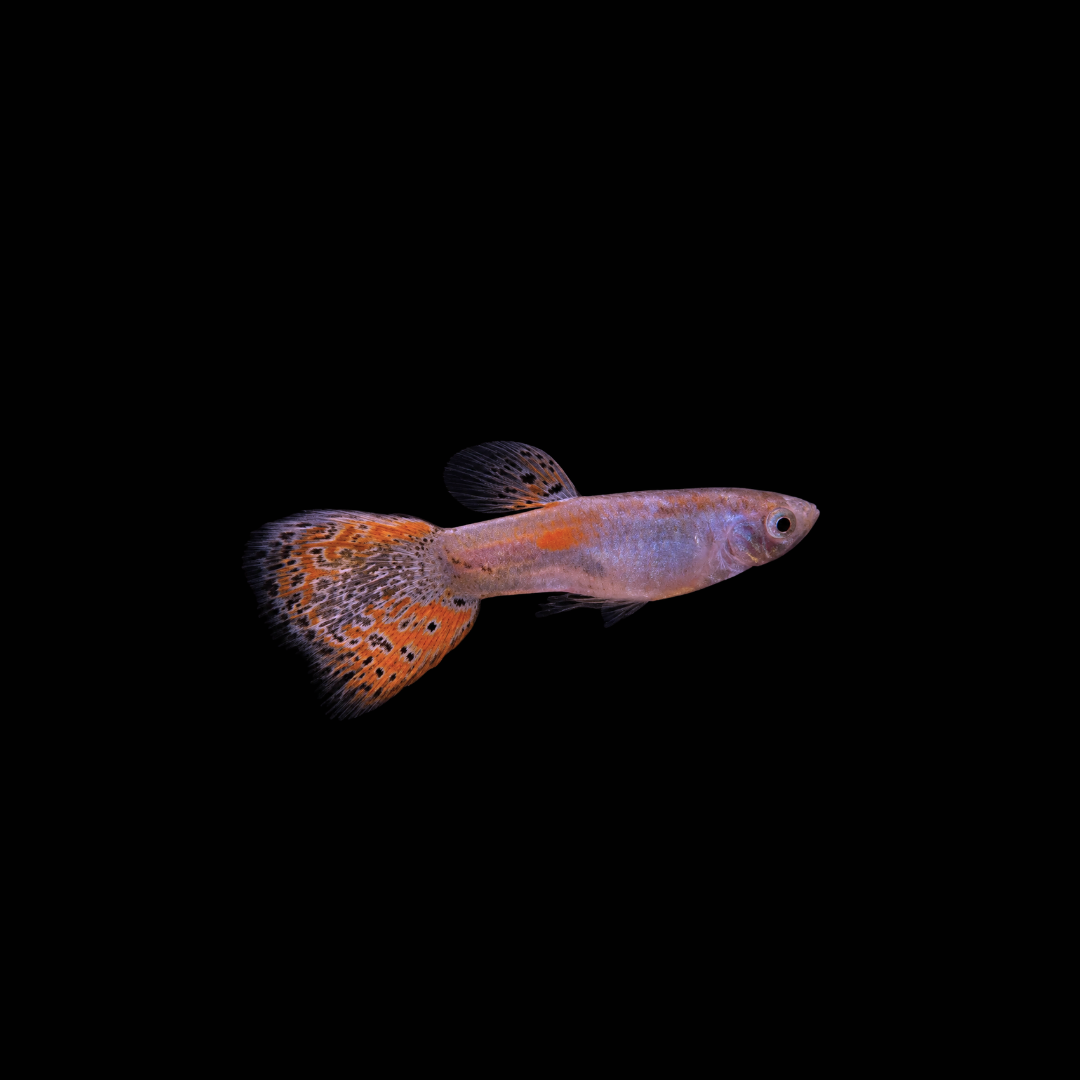
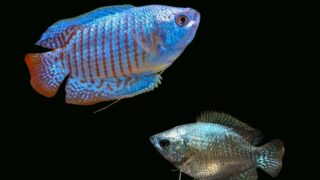
エルシルバラドレッドグラスグッピーは、南米ベネズエラ原産の野生エンドラーズ(Poecilia wingei)に由来する強い白銀光沢「エルシルバラド」の形質と、日本で長く親しまれてきた改良グッピー(Poecilia reticulata)の定番品種「レッドグラス」の形質を掛け合わせた、種間交雑の改良品種です。頭部から体の前半にかけては金属のように輝く白銀色が広がり、成長とともに体側へ黒斑が浮かぶ個体も多く、この黒いアクセントが銀色の輝きをいっそう引き立てます。体の後ろ半分に目を移すと、大きく扇状に開く赤い尾びれと背びれに、芝生に見立てた細かな粒状のスポットが均一に散りばめられています。白銀と赤が一匹の中でくっきりと分かれるコントラストこそ、本品種ならではの見どころです。国内では、国内のブリーダーが累代繁殖した個体が「国産」として流通しており、日本の水に馴染みやすく、長距離の輸入輸送による消耗を受けていない点が強みとされています。一方で、大きな尾びれを美しく保つには水質の安定と硬度への配慮が欠かせず、外国産グッピーとの混泳を避けた防疫管理も重要になります。 The El Silverado Red Grass Guppy is an interspecific hybrid strain that combines the intense silver-white sheen known as “El Silverado,” derived from wild Endler’s livebearers (Poecilia wingei) of Venezuela, with the traits of the Red Grass, a long-loved classic among fancy guppies (Poecilia reticulata) in Japan. A metallic silver-white luster spreads from the head through the front half of the body, and many individuals develop black spots on the flanks as they mature; these dark accents make the silver shine even brighter. Toward the rear, the large fan-shaped red caudal and dorsal fins are evenly sprinkled with fine, grain-like spots likened to a lawn of grass. The sharp contrast between silver and red within a single fish is the hallmark of this strain. In Japan, fish bred over generations by domestic breeders are sold as “Japanese-bred,” and their strengths are said to be that they adapt readily to Japanese water and have not been weakened by long-distance import shipping. On the other hand, keeping its large fins beautiful requires stable water quality and attention to hardness, and biosecurity that avoids mixing with imported guppies is also important.
基本情報 / Basic Information
| 学名 / Scientific Name | Poecilia wingei × Poecilia reticulata |
|---|---|
| 通称 / Common Name | エルシルバラドレッドグラスグッピー、エルシルバラドレッドグラス、エルシルバラド系グッピーEl Silverado Red Grass Guppy, El Silverado Red Grass |
| 分類 / Family | カダヤシ目 カダヤシ科 ポエキリア属(アカントファケルス亜属)の種間交雑改良品種Cyprinodontiformes, Poeciliidae, genus Poecilia (subgenus Acanthophacelus); an interspecific hybrid ornamental strain |
| 英名 / English Name | El Silverado Red Grass Guppy |
| 分布 / Distribution | 改良品種のため野生分布はありません。国内では、国内のブリーダーが累代繁殖した個体が流通しています。片親のルーツである原種エンドラーズは、ベネズエラ北東部の限られた沿岸ラグーンや周辺水域(クマナ近郊のパトス湖、パリア半島付近のカンポマ湖など)に固有分布し、エルシルバラドはクマナ近郊で採集された系統に由来するとされています。As a man-made strain, it has no natural range. In Japan, fish bred over generations by domestic breeders are what reach the market. Its parental root, the wild Endler’s livebearer, is endemic to a few coastal lagoons and nearby waters in northeastern Venezuela (such as Laguna de Patos near Cumaná and the Campoma lagoon near the Paria Peninsula), and the El Silverado line is said to derive from fish collected near Cumaná. |
| 最大体長 / Max Size | オス約4〜5cm、メス約5〜6cm(目安。系統や飼育環境により個体差があります)Males about 4–5 cm, females about 5–6 cm (approximate; varies with lineage and conditions) |
| 寿命 / Lifespan | 約1〜2年。良好な環境では2〜3年生きる個体もいます。About 1–2 years; some individuals live 2–3 years in good conditions. |
飼育環境 / Aquarium Environment
| 水槽サイズ / Tank Size | ペアから少数の群泳であれば、45cm規格水槽(約35L)以上が目安です。繁殖させて世代を重ねる場合や稚魚の育成スペースを確保したい場合は、60cm規格水槽(約57L)があると管理しやすくなります。病気予防の観点からは、1水槽あたり1〜3ペア程度の低密度で飼育するのが理想的です。For a pair or a small group, a 45 cm standard tank (about 35 L) or larger is a good guideline. If you plan to breed over generations or want room to raise fry, a 60 cm standard tank (about 57 L) makes management easier. To prevent disease, a low density of about one to three pairs per tank is ideal. |
|---|---|
| 水温 / Temperature | 23〜27℃前後が目安です。ヒーターで水温を安定させ、急な温度変化を避けることが大切です。 Around 23–27°C is a good guideline. Keep the temperature stable with a heater and avoid sudden changes. |
| 水質 / Water Quality | 中性〜弱アルカリ性(pH7.0〜7.8前後)で、やや硬めの水が適しています。国内で累代繁殖された個体は日本の水道水にも順応しており、カルキを抜いた水道水で飼育できますが、軟水傾向の水では大きな尾びれの縁が傷みやすくなることがあります。その場合は、砕いたサンゴを少量入れる、マグネシウムを含む粗塩を少量加えるなどして、総硬度をGH8〜18程度まで緩やかに補うと状態が安定しやすいと考えられています。ただし、数値を合わせようとして急に水質を変えることが最も危険なので、常に安定を優先してください。Neutral to slightly alkaline water (around pH 7.0–7.8) on the harder side is suitable. Fish bred over generations in Japan have adapted to Japanese tap water and can be kept in dechlorinated tap water, but in soft water the edges of their large caudal fins may deteriorate more easily. In that case, adding a little crushed coral or a small amount of coarse salt containing magnesium to gently raise general hardness to around GH 8–18 is thought to help stabilize their condition. However, changing water chemistry abruptly to hit target numbers is the greatest danger, so always put stability first. |
| レイアウト / Layout | 白銀の体と赤い尾びれを引き立てるには、暗色の底砂やつや消しの黒いバックスクリーンが効果的です。衛生管理を重視する場合は、底砂を敷かないベアタンクも向いています。マツモ、ウィローモス、ナヤスなどの細葉の水草や浮草を配置すると、光を適度に和らげながら、メスの休息場所や稚魚の隠れ家にもなります。照明は演色性の高いアクアリウム用LEDを選ぶと、銀の反射と赤の発色が自然に見えます。点灯時間は1日8〜10時間程度に管理しましょう。Dark substrate and a matte black background are effective for highlighting the silver body and red fins. If hygiene is a priority, a bare-bottom tank also works well. Fine-leaved plants and floaters such as hornwort, willow moss and Najas soften the light while providing resting places for females and cover for fry. An aquarium LED with high color rendering makes the silver reflection and red coloration look natural. Keep the photoperiod to about 8–10 hours a day. |
| 注意点 / Precautions | エンドラーズ譲りのジャンプ力があるため、飛び出しを防ぐフタを隙間なく設置してください。大きな尾びれを傷めないよう、ろ過器の水流は穏やかに調整します。外国産グッピーとの混泳は病気を持ち込むリスクが高いため避け、網などの器具の使い回しにも注意が必要です。また、グッピーは環境省の「生態系被害防止外来種リスト」に掲載されており、国内でも温泉地の排水路などで野生化した例があります。飼いきれなくなっても、河川や池、用水路などへ放流することは絶対にしないでください。Having inherited the Endler’s jumping ability, these fish need a tightly fitting lid to prevent escapes. Adjust filter flow to be gentle so the large fins are not damaged. Avoid mixing them with imported guppies, which carries a high risk of introducing disease, and take care not to share nets and other equipment. Guppies are also listed on the Japanese Ministry of the Environment’s list of invasive alien species that threaten ecosystems, and feral populations have formed in Japan, for example in channels fed by hot-spring runoff. Never release them into rivers, ponds or irrigation channels, even if you can no longer keep them. |
餌と給餌 / Feeding
| 餌の種類 / Diet | 雑食性で、グッピー用の微粒配合飼料やフレークフードをよく食べます。これを主食に、アスタキサンチンなどの色揚げ成分を含む飼料やスピルリナ配合飼料を組み合わせ、孵化させたばかりのブラインシュリンプや冷凍ミジンコ、冷凍アカムシなどの動物性の餌を少量加えると、体格と発色の両面で効果が期待できます。Omnivorous, they readily eat fine-granule guppy foods and flakes. Using these as the staple and combining them with foods containing color-enhancing ingredients such as astaxanthin or spirulina, plus small amounts of animal-based foods such as newly hatched brine shrimp, frozen daphnia and frozen bloodworms, can be expected to improve both body size and coloration. |
|---|---|
| 給餌のポイント / Feeding Tips | 口が小さいため、粒の細かい餌を1日数回に分け、数分で食べきれる量ずつ与えるのが基本です。照明はもともと体にある色を照らし出すだけで、赤い色素そのものを作るわけではありません。つまり、レッドグラスの尾びれの赤を保つには、餌からとる栄養が欠かせないのです。また、水質が悪化して体表や鱗が荒れると光が乱反射し、白銀の輝きもくすんでしまいます。食べ残しを出さない給餌ときれいな水の維持こそが、最大の色揚げといえるでしょう。Their mouths are small, so the basic approach is to offer fine foods several times a day in portions they can finish within a few minutes. Lighting only reveals the colors already in the body; it does not create red pigment. In other words, nutrition from food is essential to keep the red of the Red Grass fins. In addition, when poor water roughens the skin and scales, light scatters irregularly and the silver sheen becomes dull. Feeding without leftovers and keeping the water clean may well be the best color enhancement of all. |
性格と混泳 / Temperament and Tank Mates
| 性格 / Temperament | 温和で、活発に泳ぎ回る性格です。ただし、オスはメスを執拗に追いかけて求愛を繰り返すため、メスが疲れやすくなります。水草で視線を遮れる場所をつくり、メスを多めにした性比で飼育すると落ち着きやすくなります。They are peaceful and swim actively. However, males persistently chase females to court them, which tends to exhaust the females. Providing plants that break lines of sight and keeping more females than males helps them settle. |
|---|---|
| 混泳の相性 / Compatibility | 最も注意したいのは、外国産グッピーとの混泳を避けることです。外国産の個体の中には、病原体を持ちながら発症しないキャリアが含まれる可能性があるとされ、同じ水槽に入れると国内ブリードの個体だけが発症し、短期間で全滅してしまうこともあるといわれます。異なる国内ブリーダーの系統同士でもリスクはゼロではないため、基本は同じ系統だけで飼育することをおすすめします。同じ部屋で別系統を飼う場合は、網やバケツ、ホースなどの器具も完全に分けましょう。他の魚種と一緒に飼う場合は、ヒレをかじる魚やベタ、大型魚は避け、小型のコリドラス、オトシンクルス、温和な小型カラシン類、小型のエビ類などにとどめると安心です(稚エビは食べられることがあります)。The most important point is to avoid keeping them with imported guppies. Some imported fish are thought to carry pathogens without showing symptoms, and when placed together, only the domestically bred fish may fall ill and be wiped out within a short time. Even strains from different domestic breeders carry some risk, so keeping only a single strain together is recommended. If you keep other strains in the same room, completely separate nets, buckets, hoses and other equipment. With other species, avoid fin-nippers, bettas and large fish, and limit companions to small Corydoras, Otocinclus, peaceful small tetras and small shrimp (shrimplets may be eaten). |
病気と対策 / Diseases and Prevention
| かかりやすい病気 / Common Diseases | 尾びれが溶けるように傷んでいく尾ぐされ病(カラムナリス症)、尾びれが針のように細くすぼまるハリ病、体に白い点が現れる白点病が代表的です。また、外国産グッピーとの接触で持ち込まれるとされる、いわゆるグッピーエイズや、背びれの付け根付近が白く変色して皮膚がただれていくテトラヒメナ症は、外見から保菌個体を見分けにくく治療も難しいため、特に警戒されています。Typical diseases include fin rot (columnaris), in which the caudal fin seems to dissolve; “needle disease,” in which the caudal fin clamps into a narrow spike; and white spot disease (ich). The so-called “guppy AIDS,” thought to be introduced through contact with imported guppies, and Tetrahymena infection, in which the area near the base of the dorsal fin turns white and the skin becomes ulcerated, are especially feared because carriers are hard to identify by appearance and treatment is difficult. |
|---|---|
| 対策と予防 / Prevention | 予防の基本は、1水槽1〜3ペア程度の低密度飼育と、週1回以上・水量の30〜40%程度の定期的な換水です。尾ぐされ病が疑われる場合は、別の容器に隔離し、グリーンFゴールド顆粒などの抗菌剤で薬浴します。塩浴だけでは効果が期待しにくく、水温を上げると原因菌の活動を助けてしまうおそれもあるため、塩を使う場合は抗菌剤と併用するのが基本です。ハリ病は初期であればきれいな水へ移し、0.5%程度の塩浴で体への負担を軽くすると回復が期待できますが、進行すると回復は難しくなります。白点病は、隔離水槽でエアレーションを強めながら水温を28〜30℃へ緩やかに上げ、塩浴やメチレンブルー系の薬剤で治療します。いずれの場合も、本水槽への投薬は水草やろ過バクテリアを傷めるため避け、薬は製品の説明書に従って使用してください。観賞魚用の塩、メチレンブルー系の薬、グリーンFゴールド顆粒を常備しておくと、急な発症にも落ち着いて対応できます。The foundations of prevention are low-density stocking of about one to three pairs per tank and regular water changes of roughly 30–40% at least once a week. If fin rot is suspected, isolate the fish in a separate container and treat it with an antibacterial such as Green F Gold granules. Salt alone is unlikely to be effective, and raising the temperature may help the causative bacteria, so salt should be used together with an antibacterial. Needle disease can be expected to improve in its early stage if the fish is moved to clean water with about a 0.5% salt bath to ease the strain on its body, but recovery becomes difficult once it advances. For ich, gradually raise the temperature to 28–30°C in a hospital tank with strong aeration and treat with salt or a methylene blue medication. In all cases, avoid medicating the main tank, which harms plants and filter bacteria, and use medications according to the product instructions. Keeping aquarium salt, a methylene blue medication and Green F Gold granules on hand lets you respond calmly to sudden outbreaks. |
増やし方(繁殖) / Breeding
| 雌雄の判別 / Sexing | オスは体が小さく、白銀の光沢と赤いグラス尾びれがはっきり現れ、しりびれが棒状の交接器(ゴノポディウム)に変化しています。メスは体が大きくふっくらしており、体色やヒレは控えめで、しりびれは扇形のままです。オスの色柄は生後2ヶ月頃から明瞭になっていきます。Males are smaller, show the silver sheen and red grass fins clearly, and have an anal fin modified into a rod-like copulatory organ (gonopodium). Females are larger and plumper, with subdued coloration and fins, and keep a fan-shaped anal fin. Male coloration becomes distinct from around two months of age. |
|---|---|
| 繁殖形態 / Reproduction | メスのお腹の中で卵を孵化させ、稚魚を直接産む卵胎生です。妊娠期間は約23〜30日で、1回に10〜30匹ほどの稚魚を産みます。メスは1回の交尾で得た精子を体内に蓄えることができ、オスがいなくても2〜3回続けて出産することがあります。They are livebearers: the eggs hatch inside the female and she gives birth to free-swimming fry. Gestation is about 23–30 days, with roughly 10–30 fry per brood. Females can store sperm from a single mating and may give birth two or three times in a row even without a male. |
| 繁殖のポイント / Breeding Tips | 性比はオス1匹に対してメス2〜3匹が目安です。エンドラーズ寄りの系統は稚魚を食べにくい傾向があるともいわれますが、確実に育てるには産卵ネットや隔離ケース、密生した水草を用意しましょう。系統を維持する場合は、オスのしりびれが変化し始める生後1ヶ月前後で雌雄を分け、意図しない交配を防ぎます。そのうえで生後2〜3ヶ月の時点で、前半身の白銀と黒斑のバランス、尾びれと背びれの赤の濃さとグラススポットの均一さ、丈夫な体格を基準に親魚を選びます。近親交配を続けると小型化や虚弱化が起こりやすいため、3〜4世代に1回程度、信頼できる別系統のレッドグラスやエルシルバラド系を導入して血を入れ替えるとよいでしょう。なお、メス親が青系の遺伝子を持っていた場合、次の世代に青みがかった個体が現れることがありますが、これはグラス系では珍しくない遺伝のふるまいで、異常ではありません。A ratio of one male to two or three females is a good guideline. Endler-leaning strains are said to be less inclined to eat their fry, but to raise them reliably, provide a breeding net, an isolation box or dense plants. To maintain a strain, separate the sexes at around one month of age, when the male’s anal fin begins to change, to prevent unintended matings. Then, at two to three months, select breeders based on the balance of front-body silver and black spots, the depth of red and evenness of grass spots on the caudal and dorsal fins, and a sturdy body. Continued inbreeding tends to cause reduced size and weakness, so it is advisable to introduce a reliable unrelated Red Grass or El Silverado line about once every three or four generations. If the mother carries a blue-type gene, bluish offspring may appear in the next generation; this is common genetic behavior in grass strains, not an abnormality. |
雑学と豆知識 / Trivia and Fun Facts
| 1. 「エルシルバラド」という名前の響き / 1. The Sound of the Name “El Silverado” | エルシルバラド(El Silverado)は、英語の「シルバー(銀)」にスペイン語風の響きを重ねた名前で、その体を覆う銀色の輝きにちなんで付けられました。南米の伝説上の黄金郷「エルドラド(El Dorado)」と対をなすような響きを持ち、実際にエンドラーズの世界には「エルドラド」と呼ばれる別の系統も存在します。金の名を持つ系統と銀の名を持つ系統が並ぶのは、南米原産の魚らしい遊び心のある命名といえるでしょう。El Silverado is a name that combines the English word “silver” with a Spanish-sounding ring, given in reference to the silvery sheen covering the fish’s body. It sounds like a counterpart to El Dorado, the legendary South American city of gold, and in fact a separate Endler’s line called “El Dorado” also exists. Having one line named for gold and another for silver is a playful touch befitting fish from South America. |
|---|---|
| 2. 40年近く眠っていた原種エンドラーズ / 2. The Endler’s Livebearer That Slept for Nearly 40 Years | エルシルバラドの母体となったエンドラーズには、少し変わった発見の歴史があります。最初の標本は1937年、フランクリン・F・ボンドによってベネズエラ北東部のパトス湖で採集されましたが、その後は長く注目されないままでした。転機となったのは1975年で、進化生物学者のジョン・A・エンドラー博士が現地でこの魚を再発見したことから、やがて博士の名を冠して「エンドラーズ・ライブベアラー」と呼ばれるようになります。その後、愛好家による採集と繁殖を通じて世界へ広まり、2005年には学名 Poecilia wingei として正式に記載されました。種小名の「wingei」は、デンマークの生物学者で、グッピーの遺伝研究の先駆者でもあるオイヴィンド・ウィンゲ博士に献名されたものです。The Endler’s livebearer, from which El Silverado descends, has an unusual discovery story. The first specimens were collected in 1937 by Franklyn F. Bond at Laguna de Patos in northeastern Venezuela, but the fish then went largely unnoticed for many years. The turning point came in 1975, when evolutionary biologist Dr. John A. Endler rediscovered it in the field, and it eventually came to be called “Endler’s livebearer” after him. It later spread worldwide through collecting and breeding by hobbyists, and in 2005 it was formally described as Poecilia wingei. The species name “wingei” honors Dr. Øjvind Winge, a Danish biologist who was also a pioneer of guppy genetics. |
| 3. クマナ近郊の水路で見つかった銀色の魚 / 3. A Silver Fish Found in a Channel near Cumaná | エルシルバラドの物語は、2013年に始まったとされています。フランスの熱帯魚採集家フィリップ・ヴォワザン氏が、ベネズエラ・クマナ市南部の排水路で、それまでの野生型とは明らかに異なる、強い銀白色の胸部と体側を持つエンドラーズを採集したと伝えられています。欧州へ持ち帰られて殖やされたこの魚は、その体色にちなんで「エルシルバラド」と名付けられ、2014年頃から欧州の愛好家や問屋を通じて世界中のブリーダーへ広がっていきました。華やかな品種のルーツが道路脇の何気ない水路にあったというのは、なんとも意外で興味深い話です。The El Silverado story is said to have begun in 2013. French tropical fish collector Philippe Voisin is reported to have collected Endler’s livebearers with strikingly silver-white chests and flanks, clearly different from known wild types, from a drainage channel south of Cumaná, Venezuela. Brought back to Europe and propagated, the fish was named “El Silverado” after its coloration, and from around 2014 it spread to breeders worldwide through European hobbyists and wholesalers. It is a surprising and intriguing thought that the roots of such a showy strain lie in an unremarkable roadside channel. |
| 4. 全長2cmの銀色を5cmの改良グッピーへ移す挑戦 / 4. Transferring a 2 cm Fish’s Silver to a 5 cm Fancy Guppy | 全長わずか2cmほどの野生エンドラーズの白銀色を、5cm級の改良グッピーへ移す試みは、決して簡単なものではありませんでした。台湾のブリーダー、ゲイリー・リー氏は、従来の改良グッピーが持つ光沢の遺伝子では黄色や緑、青に寄った発色にとどまり、純粋な銀白色を出しきれないことに着目し、2015年にエルシルバラドを台湾へ導入して改良に取りかかりました。ところが、近親交配を行うと体が小さくなり、別系統との交配を重ねても全長4〜4.5cmの壁を越えられず、体格を大きくしようと別の系統を掛けると今度は黒い色素が銀色を曇らせてしまうなど、試行錯誤が続いたと記録されています。2017〜2018年にかけて体格の良い系統との戻し交配を重ねた結果、ようやく欧州のショー基準を満たす5cm級に到達しました。その後、エルシルバラドの改良品種は海外のコンテストで入賞を重ね、アジアや欧州で大きな流行となっていきます。この流れには日本のブリーダーも深く関わっており、独自のモザイク系統にエルシルバラドの遺伝子を取り入れた作品が、海外のブリーダーに強い印象を与えたことも伝えられています。Transferring the silver-white of a wild Endler’s only about 2 cm in total length to a 5 cm-class fancy guppy was far from easy. Taiwanese breeder Gary Lee noticed that the sheen genes in existing fancy guppies produced colors leaning toward yellow, green or blue and could not yield pure silver-white, so in 2015 he introduced El Silverado to Taiwan and began improving it. Records describe a long process of trial and error: inbreeding shrank the fish, repeated crosses with other lines could not break past 4–4.5 cm total length, and crossing in another strain to gain size let black pigment cloud the silver. By backcrossing with large-bodied lines in 2017–2018, the fish finally reached the 5 cm class that meets European show standards. El Silverado strains then won prizes at overseas contests and became a major trend in Asia and Europe. Japanese breeders were also deeply involved; one work that brought El Silverado genes into an original Japanese mosaic line is said to have made a strong impression on breeders abroad. |
| 5. 日本が育んだグラス系グッピーの系譜 / 5. The Lineage of Grass Guppies Nurtured in Japan | 本品種のもう一方の親であるレッドグラスは、日本のグッピー文化の中で磨かれてきた系統です。グッピーが日本に伝わったのは1920年代頃とされ、昭和初期には百貨店などに展示されたことで広く知られるようになったといわれます。国産グッピーの隆盛を象徴する品種のひとつが、1984年に日本のブリーダーが作出したとされる「ブルーグラス」で、1980年代後半から1990年代のグッピーブームを牽引しました。同じ頃、外国産のグラスグッピーと国産のレッドモザイクを交配して生まれたとされるレッドグラスが、赤系の定番品種として定着していきます。2010年代後半以降は日本でもエルシルバラドの導入が進み、さまざまな改良品種へと展開されました。その中で、日本で最も親しまれてきたグラス系の尾びれとエルシルバラドの白銀の体が組み合わされ、エルシルバラドレッドグラスグッピーとして国内に定着したのです。The other parent of this strain, the Red Grass, is a line refined within Japan’s guppy culture. Guppies are thought to have arrived in Japan around the 1920s and are said to have become widely known after being displayed in department stores in the early Showa era. One strain that symbolized the flourishing of Japanese-bred guppies was the Blue Grass, said to have been created by Japanese breeders in 1984, which drove the guppy boom of the late 1980s and 1990s. Around the same time, the Red Grass, said to have come from crossing imported grass guppies with Japanese-bred red mosaics, became established as the classic red strain. From the late 2010s, El Silverado was introduced in Japan and developed into various strains. Among them, the grass-type tail most loved in Japan was combined with El Silverado’s silver body, and the El Silverado Red Grass Guppy became established in Japan. |
| 6. 血統区分「クラスK」という立ち位置 / 6. Its Place as a “Class K” Hybrid | エンドラーズとグッピーが同じ種か別の種かについては長く議論が続いてきました。現在は、遺伝子の解析結果や交接器の形の違い、求愛行動の違い、生息地が地理的に隔てられていることなどを根拠に、別種とする見解が主流です(別種とすることに疑問を示す研究もあります)。ただし、両種は近縁なため簡単に交雑し、生まれた子にも繁殖能力があります。そこで米国のエンドラーズ愛好家団体は、野生採集まで記録で遡れる純血の「クラスN」、見た目は純血でも記録のない「クラスP」、グッピーなど他系統と交配されたすべての子孫を指す「クラスK」という区分を設けています。エルシルバラドレッドグラスグッピーは、この基準ではクラスKに当たります。つまり、純血エンドラーズの保存とは目的の異なる観賞用の改良品種であり、純血のエンドラーズを飼育している水槽には混ぜないという意識が大切です。Whether Endler’s livebearers and guppies are the same species has long been debated. Today, based on genetic analyses, differences in gonopodium shape and courtship behavior, and the geographic separation of their habitats, the prevailing view treats them as separate species (though some studies question this). Still, the two are closely related, hybridize easily, and produce fertile offspring. An American Endler’s association therefore uses three classes: Class N, purebred fish traceable by records to wild collections; Class P, fish that look pure but lack records; and Class K, all descendants crossed with guppies or other lines. By this standard, the El Silverado Red Grass Guppy is Class K. In other words, it is an ornamental strain with a purpose different from preserving pure Endler’s, and it should be kept out of tanks housing purebred Endler’s. |
| 7. 銀と赤を支える二層の遺伝の仕組み / 7. The Two-Layer Genetics Behind Silver and Red | 本品種の美しさは、性別を決める染色体と、それ以外の染色体という二つの層の遺伝に支えられていると考えられています。改良に携わったブリーダーの長年の交配経験からは、エルシルバラドの前半身の白銀光沢は主にオスだけが持つY染色体に乗っており、父から息子へそのまま受け継がれやすいと報告されています(正式な科学的検証を経たものではないとされています)。興味深いのは、この白銀光沢が「赤い背びれ」と一緒に受け継がれやすいという点です。背びれを黄色に揃えたい系統づくりでは大きな障壁となったこの性質が、尾びれと背びれを赤く仕上げるレッドグラスにとっては、むしろ見た目を安定させる追い風になっていると考えられます。一方、尾びれが赤くなるか青くなるかには、「ブラオ」と呼ばれる遺伝子が関わっています。国内の愛好家の間では、ブラオを持たないものがレッドグラス、片方だけ持つものがブルーグラス、両方に持つものは赤みが抑えられたくすんだ色合いになると説明されており、ブルーグラス同士を掛け合わせると、理論上はレッドグラス、ブルーグラス、ブラオが1対2対1の割合で生まれるとされます。ちなみに、銀の輝きの正体は、皮膚の中に並ぶグアニンという結晶が光を反射して生まれる「構造色」です。グッピーの構造色は人の目には見えない紫外線まで反射し、隣り合う赤い色との対比を際立たせていることが研究で指摘されています。The beauty of this strain is thought to rest on two layers of inheritance: the chromosomes that determine sex and the remaining chromosomes. Long-term breeding experience by those who developed it suggests that El Silverado’s front-body silver sheen sits mainly on the Y chromosome, which only males carry, and tends to pass directly from father to son (this has not been formally verified scientifically). Interestingly, this silver sheen tends to be inherited together with a red dorsal fin. This trait was a major obstacle for breeders trying to create lines with yellow dorsals, but for the Red Grass, whose caudal and dorsal fins are finished in red, it is thought to act as a tailwind that stabilizes its appearance. Meanwhile, whether the tail turns red or blue involves a gene called “blau.” Japanese hobbyists explain that fish without blau are Red Grass, fish carrying one copy are Blue Grass, and fish carrying two copies show a dull coloration with suppressed red, so crossing Blue Grass with Blue Grass theoretically yields Red Grass, Blue Grass and blau at a 1:2:1 ratio. Incidentally, the silver shine is a “structural color” produced when crystals of guanine arranged in the skin reflect light. Research has noted that guppy structural colors reflect even ultraviolet light invisible to the human eye, heightening the contrast with adjacent red coloration. |
| 8. オスが使い分ける二つの求愛戦略 / 8. Two Courtship Strategies Used by Males | 水槽のオスをじっくり観察すると、メスへのアプローチに二つの戦術を使い分けていることに気づきます。一つは、メスの前で体をS字にくねらせ、ヒレを広げて小刻みに震わせながら色や模様を見せる「シグモイド・ディスプレイ」と呼ばれる正攻法です。もう一つは、受け入れる気のないメスに対し、背後や死角から交接器を突き出して交尾を試みる、いわば不意打ちの戦術です。グッピーの行動研究では、尾びれの長いオスほど正攻法の求愛をメスに受け入れてもらいにくく、そのぶん不意打ちの交尾を試みる回数が増えるという報告もあります。俊敏なエンドラーズの血と大きなグラス尾びれをあわせ持つ本品種でも、オスの追尾はメスにとって大きな負担になりえます。水草で視線を遮れる場所を設け、メスを多めにする飼い方は、こうした習性からみても理にかなっているのです。Watch the males closely and you will notice they switch between two tactics when approaching females. One is the straightforward “sigmoid display,” in which the male bends his body into an S shape in front of the female, spreads his fins and quivers to show off his colors and patterns. The other is a surprise tactic, in which he thrusts his gonopodium from behind or from a blind spot toward an unreceptive female. Some behavioral studies of guppies report that males with longer tails are less likely to have their normal courtship accepted and correspondingly make more surprise mating attempts. In this strain, which combines agile Endler’s blood with large grass tails, male pursuit can also be a heavy burden for females. Providing plants that break lines of sight and keeping more females makes sense in light of these habits. |
| 9. 遠い故郷で危機に直面する原種 / 9. The Wild Ancestor Facing Crisis in Its Distant Homeland | 世界中の水槽で親しまれている一方で、ベネズエラ北東部の限られた水域にしか生息しない野生のエンドラーズは、IUCN(国際自然保護連合)のレッドリストで絶滅危惧種(EN)に評価されています。生息地への人の進出に伴う水の汚染、外来種の持ち込み、そして逃げ出したり放されたりしたグッピーとの交雑が、その背景にあると考えられています。華やかな改良品種が水槽で泳ぐ一方で、そのルーツとなった野生の魚は、故郷の水辺で静かに数を減らしているのです。日本の水槽で輝く一匹の向こうには、そんな遠い故郷の物語が広がっています。While loved in aquariums around the world, the wild Endler’s livebearer, found only in limited waters of northeastern Venezuela, is assessed as Endangered (EN) on the IUCN (International Union for Conservation of Nature) Red List. Water pollution accompanying human encroachment on its habitat, the introduction of non-native species, and hybridization with escaped or released guppies are thought to be behind this. While showy ornamental strains swim in aquariums, the wild fish at their roots are quietly declining in the waters of their homeland. Behind each fish shining in a Japanese aquarium lies the story of that distant homeland. |
まとめ / Conclusion
エルシルバラドレッドグラスグッピーは、ベネズエラの水路で見つかった銀色のエンドラーズと、日本で磨かれてきたレッドグラスという、遠く離れた二つの系譜が一匹の中で出会った魚です。光を受けて輝く白銀の体と、細かなスポットが散る赤い扇状の尾びれが水槽の中でゆったりと揺れる姿は、見るたびに違った表情を見せてくれます。国内で世代を重ねてきた個体は日本の水に馴染みやすく、心強い存在でもあります。 The El Silverado Red Grass Guppy is a fish in which two distant lineages meet: a silver Endler’s found in a Venezuelan channel and the Red Grass refined in Japan. Its silver body gleaming in the light and its red, fan-shaped tail scattered with fine spots, swaying gently in the tank, show a different expression each time you look. Fish bred over generations in Japan adapt readily to local water, making them reassuring companions.
安定した水質と、外国産グッピーとの混泳を避けた丁寧な管理、そして世代を見守りながらの選別。そうした手間に応えるように、生まれた稚魚はやがて銀と赤の輝きをまとっていきます。短い一生を次の世代へとつないでいく小さな命と向き合う時間は、遠い故郷の水辺に思いを馳せるきっかけにもなるでしょう。 Stable water, careful management that avoids mixing with imported guppies, and selection while watching over each generation: as if in response to that effort, the fry gradually take on the glow of silver and red. Time spent with these small lives that pass their brief existence on to the next generation may also become a moment to think of the distant waters of their homeland.

困りごとの解決から、用品えらび、水槽づくり、生き物えらびまで。飼育に役立つ案内です。
分布マップ
本品種は国内で累代繁殖された改良品種のため、野生の分布域はありません。地図には、片親のルーツである原種エンドラーズが固有分布するベネズエラ北東部、クマナ近郊からパリア半島付近にかけての沿岸域を示しています。
※地図は分布域のおおよその範囲を示す概略表示です。マーカーは地域を示すための代表地点であり、実際の採集地点ではありません。
参考文献
分類・分布・保全状況
- Poeser, F. N., Kempkes, M. & Isbrücker, I. J. H. (2005). Description of Poecilia (Acanthophacelus) wingei n. sp. from the Paría Peninsula, Venezuela, including notes on Acanthophacelus Eigenmann, 1907 and other subgenera of Poecilia Bloch and Schneider, 1801 (Teleostei, Cyprinodontiformes, Poeciliidae). Contributions to Zoology, 74(1/2), 97–115. https://repository.naturalis.nl/pub/214343/
- Schories, S., Meyer, M. K. & Schartl, M. (2009). Description of Poecilia (Acanthophacelus) obscura n. sp., (Teleostei: Poeciliidae), a new guppy species from western Trinidad, with remarks on P. wingei and the status of the “Endler’s guppy”. Zootaxa, 2266, 35–50.
- Alexander, H. J. & Breden, F. (2004). Sexual isolation and extreme morphological divergence in the Cumaná guppy: a possible case of incipient speciation. Journal of Evolutionary Biology, 17, 1238–1254.
- Herdegen, M., Alexander, H. J., Babik, W., Mavárez, J., Breden, F. & Radwan, J. (2014). Population structure of guppies in north-eastern Venezuela, the area of putative incipient speciation. BMC Evolutionary Biology, 14, 28.
- Froese, R. & Pauly, D. (Eds.). FishBase: Poecilia wingei, Endlers guppy. https://www.fishbase.org/summary/SpeciesSummary.php?id=63223
- Fricke, R., Eschmeyer, W. N. & Van der Laan, R. (Eds.). Eschmeyer’s Catalog of Fishes: Poecilia wingei. California Academy of Sciences. https://researcharchive.calacademy.org/research/ichthyology/catalog/fishcatget.asp?spid=68976
- 環境省 自然環境局. 生態系被害防止外来種リスト. https://www.env.go.jp/nature/intro/2outline/iaslist.html
遺伝・行動・繁殖
- Winge, Ø. (1922). One-sided masculine and sex-linked inheritance in Lebistes reticulatus. Journal of Genetics, 12, 145–162.
- Houde, A. E. (1997). Sex, Color, and Mate Choice in Guppies. Princeton University Press.
- Magurran, A. E. (2005). Evolutionary Ecology: The Trinidadian Guppy. Oxford University Press.
病気と対策
- Declercq, A. M., Haesebrouck, F., Van den Broeck, W., Bossier, P. & Decostere, A. (2013). Columnaris disease in fish: a review with emphasis on bacterium-host interactions. Veterinary Research, 44, 27.
- Pimenta Leibowitz, M., Ariav, R. & Zilberg, D. (2005). Environmental and physiological conditions affecting Tetrahymena sp. infection in guppies, Poecilia reticulata Peters. Journal of Fish Diseases, 28(9), 539–547.
- Leibowitz, M. P. & Zilberg, D. (2009). Tetrahymena sp. infection in guppies, Poecilia reticulata Peters: parasite characterization and pathology of infected fish. Journal of Fish Diseases, 32(10), 845–855.
- Matthews, R. A. (2005). Ichthyophthirius multifiliis Fouquet and ichthyophthiriosis in freshwater teleosts. Advances in Parasitology, 59, 159–241.
コメント