

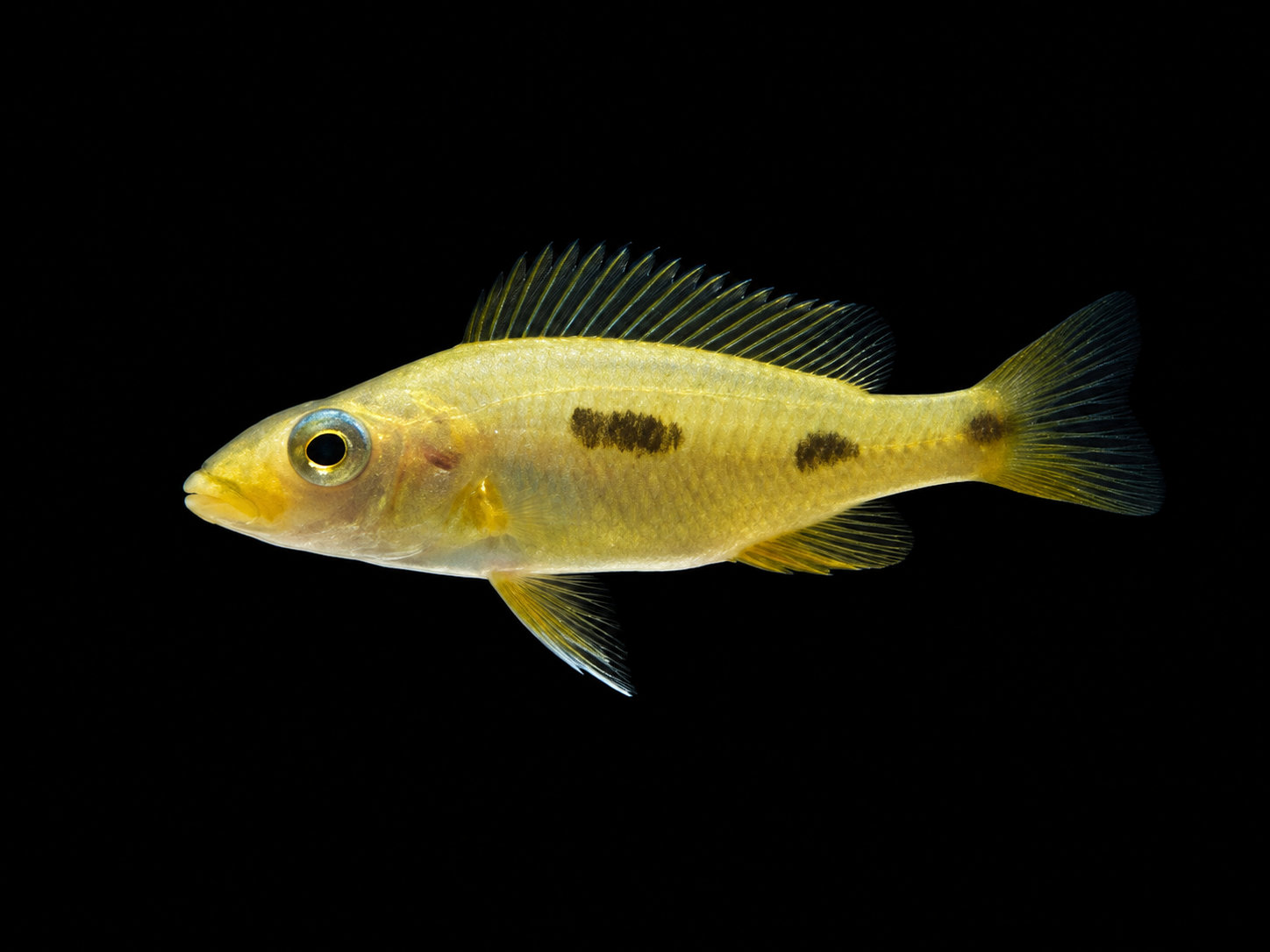
解説 / Description
エクソコクロミス・アナゲニスは、アフリカ大地溝帯に位置するマラウイ湖の固有種で、魚類を主な餌とする大型のシクリッドです。魚雷を思わせる細長い流線型の体、体側に並ぶ3つの黒色斑点、鳥の嘴を思わせる独特な顎が大きな特徴です。成熟したオスは繁殖期になると体全体に鮮やかな青色が現れ、広い水槽では力強く伸びやかな遊泳を見せます。本種はエクソコクロミス属を構成する唯一の種であり、特殊化した顎や歯、独特の捕食行動は、マラウイ湖のシクリッドが遂げてきた多様な適応の一例として興味深い存在です。飼育下では大型化するため、十分な遊泳空間と高い濾過能力を備えた大型水槽、さらにマラウイ湖産シクリッドに適した安定した弱アルカリ性の水質が必要になります。 Exochochromis anagenys is a large piscivorous cichlid endemic to Lake Malawi in the African Rift Valley. Its defining features include a streamlined, torpedo-like body, three dark blotches along the flank, and an unusual beak-like jaw. Breeding males develop vivid blue coloration and, when given sufficient room, display powerful open-water swimming. The species is the sole member of the genus Exochochromis, and its specialized jaws, teeth, and hunting behavior provide a striking example of ecological specialization among Lake Malawi cichlids. Because it becomes a large fish in captivity, long-term care requires generous swimming space, strong filtration, and stable alkaline water suitable for Malawi cichlids.
基本情報 / Basic Information
| 学名 / Scientific Name | Exochochromis anagenys |
|---|---|
| 通称 / Common Name | エクソコクロミス・アナゲニス、スリースポット・トーピード、マラウイ・トーピードThreespot torpedo, Malawi torpedo |
| 分類 / Family | シクリッド科、アフリカンシクリッド亜科。エクソコクロミス属は本種1種のみからなる単型属です。Family Cichlidae, subfamily Pseudocrenilabrinae. Exochochromis is a monotypic genus containing only this species. |
| 英名 / English Name | Threespot torpedo / Malawi torpedo |
| 分布 / Distribution | マラウイ湖固有種。FishBaseではタンビ島西岸と湖の南東部から記録されており、水深5〜126mの範囲で確認されています。砂地と岩場が接する環境や、砂と岩が混在する比較的深い場所に生息します。趣味分野の文献では、より広い湖内分布を示す記述もあります。Endemic to Lake Malawi. FishBase records the species from Thumbi Island West and the southeastern arm of the lake, at depths of about 5–126 m. It inhabits moderately deep areas with sandy and rocky substrates. Some specialist aquarium literature describes a broader distribution within the lake. |
| 最大体長 / Max Size | FishBaseで確認されている最大標準体長は20cmです。飼育分野では25〜30cm前後まで成長する例も紹介されており、大型化を見越した飼育環境が必要です。FishBase lists a maximum standard length of 20 cm. Specialist aquarium sources also report captive individuals reaching roughly 25–30 cm, so the species should be housed with its potential large adult size in mind. |
| 寿命 / Lifespan | 信頼できる資料から具体的な寿命年数を確認できません。長期飼育では、急激な水質変化を避け、十分な空間と安定した濾過環境を維持することが重要です。A reliable species-specific lifespan figure could not be confirmed. Long-term husbandry should therefore focus on stable water conditions, ample space, and consistent filtration. |
飼育環境 / Aquarium Environment
| 水槽サイズ / Tank Size | 大型で活発に泳ぐため、少なくとも150×60×60cm級(約540L)の大型水槽を目安にします。専門的な飼育情報では、160cm・500L超を最低クラスとする例や、成魚の長期飼育では220〜250cm級・800〜1,000L以上を勧める例もあります。日本で一般的な感覚では150〜180cm級の大型水槽以上を前提とし、混泳や繁殖を行う場合はさらに余裕を持たせるのが安全です。Because this is a large and active swimmer, an aquarium around 150 × 60 × 60 cm, roughly 540 L, should be regarded as a practical minimum target. Specialist sources also recommend tanks exceeding 500 L and, for long-term adult care, aquariums of about 220–250 cm and 800–1,000 L or more. Extra space is especially important for mixed groups or breeding setups. |
|---|---|
| 水温 / Temperature | 23〜27℃を基本の目安とし、飼育情報によっては28℃程度までの範囲も示されています。高温そのものよりも、短時間での急激な水温変化を避けることが大切です。 About 23–27°C is a well-supported target range, although some specialist aquarium sources extend the upper end to around 28°C. Stability is more important than maintaining the fish near either extreme. |
| 水質 / Water Quality | 弱アルカリ性の中硬水〜硬水が適します。FishBaseではpH 7.4〜8.4、総硬度7〜30 dHが示されています。サンゴ砂やリフトレイク向けのミネラル調整材は水質を安定させる補助になりますが、数値を急に変えることは避けます。アルカリ性の水では非イオン化アンモニアの割合が増えるため、アンモニアと亜硝酸を検出させない安定した生物濾過と、定期的な換水が重要です。Moderately hard to hard, alkaline water is appropriate. FishBase gives a range of pH 7.4–8.4 and 7–30 dH. Coral sand or Rift Lake mineral products can help stabilize water chemistry, but sudden adjustments should be avoided. In alkaline water, a greater proportion of total ammonia is present as toxic un-ionized ammonia, making stable biological filtration and regular water changes especially important. |
| レイアウト / Layout | 広い遊泳スペースを確保しつつ、岩組みで隠れ場所と視線を遮る場所を作ります。岩を詰め込みすぎると、追われた個体が衝突して傷つくおそれがあるため、岩場と開けた空間の両方を残すことが大切です。底床は砂系が扱いやすく、必要に応じてサンゴ砂やアラゴナイト系素材を水質維持の補助として利用できます。岩組みは大型魚が接触しても崩れないよう、安定させて設置します。Provide broad open swimming areas together with stable rockwork that creates refuge and visual barriers. Avoid overcrowding the tank with rocks, because chased fish can collide with hard structures. A sandy substrate is practical, and coral sand or aragonite may be used when helpful for mineral buffering. All rockwork should be secured against movement by large fish. |
| 注意点 / Precautions | 大型で遊泳力が高く、同種間、とくに成熟したオス同士では強い争いが起こる可能性があります。狭い水槽では逃げ場が不足し、追跡や衝突による外傷につながりやすいため、十分な空間を確保します。肉食性の大型魚は生体負荷も大きいため、濾過能力には余裕を持たせます。換水では新しい水の水温やpHを極端に変えず、水質の急変を避けることが重要です。This is a large, powerful swimmer, and strong intraspecific aggression may occur, particularly between mature males. Cramped quarters leave subordinate fish with too little escape space and increase the risk of injury. As a large carnivore, the species also places a substantial load on filtration. During water changes, avoid abrupt shifts in temperature or pH. |
餌と給餌 / Feeding
| 餌の種類 / Diet | 自然下では魚類を捕食する魚食性です。飼育下では、肉食性シクリッド向けの品質の良い配合飼料を主食にし、個体の大きさに合わせてフレーク、顆粒、ペレットを使い分けます。補助的に甲殻類などの冷凍餌や魚肉を利用できますが、生餌だけに偏らせず、栄養バランスと衛生面を優先します。In nature it is piscivorous and feeds on other fishes. In captivity, a high-quality formulated diet for carnivorous cichlids can be used as the staple food, with flakes, granules, or pellets selected according to fish size. Frozen crustacean-based foods or fish flesh may be offered as supplements, but the diet should not rely exclusively on unbalanced live or raw foods. |
|---|---|
| 給餌のポイント / Feeding Tips | 一度に大量に与えるのではなく、短時間で食べ切れる量を与えます。大型魚は食欲が強くても、過剰給餌は肥満や水質悪化につながります。特定の原料だけに原因を求めるのではなく、配合飼料を軸に餌の質と量を整え、残餌を出さない管理を続けることが重要です。Offer portions that can be consumed promptly rather than feeding large amounts at once. A strong appetite should not be taken as a reason to overfeed, because excess food contributes to obesity and declining water quality. Use a balanced formulated diet as the foundation and manage both food quality and quantity so that little or no waste remains. |
性格と混泳 / Temperament and Tank Mates
| 性格 / Temperament | 大型の捕食魚ですが、他種に対して常に攻撃的というわけではありません。一方、同種間では力関係がはっきりしやすく、とくに成熟したオス同士では激しい追跡や争いにつながる可能性があります。個体差もあるため、混泳では常に逃げ場と十分な距離を確保し、攻撃が続く場合にすぐ隔離できる準備をしておきます。Although this is a large predator, it is not necessarily aggressive toward every other species. Intraspecific hierarchy can be much more problematic, and mature males may engage in intense chasing or fighting. Individual temperament varies, so mixed aquaria should provide escape routes, ample distance, and a practical way to separate fish if aggression persists. |
|---|---|
| 混泳の相性 / Compatibility | 小型魚は捕食される可能性があるため、混泳相手には向きません。候補になるのは、口に入らない大きさで、過度に攻撃的ではない大型のマラウイ湖産シクリッドです。ただし、属名だけで相性を判断することはできないため、体格、性格、収容数、水槽の広さを総合して選びます。成熟オス同士の同居はとくに慎重に判断し、繁殖を目的とする場合も、1オスと複数メスを収容できる十分な空間が必要です。Small fish may be treated as prey and are unsuitable tank mates. Better candidates are large Malawi cichlids that cannot be swallowed and are not excessively aggressive. Compatibility should not be judged by genus alone; body size, temperament, stocking density, and available space all matter. Housing mature males together requires particular caution, and breeding groups also need enough room for one male and multiple females. |
病気と対策 / Diseases and Prevention
| かかりやすい病気 / Common Diseases | 本種だけに特有の「かかりやすい病気」は、信頼できる資料から明確には確認できません。アフリカンシクリッドでは、食欲低下、白く細い便、腹部膨満、呼吸の乱れなどを伴う症状群が「マラウイ・ブロート」と呼ばれることがありますが、原因は一つに決められておらず、似た症状を示す別の疾病や消化器トラブルもあります。また、口内保育中のメスは正常でも餌を取らなくなるため、繁殖行動との見分けも必要です。No disease can be confirmed as uniquely or especially characteristic of this species from reliable species-specific sources. African cichlids may develop a syndrome commonly called Malawi bloat, with signs such as appetite loss, thin pale feces, abdominal swelling, or abnormal respiration, but the underlying cause is not considered singular or certain. Similar signs can arise from other diseases or digestive problems, and a mouthbrooding female may also stop feeding normally. |
|---|---|
| 対策と予防 / Prevention | 予防の基本は、アンモニアと亜硝酸を検出させない濾過、定期的な換水、過密や持続的な攻撃によるストレスの軽減、そして過剰給餌を避けた安定した食餌管理です。食欲低下や腹部膨満などの異常が見られたら、まず水温、pH、アンモニア、亜硝酸などを確認し、必要に応じて隔離します。症状だけで病原体を特定することは難しいため、薬剤を自己判断で選ぶより、魚病に詳しい獣医師や専門家へ相談し、原因に応じた処置を行うのが安全です。Prevention centers on stable filtration with no detectable ammonia or nitrite, regular water changes, reduced chronic social stress, and controlled feeding without excess. If appetite loss, abdominal swelling, or other abnormal signs appear, first check temperature, pH, ammonia, and nitrite, and isolate the fish when appropriate. Because external signs alone rarely identify a single cause with confidence, medication should not be chosen solely from a symptom label; consultation with a veterinarian or experienced aquatic-animal professional is the safer approach. |
増やし方(繁殖) / Breeding
| 雌雄の判別 / Sexing | 成熟したオスは繁殖期に青色が強くなり、メスや非繁殖期のオスよりも色彩差が分かりやすくなります。専門的な飼育資料では、湖の北側の個体群ではメスや非繁殖期のオスが黄色みを帯び、南側では銀色を呈する傾向が紹介されています。幼魚では色彩差が十分に出ないため、外見だけでの雌雄判別は難しくなります。Mature males become much bluer during breeding, making them easier to distinguish from females and non-breeding males. Specialist aquarium literature reports that females and non-breeding males from northern populations tend to be more yellowish, while southern populations may appear silvery. Juveniles lack fully developed adult coloration and are correspondingly difficult to sex by appearance alone. |
|---|---|
| 繁殖形態 / Reproduction | 母系口内保育型です。産卵後はメスが卵を口に回収し、孵化後の稚魚が自力で泳げる段階まで口内で保護します。飼育資料では口内保育期間はおよそ3週間前後とされ、この間、メスは通常ほとんど餌を取りません。A maternal mouthbrooder. After spawning, the female collects the eggs and protects the developing brood in her mouth until the fry are able to swim independently. Specialist aquarium sources describe a brooding period of roughly three weeks, during which the female normally eats little or not at all. |
| 繁殖のポイント / Breeding Tips | 繁殖には、親魚が互いに距離を取れる大型水槽が必要です。1オスに複数メスを組み合わせる方法が一般的ですが、固定的な比率だけで安全が保証されるわけではありません。オスの追尾が強い場合は、メスが身を隠せる場所を増やし、必要に応じて隔離します。口内保育中のメスは落ち着ける環境を保ち、稚魚を分けて育てる場合は、ブラインシュリンプ幼生や細かくした良質な人工飼料を少量ずつ与え、安定した水質のもとで成長させます。Breeding requires a large aquarium in which adults can maintain distance from one another. One male with multiple females is a common arrangement, but no fixed ratio can guarantee safety. If courtship pressure becomes excessive, increase refuge and separate fish when necessary. A brooding female should be kept under calm, stable conditions, and separated fry can be raised on newly hatched brine shrimp and finely crushed high-quality prepared foods with careful water-quality control. |
雑学と豆知識 / Trivia and Fun Facts
| 1. たった1種だけの属をつくる魚 / 1. A genus built around a single species | エクソコクロミス・アナゲニスは、Michael K. Oliverによって1989年に記載されました。これに先立つ未公刊の学位論文では「Cyrtocara anagenys」という組み合わせが使われていましたが、これは動物命名規約上の正式な学名として公表されたものではありません。1989年の分類学的整理では、特徴的な顎や歯列、頭部の形態をもつ本種のためにエクソコクロミス属が設けられました。現在もこの属に含まれるのは本種だけで、単型属という位置づけそのものが、マラウイ湖産シクリッドの中でも形態的な独自性が際立つことを物語っています。Exochochromis anagenys was described by Michael K. Oliver in 1989. The combination Cyrtocara anagenys had appeared earlier in an unpublished dissertation, but it was not a formally published zoological name. In the 1989 taxonomic treatment, the genus Exochochromis was established for this fish because of its distinctive jaw, dentition, and cranial morphology. The genus still contains only this species, and that monotypic status underscores its unusual anatomical position among Lake Malawi cichlids. |
|---|---|
| 2. 嘴のような顎は捕食のための道具 / 2. A beak-like jaw built for predation | 本種の印象的な顔つきは、独特な顎の構造から生まれています。下顎の先端は上顎の先端より後方に位置し、歯列を支える部分は外側へ張り出すような形をしています。口の前方には後方へ湾曲した単尖頭の歯が並び、獲物を側方からとらえる捕食方法に適した形態と考えられています。さらに、喉の奥にある咽頭顎にも尖った歯が備わっています。獲物をつかむ口顎と、飲み込んだ餌を処理する咽頭顎がそれぞれ役割を分担していることは、シクリッドの摂食器官がいかに多様化してきたかを実感させる特徴です。The species’ distinctive facial profile comes from an unusual jaw structure. The lower jaw tip lies behind the upper jaw tip, while the tooth-bearing region projects outward. Backward-curving, single-pointed teeth occur toward the front of the mouth and are consistent with a feeding style that grips prey during a lateral strike. Pointed teeth are also present on the pharyngeal jaws deeper in the throat. The division of labor between the oral jaws that seize prey and the pharyngeal jaws that process swallowed food illustrates the remarkable diversity of feeding structures in cichlids. |
| 3. 斜めに忍び寄る独特の狩り / 3. A tilted approach to hunting | 本種は魚類を捕食し、岩場の周辺で獲物を探す行動が知られています。専門的な観察記録では、獲物に対して体を傾け、一方の眼で位置を確かめるように接近したのち、頭を横方向へすばやく動かして捕らえる行動が紹介されています。傾いた姿勢には獲物から見つかりにくくする効果がある可能性も指摘されていますが、その機能を断定できるだけの情報は限られています。それでも、流線型の体と特殊な顎、横方向からの素早い攻撃が結びついた捕食方法は、本種を特徴づける非常に興味深い行動です。The species is piscivorous and is known to hunt around rocky habitats. Specialist observations describe it approaching prey with the body tilted, apparently using one eye to track the target, before making a rapid sideways movement of the head to capture it. The tilted posture has been suggested to reduce detection by prey, although the function should be treated as a hypothesis rather than a proven optical mechanism. Its streamlined body, unusual jaws, and lateral strike nevertheless form a distinctive predatory strategy. |
| 4. 地域で変わる雌や非発情オスの色 / 4. Regional variation in non-breeding coloration | 成熟オスの鮮やかな青色が目を引く本種ですが、メスや非繁殖期のオスにも興味深い地域差が報告されています。専門的な飼育資料では、湖の北側では黄色みを帯びた体色に3つの斑点が現れ、南側では銀色を基調とする個体が見られるとされています。こうした色彩差が生じる背景については慎重に考える必要がありますが、同じ種でも採集地によって外見の印象が変わることは、マラウイ湖の魚を観察する楽しさの一つです。Breeding males are best known for their vivid blue coloration, but specialist aquarium literature also reports geographic variation in females and non-breeding males. Northern fish are described as more yellowish with three flank blotches, whereas southern fish may have a more silvery base color. The causes of this variation should not be overstated, but differences associated with collection locality add another layer of interest when observing the species. |
| 5. 母親の口が育児室になる / 5. The mother’s mouth becomes a nursery | 本種はメスが卵と稚魚を口の中で守る母系口内保育を行います。産卵後、メスは卵を口へ回収し、その後は孵化した稚魚がある程度育つまで口腔内で保護します。飼育下では約3週間前後の口内保育が報告されており、この間のメスはほとんど餌を取りません。鋭い顎を持つ捕食魚でありながら、繁殖期には同じ口が次世代を守るための空間になるという対比は、マラウイ湖産シクリッドの繁殖生態を象徴する興味深い一面です。The species is a maternal mouthbrooder: after spawning, the female collects the eggs and protects the developing brood inside her mouth. Captive accounts describe a brooding period of roughly three weeks, during which the female eats little or not at all. The contrast is striking—a specialized predatory fish uses the same mouth that captures prey as a protected space for the next generation. |
まとめ / Conclusion
エクソコクロミス・アナゲニスは、マラウイ湖のシクリッドが示す多様な適応を、姿と行動の両面から感じさせる大型種です。流線型の体、3つの黒色斑点、独特な顎と歯、そして獲物へ横方向から仕掛ける捕食行動には、魚食性の生活に合わせて形態と行動が結びついてきたことが表れています。繁殖期のオスが見せる鮮やかな青色だけでなく、単型属として扱われる分類学的な独自性や、母系口内保育という繁殖方法まで知ることで、この魚の奥行きはいっそう深まります。 Exochochromis anagenys is a large cichlid that expresses the diversity of Lake Malawi through both form and behavior. Its streamlined body, three dark flank blotches, unusual jaws and teeth, and lateral predatory strike all reflect a life specialized around feeding on other fishes. The vivid blue of breeding males is only one part of its appeal; its monotypic taxonomic status and maternal mouthbrooding behavior add further depth to the species.
飼育では、その魅力に見合うだけの空間と管理が欠かせません。大型水槽に広い遊泳域を確保し、弱アルカリ性の水質を安定させ、余裕のある濾過と適切な給餌を続けることで、本種らしい力強い体つきと落ち着いた泳ぎを引き出しやすくなります。同種間の争いや小型魚への捕食にも十分な配慮が必要ですが、条件を整えた環境で成熟したオスが青く発色し、長い体を伸ばして泳ぐ姿には、マラウイ湖で培われた捕食者としての美しさと、シクリッドならではの進化の奥深さが凝縮されています。 Keeping the species well requires space and husbandry equal to its presence. A large aquarium with broad swimming room, stable alkaline water, ample filtration, and controlled feeding helps the fish maintain strong condition and natural movement. Intraspecific aggression and predation on smaller tank mates still require careful management, but when a mature male turns blue and moves through a spacious aquarium with its elongated profile, the result conveys both the beauty of a Lake Malawi predator and the evolutionary depth of the cichlid lineage.

気になる道具や飼い方を見つけてみませんか?
 アイのアクアグッズ案内水槽の流木の選び方|枝・マングローブ・アク抜きとおすすめ商品水槽に小さな森を作る流木。枝流木やマングローブという名前の違いから、魚の隠れ家、水草の取り付け、浮く・水が茶色くなるときの準備まで、アイとコタロウが商品とともに案内します。記事はコチラ →
 アイのアクアグッズ案内プレコ飼育に必要なもの|餌・流木・ろ過・隠れ家・掃除用品道具の特徴や使い方、選ぶときのポイントをアイが紹介します。記事はコチラ →
 アイのアクアグッズ案内マジックリーフ物語|一枚の葉がアクアリウム用品になるまで道具の特徴や使い方、選ぶときのポイントをアイが紹介します。記事はコチラ →
 アイのアクアグッズ案内水換え・底砂掃除の道具の選び方|砂利・砂・ソイルに合うクリーナーとポンプ道具の特徴や使い方、選ぶときのポイントをアイが紹介します。記事はコチラ →
さまざまな飼育テーマをご紹介。リンク先の記事には広告・商品紹介が含まれます。
案内・紹介記事一覧へ →分布マップ
エクソコクロミス・アナゲニスはマラウイ湖の固有種です。記事ではタンビ島西岸と湖の南東部から記録され、水深5〜126mほどの砂地と岩場が接する環境などに生息するとされています。下の地図は記載内容を位置関係として把握するための概略表示で、実際の採集地点や厳密な生息範囲を示すものではありません。
※ 地図上の点と範囲は、記事に記載された分布情報をもとに設定した概略的な代表位置・代表範囲です。実際の採集地点、個体ごとの観察地点、厳密な生息域の境界を示すものではありません。また、趣味分野の文献で示されるより広い湖内分布については、確実な地点としてプロットしていません。
参考文献
-
Eccles, D. H. & Trewavas, E. (1989). Malawian Cichlid Fishes: The Classification of Some Haplochromine Genera. Lake Fish Movies, Herten, West Germany, 334 pp. Exochochromis属およびExochochromis anagenysの原記載を含み、形態、分類、生息環境、食性を確認する基礎文献。
FishBase Reference Summary -
Snoeks, J. (ed.) (2004). The Cichlid Diversity of Lake Malawi/Nyasa/Niassa: Identification, Distribution and Taxonomy. Cichlid Press, El Paso, 360 pp. ISBN 0-9668255-8-6. マラウイ湖産シクリッドの同定、分布、分類を湖全体の調査データに基づいて整理した専門書。
FishBase Reference Summary -
Maréchal, C. (1991). Exochochromis. In: Daget, J., Gosse, J.-P., Teugels, G. G. & Thys van den Audenaerde, D. F. E. (eds.), Check-list of the Freshwater Fishes of Africa, Vol. 4, p. 89. ISNB, MRAC & ORSTOM. 属の扱い、タイプ情報、分布、標準体長などを確認できるアフリカ淡水魚の体系的チェックリスト。
IRD 公開PDF -
Froese, R. & Pauly, D. (eds.). FishBase. Exochochromis anagenys species summary. 分類、最大体長、マラウイ湖内の確認分布、水深5〜126m、砂地と岩場を含む生息環境、魚食性、水温23〜27℃、pH 7.4〜8.4、硬度7〜30 dHなどの総合的な参照資料。
FishBase: Exochochromis anagenys -
Duponchelle, F., Paradis, E., Ribbink, A. J. & Turner, G. F. (2008). Parallel life history evolution in mouthbrooding cichlids from the African Great Lakes. Proceedings of the National Academy of Sciences, 105(40), 15475–15480. doi:10.1073/pnas.0802343105. マラウイ湖産シクリッドに広く見られる母系口内保育と、その生活史上の位置づけを支える査読論文。
PubMed Central -
Petty, B. D., Francis-Floyd, R. & Yanong, R. P. E. Bacterial Diseases of Fish. MSD Veterinary Manual. Updated September 2024. 観賞魚の細菌性疾患について、水質悪化、有機物負荷、輸送、温度変化、低酸素、ストレスなどが発症リスクを高めること、また症状だけで病原体を断定せず診断に基づいて治療する必要性を示す獣医学資料。
MSD Veterinary Manual -
Francis-Floyd, R. Cryptobia iubilans in Cichlids. University of Florida IFAS Extension. シクリッド類の消化管性疾患について、Spironucleus類などとの鑑別、過密、衛生状態、水質、有機物負荷、取扱いストレスなどの関与を解説する大学機関資料。
University of Florida IFAS Extension




コメント