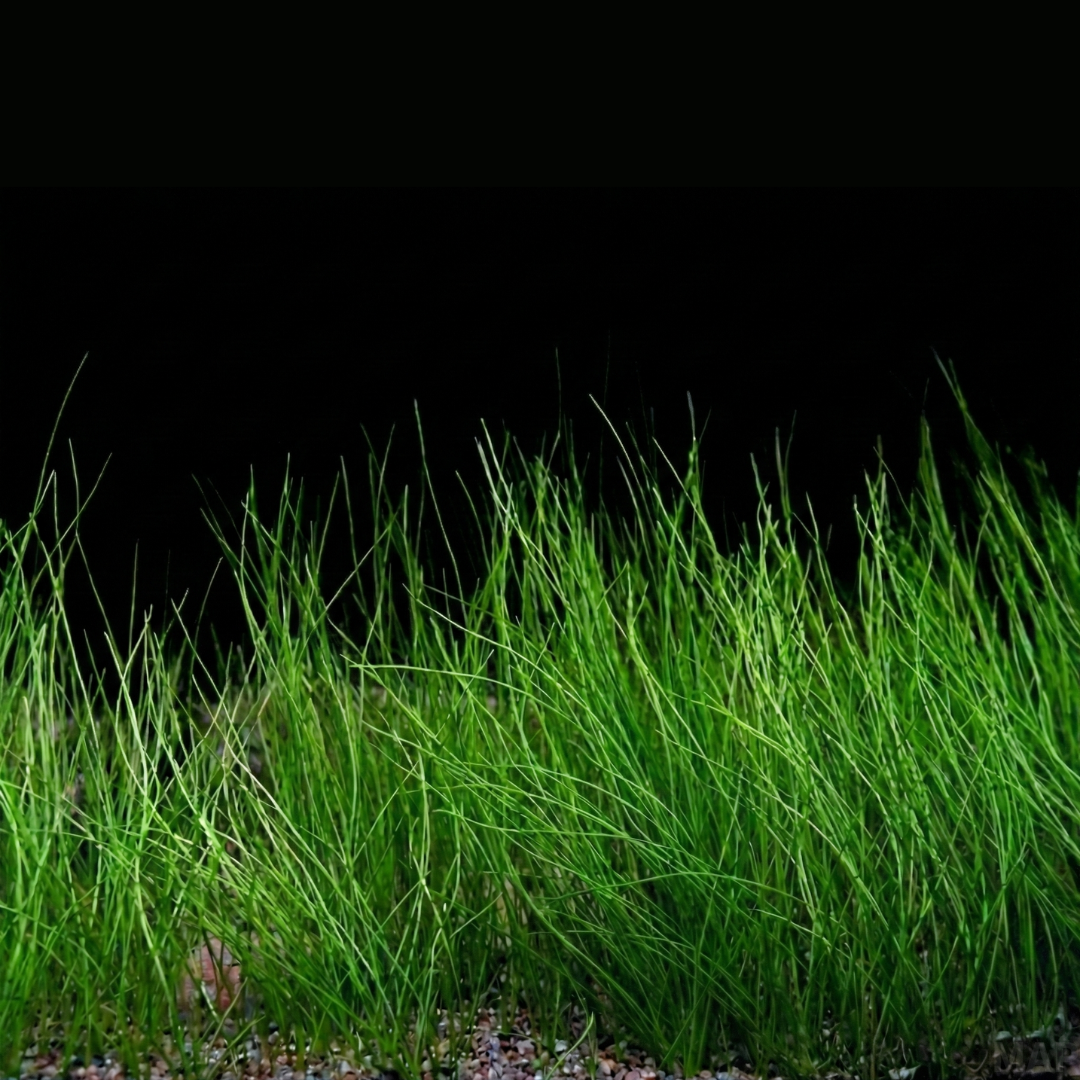
ヘアーグラスは、アクアリウムにおける前景草の代表格であり、水槽内に広大な草原を再現するために欠かせない存在です。カヤツリグサ科ハリイ属に分類されるこの植物は、針状の繊細な葉を密生させ、涼しげで自然感あふれる景観を作り出します。日本国内でもマツバイとして自生しているため親しみ深く、特に石組を用いたネイチャーアクアリウムにおいて、主役の石を際立たせるための名脇役、あるいは主役としての地位を確立しています。強靭な生命力を持ち、適切な環境下では地下茎で勢いよく増殖し、美しい緑の絨毯を完成させてくれます。Hairgrass is a quintessential foreground plant in the aquarium hobby, essential for recreating vast grasslands within a tank. Belonging to the genus Eleocharis in the Cyperaceae family, this plant produces dense, delicate needle-like leaves, creating a cool and natural-looking landscape. In Japan, it is familiar as Matsubai and has established a position as a key plant, especially in Nature Aquariums using Iwagumi styles to accentuate main stones. It possesses tough vitality; under appropriate conditions, it spreads vigorously via runners, completing a beautiful green carpet.
基本情報 / Basic Information
学名 / Scientific Name
Eleocharis acicularis
通称 / Common Name
ヘアーグラス、マツバイ、アップライト・ヘアーグラス(注:「ショート」は流通名で、Eleocharis parvulaやEleocharis pusillaなどが扱われます。本記事はE. acicularisを対象とします)Hairgrass, Matsubai, Upright hairgrass (Note: Short hairgrass is a trade name used for plants such as Eleocharis parvula and Eleocharis pusilla. This article concerns E. acicularis)
分類 / Family
カヤツリグサ科ハリイ属Cyperaceae, Eleocharis
分布 / Distribution
北半球の温帯域(日本、東アジア、北米、ヨーロッパ)。熱帯域への分布は限定的です。Temperate regions of the Northern Hemisphere (Japan, East Asia, North America, Europe). Distribution in tropical regions is limited.
育成難易度 / Difficulty
中級(光量とCO2添加が必須のため、水草初心者にはやや難易度が高いです)Intermediate (Somewhat difficult for beginners due to essential requirements for light and CO2)
育成環境 / Cultivation Environment
光量 / Light
強め(60cm規格水槽で2,500から3,000ルーメン以上のLED照明を推奨)Strong (LED lighting of 2,500 to 3,000 lumens or more for a standard 60cm tank is recommended)
CO2添加 / CO2 Injection
必須(美しい絨毯を作るためには1秒1から2滴程度の添加が望ましい)Essential (1 to 2 drops per second recommended for a beautiful carpet)
水質 / Water Quality
弱酸性から中性の軟水(pH 5.5から7.0、水温 18から28度)Soft water, slightly acidic to neutral (pH 5.5 to 7.0, temperature 18 to 28 degrees Celsius)
底床 / Substrate
ソイル推奨(パウダータイプを併用すると根が張りやすくなります)Soil recommended (Using powder type soil helps root development)
レイアウト / Layout
配置 / Positioning
前景(草原を表現するメインの植物として)Foreground (As the main plant for representing grasslands)
注意点 / Precautions
光が不足すると背が高く伸びてしまい、低い絨毯状にならないため注意が必要です。Insufficient light causes vertical elongation, preventing it from forming a low carpet.
増やし方(トリミング) / Propagation & Trimming
増やし方 / Propagation
地下茎(ランナー)を伸ばして次々と新芽を出して広がります。Spreads by extending runners that produce new shoots sequentially.
トリミング / Trimming
芝刈りのようにハサミで短くカットすることで、新芽の密度が高まり、美しく揃います。Cutting short with scissors like mowing a lawn increases density and creates an even look.
病気と対策(コケなど) / Pests & Algae
かかりやすい病気 / Common Issues
葉が細いため、糸状のアオミドロや黒髭ゴケが付着しやすい傾向があります。The fine leaves are prone to filamentous green algae and black beard algae.
対策と予防 / Prevention
ヤマトヌマエビなどのお掃除役を導入し、水質を安定させてコケを防ぐことが重要です。Introducing cleaning crews like Amano shrimp and stabilizing water quality to prevent algae is crucial.
雑学と豆知識 / Trivia and Fun Facts
1. 驚異の光合成スイッチ:C3型とC4型の転換1. Incredible Photosynthetic Switch: C3 and C4 Conversion
ハリイ属の別種 Eleocharis vivipara では、陸上でC4型、水中でC3型の特徴を示す光合成可塑性が研究されています。Ueno(1998)は、水中で育つ同種にアブシシン酸を処理し、C4型に似た形態・生化学的特徴が誘導されることを報告しました。これは本記事の E. acicularis に同じ切り替えがあることを示す研究ではありません。The related species Eleocharis vivipara exhibits C4-like traits on land and C3-like traits underwater. Ueno (1998) reported that abscisic acid treatment induced C4-like anatomical and biochemical traits in submerged plants of that species. This study does not establish the same switch in E. acicularis, the subject of this article.
2. 和名「マツバイ」と「チャボイ」の語源2. Etymology of the Japanese Names Matsubai and Chaboi
日本に自生する種にはマツバイ(松葉藺)という和名がありますが、これはその細く尖った葉を松の葉に見立てた、日本人らしい風情ある命名です。また、ショート種を指すチャボイ(矮藺)のチャボは、小型のニワトリの品種名から取られており、身近な生き物に例える観察眼の鋭さが伺えます。Native Japanese species are known as Matsubai, meaning pine needle rush, a poetic naming reflecting its sharp leaves. The name Chaboi for dwarf species comes from Chabo (bantam chickens), showing keen observation in comparing plants to familiar animals.
3. 水を清めるフィトレメディエーションの力3. Phytoremediation: The Power to Purify Water
マツバイ(Eleocharis acicularis)は重金属を体内に取り込み、蓄積する能力が研究されています。Sakakibaraら(2011)は、鉱山地域での野外栽培実験から、銅・亜鉛・ヒ素・カドミウムを蓄積する性質を報告し、植物を用いる環境修復への応用を検討しました。蓄積は金属が消失・無毒化することとは異なり、一般の観賞水槽で安全な浄化を保証する結果でもありません。Heavy-metal accumulation by Eleocharis acicularis has been studied. In field cultivation at mine sites, Sakakibara and colleagues (2011) reported accumulation of copper, zinc, arsenic and cadmium and evaluated its potential for phytoremediation. Accumulation does not mean that the metals disappear or become harmless, nor does the study guarantee safe purification in an ordinary aquarium.
まとめ / Conclusion
ヘアーグラスは、その繊細な外見からは想像もつかないほど強靭な生命力を持ち、地下茎によって広がる性質を持つ水草です。日本のアクアリストにとっても古くから馴染み深く、草原を思わせるその景観は、私たちの心を癒してくれる特別な魅力を持っています。Hairgrass possesses a surprisingly tough vitality despite its delicate appearance, spreading through its underground runners. It has long been familiar to Japanese aquarists, and its landscape, reminiscent of a vast meadow, holds a special charm that heals our hearts.
美しい緑の絨毯を作るには、十分な光量(60cm規格水槽で2,500ルーメン以上)とCO2添加、そして栄養豊富なソイルが鍵となります。初心者にはやや難易度が高い一面もありますが、環境を整えればそれに応えてくれる素晴らしい植物です。茂みの密度やコケの付着を観察し、トリミングで株元まで光と水流が届く状態を維持します。The keys to creating a beautiful green carpet are sufficient light (at least 2,500 lumens for a 60cm tank), CO2 injection, and nutrient-rich soil. While it presents some challenges for beginners, it is a wonderful plant that responds well to a properly prepared environment. Observe carpet density and algae, and trim to maintain light and circulation at the plant bases.
専門知識
Ueno, O. (1998). Induction of Kranz Anatomy and C4-like Biochemical Characteristics in a Submerged Amphibious Plant by Abscisic Acid. The Plant Cell, 10(4), 571–583. doi:10.1105/tpc.10.4.571 (別種E. viviparaの研究)
専門知識
Sakakibara, M., Ohmori, Y., Ha, N. T. H., Sano, S., & Sera, K. (2011). Phytoremediation of heavy metal-contaminated water and sediment by Eleocharis acicularis. CLEAN – Soil, Air, Water, 39(8), 735–741. doi:10.1002/clen.201000488 (本種の野外栽培・重金属蓄積実験)




コメント