

解説 / Description
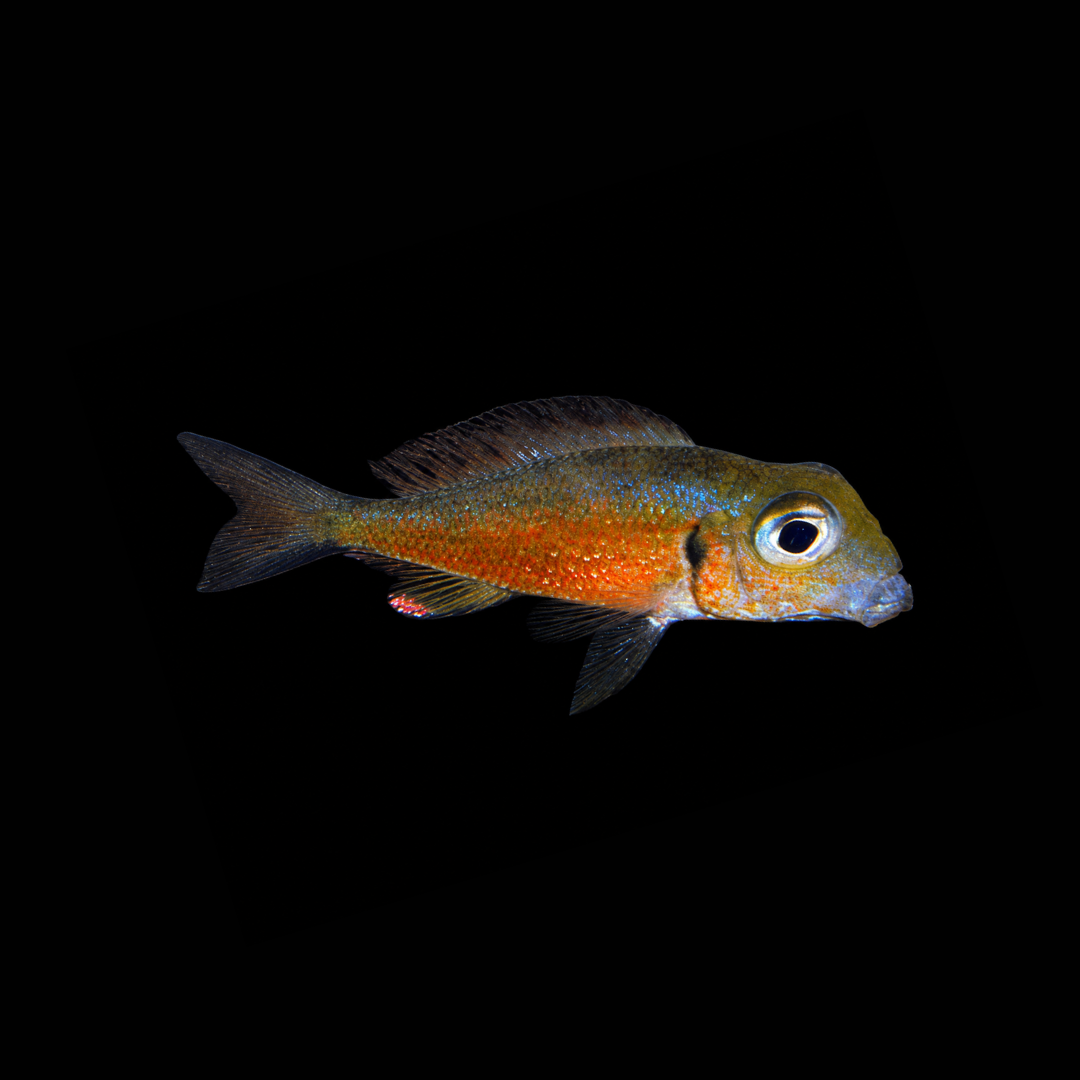
カロクロミス・マクロプスは、東アフリカの古代湖・タンガニーカ湖に固有のカワスズメ科魚類です。砂底を生活の中心とするシクリッドで、種小名の由来にもなった大きな眼と、砂を口に含んで餌を選り分ける底砂濾過行動がよく知られています。成熟したオスは繁殖期になると体色が鮮やかになり、銀灰色を基調とした平常時とは異なる印象を見せます。自然下では砂底や岩場に近い底層で採餌し、メスは口内で卵や仔魚を保護します。飼育では弱アルカリ性の硬水と細かな砂底を用意し、成熟したオスの縄張り行動を受け止められる広い底面積を確保することが重要です。 Callochromis macrops is a cichlid endemic to Lake Tanganyika in East Africa. It is closely associated with sandy bottom habitats and is well known for its large eyes and sand-sifting feeding behavior. Mature males become much more colorful during breeding, contrasting with their comparatively subdued non-breeding appearance. In the wild, adults feed over sandy bottoms near rocky areas, and females brood eggs and larvae in the mouth. Aquarium care is centered on hard, alkaline water, fine sand, a broad bottom area, and enough space to manage the territorial behavior of mature males.
基本情報 / Basic Information
| 学名 / Scientific Name | Callochromis macrops (Boulenger, 1898) |
|---|---|
| 通称 / Common Name | カロクロミス・マクロプス。英語圏では「Big-eyed Mouthbrooder」「Large-eyed Mouthbrooder」などの呼称が見られます。産地や流通名によって「Red Macrops」などと呼ばれることもあります。Callochromis macrops; common English names include “Big-eyed Mouthbrooder” and “Large-eyed Mouthbrooder.” Some locality forms are also traded under names such as “Red Macrops.” |
| 分類 / Family | シクリッド目・カワスズメ科・プセウドクレニラブルス亜科・エクトドゥス族・カロクロミス属Order Cichliformes, family Cichlidae, subfamily Pseudocrenilabrinae, tribe Ectodini, genus Callochromis. |
| 英名 / English Name | Big-eyed Mouthbrooder / Large-eyed Mouthbrooder |
| 分布 / Distribution | タンガニーカ湖固有。湖の極北部を除く広い範囲に分布し、FishBaseではブルンジのニャンザ・ラックより北の極北域を除いて見られるとされています。成魚は岩場に近い砂底で採餌することが知られています。Endemic to Lake Tanganyika. FishBase reports the species from most of the lake except the extreme north, north of Nyanza-Lac in Burundi. Adults are known to feed over sandy bottoms near rocky areas. |
| 最大体長 / Max Size | 最大全長は13.5cmほどです。成熟したオスはメスより大きくなる傾向がありますが、雌雄別の最大値については情報にばらつきがあります。Maximum total length is about 13.5 cm. Mature males tend to be larger than females, although sex-specific maximum sizes are not consistently reported. |
| 寿命 / Lifespan | 寿命については一貫した信頼性の高いデータが乏しく、明確な年数は示せません。A consistent, well-supported lifespan figure could not be confirmed, so no specific number is given. |
飼育環境 / Aquarium Environment
| 水槽サイズ / Tank Size | 最低でも120×45cm以上の底面積を持つ120cm規格水槽クラス、水量240〜300L以上が推奨されます。オスを複数飼育する場合は180cmクラス以上が必要とされますが、基本は1水槽につきオス1匹が安全です。A tank with at least a 120 × 45 cm footprint, roughly equivalent to a standard Japanese 120 cm aquarium and 240–300 L or more, is recommended. Keeping multiple males calls for a tank in the 180 cm class or larger, although one male per aquarium is the safer approach. |
|---|---|
| 水温 / Temperature | 飼育の目安は24〜27℃です。FishBaseでは24〜26℃の熱帯性魚類として扱われています。日本の夏季は水温が大きく上昇しないように管理し、年間を通して急激な温度変化を避けます。 A practical aquarium range is about 24–27°C, while FishBase lists 24–26°C for the species. During hot summers, prevent excessive warming and avoid abrupt temperature changes throughout the year. |
| 水質 / Water Quality | 弱アルカリ性の硬水を安定して維持します。飼育の目安はpH 7.8〜9.0前後、GH 10〜25°dH程度です。個体差や飼育環境を考慮し、数値そのものよりも安定性を優先します。日本の軟水ではサンゴ砂やタンガニーカ湖産シクリッド向けのミネラル調整剤を利用できますが、数値を急変させないことが何より重要です。換水は定期的に行い、アンモニアと亜硝酸を検出させず、硝酸塩の蓄積も抑えます。Maintain stable hard, alkaline water. A practical aquarium target is around pH 7.8–9.0 and GH 10–25°dH. Stability is more important than pursuing the edge of any published range. In soft Japanese tap water, coral sand or mineral products intended for Lake Tanganyika cichlids can be useful, but stability is more important than chasing an exact number. Perform regular water changes, keep ammonia and nitrite undetectable, and limit nitrate accumulation. |
| レイアウト / Layout | 底砂には角のない細かな砂を用い、広い砂地を確保します。オスは砂を使って産卵場を整えるため、底面を石組みで埋め尽くさないことが大切です。一方で、水槽の後方や側面には岩や石組みを配置し、視線を遮る場所と逃げ場を作ります。バリスネリアやマツモなどの水草も利用できますが、砂を動かす習性があるため、植栽位置には余裕を持たせます。Use fine, smooth sand and preserve a broad open sandy area. Males prepare spawning sites in the substrate, so the bottom should not be filled completely with rockwork. At the same time, rocks placed toward the rear and sides can break lines of sight and provide retreats. Vallisneria and hornwort can also be used, although their placement should allow for the fish’s habit of moving sand. |
| 注意点 / Precautions | 成熟したオスは同種、とくに他のオスに対して非常に強い縄張り性を示します。狭い水槽で複数のオスを飼育すると激しい闘争に発展するおそれがあります。また、異なるロケーションの個体を混ぜると交雑する可能性があるため、産地情報を維持した飼育が重要です。換水時は飼育水と新水のpH・硬度差を小さくし、急変を避けます。Mature males are highly territorial toward conspecifics, especially other males, and serious fighting can occur in confined aquaria. Different locality forms may interbreed, so keeping locality information intact is important. During water changes, minimize differences in pH and hardness between old and new water to avoid sudden osmotic stress. |
餌と給餌 / Feeding
| 餌の種類 / Diet | 肉食傾向の強い雑食性で、自然下では砂中の昆虫幼虫、小型軟体動物、甲殻類などを捕食します。飼育下では肉食性シクリッド向けの高品質な沈下性ペレットを主食にし、補助的に冷凍イサザアミ、ミジンコ、ケンミジンコ類などを与えます。It is an omnivore with a strong carnivorous tendency, feeding in nature on insect larvae, small mollusks, crustaceans, and other invertebrates in the substrate. In captivity, high-quality sinking pellets for carnivorous cichlids can form the staple diet, supplemented with frozen mysids, Daphnia, and cyclopoid copepods. |
|---|---|
| 給餌のポイント / Feeding Tips | 底付近で自然に拾える沈下性フードを中心にし、食べ残しが出ない量を複数回に分けて与えます。底付近で自然に食べられる沈下性フードを中心にすると、本来の採餌行動を引き出しやすくなります。高脂肪な動物性食品や消化性に不安のある餌へ偏らせず、複数種類の餌を少量ずつ組み合わせます。Favor sinking foods that can be collected naturally from the bottom, and offer modest portions without leaving excess food. Sinking foods make it easier for the fish to feed close to the substrate and encourage more natural foraging behavior. Avoid relying on fatty animal foods or poorly digestible items, and use several suitable foods in modest portions. |
性格と混泳 / Temperament and Tank Mates
| 性格 / Temperament | 底層で活発に行動し、成熟したオスは繁殖期を中心に非常に強い縄張り意識を示します。同種のオスに対する攻撃性は特に強く、メスに対しても執拗な追尾が起こるため、広い底面積と十分な逃げ場が必要です。一方で、他種に対する攻撃性は同種間ほど強くないとされています。It is an active bottom-oriented fish, and mature males become strongly territorial, especially during breeding. Aggression toward rival males can be intense, and persistent chasing of females also occurs, so a large footprint and ample refuges are essential. Aggression toward unrelated species is generally described as lower than aggression among conspecifics. |
|---|---|
| 混泳の相性 / Compatibility | 同じタンガニーカ湖産で遊泳層が異なる種類との組み合わせが考えやすく、キプリクロミス属やパラキプリクロミス属など、上層を泳ぐ比較的温和な魚が候補になります。自然界で同所的に見られるアウロノクラヌス・デウィンティやエクトドゥス・デスカンプシィも生態的な参考になります。ただし、混泳では水槽サイズ、個体差、縄張りの形成状況を見ながら慎重に判断します。Tank mates from Lake Tanganyika that occupy different swimming zones are the easiest candidates. Relatively peaceful upper-water fishes such as Cyprichromis and Paracyprichromis are suitable candidates. Aulonocranus dewindti and Ectodus descampsii, which occur sympatrically in nature, are also useful ecological references. Even so, compatibility should be judged carefully according to tank size, individual temperament, and territory formation. |
病気と対策 / Diseases and Prevention
| かかりやすい病気 / Common Diseases | 本種だけに特有の代表的な疾病が確立されているわけではありません。飼育下では、他のアフリカンシクリッドと同様に、消化器症状、外部寄生虫、細菌性感染症など一般的な魚病に注意します。水質の悪化や急激なpH・硬度変化、過度な争いによるストレスは、体調を崩すきっかけになります。No single disease is established as uniquely characteristic of this species. As with other African cichlids, aquarium keepers should watch for general problems such as digestive disorders, external parasites, and bacterial infections. Poor water quality, abrupt changes in pH or hardness, and chronic social stress can all contribute to declining health. |
|---|---|
| 対策と予防 / Prevention | 予防の基本は、24〜27℃の安定した水温、弱アルカリ性の硬水、低い硝酸塩濃度を維持することです。換水は新水の水質を飼育水に近づけてから行い、食事は消化しやすい沈下性フードを中心にします。夏季の高水温対策、過密飼育の回避、日常的な食欲や呼吸、体色の観察も重要です。Prevention centers on maintaining a stable temperature of 24–27°C, hard alkaline water, and low nitrate. Match replacement water closely to the aquarium before water changes, and base the diet on easily digested sinking foods. Summer cooling, avoidance of overcrowding, and daily observation of appetite, respiration, and coloration are also important. |
増やし方(繁殖) / Breeding
| 雌雄の判別 / Sexing | 性的二型は明瞭で、成熟したオスはメスより大きく、繁殖期には体色が強く現れます。オスの尻びれにはオレンジ色の斑紋が見られ、行動学の文献ではエッグスポットとして扱われることがあります。一方、遺伝子発現を比較した研究では、本種の模様をハプロクロミス系統の典型的なエッグスポットとは区別して「ブロッチ(斑紋)」として解析しています。メスはオスより小型で、銀灰色を基調とした控えめな体色です。Sexual dimorphism is clear: mature males are larger and become more strongly colored during breeding. Orange markings occur on the male anal fin and are described as egg-spots in behavioral literature. However, comparative gene-expression studies analyze the Callochromis macrops marking as a “blotch,” distinguishing it from the typical haplochromine egg-spot. Females are smaller and retain a more subdued silvery-gray coloration. |
|---|---|
| 繁殖形態 / Reproduction | 母系口内保育型で、繁殖時にはオスが砂地に産卵場を作ります。メスは産卵した卵をすぐに口へ取り込み、その後も口内で卵と仔魚を保護します。行動学的研究では、オスの尻びれの斑紋が繁殖時の視覚信号として働く可能性が示されていますが、その機能を単純な「卵のだまし絵」と断定するのは避けた方が適切です。抱卵期間は飼育情報ではおおむね3週間前後とされています。This is a maternal mouthbrooder. During breeding, the male prepares a spawning site in the sand, and the female quickly takes spawned eggs into her mouth, where she continues to protect the eggs and larvae. Behavioral studies suggest that the male’s anal-fin markings may function as visual signals during reproduction, but it is more accurate not to reduce their role to a simple “fake egg” illusion. Aquarium references generally report a brooding period of about three weeks. |
| 繁殖のポイント / Breeding Tips | 繁殖グループはオス1匹にメス3〜4匹を組み合わせ、オスの求愛や追尾を複数のメスに分散させます。抱卵中のメスは強いストレスを避け、隔離する場合も抱卵後2週間以上経過してから慎重に移動させます。放出された稚魚は比較的大きく、ふ化直後のブラインシュリンプ幼生や細かく砕いたフードを食べることができます。稚魚は親魚から隔離し、少量を1日3〜4回に分けて給餌すると育成しやすくなります。A breeding group of one male with three to four females helps distribute courtship pressure. Mouthbrooding females should be kept free from excessive stress; if isolation is necessary, the source recommends moving them carefully after more than two weeks of brooding. Newly released fry are relatively large and can take newly hatched brine shrimp nauplii or finely crushed prepared food. Separating fry from adults and feeding small portions three to four times per day supports growth. |
雑学と豆知識 / Trivia and Fun Facts
| 1. 「大きな眼」を意味する種小名 / 1. A Species Name Meaning “Large-Eyed” | 種小名の「macrops」は、「大きな眼」を意味する語に由来します。実際に本種は眼が大きく、その姿は名前の印象とよく一致します。生息地として知られるのは、タンガニーカ湖の砂底や岩場に近い底層です。大きな眼と生息環境の関係については適応的な意味が考えられますが、眼の大きさだけから機能を断定することはできません。名前の由来と実際の姿が分かりやすく結びついている点は、本種を覚えるうえで格好の手がかりになります。The species name “macrops” derives from a term meaning “large-eyed,” and the fish does indeed have conspicuously large eyes. The species is associated with sandy bottom habitats, often near rocky areas in Lake Tanganyika. An adaptive relationship between eye size and habitat is plausible, but function should not be inferred from eye size alone. The close match between the name and the fish’s appearance makes this one of its most memorable taxonomic details. |
|---|---|
| 2. 砂を食べているように見えて、実は選別している / 2. It Looks Like It Eats Sand, but It Is Actually Sorting Food | 底砂に吻を差し込み、砂ごと口に含む姿は、初めて見ると「砂を食べている」ように見えます。しかし実際には、口とエラの中で水流を作り、砂粒を排出しながら小さな無脊椎動物だけを選び取っています。こうした底砂濾過は、遠く離れた南米のゲオファーグス属にも似た行動が見られます。系統的には別の魚たちが、同じような砂底生活の課題に直面した結果、よく似た方法へたどり着いたとみることができ、収斂進化を身近に感じられる行動のひとつです。When the fish plunges its snout into the substrate and takes in a mouthful of sand, it can appear to be eating the sand itself. In reality, it generates water movement within the mouth and gill chamber, expelling sand grains while retaining small invertebrate prey. Similar sand-sifting behavior is also seen in the distantly related South American genus Geophagus. These fishes belong to different evolutionary lineages, yet both arrived at comparable solutions to the challenges of feeding on sandy bottoms, making the behavior an accessible example of convergent evolution. |
| 3. 砂地に作られる産卵場 / 3. A Spawning Site Built in Sand | 繁殖期のオスは砂地に産卵場を作り、そこでメスを迎えます。タンガニーカ湖産シクリッドの研究では、本種は産卵場を構築する口内保育魚の一つとして扱われています。水槽でも砂を動かして地形を変えるため、十分な砂地を用意しておくと、本来の行動を観察しやすくなります。逆に、底面を大きな石で埋め尽くしてしまうと、採餌と繁殖の両方で本種らしい行動を妨げやすくなります。Breeding males prepare a spawning site in the sand and receive females there. Research on Lake Tanganyika cichlids includes this species among mouthbrooders that construct bowers. In aquaria, males also move sand and reshape the substrate, so providing a broad sandy area makes natural behavior easier to observe. Covering most of the bottom with large rocks can interfere with both feeding and reproductive behavior. |
| 4. 尻びれの斑紋は何を意味するのか / 4. What Do the Anal-Fin Markings Mean? | オスの尻びれに見られるオレンジ色の斑紋は、本種の繁殖を語るうえで興味深い特徴です。行動学の研究ではエッグスポットとして扱われ、繁殖時にメスの行動へ関与する視覚信号である可能性が示されています。ただし、「メスが本物の卵と完全に見間違えるから受精する」という説明だけで機能のすべてを説明できるわけではありません。現在は、繁殖行動の中で何らかの役割を果たす模様として理解しつつ、その働きを過度に単純化しない表現が適切です。The orange markings on the male anal fin are one of the most interesting features of this species’ reproduction. Behavioral literature refers to them as egg-spots and suggests that they may act as visual signals affecting female behavior during spawning. However, their function should not be reduced to the claim that females simply mistake them for real eggs. It is more accurate to describe them as markings involved in the reproductive interaction while avoiding an overly simplified explanation. |
| 5. 「エッグスポット」と「ブロッチ」は同じではない / 5. “Egg-Spots” and “Blotches” Are Not Necessarily the Same Trait | 本種の尻びれの模様は、行動学ではエッグスポットとして言及される一方、比較トランスクリプトーム研究では「ブロッチ(斑紋)」として扱われています。そこで調べられた遺伝子群の発現パターンは、ハプロクロミス系統の典型的なエッグスポットとはかなり異なっていました。共通して過剰発現した候補遺伝子は一部に限られ、研究者は両者が同じ遺伝的基盤から生じたとは考えにくいとしています。見た目が似ていても、その成り立ちまで同じとは限らないという、進化研究らしい奥行きを持つ特徴です。The anal-fin marking of this species is referred to as an egg-spot in behavioral literature, but comparative transcriptomic research treats it as an ectodine “blotch.” The gene-expression pattern measured in this blotch differed substantially from that of typical haplochromine egg-spots, with only limited overlap among candidate genes. The researchers therefore argued against assuming that the two traits share the same genetic basis. It is a useful reminder that similar-looking structures need not have the same evolutionary origin. |
| 6. 産地ごとに異なる色彩と、ロケーション管理の意味 / 6. Locality Color Forms and Why Their Identity Matters | タンガニーカ湖の長い湖岸では、砂地と岩礁が交互に現れます。底砂環境に依存する魚にとって岩礁帯は移動の壁となりやすく、地域ごとに分かれた個体群が独自の色彩を育んできたと考えられています。ンドレ湾では赤やオレンジ、モリロでは赤紫を帯びた重厚な金属光沢、カサンガでは黄からオレンジ、イサンガ湾では青銀色の光沢が目立つとされています。飼育下では異なる産地同士が交雑する可能性があるため、ロケーション名を保ったまま系統を管理することは、美しさだけでなく遺伝的な背景を未来へ残す意味も持ちます。Along Lake Tanganyika’s vast shoreline, sandy stretches alternate with rocky barriers. For fishes tied closely to bottom habitats, those rocky zones can restrict movement, allowing isolated populations to develop distinctive coloration. The source describes stronger red and orange tones from Ndole Bay, deep reddish-purple metallic hues from Moliro, yellow-to-orange coloration from Kasanga, and bluish-silver sheen from Isanga Bay. Because locality forms may interbreed in captivity, preserving locality labels is not simply a matter of aesthetics; it also helps maintain the genetic identity shaped by long-term geographic separation. |
まとめ / Conclusion
カロクロミス・マクロプスは、大きな眼と砂底での採餌行動、繁殖期に色彩を強めるオス、砂地に作られる産卵場、そして母系口内保育という特徴をあわせ持つタンガニーカ湖固有のシクリッドです。派手な発色だけが見どころではなく、砂を口に含んで餌を探し、底床の形を少しずつ変えていく日常の行動そのものに、この魚が湖底で築いてきた暮らし方が表れています。 Callochromis macrops combines large eyes, sand-oriented feeding, intensified male breeding coloration, sand-built spawning sites, and maternal mouthbrooding in a distinctly Lake Tanganyika way of life. Its appeal is not limited to color: the daily act of taking up sand, searching for food, and gradually reshaping the substrate reveals how closely its behavior is tied to the lake bottom.
長く付き合うには、120cm規格水槽を一つの目安とした広い底面積、細かな砂、安定した弱アルカリ性の硬水、そしてメスがオスの追尾を避けられる逃げ場が欠かせません。産地情報を大切にしながら環境を整えるほど、成熟したオスの発色だけでなく、砂を選り分ける採餌や産卵場づくりといった行動まで落ち着いて観察できるようになります。十分な空間と適切な水質を用意できる飼育者にとって、カロクロミス・マクロプスは、タンガニーカ湖の砂底に生きるシクリッドの奥深さをじっくり味わわせてくれる魚です。 Long-term care calls for a broad-bottomed aquarium around the Japanese 120 cm class or larger, fine sand, stable hard alkaline water, and retreats where females can escape persistent male attention. When locality identity is respected and the environment is carefully prepared, the reward is not only mature male coloration but also relaxed observation of sand-sifting and spawning-site construction. For aquarists able to provide the required space and water chemistry, Callochromis macrops offers an unusually rich view of the life of a sand-associated Lake Tanganyika cichlid.

気になる道具や飼い方を見つけてみませんか?
 アイのアクアグッズ案内アカヒレの仲間に合わせる飼育用品|無加温・混泳・繁殖の水槽とろ過道具の特徴や使い方、選ぶときのポイントをアイが紹介します。記事はコチラ →
 アイのアクアグッズ案内おとひめ物語|養殖生まれの餌を、わが家の魚に合う一粒へ道具の特徴や使い方、選ぶときのポイントをアイが紹介します。記事はコチラ →
 アイのアクアグッズ案内小型カラシンの群れを楽しむ|餌と水換えから考える飼育用品ガイド小型カラシンの群れを眺める時間を、もっと楽しく。泳ぐ余白、餌の食べ方、続けやすい水換えを軸に、日本で揃えやすい用品の選び方を紹介します。記事はコチラ →
 アイのアクアグッズ案内カルキ抜き・水質調整剤の選び方|水換えと水槽の種類に合わせて選ぶ道具の特徴や使い方、選ぶときのポイントをアイが紹介します。記事はコチラ →
さまざまな飼育テーマをご紹介。リンク先の記事には広告・商品紹介が含まれます。
案内・紹介記事一覧へ →分布マップ
カロクロミス・マクロプス(Callochromis macrops)はタンガニーカ湖の固有種で、極北部を除く湖岸の広い範囲に分布します。下の地図はその分布傾向を把握するための概略表示で、実際の採集地点や厳密な生息範囲を示すものではありません。
※ 表示している範囲とマーカーは分布を理解しやすくするための概略です。実際の採集地点、個体確認地点、厳密な生息範囲を示すものではありません。
参考文献
-
FishBase. Callochromis macrops (Boulenger, 1898).分類、学名、分布、最大体長、自然水温、砂底での生活、母系口内保育に関する基礎情報。
-
Maréchal, C. & Poll, M. 1991. Callochromis. In: Daget, J., Gosse, J.-P., Teugels, G.G. & Thys van den Audenaerde, D.F.E. (eds.), Check-list of the Freshwater Fishes of Africa, Vol. 4.Callochromis属およびC. macropsの分類学的位置、原記載、異名、タイプ産地を確認するための基礎文献。
-
Konings, A. 2019. Tanganyika Cichlids in their Natural Habitat, 4th ed. Cichlid Press.タンガニーカ湖産シクリッドの生息環境、分布、食性、繁殖行動、地域個体群の観察情報を補う総合資料。C. macropsは同書p.234に収録。
-
Morita, M. et al. 2014. Bower-building behaviour is associated with increased sperm longevity in Tanganyikan cichlids. Journal of Evolutionary Biology.C. macropsを含むタンガニーカ湖産口内保育シクリッドの野外繁殖行動、オスによる産卵床形成、産卵時の行動を支える研究。
-
Santos, M.E. et al. 2016. Comparative transcriptomics of anal fin pigmentation patterns in cichlid fishes. BMC Genomics 17:712.C. macropsの尻びれにある橙色斑紋と、ハプロクロミス類にみられる典型的なエッグスポットとの違いを、遺伝子発現の比較から検討した研究。
-
Sugawara, T. et al. 2011. Reverse Evolution in RH1 for Adaptation of Cichlids to Water Depth in Lake Tanganyika. Molecular Biology and Evolution 28(6):1769–1776.タンガニーカ湖産シクリッドの水深分布と視覚系の適応を扱い、Ectodini内でC. macropsの分布水深を比較する資料。
-
FAO. Historical Data Report on the Fisheries, Fisheries Statistics, Fishing Gears, and Water Quality of Lake Tanganyika (Tanzania).タンガニーカ湖の水温、pH、導電率、透明度などの物理化学的性質を確認するための基礎資料。弱アルカリ性からアルカリ性で、ミネラル分の多い飼育水を設定する根拠として参照。
-
FAO. Source Book for the Inland Fishery Resources of Africa, Vol. 1: Lake Tanganyika.タンガニーカ湖の表層水温、pH、導電率、主要イオン組成など、水質条件の背景を補完する資料。
-
Merck Veterinary Manual. Management of Aquarium Fish.観賞魚の健康管理、検疫、水質管理、新規導入魚からの病原体持ち込み防止など、病気と予防に関する一般的な獣医学的根拠。




コメント