

解説 / Description
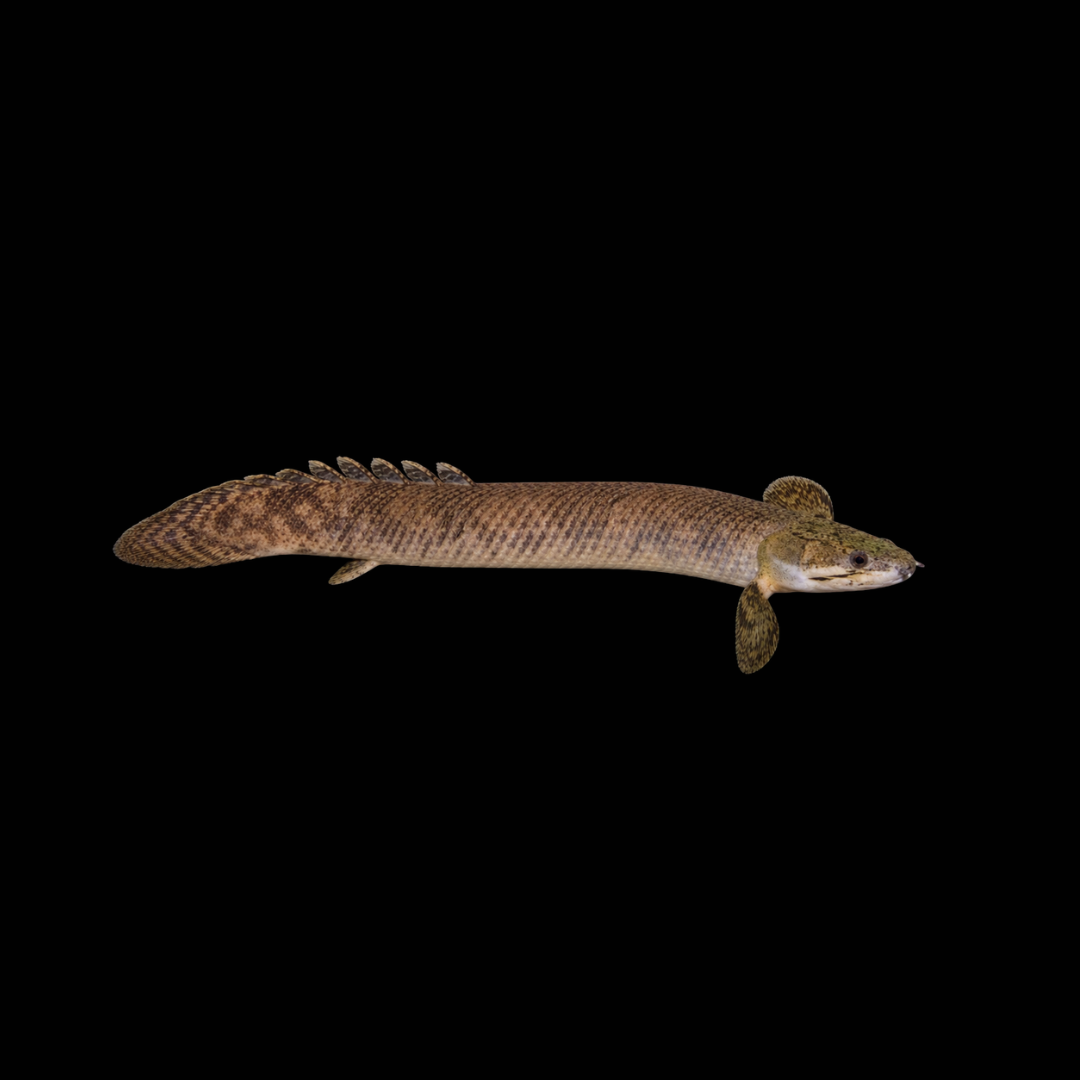
ポリプテルス・モケーレムベンベは、中央アフリカのコンゴ川流域に分布する小型のポリプテルスです。上顎が下顎より前に出る上顎突出型で、暗灰色から黄褐色、暗緑色を基調とする体に不規則な網目模様や鞍状斑が入り、胸鰭の基部に大きな黒斑を持つのが特徴です。暗い底床と落ち着いた環境でじっくり飼い込むと、深いモスグリーンの体色が現れやすく、赤みの強い虹彩と相まって独特の渋い美しさを見せます。長くポリプテルス・レトロピンニスと混同されてきましたが、2006年に別種として正式記載された、分類学的にも興味深い古代魚です。 Polypterus mokelembembe is a small bichir native to the Congo River basin of Central Africa. It has an upper jaw that projects beyond the lower jaw, a dark gray, yellow-brown to dark green body with irregular reticulated or saddle-like markings, and a conspicuous dark blotch at the base of the pectoral fin. In a calm aquarium with a dark substrate, well-settled individuals may develop a deep moss-green coloration that contrasts beautifully with their often reddish irises. The species was long confused with Polypterus retropinnis and was formally described as a separate species in 2006, giving it unusual importance in the taxonomic history of bichirs.
基本情報 / Basic Information
| 学名 / Scientific Name | Polypterus mokelembembe |
|---|---|
| 通称 / Common Name | ポリプテルス・モケーレムベンベ、旧レトロピンニスMokele-mbembe bichir; historically traded in Japan as “old retropinnis” |
| 分類 / Family | ポリプテルス科 Polypteridae、ポリプテルス目 Polypteriformes、分岐鰭類 CladistiaFamily Polypteridae, Order Polypteriformes, Clade Cladistia |
| 英名 / English Name | Mokele-mbembe bichir |
| 分布 / Distribution | 中央アフリカのコンゴ川流域。日本に流通する個体はコンゴ共和国およびコンゴ民主共和国由来のワイルド個体が中心とされます。The Congo River basin in Central Africa. Specimens in the Japanese aquarium trade are mainly wild-caught fish originating from the Republic of the Congo and the Democratic Republic of the Congo. |
| 最大体長 / Max Size | 野生での最大記録は約36cm。一般には25〜27cm前後で成長が落ち着く個体が多いとされ、ポリプテルス属では小型の部類に入ります。The reported wild maximum is about 36 cm. Many individuals are said to level off around 25–27 cm, making this one of the smaller species in the genus Polypterus. |
| 寿命 / Lifespan | 本種単独の確立された飼育寿命データは、提示情報では明らかではありません。長期飼育を前提に、水質・水温・栄養状態を安定させて管理します。A well-established species-specific captive lifespan was not available in the provided information. It should therefore be managed as a long-term aquarium fish with stable water quality, temperature and nutrition. |
飼育環境 / Aquarium Environment
| 水槽サイズ / Tank Size | 幼魚は30〜45cm水槽から始められますが、成魚では旋回スペースを確保するため60cmワイド水槽(60×45×45cm)以上が目安です。余裕を持たせるなら90cm規格水槽(90×45×45cm)が適しています。Juveniles can start in a 30–45 cm tank, but adults are best kept in at least a 60 cm wide tank measuring around 60 × 45 × 45 cm. A standard 90 cm tank measuring around 90 × 45 × 45 cm provides more comfortable turning space. |
|---|---|
| 水温 / Temperature | 24〜28℃を基本とし、30℃を大きく超える状態は避けます。日本では冬季のヒーター管理に加え、夏季は冷却ファン、水槽用クーラー、または室内エアコンで高水温を防ぎます。 A basic range of 24–28°C is recommended, while prolonged temperatures well above 30°C should be avoided. In Japan, reliable heating is needed in winter, while fans, aquarium chillers or room air conditioning may be required in summer. |
| 水質 / Water Quality | pH6.5〜7.5の弱酸性から中性を目安に、比較的軟らかい水を安定して維持します。流れの緩いブラックウォーター環境を意識し、マジックリーフなどでタンニンを含む落ち着いた水を作る方法もあります。週1回、全水量の1/4〜1/3程度を目安に急変を避けて換水します。Aim for stable, relatively soft water from mildly acidic to neutral, around pH 6.5–7.5. A calm blackwater-style environment can be created with botanicals such as Indian almond leaves. As a general routine, change roughly one-quarter to one-third of the water weekly while avoiding sudden changes. |
| レイアウト / Layout | 角のない細かな暗色系の砂を薄く敷き、流木、土管、アヌビアスやミクロソリウムなどで日中に隠れられる場所を作ります。照明は強すぎない方が落ち着きやすく、暗い底床では本種らしい深緑色が現れやすくなります。強い水流は避け、排水をガラス面に当てるなどして穏やかな流れに調整します。Use a thin layer of fine, smooth, dark substrate and provide daytime shelters with driftwood, pipes, Anubias or Microsorum. Moderate or subdued lighting helps the fish settle, and a dark substrate often enhances its characteristic deep green coloration. Avoid strong current and diffuse filter outflow against the glass if necessary. |
| 注意点 / Precautions | 最重要なのは飛び出し防止です。頑丈なフタを隙間なく設置し、必要に応じて重しで固定します。ただし肺呼吸のために水面へ上がるので、水面とフタの間には必ず空気層を確保してください。ワイルド個体は導入時に寄生虫を持ち込む可能性があるため、別水槽での検疫を行うと安全です。Preventing escapes is critical. Use a sturdy, tightly fitted lid and secure it if necessary, but always leave an air gap above the water because bichirs must surface to breathe atmospheric air. Wild-caught fish may carry external parasites, so quarantine in a separate tank is strongly advisable before introduction to the main aquarium. |
餌と給餌 / Feeding
| 餌の種類 / Diet | 肉食性で、冷凍アカムシ、冷凍エビ、キビナゴなどの動物質の餌をよく食べます。状態が安定した個体は、ポリプテルス向けの沈下性人工飼料にも慣らせます。導入直後のワイルド個体では、メダカ、小赤、スジエビなど嗜好性の高い餌から始める方法が用いられます。This is a carnivorous fish that accepts animal-based foods such as frozen bloodworms, shrimp and small whole fish. Settled specimens can often be trained onto sinking formulated foods for bichirs. Newly imported wild fish may initially respond better to highly palatable live foods such as small fish or freshwater shrimp. |
|---|---|
| 給餌のポイント / Feeding Tips | 夜行性が強いため、消灯前から消灯直後の薄暗い時間帯が給餌しやすいタイミングです。混泳水槽では動きの速い魚に餌を奪われやすいので、本種の目の前へ沈む餌を落とします。一口で飲み込める大きさを選び、食べ残しは水質悪化を防ぐため速やかに除去します。慣れた個体ではピンセット給餌も可能です。Because the species is strongly nocturnal, feeding just before or after lights-out is often effective. In community tanks, place sinking food directly in front of the bichir so faster fish do not take everything first. Offer pieces small enough to swallow whole and remove leftovers promptly to protect water quality. Tame individuals may also accept food from feeding tongs. |
性格と混泳 / Temperament and Tank Mates
| 性格 / Temperament | ポリプテルスの中では比較的温和で臆病な傾向があります。日中は物陰で休み、薄暗くなると餌を探して動き始める個体が多く見られます。口に入らない大きさの魚を積極的に追い回すタイプではありませんが、捕食可能な小魚やエビは餌として認識します。Among bichirs, this species tends to be relatively docile and shy. Many individuals rest under cover during the day and become more active as the aquarium darkens. It does not usually pursue tank mates too large to swallow, but small fish and shrimp that fit into its mouth may be treated as prey. |
|---|---|
| 混泳の相性 / Compatibility | 同程度の大きさのポリプテルス類や、本種を飲み込めず攻撃性が強すぎない中・大型魚とは混泳しやすい傾向があります。一方、ネオンテトラなどの小型魚やヌマエビ類は捕食対象になります。プレコ類は体表の粘膜を舐める事故、コリドラスなど棘の強い小型ナマズは誤飲時の喉詰まりが懸念されるため避けます。大型で食欲の強いポリプテルスと同居させる場合は、本種が餌を確保できているかを必ず確認します。Tank mates of similar size, including other bichirs and non-aggressive medium to large fish that cannot swallow this species, are generally easier to manage. Very small fish and dwarf shrimp may be eaten. Plecos are best avoided because they may rasp the bichir’s slime coat, while small armored catfish with strong spines can cause dangerous swallowing accidents. When housed with larger, more aggressive feeders, make sure this slower fish actually receives enough food. |
病気と対策 / Diseases and Prevention
| かかりやすい病気 / Common Diseases | ワイルド個体では、ポリプテルス類に寄生する単生類のマクロギロダクティルス・ポリプティ(Macrogyrodactylus polypteri)が特に注意対象です。また、水質悪化や輸送・衝突のストレスに伴い、過剰な粘膜分泌、食欲低下、眼球の白濁などが見られることがあります。Wild-caught fish require particular attention for the monogenean parasite Macrogyrodactylus polypteri, which is associated with bichirs. Poor water quality, transport stress or physical impact may also be followed by excessive mucus production, reduced appetite or cloudy eyes. |
|---|---|
| 対策と予防 / Prevention | 新規導入魚は本水槽へすぐ入れず、別水槽で皮膚、鰓、呼吸、食欲を観察します。日常管理ではろ過を安定させ、食べ残しを残さず、急激なpH変化を避けます。眼球白濁や粘膜異常が出た場合は、まず水質とろ過状態を確認し、少量ずつの換水で環境を整えます。ポリプテルス類は薬剤に敏感とされるため、薬浴を行う場合は成分と魚への適合性を確認し、状態を細かく観察しながら慎重に進めます。Quarantine new arrivals instead of adding them directly to the display tank, and observe the skin, gills, breathing and appetite. Keep filtration stable, remove uneaten food and avoid abrupt pH changes. When cloudy eyes or abnormal mucus appear, first check water quality and filtration and restore conditions with controlled partial water changes. Bichirs are regarded as sensitive to some medications, so any treatment should be chosen carefully with close observation of the fish. |
増やし方(繁殖) / Breeding
| 雌雄の判別 / Sexing | 成熟したオスは尻鰭が幅広く筋肉質で、扇状に発達します。メスの尻鰭は比較的細く小ぶりです。幼魚では差が分かりにくく、成長して性成熟に近づくほど判別しやすくなります。Mature males develop a much broader, more muscular, fan-shaped anal fin, while females have a narrower and smaller anal fin. The difference is difficult to judge in young juveniles and becomes clearer as the fish approaches sexual maturity. |
|---|---|
| 繁殖形態 / Reproduction | 卵生の卵散布型です。繁殖時、オスは幅広い尻鰭をカップ状にしてメスが放出した卵を受け、受精後の卵は水草や底床へ散らされます。親魚による保護は行われず、親が卵や稚魚を食べる可能性があります。It is an egg-scattering species. During spawning, the male forms his broad anal fin into a cup that receives eggs released by the female, after which fertilized eggs are scattered among plants or over the substrate. The parents do not guard the eggs and may eat eggs or fry. |
| 繁殖のポイント / Breeding Tips | 本種の飼育下繁殖例は非常に少なく、商業的なブリードもほぼ確立していません。雨季を思わせる環境変化が産卵刺激になると考えられており、繁殖を狙う場合は落ち着いた軟水環境と十分なコンディショニングが重要です。産卵を確認したら卵を親魚から隔離します。孵化した幼生は外鰓を持ち、卵黄嚢を吸収した後はブラインシュリンプなどの小さな餌へ移行します。Captive breeding of this species is extremely uncommon, and commercial production is not established. Environmental changes resembling the rainy season are thought to act as spawning cues, so calm soft water and strong conditioning of the adults are important when attempting breeding. Remove the eggs from the parents after spawning. Larvae bear external gills and, after absorbing the yolk sac, can be moved onto very small live foods such as newly hatched brine shrimp. |
雑学と豆知識 / Trivia and Fun Facts
| 1. 100年以上続いた「レトロピンニス」との混同 / 1. More than a century of confusion with retropinnis | 物語の始まりは1899年です。レオン・ヴァイヨンがポリプテルス・レトロピンニスを記載した際、そのタイプ標本群には、現在では別種と分かっている魚が混在していました。長いあいだ両者は同じ種の変異と見なされましたが、2006年、ウルリッヒ・シュリーヴェンとフランク・シェーファーが胸鰭軟条数、鼻孔間距離、背鰭棘の幅などを比較し、混在していた一群を新種ポリプテルス・モケーレムベンベとして正式に切り分けました。観賞魚として知られていた魚が、1世紀以上たって本当の名前を得たという珍しい歴史を持っています。The story begins in 1899, when Léon Vaillant described Polypterus retropinnis from a type series that later proved to contain more than one species. For decades the forms were treated as variations of the same fish. In 2006, Ulrich Schliewen and Frank Schäfer compared characters such as pectoral-fin ray counts, internostril distance and the width of the first dorsal-fin spine, and formally separated one lineage as the new species Polypterus mokelembembe. It is an unusual case of a familiar aquarium fish receiving its correct scientific identity more than a century after the original confusion began. |
|---|---|
| 2. 名前の由来はコンゴの伝説「モケーレ・ムベンベ」 / 2. Named after the Congo legend “Mokele-mbembe” | 種小名mokelembembeは、コンゴ川流域で語られる未確認動物「モケーレ・ムベンベ」に由来します。伝説では恐竜を思わせる存在として語られることがあり、古い系統を今に残すポリプテルスと、コンゴという土地の神秘性を重ね合わせた命名です。もちろん魚そのものが恐竜の生き残りという意味ではありませんが、数億年規模の進化史を背負う古代魚に、地域文化の物語が重ねられている点は本種ならではの魅力です。The species name mokelembembe comes from “Mokele-mbembe,” a legendary unidentified creature associated with the Congo basin and sometimes portrayed as dinosaur-like. The name links the deep evolutionary history of bichirs with the cultural mystery of the region. This does not mean that the fish itself is a surviving dinosaur, but the combination of ancient lineage and local legend gives the species an especially memorable identity. |
| 3. ポリプテルス属の中でも基底的な位置 / 3. A notably basal position within Polypterus | ミトコンドリアDNAを用いた系統解析では、訂正後のデータにおいて、本種はアミメウナギの分岐に続き、ほかのポリプテルス属の多くに対する基底的な姉妹系統として位置づけられました。この結果は、本種がポリプテルス属の初期的な特徴を考えるうえで重要な存在であることを示唆します。ポリプテルス科そのものも、現生条鰭類の中で非常に早い段階に分岐した分岐鰭類に属し、魚類進化を考えるうえで特別な立場にあります。Mitochondrial DNA analyses, after correction of earlier specimen-identification errors, placed this species as a basal sister lineage relative to many other members of Polypterus, following the split of the ropefish Erpetoichthys. This makes P. mokelembembe especially interesting when considering early characteristics within the genus. The entire family Polypteridae also belongs to Cladistia, one of the earliest-diverging living lineages of ray-finned fishes. |
| 4. 肺で呼吸し、低い音まで出す古代魚 / 4. An ancient fish that breathes air and can produce low sounds | ポリプテルス類は鰓だけでなく、袋状の肺を使って空気呼吸を行います。水面まで上がって空気を取り込む行動は、単なる癖ではなく生理的に重要な呼吸です。さらに、レトロピンニス・グループを対象とした研究では、肺を利用して「うめき声」や「ドスッ」という低周波音を発する行動が記録されています。当時の分類にはモケーレムベンベが混在していた可能性があるため、本種だけの発声能力として断定はできませんが、ポリプテルスの肺が呼吸以外にも役割を持つ可能性を示す興味深い知見です。Bichirs do not rely on gills alone. They also possess sac-like lungs and regularly rise to the surface to breathe air, making access to an air space physiologically important rather than optional. Studies on the historical retropinnis group also recorded low-frequency “moans” and “thumps” associated with lung movement. Because specimens were classified under older taxonomic concepts at the time, the observation cannot be assigned to P. mokelembembe alone with certainty, but it remains a fascinating clue that bichir lungs may serve functions beyond respiration. |
| 5. 日本市場では名前が“逆転”した歴史がある / 5. The Japanese trade went through a remarkable name reversal | 日本では2000年代初頭、「レトロピンニス」として流通する魚の中に、特に緑色の強いタイプが現れ、「sp. ザイールグリーン」と呼ばれていました。ところが2006年の再検討で、それまで一般的なレトロピンニスと思われていた魚がモケーレムベンベとなり、ザイールグリーンと呼ばれていた側が真のレトロピンニスに近いことが明確になりました。このため現在でも、モケーレムベンベが「旧レトロピンニス」と併記されることがあります。古い書籍や過去の販売記録を読むときは、この名称逆転を知っていると混乱しにくくなります。In Japan during the early 2000s, especially green individuals appearing among fish sold as “retropinnis” were often called “sp. Zaire Green.” The 2006 taxonomic revision overturned this trade convention: the fish widely sold as retropinnis became P. mokelembembe, while the green form was associated with the true concept of P. retropinnis. This is why P. mokelembembe is still sometimes labeled “old retropinnis” in Japan. Knowing this name reversal is essential when reading older aquarium books or sales records. |
| 6. 暗い底床で引き出される深い緑 / 6. Dark substrate can reveal its deep green coloration | 本種は周囲の明るさに合わせて体色が変わりやすく、明るい砂では黄褐色や灰色が強く見える一方、暗い砂と落ち着いた環境で長く飼い込むと、深いモスグリーンへ変化する個体があります。これは単に「色の濃い個体を買う」だけでは味わえない魅力です。水質、底床、照明、隠れ家、そして日々の安定した管理が重なり、時間をかけて本来の色が引き出されていく過程そのものが、モケーレムベンベ飼育の楽しさの一つです。This species can alter its visible coloration in response to its surroundings. On pale sand it may appear grayish or yellow-brown, while long-term maintenance over a dark substrate in a calm environment can bring out a deep moss-green tone in some individuals. The appeal is therefore not limited to choosing an already colorful fish. Water quality, substrate, lighting, shelter and steady husbandry work together over time to reveal the fish’s characteristic appearance. |
| 7. 幼生には両生類のような外鰓がある / 7. Larvae carry amphibian-like external gills | ポリプテルスの幼生は、頭の後方に羽毛のような外鰓を持ちます。その姿はイモリなどの有尾類の幼生を思わせ、成魚の重厚な姿とはまるで別の生き物のようです。成長に伴って外鰓は徐々に吸収され、やがて消失します。古代的な特徴を多く残すポリプテルスの発生過程を象徴する、非常に印象的な形態です。Bichir larvae carry feathery external gills behind the head, giving them an appearance reminiscent of salamander larvae and making them look strikingly different from the heavy-bodied adults. These external gills are gradually absorbed as the fish grows and eventually disappear. The feature is one of the most memorable developmental traits of this ancient ray-finned fish lineage. |
まとめ / Conclusion
ポリプテルス・モケーレムベンベは、ポリプテルスらしい古代的な姿を保ちながら比較的小型に収まり、暗い底床では深い緑色まで見せる個性豊かな種類です。ゆったりした水流、隠れ家、安定した水質、確実な飛び出し対策を整えることで、その臆病さも少しずつ和らぎ、落ち着いた動きをじっくり観察できるようになります。 Polypterus mokelembembe combines the ancient appearance of a bichir with a comparatively compact adult size and, under suitable dark conditions, an exceptionally deep green coloration. Gentle current, good shelter, stable water quality and secure escape prevention allow its shy temperament to settle and make its slow, deliberate behavior much easier to appreciate.
日本では「旧レトロピンニス」という歴史的な呼び名が今も残り、分類学の物語まで含めて楽しめる一匹です。ワイルド個体ならではの導入時の検疫と餌付けには丁寧さが必要ですが、環境に馴染み、飼育者の気配を覚えて餌を待つようになった姿には、大型古代魚とはまた違う親密な魅力があります。 In Japan, the historical name “old retropinnis” still survives, adding a layer of taxonomic history to the fish’s appeal. Wild-caught specimens require careful quarantine and patient feeding during introduction, but once settled and accustomed to their keeper, they offer a close and rewarding relationship quite different from that of the largest ancient fishes.

気になる道具や飼い方を見つけてみませんか?
 アイのアクアグッズ案内水槽フィルターの選び方|外掛け・外部・上部から小型オーバーフローまで道具の特徴や使い方、選ぶときのポイントをアイが紹介します。記事はコチラ →
 アイのアクアグッズ案内水槽の底砂の選び方|砂・砂利の違いとおすすめ商品道具の特徴や使い方、選ぶときのポイントをアイが紹介します。記事はコチラ →
 アイのアクアグッズ案内ベタの一匹飼いを楽しむ|水槽・ヒーター・ふた・フィルターの選び方ベタの一匹飼いに向く水槽容量、ふたと空気層、ヒーターと水温計、弱い水流のフィルターを、コタロウとアイの会話で分かりやすく解説します。記事はコチラ →
 アイのアクアグッズ案内おとひめ物語|養殖生まれの餌を、わが家の魚に合う一粒へ道具の特徴や使い方、選ぶときのポイントをアイが紹介します。記事はコチラ →
さまざまな飼育テーマをご紹介。リンク先の記事には広告・商品紹介が含まれます。
案内・紹介記事一覧へ →分布マップ
ポリプテルス・モケーレムベンベは中部コンゴ盆地に分布し、キンシャサより上流側からマリンガ川までの範囲で知られています。記録にはアリマ川水系、レフィニ川水系、マリンガ川・ツアパ川周辺などが含まれます。
※地図上の点は、記事の分布情報をもとに中部コンゴ盆地を示すため設定した概略代表地点です。実際の採集地点や厳密な生息位置・生息範囲を示すものではありません。分布の細部には未解明な部分があります。
参考文献・資料
分類、分布、形態については本種の原記載とポリプテルス科の分類学的再検討を中心に据え、系統、呼吸、繁殖、幼生、寄生虫、飼育衛生については査読論文または専門機関の資料で補完しています。本種を直接対象としていない研究は、ポリプテルス科・ポリプテルス属に共通する特徴を説明する範囲に限って参照しています。
本文中の「90cm規格水槽」「24〜28℃」「pH6.5〜7.5」などは、ポリプテルス・モケーレムベンベを対象とした比較飼育試験によって確立された閾値ではありません。確認されている成魚サイズ、ポリプテルス類の呼吸生理、一般的な観賞魚の水質管理を踏まえた実用上の目安として扱う必要があります。また、日本国内におけるワイルド個体の流通比率についても、ここに挙げた学術・公的資料だけでは定量的に確認できません。
本種固有の自然生態を詳しく調べた現地研究は限られています。原記載と分類学的再検討からは中部コンゴ盆地の河川・支流での採集記録を確認できますが、「ブラックウォーターを必須とする魚」のような一般化は避けるのが安全です。
-
原記載・分類・分布・形態Schliewen, U. K. & Schäfer, F. (2006)Polypterus mokelembembe, a new species of bichir from the central Congo River basin (Actinopterygii: Cladistia: Polypteridae). Zootaxa, 1129(1), 23–36.本種の原記載。タイプ標本、レトロピンニスとの分類学的整理、中部コンゴ盆地の採集地、当初提示された識別形質を確認するための基礎資料です。https://doi.org/10.11646/zootaxa.1129.1.2
-
分類再検討・最大体長・識別Moritz, T. & Britz, R. (2019)Revision of the extant Polypteridae (Actinopterygii: Cladistia). Ichthyological Exploration of Freshwaters, 29(2), 97–192.現生ポリプテルス科の包括的な分類学的再検討。本種では最大261mm標準体長・280mm全長の標本を報告し、胸鰭軟条数、眼下線、虹彩、第1背鰭棘などの識別形質を再整理しています。2006年に示された鼻孔間距離の差が十分に再現されなかったことも述べられています。https://doi.org/10.23788/IEF-1094
-
現在の分類学的ステータスFricke, R., Eschmeyer, W. N. & van der Laan, R. (eds) (2026)Eschmeyer’s Catalog of Fishes: Genera, Species, References. California Academy of Sciences, electronic version.魚類の学名・タイプ情報を継続的に更新する専門データベース。本種を Polypterus mokelembembe Schliewen & Schäfer, 2006 の有効種として扱い、タイプ産地と現在の分類学的ステータスを確認できます。Eschmeyer’s Catalog of Fishes: Polypterus mokelembembe参照日:2026年7月25日
-
分子系統・訂正Suzuki, D., Brandley, M. C. & Tokita, M. (2010)Erratum to: The mitochondrial phylogeny of an ancient lineage of ray-finned fishes (Polypteridae) with implications for the evolution of body elongation, pelvic fin loss, and craniofacial morphology in Osteichthyes. BMC Evolutionary Biology, 10, 209.2010年の原論文で P. mokelembembe と P. retropinnis が取り違えられていたことを正式に訂正した資料です。記事中で「訂正前の系統的位置をそのまま本種へ適用できない」と説明する根拠になります。https://doi.org/10.1186/1471-2148-10-209
-
空気呼吸・水面アクセスGraham, J. B. et al. (2014)Spiracular air breathing in polypterid fishes and its implications for aerial respiration in stem tetrapods. Nature Communications, 5, 3022.複数のポリプテルス属魚類で噴水孔を介した空気呼吸を実証した研究です。本種そのものを実験対象にはしていないため、ポリプテルス属に共通する呼吸生理を説明する範囲で参照します。https://doi.org/10.1038/ncomms4022
-
繁殖行動Arnoult, J. (1964)Comportement et reproduction en captivité de Polypterus senegalus Cuvier. Acta Zoologica, 45, 191–199.セネガルスの飼育下繁殖を記録した古典的研究です。本種固有の繁殖手順を示す資料ではなく、ポリプテルス属の産卵行動を説明する比較資料として参照します。https://doi.org/10.1111/j.1463-6395.1964.tb00719.x
-
雌雄判別・繁殖Holden, M. J. (1971)Significance of Sexual Dimorphism of the Anal Fin of Polypteridae. Nature, 232, 135–136.ポリプテルス科における尻鰭の性的二型と、オスの幅広い尻鰭が産卵時に果たす役割を扱った研究です。成熟個体の雌雄判別の根拠になります。https://doi.org/10.1038/232135b0
-
発生・幼生・外鰓Bartsch, P., Gemballa, S. & Piotrowski, T. (1997)The Embryonic and Larval Development of Polypterus senegalus Cuvier, 1829: its Staging with Reference to External and Skeletal Features, Behaviour and Locomotory Habits. Acta Zoologica, 78(4), 309–328.ポリプテルス幼生の発生段階を詳細に記載した研究です。幼生期の外鰓など、記事中の発生に関する説明をポリプテルス属レベルで支えます。https://doi.org/10.1111/j.1463-6395.1997.tb01014.x
-
外部寄生虫Khalil, L. F. (1970)Further Studies on Macrogyrodactylus polypteri, a Monogenean on the African Freshwater Fish Polypterus senegalus. Journal of Helminthology, 44(3–4), 329–348.ポリプテルス類で知られる単生類 Macrogyrodactylus polypteri の基礎研究です。主な宿主は P. senegalus であり、モケーレムベンベ固有の寄生虫とする根拠にはなりません。https://doi.org/10.1017/S0022149X00022008
-
検疫・水質・投薬の基本Petty, B. D., Francis-Floyd, R. & Yanong, R. P. E. (2024 update)Management of Aquarium Fish. Merck Veterinary Manual. Full review May 2022; last updated September 2024.観賞魚の検疫、バイオセキュリティ、水質異常、診断、薬剤使用の基本を獣医学的に整理した専門資料です。原因を確認せず予防的に投薬することを避け、水質評価と適切な診断を優先するという記事の方針を支えます。Merck Veterinary Manual: Management of Aquarium Fish参照日:2026年7月25日




コメント