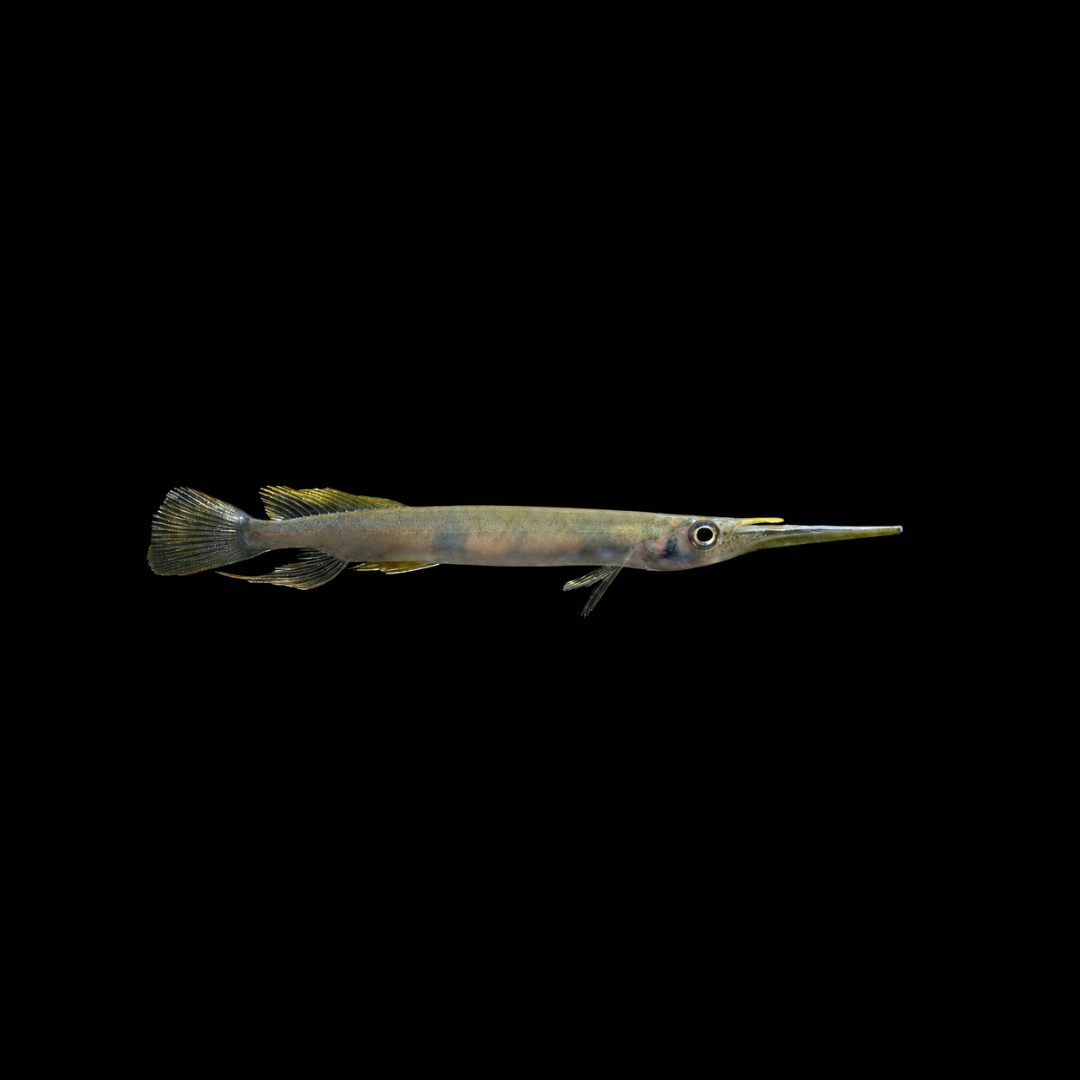
ヘミランフォドン・ポゴノグナタスは、東南アジアの泥炭湿地や低地の森林渓流などに生息する、ダツ目コモチサヨリ科の表層性魚類です。淡水を中心に汽水域からの記録もあり、細長い体、前方へ伸びた下顎、体側に散る緑色から金色の光沢斑が目を引きます。水面直下で生活する傾向が強いため、飼育では水深よりも水面の広さ、穏やかな流れ、水面で確実に食べられる餌を意識した環境づくりが重要です。Hemirhamphodon pogonognathus is a surface-oriented halfbeak of the family Zenarchopteridae found in peat habitats and lowland forest streams of Southeast Asia, with records from both fresh and brackish water. Its slender body, elongated lower jaw, and green to golden reflective flank spots are especially distinctive. Because it spends much of its time immediately below the surface, aquarium care should prioritize surface area, gentle flow, and food that remains readily accessible at the surface.
基本情報 / Basic Information
学名 / Scientific Name
Hemirhamphodon pogonognathus
通称 / Common Name
ヘミランフォドン・ポゴノグナタス、グリーンスポットハーフビーク、ゴールデンスポットラインハーフビークGreen Spot Halfbeak, Golden Spot Line Halfbeak
分類 / Family
ダツ目 コモチサヨリ科 ヘミランフォドン属Order Beloniformes, Family Zenarchopteridae, Genus Hemirhamphodon
英名 / English Name
Green Spot Halfbeak
分布 / Distribution
タイ南部、マレーシア、シンガポール、スマトラ島、ジャワ島、バンカ島、ビリトン島、ボルネオ島などの東南アジア。泥炭湿地や低地の森林渓流を中心に、淡水・汽水の双方から記録があります。Southeast Asia, including southern Thailand, Malaysia, Singapore, Sumatra, Java, Bangka, Belitung, and Borneo. It is associated especially with peat habitats and lowland forest streams and has been recorded in both fresh and brackish water.
最大体長 / Max Size
最大約10cm。FishBaseではオスまたは未判別個体で標準体長10cm、メスで全長6cmの記録が示されています。雌雄で体格差が見られることがあります。Up to about 10 cm. FishBase lists a maximum standard length of 10 cm for males or unsexed specimens and a total length of 6 cm for females. A size difference between the sexes may be apparent.
寿命 / Lifespan
不明。信頼できる種固有の寿命データは乏しく、明確な年数を示すことはできません。Unknown. Reliable species-specific lifespan data are scarce, so a definite lifespan cannot currently be stated.
飼育環境 / Aquarium Environment
水槽サイズ / Tank Size
最低でも60cm規格水槽が目安です。オス同士の縄張りを考えると、水深より水面積を優先し、複数飼育や繁殖を狙う場合は90cm規格水槽以上がより安全です。A standard 60 cm aquarium is a practical minimum. Because males defend surface territories, surface area is more important than depth, and a standard 90 cm aquarium or larger is preferable for groups or breeding setups.
水温 / Temperature
24〜28℃が目安です。数値そのものよりも、導入時に急変させず安定した水温を維持することが重要です。A practical reference range is 24-28°C. Stability is more important than chasing an exact value, especially during acclimation.
水質 / Water Quality
FishBaseではpH 6.0〜8.0、硬度5〜12 dH、水温24〜28℃が参考範囲として示されています。自然下では泥炭湿地や低地の森林渓流にも生息するため、飼育では弱酸性から中性寄りの安定した水を軸にすると管理しやすいでしょう。淡水・汽水の双方から記録がありますが、常時の塩分添加を必須とする種ではありません。FishBase lists pH 6.0-8.0, hardness 5-12 dH, and 24-28°C as reference values. Because the species also occurs in peat and lowland forest streams, stable slightly acidic to neutral water is a sensible aquarium target. It has been recorded from both fresh and brackish water, but routine salt addition is not a requirement.
レイアウト / Layout
水面を主生活圏とするため、アマゾンフロッグビットやサルビニアなどの浮き草、または水面近くまで伸びる水草やモス類を使い、視線を遮る区画を作ります。強い水流は避け、スポンジフィルターや排水を弱めたろ過方式で穏やかな表層を確保します。飛び出しにも備え、フタは確実に設置します。Because the species lives at the surface, use floating plants such as Amazon frogbit or Salvinia, together with near-surface vegetation or moss, to break lines of sight and divide territories. Avoid strong flow and maintain a calm surface with a sponge filter or diffused outflow. A secure lid is also advisable for a surface-oriented fish.
注意点 / Precautions
輸送直後は、水温・水質の急変、外傷、摂餌不良に注意します。本種がブラックウォーターに生息することと、細菌感染に特別弱いことを直接結び付ける十分な種固有データはありません。導入時は清浄で安定した水、穏やかな水流、静かな環境を整え、食欲や体表の状態を丁寧に観察します。After transport, pay close attention to abrupt changes in temperature or water chemistry, physical injury, and poor feeding response. There is not sufficient species-specific evidence to directly link blackwater habitat use with exceptional susceptibility to bacterial infection. Provide clean, stable water, gentle flow, and a quiet environment while monitoring appetite and body condition.
餌と給餌 / Feeding
餌の種類 / Diet
完全浮上性の人工飼料、ブラインシュリンプ、ミジンコ、ボウフラ、無翅ショウジョウバエなど、水面で認識しやすい餌が適します。冷凍アカムシを使う場合は沈下させず、水面で与える工夫が必要です。Suitable foods include fully floating prepared foods, Artemia, Daphnia, mosquito larvae, and wingless fruit flies, all of which are easy to detect at the surface. Frozen bloodworms can also be used if they are presented at the surface rather than allowed to sink.
給餌のポイント / Feeding Tips
本種は表層食性が非常に強く、沈んだ餌を追わないため、餌が水面に長く残ることが重要です。導入直後は反応の良い生餌や冷凍餌から始め、状態が安定してから浮上性のフレークや顆粒へ慣らすと管理しやすくなります。冷凍餌はピンセットで水面に保持する、浮き草に引っ掛けるなどの方法が有効です。This is an extremely surface-oriented feeder and may ignore food once it sinks. Food should remain accessible at the surface for as long as possible. Newly imported fish can be started on responsive live or frozen foods and then gradually accustomed to floating flakes or granules once stable. Holding frozen food at the surface with tweezers or resting it among floating plants can be effective.
性格と混泳 / Temperament and Tank Mates
性格 / Temperament
他種に対しては極端に攻撃的な魚ではありませんが、オス同士は水面に縄張りを作り、優位個体が劣位個体を追い払うことがあります。水面が狭いと逃げ場がなくなりやすいため、複数飼育では水面積と視線遮断が重要です。It is not generally described as highly aggressive toward unrelated species, but males establish territories at the surface and dominant individuals may chase subordinates. In group setups, ample surface area and visual barriers are important so weaker fish can avoid constant harassment.
混泳の相性 / Compatibility
生活圏が重なりにくい温和な底層魚や、小型で穏やかな中層魚が候補になります。コリドラス類、クーリーローチ、温和な小型ラスボラ類などが一例です。反対に、水面を高速で泳ぎ回る魚や餌取りの激しい魚は、表層での競合を招きやすいため避けたほうが無難です。Peaceful bottom dwellers and calm, small midwater fishes are suitable candidates because they overlap less with the surface zone. Corydoras, kuhli loaches, and gentle small rasboras are examples. Fast or highly competitive surface feeders are better avoided because they can create persistent competition at the surface.
病気と対策 / Diseases and Prevention
かかりやすい病気 / Common Diseases
本種に特有の好発疾患を示す信頼性の高い資料は乏しく、特定の病名を挙げて「かかりやすい」と断定することはできません。輸送や環境変化の後は、外傷、食欲低下、ヒレの傷み、体表の異常など、一般的な不調の兆候を早期に見つけることが重要です。Reliable evidence for a species-specific disease predisposition is scarce, so no particular disease should be presented as characteristically common without evidence. After transport or environmental change, watch for general warning signs such as injuries, loss of appetite, fin damage, or abnormal skin condition.
対策と予防 / Prevention
予防の基本は、輸送直後に水温や水質を急変させず、清浄で安定した環境へゆっくり移行させることです。過密と食べ残しを避け、穏やかな流れを保ちながら十分な酸素供給を確保します。症状がない段階で薬剤を一律に使用するのではなく、異常が見られた場合は原因を見極めたうえで治療方法を選びます。Prevention begins with avoiding abrupt temperature or water-chemistry changes after transport and moving the fish gradually into clean, stable conditions. Avoid crowding and uneaten food, while maintaining gentle flow and adequate oxygenation. Medication should not be used automatically in symptom-free fish; treatment is best chosen after the likely cause of any abnormal signs has been assessed.
増やし方(繁殖) / Breeding
雌雄の判別 / Sexing
オスはメスより大きくなる傾向があり、下顎先端に髭状の肉質突起が見られます。また、尻鰭が交尾器官として特殊化し、筋肉質で可動性のある生殖乳頭を備える点も重要な性的二型です。Males tend to grow larger than females and develop a fleshy tassel-like structure at the tip of the lower jaw. Their anal fin is modified for internal fertilization, and they also possess an elongated, muscular, mobile urogenital papilla.
繁殖形態 / Reproduction
体内受精を行う胎生性のハーフビークです。卵巣内には発生段階の異なる卵や胚が前後に並ぶ独特の superfetation(複数の発生段階を同時に保持する繁殖様式)が知られています。文献では、飼育下で1〜4尾ほどの仔魚を数日おきに産んだ観察例が紹介されており、「一度に多数をまとめて産む」タイプとは異なる繁殖像を示します。This is an internally fertilizing livebearing halfbeak. It shows an unusual form of superfetation, with ova and embryos at different developmental stages arranged along the ovary. Published observations describe females producing roughly one to four young at a time at intervals of a few days, rather than releasing a single large brood all at once.
繁殖のポイント / Breeding Tips
オス同士の争いを抑えるため、広い水面と大量の浮き草を用意します。妊娠したメスは落ち着ける区画を確保し、出産が近い場合は隔離ネットなどを使う方法があります。稚魚は親魚に捕食される可能性があるため、水面を覆う浮き草や稚魚専用スペースで逃げ場を作ります。初期餌にはブラインシュリンプや細かくした人工飼料が使えます。Provide a broad surface area and abundant floating cover to reduce conflict among males. A gravid female should have a quiet refuge, and a breeder net can be used when birth appears close. Because the parents may prey on newborn fry, dense floating plants or a separate nursery area should be provided. Newly born fry can be offered Artemia and finely crushed prepared foods.
雑学と豆知識 / Trivia and Fun Facts
1. 1853年に記載された「半分の嘴」の魚 / 1. A “Half-Beaked” Fish Described in 1853
本種は1853年、オランダの魚類学者ピーター・ブリーカーによって、バンカ島マラワン産の標本をもとに記載されたとされています。当初はHemiramphus属に置かれましたが、その後ブリーカー自身が提唱したHemirhamphodon属へ移されました。属名には「半分」を意味するhemiと「嘴」を意味するrhamphosが含まれ、下顎だけが長く伸びた姿そのものが名前に刻まれています。The species was described in 1853 by the Dutch ichthyologist Pieter Bleeker from material collected at Marawang on Bangka Island. It was initially placed in Hemiramphus and later transferred to Hemirhamphodon, a genus established by Bleeker himself. The name combines roots referring to “half” and “beak,” preserving the fish’s unusual jaw profile in its scientific identity.
2. 下顎は「槍」ではなく感覚アンテナ / 2. The Lower Jaw Is More Sensor Than Spear
長い下顎は、単なる「槍」として理解するより、水面生活に適応した複合的な器官として見るほうが適切です。ハーフビーク類では下顎に沿って側線系が延長し、H. pogonognathusでも側線管内の機械受容性ニューロマストが報告されています。これらは水の動きを感知する仕組みに関わりますが、「暗闇で獲物をミリ単位で特定できる」といった能力まで本種で直接実証されたわけではありません。The elongated lower jaw is better understood as part of a complex surface-feeding adaptation than simply as a spear. In halfbeaks the lateral-line system extends along the lower jaw, and mechanoreceptive neuromasts within the canal have been reported in H. pogonognathus. These structures are involved in sensing water movement, although highly specific claims such as millimetre-scale prey localization in complete darkness have not been directly demonstrated for this species.
3. 水面という二次元世界に特化した暮らし / 3. Life in a Two-Dimensional Surface World
本種の生活はほとんど水面直下に集中します。下顎の形と小さな口は、落下昆虫を拾うには都合がよい一方、沈んだ餌を追う生活には向きません。飼育で「餌はあるのに痩せる」という問題が起こり得るのは、この強い表層適応を無視したときです。水槽の高さより水面積が重要になるのも、野生下と同じ二次元的な生活空間を確保する必要があるからです。Most of this fish’s life is concentrated immediately below the surface. Its jaw structure and small mouth are well suited to collecting fallen prey but poorly suited to chasing food that sinks. This explains why captive fish can lose condition even in a tank containing plenty of food if that food is not available at the surface. It also explains why horizontal surface area matters more than depth.
4. 求愛行動はまだ十分に解明されていない / 4. Courtship Is Still Incompletely Known
Hemirhamphodon属の求愛行動は、詳しく記録された例がまだ多くありません。H. pogonognathusでは、オスがメスの周囲を半円状に泳ぐという古い観察が紹介されています。一方、「不完全な長方形」を描くようなメイティング・ダンスが詳細に観察されたのは近縁種H. tengahです。両種の行動を同一視せず、本種の求愛については未解明の部分が残ると考えるのが妥当です。Courtship in Hemirhamphodon remains incompletely documented. An older account of H. pogonognathus describes the male swimming around the female in a semicircle. By contrast, the well-described “incomplete rectangle” mating dance was observed in the related H. tengah. These behaviors should not be treated as identical, and the courtship of H. pogonognathus still deserves further study.
5. 学名にも表れる特徴的な顎 / 5. The Distinctive Jaw Reflected in Its Name
属名Hemirhamphodonは、ギリシャ語のhemi(半分)、rhamphos(嘴)、odous(歯)に由来するとされ、ハーフビーク類らしい顎の形態を反映した名称です。種小名pogonognathusについては「髭」と「顎」を示す語根に結び付けて解釈されることがあり、成熟したオスの下顎先端に見られる髭状の突起を連想させます。The genus name Hemirhamphodon is derived from Greek roots meaning “half,” “beak,” and “teeth,” reflecting the characteristic halfbeak jaw form. The species epithet pogonognathus is commonly interpreted from roots associated with “beard” and “jaw,” recalling the tassel-like structure seen at the tip of the lower jaw in mature males.
6. 広域分布種に見えて、実は複数系統かもしれない / 6. A Widespread Species That May Hide Multiple Lineages
2016年のDNAバーコーディング研究では、スンダランド各地のHemirhamphodon個体群から大きな遺伝的分化が検出され、H. pogonognathusとして同定されてきた集団の中にも、隠蔽的な独立系統が含まれる可能性が示されました。とくにマレー半島北東部のクランタン個体群は他集団との遺伝的距離が大きく、産地情報を残す重要性を示す例となっています。A 2016 DNA-barcoding study detected substantial genetic divergence among Hemirhamphodon populations across Sundaland and suggested that populations identified as H. pogonognathus may include cryptic, independently evolving lineages. Northeastern Malay Peninsula populations from Kelantan were especially divergent, highlighting the value of retaining locality information for aquarium stocks.
7. ブラックウォーター生息と輸送耐性は分けて考える / 7. Blackwater Habitat and Transport Sensitivity Are Separate Questions
本種は泥炭湿地や低地の森林渓流など、落ち葉や流木が多い環境から記録されています。ただし、「ブラックウォーターに暮らすため免疫が弱く、細菌感染に特別弱い」という因果関係を本種で直接示した研究は確認されていません。輸送後に慎重な管理が必要なのは確かですが、その理由は水質急変、外傷、絶食など複数のストレス要因を含めて考える必要があります。The species is recorded from peat areas and lowland forest streams rich in leaf litter and woody debris. However, there is no clear species-specific evidence showing that blackwater adaptation causes weak immunity or exceptional bacterial susceptibility. Careful post-transport management is still important, but likely involves multiple stressors such as abrupt water changes, injury, and fasting.
近縁種は体型や光沢が似ているため、背鰭の色素パターンが重要な手掛かりになります。H. pogonognathusは背鰭の黒色素胞が単一サイズで、第3〜第8鰭条付近の先端側の色素と背鰭基部との間に、隣接する鰭条間隔より広い明瞭な隙間を持つことが分類学的特徴として示されています。Closely related species can look very similar, making dorsal-fin pigmentation an important identification character. H. pogonognathus is characterized by a single size class of dorsal-fin melanophores and a distinct gap between distal pigmentation around rays three to eight and the fin base that is wider than the spacing between adjacent fin rays.
9. 「サヨリ型」と「ダツ型」の進化は単純ではない / 9. Halfbeak and Needlefish Jaw Evolution Is Not Simple
ダツ目では、サヨリ型の「下顎だけが長い」形と、ダツ型の「上下の顎がともに長い」形の進化関係が長く議論されてきました。現在の系統学的研究では、単純に「ダツの幼魚形がそのまま成魚に残ったのがサヨリ類」と説明するだけでは不十分とされています。発生途中の姿と系統進化は必ずしも同じ順序を示さない、という点でも興味深いグループです。Within Beloniformes, the evolutionary relationship between the halfbeak condition, in which only the lower jaw is elongated, and the needlefish condition, in which both jaws are elongated, has long been debated. Modern phylogenetic work shows that it is too simplistic to explain halfbeaks merely as needlefishes retaining a juvenile jaw stage. The group is a useful reminder that developmental sequence and evolutionary history are not necessarily the same.
10. 近縁種H. tengahは繁殖様式も特殊 / 10. H. tengah Has an Unusual Reproductive Mode
Hemirhamphodon属の多くは胎生性ですが、H. tengahでは受精後に発生が進んだ卵を産む特殊な繁殖が報告されており、一般的な意味での「卵生」と単純化しにくい面があります。同じ属の中でも繁殖様式に幅があることは、コモチサヨリ科の繁殖進化を考えるうえで興味深い点です。Most Hemirhamphodon are livebearers, whereas H. tengah has been reported to release fertilized eggs that have already begun development, making its reproductive mode more complex than a simple “egg-laying” label suggests. Variation within the genus makes Zenarchopterid reproductive evolution particularly interesting.
まとめ / Conclusion
ヘミランフォドン・ポゴノグナタスは、細長い体、特徴的な下顎、体側の光沢斑、そして水面直下に偏った生活様式が印象的なハーフビークです。飼育では見た目の珍しさ以上に、広い水面、穏やかな流れ、安定した水質、水面で確実に摂餌できる環境を整えることが重要になります。Hemirhamphodon pogonognathus is a distinctive halfbeak marked by its slender body, unusual lower jaw, reflective flank spots, and strongly surface-oriented lifestyle. In captivity, success depends less on its unusual appearance than on providing ample surface area, gentle flow, stable water conditions, and food that remains readily available at the surface.
一方で、繁殖行動や寿命、疾病感受性など、飼育魚として十分に解明されていない点も残されています。産地情報を可能な限り残し、既知の生態に沿った環境で安定飼育と繁殖を積み重ねることは、この美しい表層魚を長く楽しむだけでなく、野生個体への依存を抑えるうえでも意義があります。Important aspects of its biology, including lifespan, detailed courtship, and disease susceptibility, remain incompletely understood. Preserving locality information and refining stable captive husbandry and breeding methods can both improve long-term care and help reduce dependence on wild-caught fish.
Anderson, W. D. III & Collette, B. B. (1991). Revision of the freshwater viviparous halfbeaks of the genus Hemirhamphodon (Teleostei: Hemiramphidae). Ichthyological Exploration of Freshwaters, 2(2), 151–176.
Roberts, T. R. (1989). The Freshwater Fishes of Western Borneo (Kalimantan Barat, Indonesia). Memoirs of the California Academy of Sciences, 14, 1–210.
Li, T., Chay, C. K., Lim, W. H. & Cai, Y. (2016). The fish fauna of Nee Soon Swamp Forest, Singapore. Raffles Bulletin of Zoology, Supplement 32, 56–84.
Reznick, D., Meredith, R. & Collette, B. B. (2007). Independent evolution of complex life history adaptations in two families of fishes, live-bearing halfbeaks (Zenarchopteridae, Beloniformes) and Poeciliidae (Cyprinodontiformes). Evolution, 61(11), 2570–2583.
Jamieson, B. G. M. (1989). Complex spermatozoon of the live-bearing half-beak, Hemirhamphodon pogonognathus (Bleeker): ultrastructural description. Gamete Research, 24(3), 247–259.
H. pogonognathusの精子形態を電子顕微鏡レベルで記載した研究。体内受精を行う本種の繁殖生物学を直接扱う種固有の資料として選定。
Lim, H. C., Zainal Abidin, M., Pulungan, C. P., de Bruyn, M. & Mohd Nor, S. A. (2016). DNA Barcoding Reveals High Cryptic Diversity of the Freshwater Halfbeak Genus Hemirhamphodon from Sundaland. PLOS ONE, 11(9), e0163596.






コメント