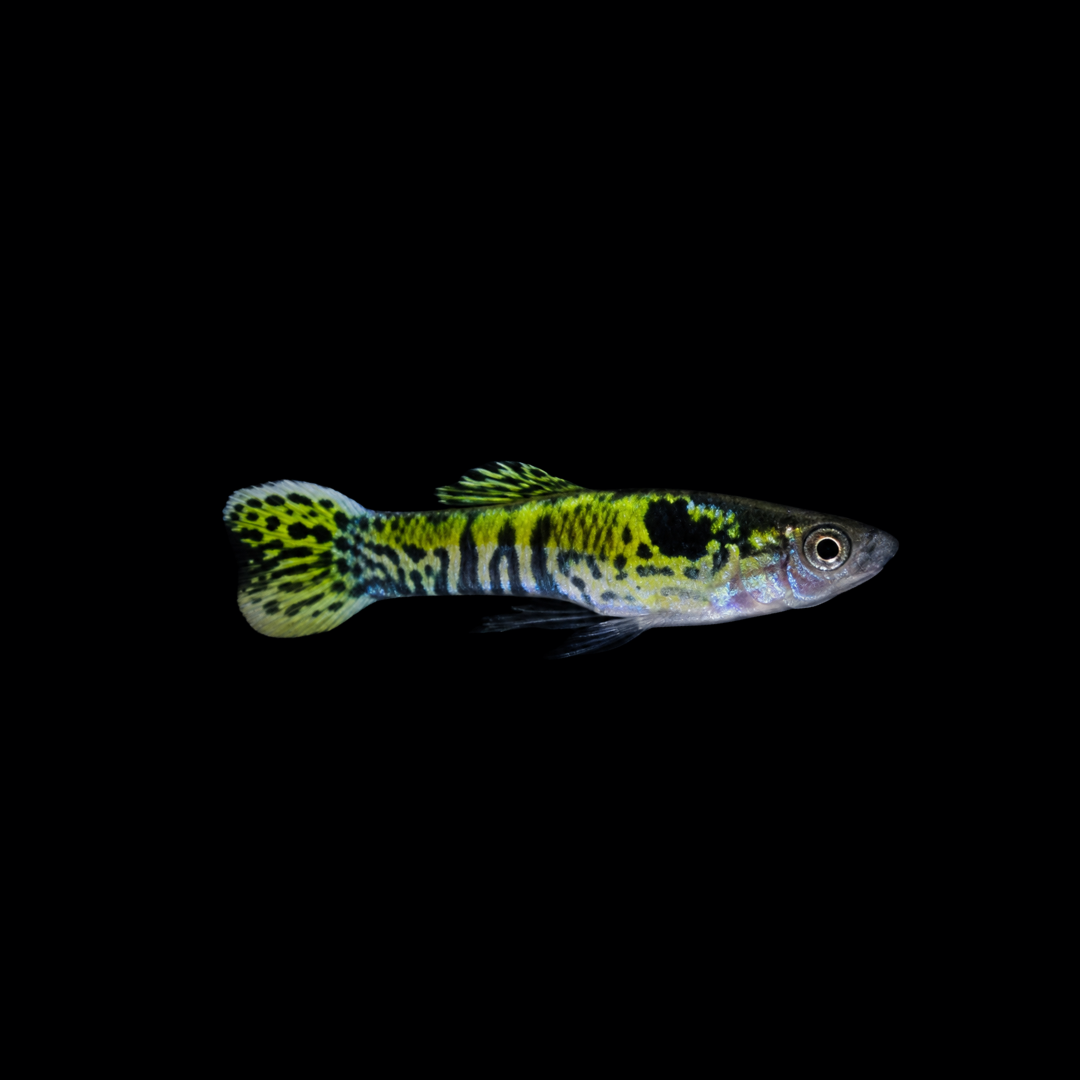
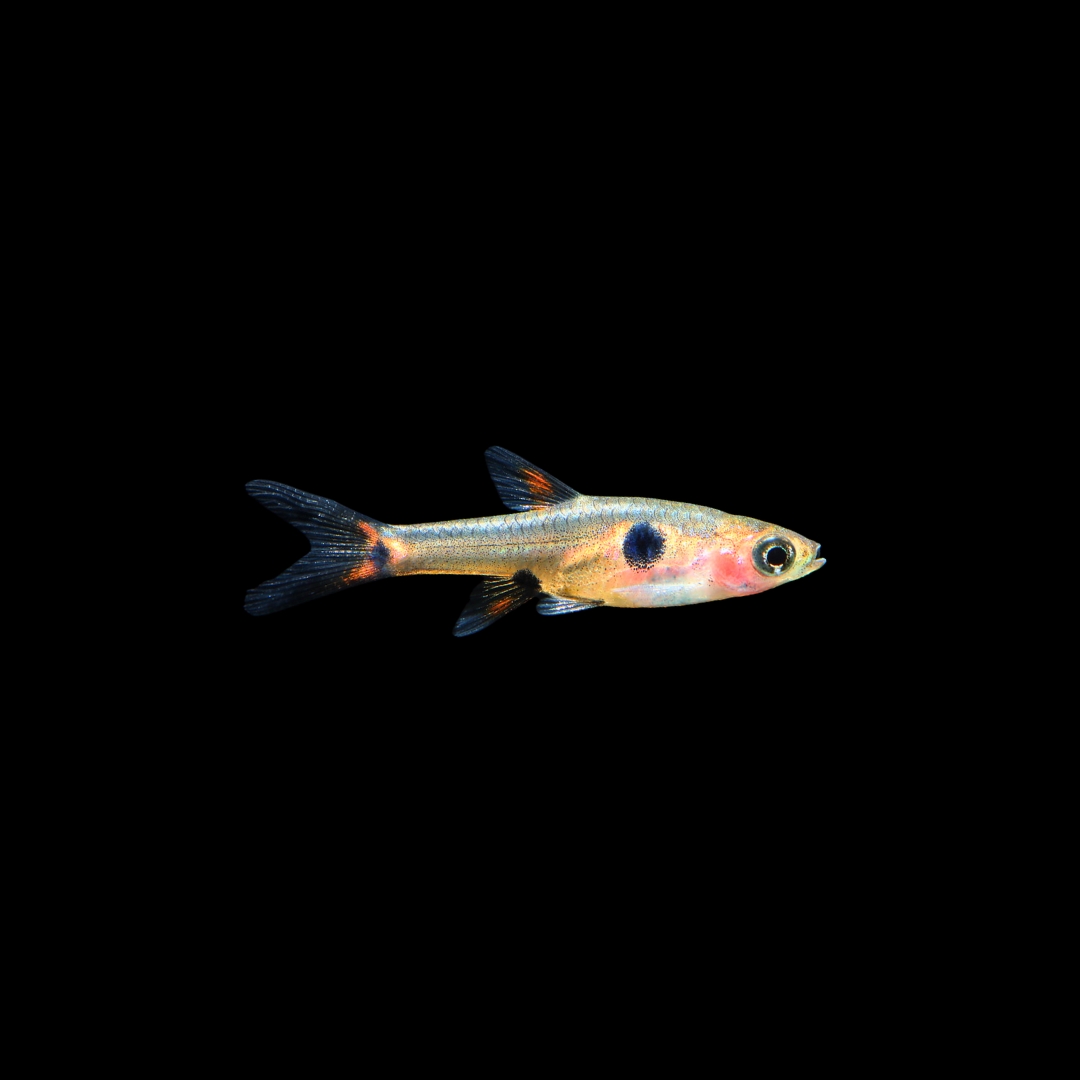
エンドラーズ・タイガーは、ベネズエラ原産の小型卵胎生魚エンドラーズ・ライブベアラー(Poecilia wingei)に、スネークスキン系やギャラクシー系の改良グッピーを交配し、さらにエンドラーズとの戻し交配を重ねて作り出された改良品種です。原種ゆずりの小柄で引き締まった体、活発な泳ぎ、金属的な光沢を受け継ぎながら、黄色から橙色の体側には墨のように黒い縦縞やコブラ模様が走ります。この模様が虎を思わせることから「タイガー」と呼ばれており、それこそがこの魚の最大の魅力です。日本国内では、主にシンガポールやインドネシア、スリランカ、タイなどの養殖場から輸入されたオスが手頃な価格で流通しています。入手しやすい魚ですが、長く楽しむためには、原産地とは性質の異なる日本の軟水への配慮と、輸入個体を迎える際の丁寧なトリートメントが欠かせません。腹部が赤く色づく「タイガーレッドベリー」や、黄色を強調した系統、青みを加えた系統など派生型も多く、小型水槽でも十分な存在感を放ちます。The Tiger Endler is an ornamental strain created by crossing the Endler’s livebearer (Poecilia wingei), a small livebearer native to Venezuela, with fancy guppies of the snakeskin and galaxy lines, and then repeatedly backcrossing the offspring to Endlers. It inherits the compact, well-muscled build, energetic swimming and metallic sheen of the wild Endler, while its yellow to orange flanks carry ink-black vertical bars or cobra patterns. Because these markings recall a tiger, the strain is called the “Tiger,” and they are its greatest attraction. In Japan, it is mainly sold as imported males from farms in Singapore, Indonesia, Sri Lanka and Thailand at affordable prices. Although it is easy to obtain, long-term success depends on adjusting for Japan’s soft tap water, which differs from the fish’s native habitat, and on careful quarantine of imported fish. Many derived forms exist, such as the “Tiger Red Belly” with a red-tinged abdomen, lines selected for bright yellow, and lines with added blue, and the fish has plenty of presence even in a small aquarium.
基本情報 / Basic Information
学名 / Scientific Name
Poecilia wingei × Poecilia reticulata
通称 / Common Name
エンドラーズ・タイガー、タイガーエンドラーズ(派生系統としてタイガーレッドベリー、イエロータイガー、ブルータイガーなど)Tiger Endler, Tiger Endler’s Livebearer (derived lines include Tiger Red Belly, Yellow Tiger and Blue Tiger)
分類 / Family
カダヤシ目 カダヤシ科 ポエキリア属(種間交雑による改良品種で、愛好家の間で用いられるクラス分類ではクラスKに該当)Cyprinodontiformes, Poeciliidae, genus Poecilia (an interspecific hybrid strain, placed in Class K under the classification system used by Endler breeders)
英名 / English Name
Tiger Endler
分布 / Distribution
飼育下で作出された改良品種のため、自然分布はありません。親種の原種エンドラーズは、ベネズエラ北東部のクマナ近郊やパリア半島周辺のカンポマ地域などの沿岸ラグーンに分布します。流通個体の多くは、シンガポール、インドネシア、スリランカ、タイなどの養殖場で生産されています。As a captive-bred strain, it has no natural range. Its parent species, the wild Endler’s livebearer, inhabits coastal lagoons in northeastern Venezuela, such as those near Cumaná and in the Campoma area around the Paria Peninsula. Most fish in the trade are produced on farms in Singapore, Indonesia, Sri Lanka and Thailand.
最大体長 / Max Size
オス約3〜4cm、メス約4〜5cm(オスは原種エンドラーズよりやや大きくなる傾向があります)Males about 3 to 4 cm, females about 4 to 5 cm (males tend to grow slightly larger than wild Endler males)
寿命 / Lifespan
2〜3年程度とされます。水温をやや低め(24〜25℃)に保つと、寿命が延びやすいと考えられています。Generally about 2 to 3 years. Keeping the temperature slightly lower (24 to 25°C) is thought to help extend lifespan.
飼育環境 / Aquarium Environment
水槽サイズ / Tank Size
45cm規格水槽(約30〜35L)以上が目安です。オスだけを少数飼育するなら30cm規格水槽(約12L)でも飼育できますが、ペアで飼うと短期間で数が増えて過密になりやすいため、繁殖させる場合は60cm規格水槽(約57L)程度の余裕があると安心です。A 45 cm standard tank (about 30 to 35 L) or larger is recommended. A small group of males alone can be kept in a 30 cm standard tank (about 12 L), but pairs multiply quickly and the tank soon becomes overcrowded, so if you plan to breed them a 60 cm standard tank (about 57 L) offers a more comfortable margin.
水温 / Temperature
24〜28℃(最適は26〜27℃前後)。20℃を下回ると動きが鈍くなり、18℃以下は危険域です。32℃以上も危険なため、冬はサーモスタット付きヒーターを使い、夏は冷却ファンやエアコン、水槽用クーラーで30℃未満を保ちましょう。24 to 28°C (ideally around 26 to 27°C). Activity drops below 20°C, and 18°C or lower is dangerous. Temperatures of 32°C or higher are also dangerous, so use a thermostat-controlled heater in winter, and in summer keep the water below 30°C with a cooling fan, air conditioning or an aquarium chiller.
水質 / Water Quality
pH7.0〜7.8の中性〜弱アルカリ性、総硬度(GH)6〜12dGH(約107〜214mg/L)が目安です。一方、日本の水道水は多くの地域で軟水で、全国平均でも硬度50mg/L前後(約2.8dGH)とされ、地域によってはさらに軟らかくなります。軟水での飼育が続くと、金属光沢がくすんだり繁殖率が下がったりしやすいため、ろ材ネットにごく少量のサンゴ砂やカキ殻を入れ、試薬でpHとGHを測りながら穏やかに硬度を上げるのがおすすめです。入れすぎると急にアルカリ性へ傾くので、少量から調整してください。Aim for a neutral to slightly alkaline pH of 7.0 to 7.8 and a general hardness (GH) of 6 to 12 dGH (about 107 to 214 mg/L). Japanese tap water, however, is soft in most areas, with a national average of around 50 mg/L (about 2.8 dGH), and some areas are even softer. Long-term keeping in soft water tends to dull the metallic sheen and lower breeding success, so it is a good idea to place a very small amount of coral sand or oyster shell in a filter media bag and raise hardness gently while testing pH and GH. Too much can push the water alkaline quickly, so start small.
レイアウト / Layout
上層から中層を活発に泳ぐため、前面に十分な遊泳スペースを確保しましょう。あわせてウィローモスや浮草を配置すると、メスの隠れ家や稚魚の避難場所になり、水槽全体が落ち着きます。底床は水質に影響を与えにくい大磯砂や田砂、中性を保つタイプのソイルが扱いやすく、pHを強く下げる吸着系ソイルや、大量の流木やピートモスを使ったブラックウォーター環境は避けましょう。ろ過には、強い水流を生まないスポンジフィルターや、吸水口にスポンジを付けた上部式・外掛け式が適しています。These fish swim actively in the upper and middle levels, so leave plenty of open swimming space at the front. Adding Java moss or floating plants gives females a refuge and fry a place to hide, which helps the whole tank settle. Substrates that hardly affect water chemistry, such as Oiso gravel, fine river sand or pH-neutral soils, are easy to manage, while adsorbing soils that strongly lower pH and blackwater setups using lots of driftwood or peat moss should be avoided. Sponge filters, or top-mounted and hang-on filters with a sponge on the intake, are suitable because they do not create strong currents.
注意点 / Precautions
エンドラーズやグッピーなどのカダヤシ科の熱帯魚は、日本への輸入時に法定の動物検疫の対象とならないため、病原体が持ち込まれる可能性を前提に考える必要があります。外国産の個体を迎える際は、本水槽とは別の容器で2〜4週間ほど隔離観察しましょう。夏場に冷却ファンを使うと蒸発量が大きく増え、放置するとミネラルや硝酸塩が濃縮されて水質が急に変わるため、カルキ抜きした水でこまめに足し水をしてください。換水は週1回、総水量の3分の1程度を目安とし、ろ過マットを一度にすべて新品へ交換するとろ過バクテリアが失われるため避けましょう。Livebearers of the family Poeciliidae, including Endlers and guppies, are not subject to mandatory animal quarantine when imported into Japan, so keepers should assume that pathogens may be brought in. When adding imported fish, observe them in a container separate from the main tank for about 2 to 4 weeks. Cooling fans greatly increase evaporation in summer, and if this is left unchecked, minerals and nitrate become concentrated and water quality can change suddenly, so top up frequently with dechlorinated water. Change about one third of the water once a week, and avoid replacing all the filter media with new material at once, as this wipes out the beneficial bacteria.
餌と給餌 / Feeding
餌の種類 / Diet
雑食性で、口に入る大きさの微粒の人工飼料や、細かく砕いたフレークフードを主食としてよく食べます。黄橙色と黒のコントラストを引き出すには、カロテノイドや動物性タンパク質が豊富な冷凍ブラインシュリンプ、冷凍ミジンコ、活きたタマミジンコ、マイクロワームを副食に加えると効果的です。水草の表面に付く柔らかい藻類もついばむため、スピルリナ配合の植物性フレークを織り交ぜると栄養のバランスが整いやすくなります。They are omnivorous and readily take fine-grained prepared foods and finely crushed flakes as their staple diet. To bring out the contrast between the yellow-orange body and the black bars, add frozen brine shrimp, frozen daphnia, live Moina or microworms, which are rich in carotenoids and animal protein, as supplements. They also graze on soft algae growing on plant leaves, so mixing in spirulina-based plant flakes helps balance their nutrition.
給餌のポイント / Feeding Tips
グッピーの仲間は胃を持たない「無胃魚」で、一度にたくさん食べ溜めすることができません。成魚には1日2回(朝・夕)、1〜2分で食べ切れる量だけを与え、消灯直前の給餌は避けましょう。冷凍餌や生き餌などの副食は週2〜3回程度が目安です。与えすぎは消化不良や水質悪化に直結するため、少量をこまめに与えることが基本です。Like other guppies, they are stomachless fish and cannot store large amounts of food at once. Feed adults twice a day (morning and evening), giving only as much as they can finish in 1 to 2 minutes, and avoid feeding just before the lights go out. Frozen or live supplements two to three times a week are a good guide. Overfeeding leads directly to digestive trouble and poor water quality, so small, frequent portions are the rule.
性格と混泳 / Temperament and Tank Mates
性格 / Temperament
温和で、他の魚を攻撃することはほとんどありませんが、とても活発に泳ぎ回ります。オスはメスを熱心に追いかけて求愛し、オス同士でもヒレを大きく広げて見せ合う姿がよく見られます。オスだけで飼っていても互いにディスプレイを繰り広げるため、眺めていて飽きない魚です。Peaceful and rarely aggressive toward other fish, but a very active swimmer. Males chase and court females with great persistence, and they often spread their fins wide to display to one another. Even in a males-only tank they keep displaying to each other, so they are endlessly entertaining to watch.
混泳の相性 / Compatibility
泳ぐ層が異なる小型のコリドラスやオトシンクルス、ミナミヌマエビやヤマトヌマエビとは平和に暮らせます。ただし、エビがコリドラス用の沈下性タブレットを持ち去ることがあるため、コリドラスへの給餌は消灯後に行うなどの工夫が必要です。一方、一般の改良グッピーや他品種のエンドラーズとの混泳は避けてください。すぐに交雑が起こり、双方の系統を元に戻せなくなります。スマトラやタイガーバルブなどヒレをかじる魚、中型以上の肉食魚も同居には向きません。また、感染症のリスクを考えると、同じタイガー系統であっても、国内で繁殖された個体と外国産の個体をいきなり同居させるのは避けましょう。They live peacefully with small Corydoras and Otocinclus, which occupy different levels of the tank, and with dwarf shrimp and Amano shrimp. Shrimp may carry off sinking tablets meant for Corydoras, however, so it helps to feed the Corydoras after lights out. On the other hand, do not keep them with fancy guppies or other Endler strains: they hybridize almost immediately, and neither line can be restored afterward. Fin-nipping fish such as tiger barbs and medium-sized or larger predatory fish are also unsuitable. Because of disease risk, avoid suddenly putting domestically bred fish and imported fish together, even if both are tiger lines.
病気と対策 / Diseases and Prevention
かかりやすい病気 / Common Diseases
水質が合えば丈夫な魚ですが、最も警戒したいのは、国内で「グッピーエイズ」「グッピー病」と呼ばれてきた感染症です。胸ビレが白く曇り、ヒレをたたんで痩せ細り、次々と死んでいくのが典型的な症状です。シンガポールから日本へ輸入された病気のグッピーを調べた研究では、半数以上の個体から繊毛虫テトラヒメナ(Tetrahymena corlissi)が見つかり、鱗の内側だけでなく筋肉や内臓、さらには眼窩や脊髄にまで入り込んでいたことが報告されています。つまり、体の奥深くまで侵入する寄生虫であり、いったん内部に入られると薬浴による治療は難しいと考えられています。体表には白い点や傷として現れることもあり、白点病と紛らわしい場合があります。このほか、カラムナリス菌による尾ぐされ病や、稚魚に多い、尾ビレが針のようにすぼまる「ハリ病」にも注意が必要です。They are hardy when water conditions suit them, but the greatest concern is the infection known in Japan as “guppy AIDS” or “guppy disease.” Typical signs are cloudy white pectoral fins, clamped fins, wasting, and one death after another. A study of diseased guppies imported from Singapore into Japan found the ciliate Tetrahymena corlissi in more than half of the fish, not only beneath the scales but also in the muscles and internal organs, and even in the eye sockets and spinal cord. In other words, this parasite can penetrate deep into the body, and once it is inside, treatment with medicated baths is thought to be difficult. On the body surface it may appear as white spots or sores and can be confused with ich. Fin rot caused by Columnaris bacteria and “needle tail,” a condition common in young fish in which the tail fin closes into a thin point, also require attention.
対策と予防 / Prevention
最大の予防策は、病原体を本水槽へ持ち込まないための隔離です。新しく迎えた個体、とくに外国産の個体は、スポンジフィルターとヒーターを備えた専用の容器で2週間〜1か月ほど観察しましょう。水合わせは、10分おきにコップ1杯ずつ飼育水を加える手順を3〜4回繰り返し、輸送の疲れと水質の変化が重ならないようにします。隔離水槽で使った網やホースは、本水槽と共用しないでください。観察期間中は、胸ビレが透明か、ヒレをたたんでいないか、体表に白い濁りや傷がないか、泳ぎがふらついていないかを毎日確認します。軽い尾ぐされやハリ病には、まず換水と0.3〜0.5%の塩水浴(水1Lに塩3〜5g)を試し、細菌感染が進行している場合はグリーンFゴールドなどの抗菌薬による薬浴を検討します。ただし、ひどく弱った個体に急に薬浴をさせると負担になることもあるため、清潔な水を保って様子を見る判断も大切です。The best prevention is quarantine that keeps pathogens out of the main tank. Observe new arrivals, especially imported fish, in a dedicated container with a sponge filter and heater for two weeks to a month. Acclimate them by adding one cupful of tank water every 10 minutes, repeated three or four times, so that shipping fatigue and changes in water chemistry do not hit at the same time. Never share nets or hoses between the quarantine tank and the main tank. During observation, check daily whether the pectoral fins are clear, whether the fins are clamped, whether there is cloudiness or sores on the skin, and whether swimming is unsteady. For mild fin rot or needle tail, start with water changes and a 0.3 to 0.5 percent salt bath (3 to 5 g of salt per liter of water), and for advancing bacterial infections consider an antibacterial bath such as Green F Gold. However, a sudden medicated bath can burden a badly weakened fish, so sometimes the better choice is to keep the water clean and watch.
増やし方(繁殖) / Breeding
雌雄の判別 / Sexing
オスは体が小さく、黄色から橙色の体に黒い縦縞やコブラ模様が鮮やかに入り、尻ビレが交接器(ゴノポディウム)と呼ばれる細い棒状の器官に変化しています。メスはひと回り大きくふっくらとした体つきで、模様の目立たない銀灰色をしています。Males are smaller, with vivid black bars or cobra patterns on a yellow to orange body, and their anal fin is modified into a slender rod-like organ called the gonopodium. Females are noticeably larger and rounder, with a plain silver-gray body.
繁殖形態 / Reproduction
卵胎生で、メスは体内で卵を孵化させ、すでに泳げる状態の稚魚を産みます。水温28℃前後で行われた飼育研究では、生まれた稚魚の全長は約7.8mmで、オスは平均約37日で成熟し、メスも生後2か月前後で初めての出産が可能になったと報告されています。同じ研究での1回の出産数は平均17匹前後で、出産は23〜30日ほどの間隔で繰り返されました。成熟の早さと出産間隔の短さから、条件が整えば短期間で数が増えていく魚だといえます。They are livebearers: the female hatches the eggs inside her body and gives birth to fry that can already swim. A rearing study conducted at around 28°C reported that newborn fry measured about 7.8 mm in total length, that males matured in about 37 days on average, and that females could give birth for the first time at around two months of age. In the same study, broods averaged about 17 fry, and births were repeated at intervals of roughly 23 to 30 days. Given how quickly they mature and how often they give birth, the fish can increase in number within a short time when conditions are right.
繁殖のポイント / Breeding Tips
水温と水質が整っていれば、特別なことをしなくても自然に殖えていきます。オスはメスをしつこく追いかけるため、オス1匹に対してメス2〜4匹の割合にして、メスの負担を分散させましょう。稚魚には孵化直後のブラインシュリンプや極細の粉末フードを1日3〜4回、少量ずつ与えます。系統を計画的に維持したい場合は、遅くとも生後3〜4週間までに雌雄を分けてください。虎柄を保つには、縞のくっきりしたオスを種親に選ぶとともに、メスも必ずタイガー系統の個体を使うことが重要です。縦縞の発現には、父から息子へ受け継がれるY染色体上の遺伝子と、両親の双方から受け継ぐ必要のある劣性の遺伝子が関わっていると考えられているため、一般の改良グッピーのメスと交配すると、次の世代で縞が出なくなることがあります。また、兄妹交配を長く続けると活力が落ちやすいため、数世代ごとに別ラインのタイガー系統と交配して血を入れ替えるのが効果的とされています。When temperature and water quality are suitable, they breed naturally without any special effort. Males chase females persistently, so keep one male to two to four females to spread the burden. Feed fry newly hatched brine shrimp or very fine powdered food in small amounts three or four times a day. If you want to maintain the line deliberately, separate the sexes by three to four weeks of age at the latest. To preserve the tiger pattern, choose males with sharp, clean bars as breeders, and always use females from tiger lines as well. The barred pattern is thought to involve a gene on the Y chromosome, which passes from father to son, together with a recessive gene that must be inherited from both parents, so crossing with an ordinary fancy guppy female can cause the bars to disappear in the next generation. Prolonged sibling mating also tends to reduce vigor, so outcrossing to a separate tiger line every few generations is considered effective.
雑学と豆知識 / Trivia and Fun Facts
1. 本人の知らないうちに付けられた名前 / 1. A Name Given Without Its Namesake’s Knowledge
タイガーの片親である原種エンドラーズは、1937年に魚類学者フランクリン・F・ボンドによって最初に採集されましたが、その後長いあいだ広く知られることはありませんでした。転機となったのは1975年、進化生物学者ジョン・エンドラー博士がベネズエラのラグーナ・デ・パトスでこの魚を再発見したときです。博士は命名を託すため、カダヤシ科の分類の専門家ドン・E・ローゼン博士に標本を渡しましたが、ローゼン博士は名前を付ける前に亡くなってしまいます。その一方で、生体を受け取っていたニューヨーク水族館の遺伝学者クラウス・カルマン博士が、この魚をドイツのアクアリウム界へ紹介しました。このとき付けられた「エンドラーズ・ライブベアラー」という名前は、エンドラー博士には知らされておらず、博士自身は1980年頃になって初めてそのことを知ったと語っています。学名が与えられたのはさらに後の2005年で、新種 Poecilia wingei として記載されました。種小名は、グッピーの体色がY染色体を通じて父から息子へ受け継がれることを示した研究者の一人、デンマークの生物学者オイヴィント・ウィンゲにちなみます。なお、グッピーと交配すれば子孫を残せることから、独立種とすべきかどうかは現在も議論がありますが、主要な魚類データベースや国際自然保護連合では独立種として扱われています。The wild Endler, one of the Tiger Endler’s parents, was first collected in 1937 by ichthyologist Franklyn F. Bond, but for a long time afterward it remained largely unknown. The turning point came in 1975, when evolutionary biologist Dr. John Endler rediscovered the fish at Laguna de Patos in Venezuela. He gave specimens to Dr. Donn E. Rosen, an expert in the taxonomy of livebearers, so that he could name it, but Dr. Rosen died before doing so. Meanwhile, Dr. Klaus Kallman, a geneticist at the New York Aquarium who had received live fish, introduced it to the German aquarium community. The name given at that time, “Endler’s livebearer,” was not shared with Dr. Endler, who has said that he first learned of it around 1980. A scientific name came even later, in 2005, when the fish was described as a new species, Poecilia wingei. The species name honors the Danish biologist Øjvind Winge, one of the researchers who showed that guppy coloration is passed from father to son via the Y chromosome. Because it can produce offspring with guppies, there is still debate over whether it should be treated as a separate species, but major fish databases and the International Union for Conservation of Nature treat it as one.
2. 網目模様が「虎柄」に変わる仕組み / 2. How a Snakeskin Pattern Becomes Tiger Stripes
タイガーの縞模様のルーツは、改良グッピーのスネークスキン系統が持つ細かな網目模様にあると考えられています。グッピーの仲間では、オスを彩る色や模様の遺伝子の多くが性染色体、とりわけY染色体と結びついて受け継がれます。シンガポールの養殖場に由来するイエロースネークスキン系統のグッピーを調べた研究では、約1割のオスで、体の網目模様が尾の付け根付近の4〜5本の光沢ある縦縞に置き換わっていました。交配実験の結果、この変化は、Y染色体上にある網目模様の遺伝子と、常染色体上にある劣性の「bar」遺伝子の組み合わせによって起こることが分かっています。劣性遺伝子は両親の双方から受け継いだときにだけ表に現れるため、縞を出すには父親だけでなく母親の血統も重要になるというわけです。タイガー系統そのものを対象にした研究は見当たらないものの、同じような仕組みがタイガーの縦縞にも関わっていると考えられています。さらに、皮膚には黒を担うメラノフォア、黄や橙を担うキサントフォア、青や金属光沢を生むイリドフォアという3種類の色素胞があり、その重なり方が鮮やかなコントラストを生み出しています。色や模様の発達は成長期のホルモンや周囲の環境にも左右されることが報告されており、美しい虎柄は、遺伝と飼育環境の両方がそろって初めて引き出されるといえるでしょう。The Tiger Endler’s stripes are thought to originate from the fine net-like pattern of the snakeskin lines of fancy guppies. In guppies, many of the genes that color and pattern males are inherited together with the sex chromosomes, especially the Y chromosome. A study of Yellow Snakeskin guppies from Singapore farms found that in about one in ten males, the net pattern on the body was replaced by four or five glossy vertical bars near the base of the tail. Breeding experiments showed that this change results from the combination of the Y-linked snakeskin pattern gene and a recessive gene called “bar” on an autosome. Because a recessive gene shows only when it is inherited from both parents, the mother’s lineage matters as much as the father’s for the bars to appear. Although no study has been found on the tiger strain itself, a similar mechanism is thought to be involved in its vertical bars. The skin also holds three types of pigment cells: melanophores for black, xanthophores for yellow and orange, and iridophores that produce blue and metallic sheen, and the way they overlap creates the vivid contrast. The development of color and pattern has also been reported to depend on hormones during growth and on the surrounding environment, so a beautiful tiger pattern can be said to emerge only when genetics and husbandry both come together.
3. 「タイガー」と「エル・ティグレ」は別物 / 3. “Tiger” and “El Tigre” Are Different Fish
エンドラーズを探していると、「タイガー」とよく似た「エル・ティグレ」という名前に出会うことがあります。エル・ティグレはスペイン語で「虎」を意味しますが、模様にちなんだ名前ではありません。ベネズエラ・カンポマ地域を流れるエル・ティグレ小川で採集された野生の原種エンドラーズの子孫を指す、いわば産地の名前です。この小川はカンポマ湖とつながっていないため、独立した個体群とみなされています。つまり、交配によって作られた改良品種のタイガーとは、成り立ちがまったく異なります。販売リストなどで両者が並んで掲載されることもあるため、購入時には取り違えないように気をつけましょう。While looking for Endlers, you may come across the name “El Tigre,” which sounds very similar to “Tiger.” El Tigre means “the tiger” in Spanish, but it is not a pattern name. It refers to descendants of wild Endlers collected from the El Tigre stream in the Campoma region of Venezuela, in effect a locality name. Because this stream is not connected to Laguna Campoma, the fish are regarded as a separate population. In other words, their origin is completely different from that of the Tiger, an ornamental strain created through crossbreeding. The two are sometimes listed side by side in sales lists, so take care not to mix them up when buying.
4. 精子を蓄えるメスと、オスたちの社会性 / 4. Sperm-Storing Females and the Social Lives of Males
エンドラーズやグッピーのメスは、交尾で受け取った精子を卵巣内のひだに生きたまま蓄えておくことができます。そのため、一度の交尾だけで数か月にわたって出産を繰り返すことがあり、オスがいなくなった後でも、そのオスの子が生まれ続けます。お店でメスだけを買ってきたのに稚魚が生まれた、という出来事にはこうした理由があります。行動の面でも、この魚は研究者の関心を集めてきました。オスだけを30日間一緒に飼育した実験では、オス同士で求愛行動を示すようになったうえ、その後のメスの匂いに対する好みにも変化が見られたと報告されています。また、オスの体側の模様は左右で異なることが少なくありませんが、求愛の際にどちらの側面を見せるかを状況に応じて使い分けている可能性も示唆されています。オスだけの水槽でもにぎやかなディスプレイが続く背景には、こうした柔軟な社会性があるのかもしれません。Female Endlers and guppies can keep sperm received during mating alive in folds of the ovary. As a result, a single mating can lead to repeated births over several months, and a male’s offspring may keep arriving even after he is gone. This is why fry sometimes appear after only a female was bought from a shop. These fish have also attracted researchers’ interest for their behavior. In an experiment where males were kept together without females for 30 days, they began courting one another, and changes were also reported in their later preference for female scent. Males often have different patterns on their left and right sides, and it has been suggested that they may choose which side to show during courtship depending on the situation. The lively displays that continue even in a males-only tank may reflect this flexible social nature.
5. 純血を守るクラス分類と、野生原種の危機 / 5. The Class System and the Plight of Wild Endlers
原種とグッピーの交雑個体が市場に広がったことへの危機感から、エンドラー博士や主要なブリーダーたちは、エンドラーズを3つのクラスに分ける仕組みを整えました。野生採取個体と、その血統記録が証明された子孫がクラスN、外見は原種と同じでも記録が途切れているものがクラスP、他種との交雑で作られた既知のハイブリッドがクラスKで、タイガーはこのクラスKに当たります。この線引きの背景には深刻な事情があります。原種エンドラーズは国際自然保護連合のレッドリストで絶滅危惧種(EN)と評価されており、原産地では生息環境の悪化や、放流されたグッピーとの交雑が脅威になっています。そうしたなかで、飼育下で純血の系統を守る取り組みは、種を支える大切な役割を担っています。タイガーは飼育下で作られ、養殖されている品種なので、楽しむことが野生の個体群に採集の負担をかけることはありません。その代わり飼育者には、ハイブリッドの血が原種の系統に混ざらないよう、水槽や器具をしっかり分ける配慮が求められます。Concerned by the spread of hybrids between wild Endlers and guppies in the trade, Dr. Endler and leading breeders set up a system dividing Endlers into three classes. Class N covers wild-collected fish and descendants with documented lineage, Class P covers fish that look identical to wild Endlers but whose records are incomplete, and Class K covers known hybrids with other species. The Tiger Endler belongs to Class K. A serious situation lies behind this distinction. The wild Endler has been assessed as Endangered (EN) on the IUCN Red List, and in its native range it is threatened by habitat degradation and hybridization with released guppies. Against this background, efforts to keep pure lines in captivity play an important role in supporting the species. Because the Tiger Endler is created and farmed in captivity, enjoying it places no collecting pressure on wild populations. In return, keepers are asked to keep tanks and equipment strictly separate so that hybrid bloodlines never mix into lines of the wild species.
まとめ / Conclusion
エンドラーズ・タイガーは、原種エンドラーズの小さく俊敏な体と、改良グッピーから受け継いだ大胆な縦縞を併せ持つ魚です。黄橙色の体に墨色の縞を走らせたオスたちが群れ泳ぎ、ヒレを広げて見せ合う姿は、小型水槽の中でも鮮やかな見どころになります。The Tiger Endler combines the small, agile body of the wild Endler with the bold stripes inherited from fancy guppies. A group of males with ink-black bars across yellow-orange bodies, swimming together and spreading their fins at one another, makes a vivid highlight even in a small aquarium.
軟水に少しミネラルを補い、新しい個体は隔離して見守り、殖えたときの行き先を前もって考えておく。そうした心配りに、この魚は鮮やかな発色と元気な泳ぎで応えてくれます。そして、原種の系統とは混ぜずに向き合うことが、虎柄の小さな魚と長く付き合っていくための大切な約束になります。Add a little mineral content to soft water, quarantine and watch new fish, and plan ahead for where extra fish will go. For this kind of care, the fish rewards its keeper with brilliant color and lively swimming. And keeping it apart from lines of the wild species is an important commitment for a long life together with this little tiger-striped fish.
Poeser, F. N., Kempkes, M. & Isbrücker, I. J. H. (2005). Description of Poecilia (Acanthophacelus) wingei n. sp. from the Paría Peninsula, Venezuela, including notes on Acanthophacelus Eigenmann, 1907 and other subgenera of Poecilia Bloch and Schneider, 1801 (Teleostei, Cyprinodontiformes, Poeciliidae). Contributions to Zoology, 74(1/2): 97–115.
Schories, S., Meyer, M. K. & Schartl, M. (2009). Description of Poecilia (Acanthophacelus) obscura n. sp. (Teleostei: Poeciliidae), a new guppy species from western Trinidad, with remarks on P. wingei and the status of the “Endler’s guppy”. Zootaxa, 2266: 35–50.
Phang, V. P. E., Fernando, A. A. & Chia, E. W. K. (1990). Inheritance of the color patterns of the Blue Snakeskin and Red Snakeskin varieties of the guppy, Poecilia reticulata. Zoological Science, 7: 419–425.
Phang, V. P. E., Khoo, G. & Ang, S. P. (1999). Interaction between the autosomal recessive bar gene and the Y-linked Snakeskin Body (Ssb) pattern gene in the guppy, Poecilia reticulata. Zoological Science, 16(6): 905–908. https://doi.org/10.2108/zsj.16.905
Hatai, K., Chukanhom, K., Lawhavinit, O., Hanjavanit, C., Kunitsune, M. & Imai, S. (2001). Some biological characteristics of Tetrahymena corlissi isolated from guppy in Thailand. 魚病研究(Fish Pathology), 36(4): 195–199. https://www.jstage.jst.go.jp/article/jsfp1966/36/4/36_4_195/_article
Hoffman, G. L., Landolt, M., Camper, J. E., Coats, D. W., Stookey, J. L. & Burek, J. D. A disease of freshwater fishes caused by Tetrahymena corlissi Thompson, 1955, and a key for identification of holotrich ciliates of freshwater fishes. Journal of Parasitology. https://doi.org/10.2307/3278995




コメント