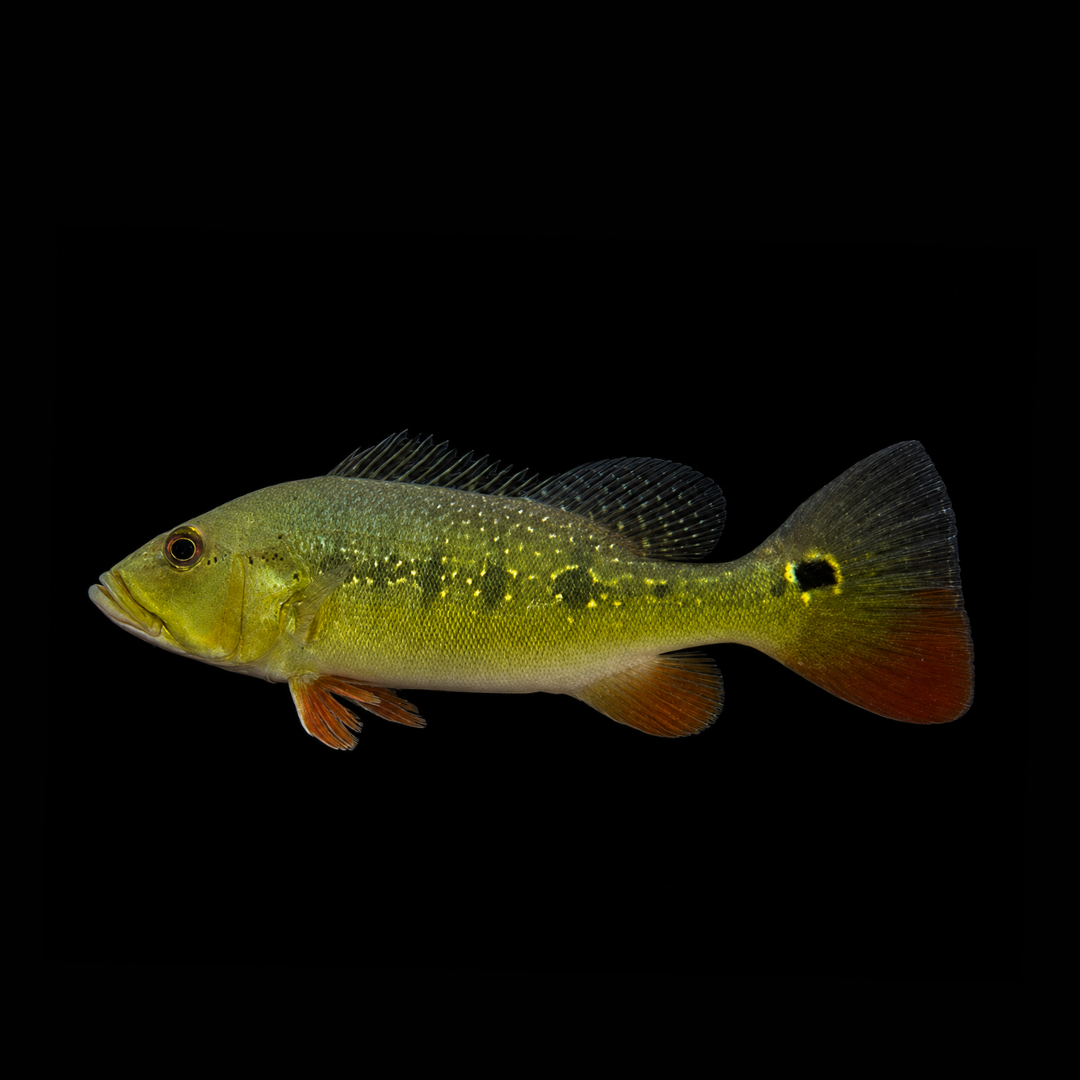
シクラ・インターメディアは、南米オリノコ川水系を中心に分布するピーコックバスの一種で、英名ではRoyal peacock bassと呼ばれます。幼魚期には体側中央を一本の暗色帯が走りますが、成長するとその帯が不規則な黒い斑紋へ分かれ、背側からは細い横帯が現れるという、同属の中でも非常に特徴的な模様の変化を見せます。赤みを帯びる下顎や鰭、尾柄部の眼状斑、筋肉質で流線型の体つきも大きな魅力です。自然界では本流の速い流れや、水没した岩・倒木の周辺を利用する昼行性の魚食魚で、観賞魚としても高い遊泳力と強い捕食性を備えています。終生飼育には大型水槽、強力なろ過、十分な酸素供給、計画的な栄養管理が欠かせません。Cichla intermedia is a peacock bass native mainly to the Orinoco River basin of northern South America and is widely known in English as the Royal peacock bass. Juveniles carry a continuous dark stripe along the middle of the flank, but this stripe breaks into irregular dark blotches as the fish matures, while narrow vertical bars become visible across the upper sides. This ontogenetic change, together with reddish tones on the lower jaw and fins, a caudal ocellus, and a muscular streamlined body, gives the species a distinctive appearance. In nature it is a diurnal piscivore strongly associated with the main river channel, especially areas of swift current around submerged rocks and woody structure. In the aquarium, its powerful swimming ability and predatory nature mean that long-term care requires a large tank, strong filtration, high dissolved oxygen, and carefully managed nutrition.
シクリッド科 Cichlidae、シクラ属 CichlaFamily Cichlidae, genus Cichla
英名 / English Name
Royal peacock bass
分布 / Distribution
ベネズエラおよびコロンビアのオリノコ川水系。カシキアレ川を含む地域から知られ、本流の流れがある場所や水没した岩・倒木の周辺でよく見られます。Orinoco River basin in Venezuela and Colombia, including records from the Casiquiare region. It is commonly associated with flowing main-channel habitats near submerged rocks and woody structure.
最大体長 / Max Size
最大約55cm(全長)の記録があります。飼育下でも40cmを超える大型魚として扱い、個体差や飼育条件によっては50cm前後まで成長することを想定します。Published records reach about 55 cm total length. In captivity it should be planned for as a fish exceeding 40 cm, with some individuals approaching roughly 50 cm depending on genetics and husbandry.
寿命 / Lifespan
本種単独の確立した飼育寿命データは乏しいため断定はできません。ピーコックバス類の長期飼育を考える場合は、おおむね10年前後、条件が良ければそれ以上を視野に入れて設備と維持費を計画するのが安全です。A well-established species-specific captive lifespan is not available. For responsible long-term planning, it is prudent to prepare for around a decade of care and potentially longer under favorable conditions, as with other large peacock bass.
飼育環境 / Aquarium Environment
水槽サイズ / Tank Size
幼魚の一時飼育では小型水槽も使用できますが、終生飼育では最低でも120cmワイド水槽(120×60×60cm程度)を基準にし、できれば150cm以上で奥行き60cm以上を確保した水槽が安心です。混泳や複数飼育では180cm級以上を検討します。成長が速いため、魚が大きくなってから設備を用意するのではなく、早い段階から最終サイズを見越すことが重要です。Smaller tanks may be used temporarily for juveniles, but long-term care should start from at least a 120 cm wide tank of roughly 120 × 60 × 60 cm, with 150 cm or longer and at least 60 cm front-to-back strongly preferred. Mixed-species or group setups often require tanks around 180 cm or larger. Because growth can be rapid, the final adult size should be planned for well before the fish reaches it.
水温 / Temperature
26〜30℃を目安とし、通常は27〜28℃前後で安定させると管理しやすいです。急激な低下や日内変動を避け、冬季はヒーター容量だけでなく予備加温や水温監視も考えておきます。Maintain approximately 26–30°C, with a stable 27–28°C being practical for routine care. Avoid sudden drops or large daily fluctuations, and in cold seasons consider heater redundancy and reliable temperature monitoring.
水質 / Water Quality
弱酸性〜中性を中心に、pH6.0〜7.5程度の安定した淡水環境が扱いやすいです。数値を無理に追うより、アンモニアと亜硝酸を検出させず、硝酸塩と溶存有機物を換水で蓄積させないことを優先します。大食で排泄量が多いため、オーバーフロー式ろ過や大型外部式ろ過など十分なろ過能力と強めのエアレーションが適しています。A stable slightly acidic to neutral freshwater environment around pH 6.0–7.5 is practical. Stability is more important than chasing an exact number: ammonia and nitrite should remain undetectable, while nitrate and dissolved waste should be controlled with regular water changes. Because this is a heavy-feeding predator with substantial waste production, oversized biological and mechanical filtration plus strong aeration are recommended.
レイアウト / Layout
広い遊泳空間を最優先し、流木や大きな岩を使う場合は転倒しないよう確実に固定します。自然界では構造物周辺を利用しますが、水槽内を複雑にし過ぎると突進時の衝突や擦り傷につながります。背景側に太い流木や岩組みを寄せ、前面と中央に長い遊泳レーンを残す構成が向いています。驚いた際の飛び出しにも備え、頑丈なフタを使用します。Prioritize an open swimming lane. If driftwood or large rocks are used, secure them so they cannot shift. Although the species naturally associates with structure, an overly cluttered aquarium increases the risk of collision and abrasion during sudden bursts of speed. Place major structure toward the rear and sides while leaving the center and front open, and use a strong lid because startled fish may jump.
注意点 / Precautions
成長速度、餌代、電気代、換水量まで含めて終生飼育を計画します。導入直後は輸送ストレスで体色が薄くなったり、擦れや拒食が出ることがあるため、消灯気味の静かな環境で様子を見ます。通販個体は袋内の水質悪化が進んでいることがあるので、到着水の状態と魚の呼吸を確認し、温度・pH差を考慮して過度に長い水合わせを避ける判断も必要です。2026年8月確認時点でCichla属は日本の外来生物法に基づく特定外来生物一覧には掲載されていませんが、野外放流は絶対に行わず、自治体の条例や輸入・移動に関する最新規則も個別に確認してください。Plan for the fish’s entire life, including rapid growth, food costs, electricity use, and water-change volume. Newly imported fish may arrive pale, abraded, or temporarily off food; a quiet, dim environment helps recovery. Shipping water can deteriorate quickly, so acclimation should be based on the fish’s respiration and the temperature and pH difference rather than automatically prolonging exposure to old bag water. As checked in August 2026, Cichla is not listed among Japan’s designated Invasive Alien Species under the national Invasive Alien Species Act, but release into the wild must never occur, and any applicable local ordinances or current import and transport rules should also be checked.
餌と給餌 / Feeding
餌の種類 / Diet
主食は大型肉食魚用の高品質な人工飼料を目標にします。導入時や餌付け初期には、冷凍アカムシ、冷凍オキアミ、小エビ、魚肉などを補助的に使えます。活魚は嗜好性が高い一方で、寄生虫・細菌の持ち込みや栄養の偏りを招きやすいため常用は避けます。金魚類を長期間主食にする給餌は、栄養バランスの面からも推奨できません。The long-term goal should be a high-quality formulated diet for large carnivorous fish. During introduction or pellet training, frozen bloodworms, krill, shrimp, and suitable fish flesh can be used as transitional foods. Live feeder fish are highly attractive but can introduce parasites and bacteria and may create nutritional imbalance, so they should not be the staple. Long-term reliance on goldfish-type feeders is not recommended.
給餌のポイント / Feeding Tips
視覚と動きへの反応が強いため、人工飼料への切り替えは「動く餌」から「流れに乗る餌」へ段階的に行うと成功しやすくなります。冷凍オキアミや小エビにペレットを混ぜたり、水流に乗せて沈下・漂流させたりすると認識しやすくなります。幼魚は少量を複数回、成魚は体型を見ながら1日1回〜隔日程度を基本とし、腹部が常に張るほどの過給餌は避けます。食欲だけで量を決めず、成長、排泄量、水質、体型を合わせて調整してください。Because the species responds strongly to movement, pellet training is often easier when the transition is made gradually from visibly moving foods to foods carried by the current. Mixing pellets with krill or shrimp, or presenting them where they drift naturally, can trigger feeding. Juveniles generally benefit from several small meals, while adults can often be maintained on one meal per day or every other day depending on condition. Avoid feeding until the abdomen remains constantly distended; adjust intake according to growth, waste production, water quality, and body condition rather than appetite alone.
性格と混泳 / Temperament and Tank Mates
性格 / Temperament
好奇心が強く飼育者を認識しやすい一方、本質的には大型の魚食性シクリッドです。普段は落ち着いて見えても、給餌時や縄張り形成時には瞬間的な突進と強い攻撃性を示します。成熟やペア形成をきっかけに、それまで成立していた力関係が急に崩れることもあります。It is an alert, inquisitive cichlid that often learns to recognize its keeper, but it remains a large piscivorous predator. Even calm individuals can show explosive acceleration and strong aggression during feeding or territorial disputes. Social relationships that appear stable can change abruptly with maturity or pair formation.
混泳の相性 / Compatibility
最も安全なのは単独飼育です。混泳する場合は、口に収まらない十分な体格があり、遊泳層や体型が競合しにくい魚を選びます。大型ポリプテルス、十分に大きいダトニオ、適切なサイズのアロワナなどで成功例がありますが、相性は個体差と水槽寸法に大きく左右されます。大型シクリッド同士やCichla同士は縄張り争いが激化しやすく、2〜3匹だけでは攻撃が1個体へ集中することがあります。多頭飼育で攻撃を分散する方法もありますが、巨大な水量と退避空間、常時観察、隔離水槽の準備が前提です。ガー類は日本では特定外来生物として規制されているため、混泳候補として新規に導入することはできません。Solitary housing is the safest approach. If tank mates are attempted, choose fish too large to swallow and with different body forms or swimming zones to reduce direct competition. Large bichirs, suitably sized datnoids, and sufficiently large arowanas are sometimes maintained successfully with peacock bass, but outcomes depend heavily on individual temperament and tank dimensions. Other large cichlids and Cichla can become highly territorial, and groups of only two or three may concentrate aggression on one subordinate fish. Larger groups may disperse aggression, but this requires very large water volume, escape space, constant observation, and a ready isolation tank. Gars are regulated in Japan as designated Invasive Alien Species and therefore cannot be newly introduced as tank mates.
病気と対策 / Diseases and Prevention
かかりやすい病気 / Common Diseases
白点病などの外部寄生虫症、輸送や衝突でできた擦り傷からの細菌感染、鰭や体表の炎症に注意します。ワイルド個体では内部寄生虫を持ち込む可能性もあります。また大型シクリッドで見られる頭部の点状病変やいわゆる穴あき症状は、栄養、水質、慢性的ストレス、原虫など複数要因が関与すると考えられており、単一原因に決めつけないことが重要です。Watch for external parasites such as ich, bacterial infection following shipping abrasions or collisions, and inflammation of the fins or skin. Wild-caught fish may also carry internal parasites. Pitting or erosive lesions of the head sometimes seen in large cichlids are considered multifactorial, with nutrition, water quality, chronic stress, and protozoal involvement among the possible contributors, so they should not be attributed to a single cause without diagnosis.
対策と予防 / Prevention
新規個体や活餌を本水槽へ直接入れず、可能なら別水槽で検疫します。水温の急変を避け、アンモニア・亜硝酸を出さないろ過能力を確保し、定期換水で硝酸塩と有機物を蓄積させないことが基本です。呼吸が速い、体色が急に暗くなる、物に体をこすりつける、食欲が続けて落ちるなどの変化があれば、薬を決め打ちせず、水質・水温・外傷・糞便・鰓の状態を順番に確認します。大型魚は投薬量の誤差も大きくなりやすいため、症状が重い場合は魚病に詳しい獣医師や専門家への相談が安全です。Quarantine new fish and, where possible, feeder organisms rather than adding them directly to the main aquarium. Prevent sudden temperature changes, maintain enough biological filtration to keep ammonia and nitrite at zero, and use regular water changes to limit nitrate and organic waste. If breathing becomes rapid, coloration suddenly darkens, the fish flashes against objects, or appetite declines repeatedly, do not medicate blindly; check water quality, temperature, injuries, feces, and gill condition systematically. Medication errors become significant in large systems, so serious cases are best discussed with a veterinarian or aquatic health professional familiar with fish.
増やし方(繁殖) / Breeding
雌雄の判別 / Sexing
幼魚の外見だけで確実に判別するのは困難です。成熟個体では繁殖期のオスに前頭部の隆起が目立つ場合がありますが、個体差があり、これだけで断定はできません。ペア行動、産卵管・生殖突起、繁殖時の行動を総合して判断します。Reliable visual sexing of juveniles is difficult. Mature males may develop a more prominent nuchal hump during reproductive condition, but individual variation means this is not definitive. Pair behavior and examination of the genital papilla near spawning provide more useful evidence.
繁殖形態 / Reproduction
Cichla属に典型的な基質産卵型で、ペアが平らな岩や底面を清掃して卵を産み、雌雄で卵や仔魚を守る両親保護を行います。繁殖期には縄張り性が大幅に強まり、親魚は周囲の魚に激しく攻撃します。本種そのものの飼育下繁殖に関する公開情報は多くないため、同属他種の一般的な繁殖知見をそのまま数値化して当てはめない方が安全です。Like other Cichla, it is a substrate-spawning cichlid. A pair cleans a flat rock or bottom surface, lays adhesive eggs, and both parents guard the eggs and fry. Territorial aggression increases sharply during breeding. Published details on captive breeding specifically for C. intermedia are limited, so precise figures from other Cichla species should not automatically be treated as species-specific values.
繁殖のポイント / Breeding Tips
最大の条件は、成熟した相性の良いペアと十分な床面積です。広い水槽に平らな石や清掃しやすい底面を用意し、強いろ過を維持しながらも産卵場所へ直撃する過剰な水流は避けます。ペア形成後は他魚への攻撃が急増するため、隔離できる設備を事前に用意します。自然界では水位変動や季節性が繁殖周期に関与することが知られていますが、飼育下で本種に人工的な急変を与えることはリスクがあるため、まず栄養状態と長期的な水質安定を優先してください。The key requirements are a compatible mature pair and enough floor area. Provide a flat spawning surface in a spacious aquarium, keep filtration strong, but avoid blasting the spawning site with excessive direct flow. Once a pair forms, aggression toward other fish can escalate quickly, so isolation facilities should be ready in advance. Seasonal hydrology influences reproduction in wild Cichla populations, but deliberately imposing abrupt environmental changes in captivity can be risky; long-term water quality and nutritional condition should come first.
雑学と豆知識 / Trivia and Fun Facts
1. 1971年に記載された「中間的」なシクラ / 1. A “middle” Cichla described in 1971
シクラ・インターメディアは、ベネズエラの魚類学者Antonio Machado-Allisonによって1971年に記載されました。種小名intermediaはラテン語で「中間の」「間にある」といった意味を持ちます。名前だけを見ると何かの中間型のようにも感じられますが、現在は独立した特徴を持つ種として扱われています。2006年にKullanderとFerreiraがCichla属を大規模に再検討した際にも有効種として維持されました。Cichla intermedia was described in 1971 by Venezuelan ichthyologist Antonio Machado-Allison. The Latin epithet intermedia conveys the sense of “intermediate” or “in between.” Although the name can sound like a transitional form, the fish is treated as a distinct species with its own diagnostic characters and remained valid in the major 2006 review of the genus by Kullander and Ferreira.
2. 2006年の「15種」から、現在は16種へ / 2. From 15 species in 2006 to 16 today
Cichla属は長く分類が難しいグループでした。2006年の包括的再検討では9種が新たに記載され、合計15種に整理されました。その後2020年にガイアナとベネズエラのエセキボ川水系からCichla cataractaeが新種として記載され、現在FishBaseではCichla属16種が掲載されています。インターメディアを語るときに「Cichla属15種」という数字を見かけるのは、2006年の重要な再検討が今も頻繁に引用されているためです。Cichla has long been taxonomically difficult. The comprehensive 2006 revision described nine new species and recognized 15 species in total. In 2020, Cichla cataractae was described from the Essequibo basin of Guyana and Venezuela, and FishBase now lists 16 species in the genus. This is why older references often still describe Cichla as a 15-species genus: they are reflecting the influential 2006 revision.
3. 幼魚の一本線が、成魚では黒い斑紋へ変わる / 3. A juvenile stripe becomes adult blotches
本種の同定でとても重要なのが、成長に伴う模様の変化です。幼魚では体側中央に連続した暗色帯が走りますが、成長するとその帯は不規則な暗色斑の列へ変化し、さらに背鰭の下には6〜7本ほどの細い暗色横帯が現れます。加えて、多くのCichlaで見られる体側の明色斑が本種では欠けます。小さな幼魚を購入しても、成魚と同じ模様をそのまま小さくした姿ではないため、成長を追う楽しさが非常に大きい魚です。One of the most useful identification features is the dramatic change in pattern with age. Juveniles show a continuous dark midlateral stripe, which later transforms into a row of irregular dark blotches, while roughly six or seven narrow dark vertical bars develop below the dorsal fin. The light spotting present in many other Cichla is absent. A juvenile therefore does not simply look like a miniature adult, making its transformation especially rewarding to observe in captivity.
4. 「速い流れのピーコックバス」という個性 / 4. A peacock bass associated with current
同じ川に複数のCichlaが暮らしていても、まったく同じ場所を同じように使うわけではありません。インターメディアは本流の流れがある場所、水没岩、倒木などの周辺で採集されることが多く、昼間に魚を捕食します。水槽で広い遊泳空間と高い溶存酸素量を重視したい理由は、単に「大型魚だから」だけではなく、この本流性の生態を考えると理解しやすくなります。Several Cichla species can live within the same river system without using identical habitats. C. intermedia is frequently captured in flowing main-channel areas around submerged rock and wood and is an active daytime fish predator. This helps explain why aquarium care should emphasize long swimming space and high oxygenation: these needs reflect not only its size, but also its ecology as a river-channel predator.
5. Tucunaréという名前は本当に「木の友」? / 5. Does Tucunaré really mean “friend of the tree”?
ブラジルでCichla類に使われるtucunaréがトゥピ語系の語に由来することは辞書資料でも確認できます。一方、「木の友」という直訳は釣り文化や一般向け解説でよく語られるものの、その語構成まで学術的に確定した説明として扱うには慎重さが必要です。倒木や水没木の周辺を利用するピーコックバスの生態と非常に相性の良い物語であるため広く定着した解釈ですが、語源の確実な部分と後世の説明を分けて楽しむのがよいでしょう。The Brazilian name tucunaré is securely recognized as a borrowing from a Tupi language. The popular interpretation that it literally means “friend of the tree,” however, is repeated widely in fishing culture and popular writing but is less secure as a formal linguistic derivation. Because peacock bass often use submerged wood and tree structure, the story fits their ecology so neatly that it has become enduring folklore. It is best enjoyed while distinguishing the certain Tupi origin from the less certain literal breakdown.
6. 尾の眼状斑は「第二の目」のように見える / 6. The tail ocellus looks like a second eye
尾柄部にある眼状斑は、英名Peacock bassの印象を強くする特徴のひとつです。眼のような模様には捕食者の攻撃方向をずらす働きがあるという一般的な仮説がありますが、インターメディアでその効果を個別に実証したとまでは言えません。防御だけでなく、種内コミュニケーションや輪郭を崩す効果など複数の可能性を考えながら観察すると、単なる模様以上の面白さが見えてきます。The eye-like spot on the caudal region is one of the features that makes the name “peacock bass” feel so appropriate. Ocelli in fishes are often hypothesized to misdirect predators away from the true head, but that function has not been specifically demonstrated for C. intermedia. Defense, social signaling, and visual disruption are all plausible roles worth keeping in mind when observing the fish.
7. 日本では希少流通だが、法規制と飼育責任は別の話 / 7. Rare in Japan, but legality and responsibility are separate issues
日本の観賞魚市場では、ケルベリやモノクルスなど比較的流通量の多いピーコックバスに比べ、インターメディアは入荷機会が限られる傾向があります。ワイルド個体とブリード個体の双方が扱われることがありますが、ロカリティ情報や純血性を重視する場合は販売店の由来表示を慎重に確認したい魚です。2026年8月時点では環境省の特定外来生物一覧にCichla属は見当たりません。しかし、規制対象でないことは放流してよいことを意味しません。大型の魚食魚である以上、飼育を始める段階で終生飼育、再譲渡先、設備故障時の避難方法まで考えておくことが大切です。In the Japanese aquarium trade, C. intermedia tends to appear less often than more commonly traded peacock bass such as C. kelberi or C. monoculus. Both wild-caught and captive-bred fish may be offered, so keepers who care about locality or genetic purity should examine origin information carefully. As of August 2026, Cichla does not appear on Japan’s national list of designated Invasive Alien Species. That does not make release acceptable. A large piscivore should only be acquired after planning for lifetime care, possible rehoming, and emergency housing in the event of equipment failure.
8. 保全状況は低懸念でも、分布は無限ではない / 8. Least Concern does not mean unlimited distribution
IUCNレッドリストでは2020年10月28日の評価でLeast Concern(低懸念)とされています。一方で、本種は南米全域に広くいる魚ではなく、オリノコ川水系を中心とする限られた自然分布を持ちます。保全ランクが低懸念であることと、どこにでも普通にいることは同じ意味ではありません。産地情報を尊重し、野生採集個体を扱う際には原産地の生態系や採集圧にも意識を向けたい魚です。The IUCN Red List assessed the species as Least Concern on 28 October 2020. However, it is not a fish distributed across all of South America; its natural range is centered on the Orinoco basin. “Least Concern” therefore does not mean “common everywhere.” Locality information remains biologically meaningful, and wild-caught fish are best appreciated with awareness of their native ecosystem and collection pressure.
まとめ / Conclusion
シクラ・インターメディアの魅力は、単に大型で迫力があることだけではありません。幼魚の一本線が成長とともに崩れ、黒い斑紋と細い横帯へ組み替わっていく姿には、この種ならではの時間の流れがあります。流れのある本流で岩や倒木を利用しながら獲物を狙うという自然の生活史を知ると、水槽で必要になる広い遊泳空間、強いろ過、十分な酸素という条件にもひとつひとつ理由が見えてきます。The appeal of Cichla intermedia goes far beyond its size and power. Watching the juvenile stripe break apart and reorganize into dark blotches and narrow vertical bars gives the keeper a visual record of the fish’s growth. Once its natural history as a main-channel predator using current, rock, and submerged wood is understood, the aquarium requirements of long swimming space, strong filtration, and high oxygenation become biologically meaningful rather than arbitrary rules.
十分な設備と長期計画を用意できる飼育者にとって、インターメディアは成長そのものを楽しめる非常に奥深いピーコックバスです。人工飼料を軸にした栄養管理、安定した水質、無理のない混泳、そして絶対に野外へ放さない責任を積み重ねることで、赤みを帯びた顔つきと独特の斑紋を持つ堂々とした成魚へ育っていきます。大河の捕食者らしい力強さを尊重しながら向き合うことが、この魚の魅力を最も長く引き出す飼い方です。For keepers who can provide the space, equipment, and long-term commitment, C. intermedia is an exceptionally rewarding peacock bass whose development is part of the experience. A formulated diet, stable water quality, conservative choices about tank mates, and an absolute commitment never to release the fish into the wild allow it to mature into a powerful adult with its characteristic red tones and distinctive pattern. Respecting the needs of a riverine predator is the best way to enjoy its presence for many years.
Machado-Allison, A. 1971. Contribución al conocimiento de la taxonomía del género Cichla (Perciformes Cichlidae) en Venezuela. Parte I. Acta Biológica Venezuelica, 7(4): 459–497.
対応内容:Cichla intermediaの原記載、分類学的位置、識別形質。Universidad Central de Venezuela
Kullander, S. O. & Ferreira, E. J. G. 2006. A review of the South American cichlid genus Cichla, with descriptions of nine new species (Teleostei: Cichlidae). Ichthyological Exploration of Freshwaters, 17(4): 289–398.
対応内容:分類、形態的特徴、成長に伴う斑紋変化、自然分布。Verlag Dr. Friedrich Pfeil
Winemiller, K. O., Taphorn, D. C. & Barbarino-Duque, A. 1997. Ecology of Cichla (Cichlidae) in two blackwater rivers of southern Venezuela. Copeia, 1997(4): 690–696. DOI: 10.2307/1447287.
対応内容:本流・急流域での生息環境、水没岩や倒木との関係、昼行性の魚食性、成熟と自然下の繁殖時期、営巣行動。DOI
FishBase. Cichla intermedia Machado-Allison, 1971. FishBase species summary.
対応内容:学名・分類の照合、最大体長、分布、形態、生息環境、食性。FishBase
Moura, M. A. M., Kubitza, F. & Cyrino, J. E. P. 2000. Feed training of peacock bass (Cichla sp.). Revista Brasileira de Biologia, 60(4): 645–654. DOI: 10.1590/S0034-71082000000400015.
対応内容:ピーコックバスを人工飼料へ馴致できること、給餌移行の考え方。DOI
Gomiero, L. M., Villares Junior, G. A. & Naous, F. 2009. Reproduction of Cichla kelberi Kullander and Ferreira, 2006 introduced into an artificial lake in southeastern Brazil. Brazilian Journal of Biology, 69(1): 175–183. DOI: 10.1590/S1519-69842009000100023.
対応内容:Cichla属で確認されている体外受精、親による保護、繁殖の季節性・可塑性を理解するための比較資料。DOI
Petty, B. D., Francis-Floyd, R. & Yanong, R. P. E. Management of Aquarium Fish. Merck Veterinary Manual. Full review May 2022; updated September 2024.
対応内容:観賞魚の水質管理、診断の基本、寄生虫・細菌性疾患への対応、投薬時の注意。Merck Veterinary Manual
MSD Veterinary Manual. Routine Health Care of Fish.
対応内容:新規導入魚の検疫、隔離飼育、疾病を本水槽へ持ち込まないための基本的な予防管理。MSD Veterinary Manual



 ポチップ
ポチップ






コメント