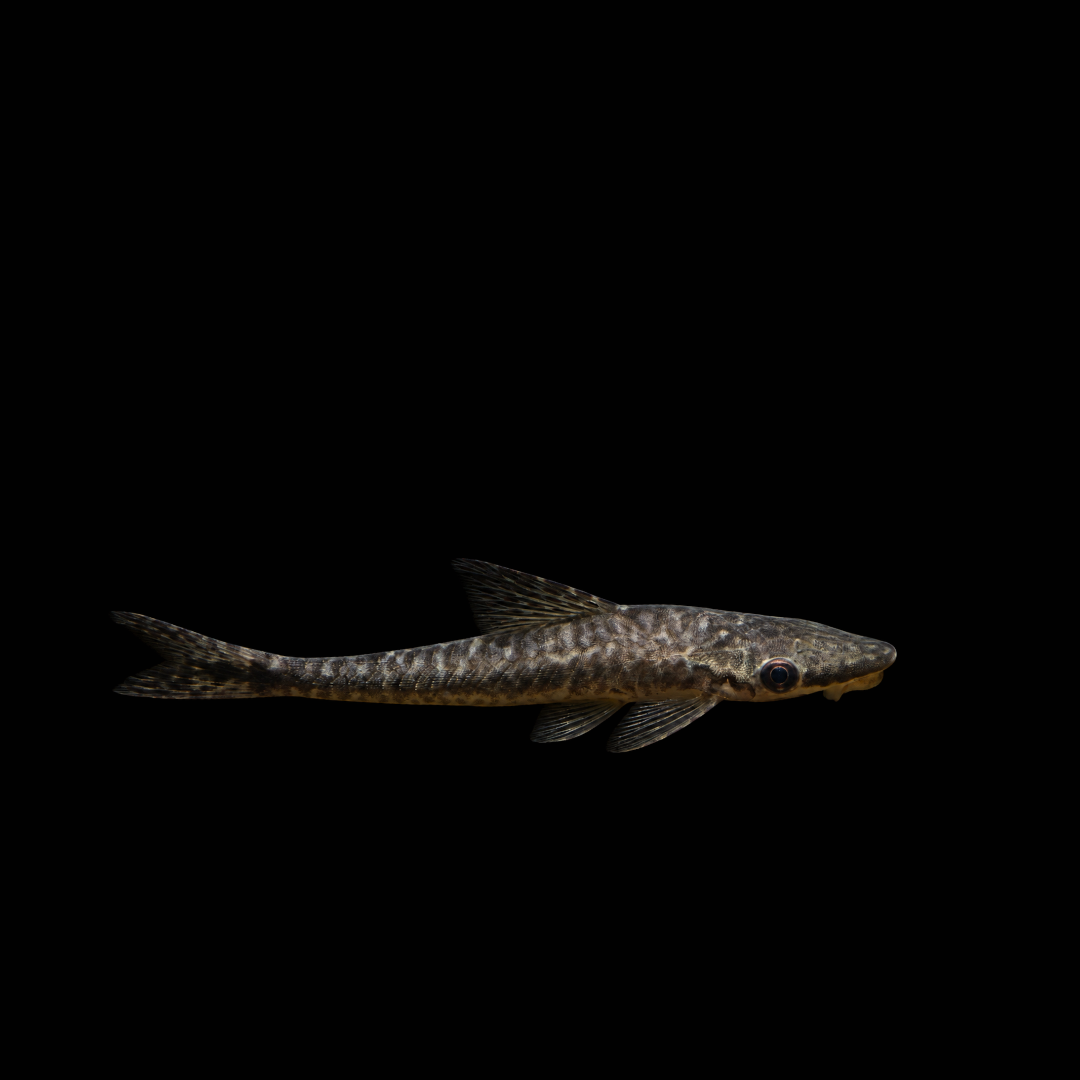
ジャイアントオトシン・トラカタムは、南米アマゾン川流域に広く分布する、ロリカリア科ヒポプトポマ亜科の大型オトシンです。1868年に記載された Hypoptopoma 属の模式種で、この仲間を分類するうえでの基準となる種でもあります。全長は最大でおよそ11cmに達し、一般的なオトシン(オトシンクルス属)の2倍以上の大きさになります。上下に平たく幅の広い頭、鋭く立ち上がる背ビレ、全身を覆う重なり合った骨板、そして頭の左右両端に大きく張り出した眼が、サメを思わせる精悍な姿をつくり出しています。ところが性格は驚くほど穏やかで、小型カラシンやコリドラス、小型エビとも落ち着いて暮らせるとされています。その一方で、大きな体を支えるには水槽内に自然に生えるコケだけでは栄養が足りないため、植物質の餌を計画的に与える必要があります。また、流通の現場では近縁種が同じ「ジャイアントオトシン」の名で混ざることも多く、尾ビレや背ビレの模様から種を確かめる目も求められます。流木に寄り添い、群れで静かに水草の茎に張り付く姿は、落ち着いた南米水槽に独特の風格を添えてくれます。The Giant Otocinclus (Hypoptopoma thoracatum) is a large member of the loricariid subfamily Hypoptopomatinae, widely distributed across the Amazon River basin in South America. Described in 1868, it is the type species of the genus Hypoptopoma, the species that serves as the reference point for classifying the group. It reaches a maximum total length of about 11 cm, more than twice the size of a typical Otocinclus. Its flattened, broad head, sharply raised dorsal fin, overlapping bony plates covering the body, and eyes bulging out at both sides of the head give it a sleek, almost shark-like appearance. Its temperament, however, is remarkably peaceful, and it is said to live calmly alongside small characins, Corydoras and even dwarf shrimp. On the other hand, the algae that grow naturally in an aquarium are not enough to sustain its large body, so plant-based foods must be provided deliberately. In the trade, closely related species are often mixed in under the same name “Giant Otocinclus,” so it also pays to check the markings on the tail and dorsal fins to confirm the species. Resting quietly in a group on driftwood or the stems of aquatic plants, it adds a distinctive dignity to a calm South American aquarium.
ナマズ目 ロリカリア科 ヒポプトポマ亜科 ヒポプトポマ属Siluriformes, Loricariidae, Hypoptopomatinae, genus Hypoptopoma
英名 / English Name
Giant Otocinclus
分布 / Distribution
南米アマゾン川流域(ペルー、コロンビア、ブラジルなど)。模式産地はペルーのアマゾン上流域です。流れの緩やかな岸辺の水草帯や、沈木の周辺に多く見られますAmazon River basin in South America (Peru, Colombia, Brazil and others). The type locality lies in the upper Peruvian Amazon. It is commonly found among vegetation along slow-flowing banks and around submerged wood.
最大体長 / Max Size
全長 約11.5cm(尾ビレを除いた標準体長で約7.8cm)。水槽内では全長8〜10cm前後が目安ですAbout 11.5 cm total length (about 7.8 cm standard length, excluding the tail fin). In aquariums, around 8 to 10 cm total length is typical.
寿命 / Lifespan
5〜8年程度とされ、良好な環境では8〜10年ほど生きる例もあるといわれていますConsidered to be about 5 to 8 years; under good conditions, some individuals are said to live 8 to 10 years.
飼育環境 / Aquarium Environment
水槽サイズ / Tank Size
本来は5〜6匹以上の群れで飼うのが望ましく、その場合は幅80cm以上・水量110L以上の水槽が目安です。日本の規格水槽なら90cm規格水槽(90×45×45cm、満水で約180L)が理想的です。1〜3匹の少数飼育であっても、成魚の大きさ、水質の安定、餌となるバイオフィルムが育つ面積を考えると、60cm規格水槽(約57L)以上を用意すると安心ですIdeally this species should be kept in a group of five or six or more, which calls for a tank at least 80 cm wide holding over 110 L. Among standard Japanese tank sizes, a 90 cm standard tank (90 x 45 x 45 cm, about 180 L when full) is ideal. Even for one to three fish, a 60 cm standard tank (about 57 L) or larger is advisable, considering adult size, water stability and the surface area needed for the biofilm it feeds on to develop.
水温 / Temperature
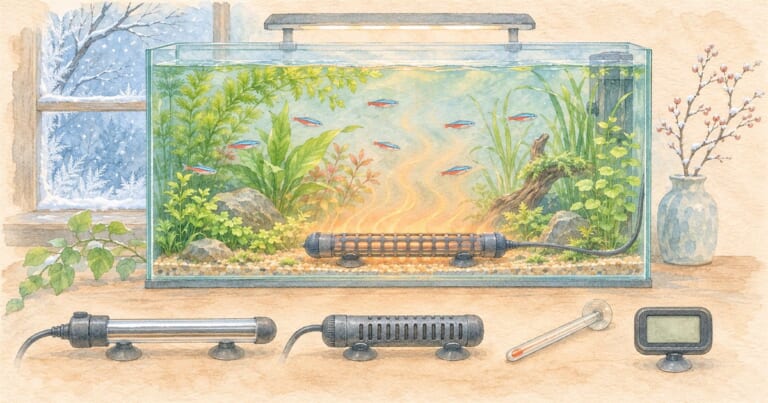
23〜27℃(24〜26℃前後で安定させるのが理想)。29℃を超える状態が続くと、水中の酸素が減ることも重なって体調を崩しやすくなるため、夏場は冷却ファンや水槽用クーラーで27℃以下に抑えると安全です。冬場はヒーターで保温し、20℃を下回らないようにします23 to 27°C (ideally kept stable at around 24 to 26°C). Prolonged temperatures above 29°C, together with the resulting drop in dissolved oxygen, make the fish prone to illness, so in summer it is safest to keep the water below 27°C with cooling fans or an aquarium chiller. In winter, use a heater so the temperature does not fall below 20°C.
水質 / Water Quality
弱酸性〜中性(pH 5.5〜7.5、推奨6.0〜7.2)、総硬度4〜15dGH程度。日本の水道水は、カルキを抜けば多くの地域でこの範囲に収まりやすいでしょう。ソイルや流木、枯れ葉を使って弱酸性寄りの落ち着いた水を保つと、ヒレの縞模様がより鮮やかに出ます。水質の急変、とくにpHの急な変化には非常に弱いので注意が必要ですSlightly acidic to neutral (pH 5.5 to 7.5, ideally 6.0 to 7.2), with a general hardness of about 4 to 15 dGH. Dechlorinated Japanese tap water falls within this range in many regions. Keeping the water stable and slightly acidic with aquasoil, driftwood and leaf litter brings out more vivid stripes on the fins. Take care, as the species is very sensitive to sudden changes in water chemistry, especially abrupt pH shifts.
レイアウト / Layout
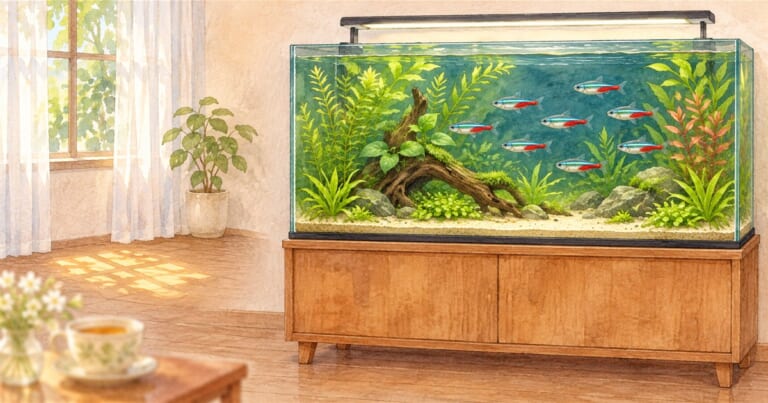
流木は隠れ家になるだけでなく、表面のバイオフィルムや柔らかくなった木の表層そのものが餌にもなるため、必ず複数本を入れたいところです。腹を底につけて休む習性があるので、底床には角の丸い細かな砂やソイルが向いています。細い茎や葉に垂直に張り付いて周りを見渡すのを好むため、バリスネリアやエキノドルス、アヌビアス、ミクロソリウムなどの水草を植え、浮草や岩組で照明をやわらげる日陰も作りましょう。水流は緩やか〜中程度とし、外部フィルターなどのしっかりした生物ろ過にエアレーションを組み合わせます。また、水面へ上がって空気を吸えるよう、水面には開けた空間を残しておきますDriftwood should always be included, in several pieces, because it serves not only as shelter but also as food, with its surface biofilm and softened outer wood being grazed directly. Since the fish rests with its belly on the bottom, fine, rounded sand or aquasoil is suitable. It likes to cling vertically to slender stems and leaves while watching its surroundings, so plant species such as Vallisneria, Echinodorus, Anubias or Microsorum, and create shade with floating plants or rockwork to soften the lighting. Keep the current gentle to moderate, and combine solid biological filtration such as a canister filter with aeration. Also leave open areas at the surface so the fish can rise to take in air.
注意点 / Precautions
導入直後の水質ショックは最も多い死因のひとつです。温度合わせだけで済ませず、点滴法などで時間をかけて丁寧に水合わせを行いましょう。1匹だけの飼育はストレスになりやすいとされるため、できれば複数匹で飼うことをおすすめします。音や振動にも敏感と考えられるので、ガラスを叩かれる、スピーカーの振動が伝わる、人の往来が激しいといった場所への設置は避けると安心です。さらに、浮草や密閉した蓋で水面を完全に覆うと空気を吸えなくなること、銅を含む薬剤に非常に弱いことにも注意してくださいWater chemistry shock right after introduction is one of the most common causes of death. Do not stop at temperature matching; acclimate slowly and carefully, for example with the drip method. Keeping a single fish alone is considered stressful, so keeping several together is recommended where possible. The fish is also thought to be sensitive to sound and vibration, so avoid placing the tank where the glass may be tapped, speaker vibrations carry through, or there is heavy foot traffic. Note as well that completely covering the surface with floating plants or a sealed lid prevents it from gulping air, and that it is highly sensitive to copper-containing medications.
餌と給餌 / Feeding
餌の種類 / Diet
自然下では、藻類や流木、石の表面にできるバイオフィルム(微生物の膜)と、そこに暮らす微小な生き物を主に食べています。水槽内では、プレコや草食魚用の沈下性植物質タブレット、スピルリナ配合フード、木質繊維を含むウェハーなどを主食にします。補助として、皮をむいたキュウリやズッキーニ、軽く茹でたホウレンソウなどの野菜も使えます。冷凍アカムシやブラインシュリンプといった動物質の餌を少し食べることもありますが、植物質と繊維質を中心に組み立てることが健康を保つ要ですIn the wild it feeds mainly on biofilm, the thin film of micro-organisms that forms on algae, driftwood and stones, together with the tiny creatures living in it. In the aquarium, sinking plant-based tablets for plecos and herbivores, spirulina-based foods and wafers containing wood fiber should form the staple diet. Vegetables such as peeled cucumber, zucchini and lightly blanched spinach can be used as supplements. It may also eat small amounts of animal foods such as frozen bloodworms or brine shrimp, but a diet built around plant matter and fiber is the key to good health.
給餌のポイント / Feeding Tips
水槽内に自然に生えるコケだけでは大きな体を到底支えられず、コケ取り役として入れたまま放っておくと、痩せて餓死してしまうことがあります。本種が得意なのはガラス面や葉に薄く付く茶ゴケや柔らかい付着物で、黒髭ゴケや糸状のコケ、硬いスポット状のコケにはほとんど効果がありません。人工飼料を餌と認識していない導入初期は、沈めた野菜のそばに割ったタブレットを置いて少しずつ慣らしていきます。野菜は水を汚しやすいので、食べ残しは早めに取り出しましょう。コリドラスやヤマトヌマエビ、活発なカラシンと一緒に飼う場合は餌の取り合いに負けやすいため、消灯の前後に、本種がよく張り付いている流木の近くなど数か所に分けて与えます。そのうえで、実際に食べているか、腹に適度な丸みがあるかを定期的に確かめてください。なお、餌が極端に足りないと水草をかじることもあると指摘されていますThe algae that grow naturally in an aquarium cannot come close to supporting its large body, and a fish added as an algae eater and then left unfed may waste away and starve. What it handles well is thin brown diatom film and soft deposits on glass and leaves; it has little effect on black beard algae, filamentous algae or hard spot algae. In the early days, before it recognizes prepared foods, place broken tablets beside sunken vegetables to accustom it gradually. Vegetables foul the water easily, so remove leftovers promptly. When kept with Corydoras, Amano shrimp or active characins, it tends to lose out in competition for food, so feed around lights-out in several spots, such as near the driftwood it usually clings to. Then check regularly that it is actually eating and that its belly looks moderately rounded. It has also been noted that a severe lack of food may lead it to nibble on aquatic plants.
性格と混泳 / Temperament and Tank Mates
性格 / Temperament
大きな見た目とは裏腹に非常に温厚で、同種・他種を問わず攻撃性を見せることは基本的にありません。群れで飼うと目立った縄張り争いもなく、落ち着いた様子で自然に餌を探す姿が見られるようになるとされています。動きはゆったりしていて、流木や水草に張り付いてじっとしている時間の長い魚ですDespite its large appearance it is extremely gentle and generally shows no aggression toward its own or other species. When kept in a group it is said to show no notable territorial disputes and to forage naturally in a relaxed manner. It moves slowly and spends long periods motionless, clinging to driftwood or plants.
混泳の相性 / Compatibility
ネオンテトラやラミーノーズテトラなどの小型カラシン、アピストグラマやラミレジィなどのドワーフシクリッド、コリドラス、一般的なオトシンとよく合います。吸盤状の小さな口をもち植物質を主に食べることから、ビーシュリンプなどの小型エビを襲う心配もほとんどないとされています。一方、大型の肉食魚、縄張り意識の強い大型シクリッド、餌を激しく奪い合う大型のプレコ類との混泳は避けましょうIt is a good match for small characins such as neon tetras and rummy-nose tetras, dwarf cichlids such as Apistogramma and rams, Corydoras and ordinary Otocinclus. With its small suctorial mouth and mainly plant-based diet, there is said to be little risk of it attacking dwarf shrimp such as bee shrimp. Avoid keeping it with large predatory fish, strongly territorial large cichlids, or large plecos that compete aggressively for food.
病気と対策 / Diseases and Prevention
かかりやすい病気 / Common Diseases
最も多いトラブルは、特定の病気というより、輸送のストレスと空腹による衰弱や、導入後の餌不足による痩せ(餓死)です。長距離輸送の直後は体表が荒れて白っぽくなりやすく、そこから尾ぐされ病や体表の白濁といった細菌感染症につながることがあります。白点病にかかることもあります。また、夏場の高水温と酸欠は抵抗力を落とし、急な体調悪化を招きやすいとされていますThe most frequent problems are not specific diseases but weakness from transport stress and hunger, and wasting (starvation) from lack of food after introduction. Right after long-distance shipping the skin tends to become damaged and whitish, which can lead to bacterial infections such as fin rot or cloudy skin. White spot disease (ich) can also occur. In addition, high summer temperatures and oxygen shortage are thought to lower resistance and readily trigger sudden declines in health.
対策と予防 / Prevention
購入時は、腹がへこんでいないか、体表に艶があるか、ヒレの模様がはっきりしているかを確かめ、できれば店舗で餌付けが進んだ個体を選びます。導入時には時間をかけた水合わせを徹底し、植物質の餌と流木を切らさないことが何よりの予防になります。夏場は冷却とエアレーションで水温と酸素量を安定させましょう。そして最も重要なのが、銅への非常に強い弱さです。硫酸銅など銅成分を含む魚病薬や駆除剤は使ってはいけません。薬浴が必要なときは、必ず成分を確認したうえで慎重に行ってくださいWhen buying, check that the belly is not sunken, the skin is glossy and the fin markings are clear, and if possible choose fish that are already feeding well at the store. Thorough, slow acclimation on introduction and a constant supply of plant-based food and driftwood are the best prevention. In summer, stabilize temperature and oxygen levels with cooling and aeration. Most important of all is its extreme sensitivity to copper. Medications or treatments containing copper, such as copper sulfate, must never be used. Whenever medication is necessary, always check the ingredients first and proceed with care.
増やし方(繁殖) / Breeding
雌雄の判別 / Sexing
体色やヒレの形から外見で見分けることは、ほぼ不可能とされています。成熟して卵をもったメスがやや太って見えることはありますが、確実に見分けるには生殖孔のまわりの細かな構造を見るしかありません。オスは細く短い生殖突起をもち、その周辺の腹側の骨板に小さなトゲが渦巻き状に密集した部分が現れます。腹ビレのトゲの後ろ側に柔らかいひだが発達することもあります。メスには独立した生殖突起がなく、こうしたトゲの集まりやひだも見られません。全長7〜8cm前後で成熟するといわれていますTelling the sexes apart by color or fin shape is considered almost impossible. Mature females carrying eggs may look slightly plumper, but the only reliable way is to examine the fine structure around the genital opening. Males have a short, slender genital papilla, and patches of small spines arranged in a whorl appear on the nearby ventral plates. A soft flap may also develop along the rear edge of the pelvic fin spine. Females lack a separate papilla and show neither the spine patches nor the flap. Maturity is said to be reached at around 7 to 8 cm total length.
繁殖形態 / Reproduction
本種の水槽内での繁殖は断片的な報告があるのみで、確立された方法はまだありません。ただ、同じ属の近縁種の記録から、ヒポプトポマ属は平らな面に卵を産み付けるタイプで、オスが卵を守る習性をもつと考えられています。産卵前にオスがエキノドルスの広い葉や石、流木、ガラス面などを丁寧に掃除し、そこにメスが緑がかった卵の塊を産み付けます。オスは稚魚が孵化してお腹の栄養の袋(ヨークサック)を吸収し終えるまで卵の上に張り付いて守り、近づく魚を追い払う様子も観察されています。一般的なオトシンには見られない、この仲間ならではの子育てですAquarium breeding of this species has only been reported in fragments, and no established method exists yet. Records of closely related species in the same genus, however, suggest that Hypoptopoma lay their eggs on flat surfaces and that the male guards them. Before spawning, the male carefully cleans a broad Echinodorus leaf, a stone, driftwood or the glass, and the female lays a greenish egg mass there. The male clings over the eggs and guards them until the fry hatch and finish absorbing their yolk sacs, and has been observed chasing away approaching fish. This kind of parental care is not seen in ordinary Otocinclus and is characteristic of the group.
繁殖のポイント / Breeding Tips
最大の壁は産卵そのものより、孵化した稚魚に餌を食べさせることにあります。近縁種の繁殖例では、育成容器を清潔に保ちすぎるとうまくいかず、メイン水槽に浮かべた容器に枯れ葉や小枝を入れ、あえて掃除しすぎずに自然なバイオフィルムを育てたところ、液状の稚魚用フードなどをごく少量与えることで稚魚が餌を食べ始めたと報告されています。孵化して間もない稚魚に栄養価の高い餌を与えすぎると、かえって死にやすいという指摘もあります。挑戦するなら、弱酸性の軟水(pH 6.0〜6.5、水温25〜27℃前後)の専用水槽で5〜6匹以上の群れをじっくり成熟させ、稚魚の時期には「徹底した清潔さ」よりも「枯れ葉や流木、親の水槽に由来する微生物」を活かす方法が理にかなっていると考えられますThe biggest hurdle is not spawning but getting the hatched fry to feed. In breeding reports for related species, keeping the rearing container too clean did not work; success came when leaf litter and twigs were placed in a container floated in the main tank and it was deliberately not over-cleaned, allowing natural biofilm to grow, after which the fry reportedly began to feed on very small amounts of liquid fry food. It has also been pointed out that overfeeding rich foods to newly hatched fry can actually increase mortality. Anyone attempting it would do best to mature a group of five or six or more in a dedicated tank of soft, slightly acidic water (pH 6.0 to 6.5, around 25 to 27°C), and during the fry stage to make use of microbes from leaf litter, driftwood and the parents’ tank rather than strict cleanliness.
雑学と豆知識 / Trivia and Fun Facts
1. 学者の「見間違い」から生まれた属名 / 1. A Genus Name Born from a Misreading
本種は1868年、ドイツ生まれでイギリスを拠点に活躍した魚類学者アルベルト・ギュンターによって、新しい属の新種として記載されました。もとになった標本は、ペルーのアマゾン上流域にあるシェベロスという土地で採集されたものです。属名の Hypoptopoma は、ギリシャ語の「下」「見える」「蓋(えらぶた)」を組み合わせた言葉です。後の研究者の指摘によると、ギュンターは頭の腹側まで大きく回り込んだ頬の骨板を「2枚の骨でできた、下から見えるえらぶた」と誤って解釈し、この名を付けたと考えられています。一方、種小名の thoracatum はラテン語で「胸当てで武装した」という意味で、左右の胸ビレの間を橋渡しするように発達した頑丈な骨板を指しています。つまり、この魚の名前には、19世紀の学者が鎧ナマズの風変わりな骨格をどう読み解こうとしたかが、そのまま刻まれているのですThis species was described in 1868 as a new species in a new genus by Albert Günther, a German-born ichthyologist based in Britain. The specimen had been collected at a place called Xeberos in the upper Peruvian Amazon. The genus name Hypoptopoma combines Greek words for “below,” “visible” and “cover” (gill cover). According to later researchers, Günther misinterpreted the cheek plates that wrap far around the underside of the head as a “gill cover made of two bones, visible from below,” and named the genus accordingly. The species name thoracatum, meanwhile, is Latin for “armed with a breastplate,” referring to the sturdy bony plates that bridge the area between the pectoral fins. In other words, the fish’s names preserve exactly how a 19th-century scientist tried to make sense of an armored catfish’s unusual skeleton.
2. 仲間の「基準」となる模式種と、揺れ動く分類 / 2. The Type Species and a Shifting Classification
ギュンターは本種1種だけで Hypoptopoma 属を設けたため、本種はこの属の模式種、つまり属の定義の基準となる種です。さらにこの属は、オトシンの仲間を含むヒポプトポマ亜科全体の名前の由来にもなっています。1870年には別の学者が Hypoptopoma bilobatum という種を記載しましたが、のちに本種と同じものと判断され、本種の名前に統合されました。長いあいだ種の区別が曖昧だったこの属は、2010年の大規模な見直しで7つの新種が記載され、小型種のグループであるナンノプトポマ属も一度は Hypoptopoma 属にまとめられました。しかし2017年の系統解析によってナンノプトポマ属は再び独立し、新たに2つの属も設けられました。現在の Hypoptopoma 属は、本種を含む十数種で構成されると整理されています。古い資料では、現在は別の属とされる小型種がこの属として紹介されていることもあるため、分類の移り変わりを知っておくと情報を正しく読み取る助けになりますBecause Günther established Hypoptopoma with this species alone, it is the genus’s type species, the species on which the definition of the genus rests. The genus in turn gives its name to the entire subfamily Hypoptopomatinae, which includes Otocinclus. In 1870 another scientist described Hypoptopoma bilobatum, which was later judged to be the same species and merged under this name. The genus, whose species boundaries had long been unclear, was thoroughly revised in 2010, when seven new species were described and the small-bodied genus Nannoptopoma was once combined into Hypoptopoma. A 2017 phylogenetic analysis, however, restored Nannoptopoma as a separate genus and established two further new genera. Hypoptopoma is now considered to consist of a dozen or so species, including this one. Older sources sometimes list small species now placed in other genera under Hypoptopoma, so knowing how the classification has changed helps in reading information correctly.
3. 「耳の格子」がもたらす鋭い聴覚 / 3. The “Ear Grating” and Keen Hearing
ドイツ語圏ではこの仲間を「耳の格子ナマズ」と呼びます。これは、耳に近い後頭部の骨に、格子のように多数の孔が開いていることに由来する名前です。ナマズの仲間の聴覚を比べた研究では、本種は50Hzから5kHzまでの音を感じ取ることができ、骨に包まれた小さな浮き袋をもつナマズ類の中では、4〜5kHzという高い音域を最もよく聞き取れることが示されました。ロリカリア科の魚は一般に高い音を聞くのが得意ではないとされますが、この仲間では後頭部の孔が大きく発達しており、それが音を内耳へ効率よく届ける通り道になっていると考えられています。つまり、水槽のガラスを叩く音やキャビネットを通して伝わる振動を、本種は私たちが想像する以上に敏感に感じ取っているかもしれないのですIn German-speaking countries this group is called “ear-grating catfish,” a name that comes from the many grating-like pores in the bones at the back of the skull, near the ear. A study comparing hearing in catfishes showed that this species can detect sounds from 50 Hz to 5 kHz and, among catfish with small swim bladders enclosed in bone, hears the high range of 4 to 5 kHz best. Loricariids are generally not good at hearing high-pitched sounds, but in this group the skull pores are greatly enlarged and are thought to act as a pathway that carries sound efficiently to the inner ear. In other words, this fish may perceive taps on the glass or vibrations passing through the cabinet far more sharply than we imagine.
4. 真下からも見える「潜望鏡の眼」 / 4. “Periscope Eyes” Visible Even from Below
本種の外見で最も目を引く、頭の左右両端に張り出した眼は、身を守る仕組みとして役立っています。一般的なオトシンの眼は頭の上寄りにあって腹側からは見えませんが、本種は頭の骨格のつくりが異なり、真下からでも眼が見えるほど外側へ張り出しています。自然下では、流れの緩やかな岸辺で水草の茎や沈木に縦に張り付いてじっとしていることを好みます。この姿勢のまま頭を動かさずに上下左右の広い範囲を見渡し、近づく天敵をいち早く察知していると考えられています。さらにロリカリア科に共通する特徴として、明るさに応じて形を変えるオメガ(Ω)形の虹彩をもっており、濁った水の中での見やすさと、上から狙う天敵に眼を目立たせない効果を両立させていると考えられていますThe eyes protruding from both sides of the head, the most striking feature of this species, help protect it. In ordinary Otocinclus the eyes sit toward the top of the head and cannot be seen from below, but this species has a differently built head skeleton, and its eyes bulge out so far that they are visible even from directly underneath. In the wild it likes to cling motionless and upright to plant stems or submerged wood along slow-flowing banks. In this posture it is thought to scan a wide area above, below and to the sides without moving its head, spotting approaching predators early. In addition, like other loricariids, it has an omega-shaped iris that changes shape with light levels, which is thought to improve vision in murky water while making the eye less conspicuous to predators above.
5. 水面で空気を吸う不思議な行動 / 5. The Curious Habit of Gulping Air
本種は水槽内で、ときおり素早く水面へ上がって空気を吸い込み、また底へ戻っていく行動を見せることがあります。ロリカリア科には、胃や食道の一部を空気をためる場所として使い、酸素の乏しい水の中でも呼吸を補える仲間が知られています。近縁のオトシンクルス属では、食道に輪のような袋状の構造があり、空気呼吸ができることが確かめられています。ヒポプトポマ属で同じ仕組みがどこまで働いているかは詳しく分かっていませんが、乾季に水位が下がり酸素が減りやすいアマゾンの水辺で暮らす魚にとって、こうした行動は理にかなったものと考えられます。水面を完全に塞いでしまうとこの行動ができなくなるため、浮上できる空間を残しておくことが大切ですIn the aquarium, this species occasionally darts up to the surface, gulps air and returns to the bottom. Some loricariids are known to use part of the stomach or esophagus as an air store, helping them breathe in oxygen-poor water. In the closely related genus Otocinclus, a ring-shaped pouch on the esophagus has been shown to allow air breathing. How far the same mechanism operates in Hypoptopoma is not well understood, but for a fish living in Amazonian waters where levels drop and oxygen tends to fall during the dry season, such behavior is thought to make good sense. Completely blocking the surface prevents this behavior, so it is important to leave space where the fish can rise.
6. 本当は「コケ」を食べていない? 腸の中の小さな相棒 / 6. Not Really Eating “Algae”? Tiny Partners in the Gut
アクアリウムでは便宜上「コケ取り魚」と呼ばれますが、本種を含むヒポプトポマ属が実際に栄養源にしているのは、藻類そのものというより、藻類や流木、石の表面にできるバイオフィルムと、そこに暮らす微小な生き物だとされています。また、動物は植物の細胞壁をつくるセルロースを自力ではほとんど分解できないため、この仲間は腸内に棲む細菌などの微生物の助けを借りて植物質を消化していると考えられています。孵化したばかりの稚魚はこうした腸内の微生物をまだもっておらず、親の糞を口にすることで受け継ぐともいわれていますが、詳しいことはまだよく分かっていません。長く水に浸かって柔らかくなった流木の表面を、そこに増えた微生物ごと好んで削り取る習性もあります。流木が単なる飾りではなく、本種にとって食卓であり、消化を支える存在でもあることがよく分かりますAlthough it is conveniently called an “algae eater” in the hobby, the real food source of Hypoptopoma, including this species, is said to be not so much the algae itself as the biofilm on algae, driftwood and stones and the tiny creatures living in it. And because animals can barely break down cellulose, the main component of plant cell walls, on their own, this group is thought to digest plant matter with the help of bacteria and other microbes living in the gut. Newly hatched fry do not yet have these gut microbes and are said to acquire them by eating their parents’ droppings, though the details are still not well understood. The fish also likes to scrape the softened surface of long-submerged driftwood together with the microbes that have multiplied on it. All of this shows that driftwood is not mere decoration but both a dining table and a support for digestion.
7. 「ジャイアントオトシン」の名に隠れたそっくりさんたち / 7. Look-alikes Hidden Behind the Name “Giant Otocinclus”
日本では1980年代にこの仲間が初めて紹介され、1990年代前半から店頭で見かける機会が増えたといわれています。現在は毎年数種の大型ヒポプトポマ属が輸入されており、その中で最も安定して流通しているのが本種です。ただ、現地での採集や出荷の段階では種の区別が大まかなことが多く、グラレ(Hypoptopoma gulare)やインコグニタム(H. incognitum)、まれにスタインダックネリィ(H. steindachneri)などが、同じ「ジャイアントオトシン」の名で混ざって届くことがあります。学術的には、尾ビレの軟条(ヒレを支える筋)に沿って伸びる細長い黒い斑紋が、本種を見分ける決め手とされています。この斑紋は尾ビレの付け根の骨板とはつながっておらず、上側より下側に広く伸びるのが特徴です。また愛好家の観察では、背ビレに太い黒帯が2本入るグラレに対し、本種は4〜5本の縞模様をもち、調子が良いと各ヒレにオレンジと黒の縞が浮かぶとされています。輸送直後は色が抜けて見分けにくいこともあるので、落ち着いてから改めて模様を観察してみると、手元の一匹の正体がはっきりしてくるでしょうThis group is said to have first been introduced to Japan in the 1980s, with shops stocking it more often from the early 1990s. Today several large Hypoptopoma species are imported each year, and this species is the most consistently available among them. Species are often only roughly sorted at the collecting and shipping stage, however, so H. gulare, H. incognitum and occasionally H. steindachneri may arrive mixed in under the same name “Giant Otocinclus.” Scientifically, the key to identifying this species is a slender dark mark running along the rays (the supporting ribs) of the tail fin. This mark is not connected to the plates at the base of the tail and extends more broadly on the lower lobe than the upper. Hobbyists also observe that while H. gulare has two broad black bands on the dorsal fin, this species has four or five stripes, and when in good condition orange and black stripes appear on each fin. Colors may fade right after shipping and make identification difficult, so looking at the markings again once the fish has settled will reveal the true identity of the one in your tank.
まとめ / Conclusion
ジャイアントオトシン・トラカタムは、頑丈な骨板と左右に張り出した眼をもつ堂々とした姿と、小型エビとも暮らせるほどの穏やかな性格をあわせもつ魚です。その一方で、大きな体を支える植物質の餌、食事と消化を支える流木、夏の高水温への備え、銅を含む薬剤を避ける注意など、一般的なオトシンとは違った心配りが欠かせません。こうした要点を押さえて迎えれば、何年にもわたって長く付き合える存在になってくれるでしょう。The Giant Otocinclus combines an imposing appearance, with sturdy bony plates and eyes bulging to either side, with a temperament gentle enough to live alongside dwarf shrimp. At the same time it needs care that differs from an ordinary Otocinclus: plant-based food to sustain its large body, driftwood to support feeding and digestion, preparation for high summer temperatures, and the avoidance of copper-based medications. Welcomed with these essentials in mind, it can be a companion for many years.
流木の陰で仲間と寄り添い、水草の茎に縦に張り付いて静かにあたりを見渡す姿には、アマゾンの岸辺で暮らしてきたこの魚本来の生き方がそのまま表れています。尾ビレの黒い斑紋やヒレのオレンジの縞がくっきりと冴えてくれば、それは鎧をまとった穏やかなナマズが、水槽での暮らしに落ち着いてくれたことを示すひとつの目安となるでしょう。Resting with its companions in the shade of driftwood, or clinging upright to a plant stem while quietly surveying its surroundings, it displays the natural way of life it has led along the banks of the Amazon. When the dark mark on its tail and the orange stripes on its fins become sharp and clear, it is one sign that this gentle, armored catfish has settled into life in the aquarium.
Aquino, A. E. & Schaefer, S. A. (2010). Systematics of the genus Hypoptopoma Günther, 1868 (Siluriformes, Loricariidae). Bulletin of the American Museum of Natural History, 336: 1–110. https://doi.org/10.1206/336.1
Delapieve, M. L. S., Lehmann A., P. & Reis, R. E. (2017). An appraisal of the phylogenetic relationships of Hypoptopomatini cascudinhos with description of two new genera and three new species (Siluriformes: Loricariidae). Neotropical Ichthyology, 15(4): e170079. https://www.scielo.br/j/ni/a/NXzPY9FZx5RqczKPrm49wXs/?lang=en
Aquino, A. E. & Miquelarena, A. M. (2001). Redescription of Hypoptopoma inexspectata (Holmberg, 1883), with notes on its anatomy (Siluriformes: Loricariidae). Physis (Buenos Aires), Sección B, 58(134–135): 1–18.
Lechner, W. & Ladich, F. (2008). Size matters: diversity in swimbladders and Weberian ossicles affects hearing in catfishes. Journal of Experimental Biology, 211: 1681–1689. https://doi.org/10.1242/jeb.016436
Armbruster, J. W. (1998). Modifications of the digestive tract for holding air in loricariid and scoloplacid catfishes. Copeia, 1998(3): 663–675. https://doi.org/10.2307/1447796
Douglas, R. H., Collin, S. P. & Corrigan, J. (2002). The eyes of suckermouth armoured catfish (Loricariidae, subfamily Hypostomus): pupil response, lenticular longitudinal spherical aberration and retinal topography. Journal of Experimental Biology, 205: 3425–3433.


コメント