

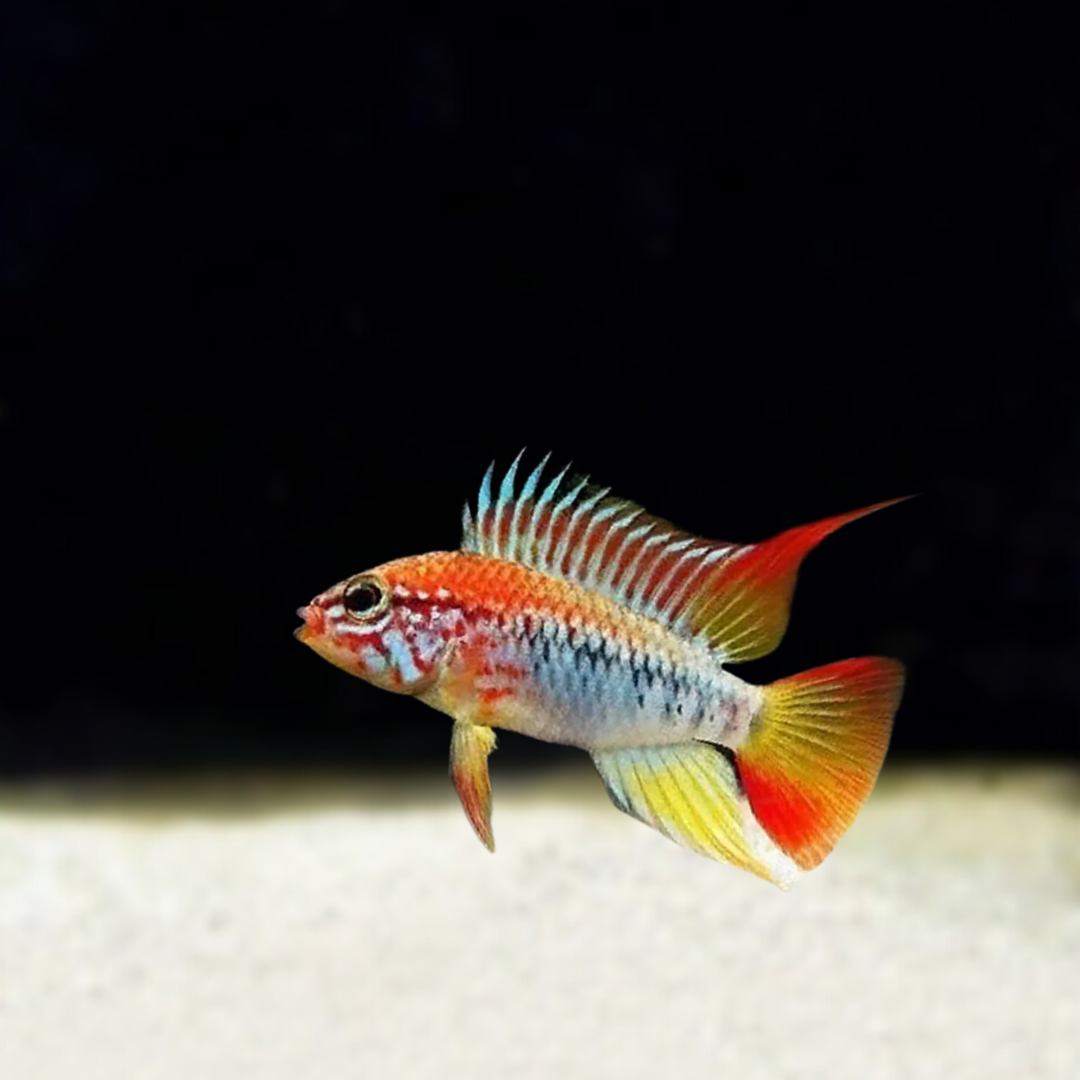
解説 / Description
アピストグラマ・ヴィエジタ・スーパーレッドは、燃えるような赤い発色とドワーフシクリッドらしい濃密な行動を楽しめる、アピストグラマの人気改良系統です。国内では「ヴィエジタ」の名で流通することが多いものの、現在一般に流通するスーパーレッド系統の多くは、分類学上の真の Apistogramma viejita そのものではなく、近縁の Apistogramma macmasteri を中心としたマクマステリ系の改良品種として扱うのが現実的です。 Apistogramma Viejita Super Red is a popular aquarium strain admired for its intense red coloration and the rich behavior typical of dwarf cichlids. Although it is commonly traded under the name “Viejita,” most Super Red fish in the aquarium trade are more accurately treated as selectively bred macmasteri-type strains, mainly based on Apistogramma macmasteri, rather than true wild Apistogramma viejita.
赤く染まる顔まわりや腹部、ヒレを広げて威嚇・求愛するフィンスプレッディングは非常に見ごたえがあります。一方で、体は小さくても縄張り意識があり、繁殖期にはメスも強くなるため、隠れ家と視線を遮るレイアウトが重要になります。弱酸性から中性付近の軟水を安定して維持できれば比較的飼育しやすく、アピストグラマ入門種としても候補になりますが、美しい発色と繁殖を狙うなら丁寧な水質管理が大切です。 The red coloration around the face, belly, and fins, together with dramatic fin-spreading displays during courtship or territorial behavior, makes this strain especially attractive. Despite its small size, it is territorial, and females can become quite assertive during breeding, so caves and visual barriers are important. It is relatively manageable when kept in stable soft water from slightly acidic to near-neutral conditions, but careful water management is essential if strong coloration and breeding are the goals.
基本情報 / Basic Information
| 学名 / Scientific Name | Apistogramma macmasteri 系改良品種として扱われることが多い。流通名では Apistogramma viejita “Super Red” と表記される場合がある。 |
|---|---|
| 通称 / Common Name | アピストグラマ・ヴィエジタ・スーパーレッド、ヴィエジタ・スーパーレッド、アピストグラマ・マクマステリ系スーパーレッドApistogramma Viejita Super Red, Macmasteri-type Super Red Apistogramma |
| 分類 / Family | シクリッド科・アピストグラマ属。実質的にはマクマステリ・グループに含まれる改良系統として扱われることが多いです。Family Cichlidae, genus Apistogramma. In practice, it is usually treated as a selectively bred strain within the macmasteri group. |
| 英名 / English Name | Apistogramma Viejita Super Red, Super Red Apistogramma, Macmasteri Super Red |
| 分布 / Distribution | 国内で流通する個体は、基本的に改良・累代されたブリード個体として扱われます。マクマステリ系の原種はコロンビアのオリノコ川流域、メタ川水系周辺に由来します。Specimens in the aquarium trade should generally be treated as selectively bred captive strains. Wild macmasteri-type fish are associated with the Orinoco drainage in Colombia, particularly the Meta River system. |
| 最大体長 / Max Size | オスで約6〜7cm、メスで約4〜5cmほど。系統や飼育環境により多少の差があります。Males reach about 6–7 cm, while females are usually around 4–5 cm. Size varies somewhat by strain and conditions. |
| 寿命 / Lifespan | おおむね2〜4年ほど。高水温で長期間維持すると代謝が上がりやすく、寿命が短くなることがあるため、安定した温度管理が大切です。Typically around 2–4 years. Prolonged high temperatures may accelerate metabolism and shorten lifespan, so stable temperature control is important. |
飼育環境 / Aquarium Environment
| 水槽サイズ / Tank Size | 安定した飼育の目安は60cm規格水槽以上です。ペア単独で隠れ家を十分に用意する場合は45cm規格水槽でも飼育されることがありますが、水質と縄張り管理の余裕を考えると60cm規格水槽が安心です。複数ペアや複数オスを扱う場合は、60cmワイド水槽から90cm規格水槽以上を用意すると管理しやすくなります。A 60 cm standard tank or larger is the safer guideline for stable care. A single pair may be kept in a 45 cm standard tank if enough hiding places are provided, but a 60 cm standard tank gives more margin for water quality and territorial behavior. For multiple pairs or males, a 60 cm wide to 90 cm standard tank or larger is easier to manage. |
|---|---|
| 水温 / Temperature | 通常飼育では24〜27℃前後が扱いやすい範囲です。繁殖と稚魚の育成を意識する場合は、急な上下を避けて24〜26℃前後で安定させると扱いやすいでしょう。夏場に28℃以上が長く続く環境では、体力消耗や稚魚の性比の偏りを避けるため、水槽用ファンやクーラーの利用を検討しておくと安心です。 For general care, around 24–27°C is suitable. When breeding and raising fry, keeping the temperature stable around 24–26°C without sudden swings is easier to manage. If temperatures remain above 28°C for long periods in summer, aquarium fans or chillers should be considered to reduce stress and the risk of skewed fry sex ratios. |
| 水質 / Water Quality | 弱酸性から中性付近、軟水を好みます。pHはおおむね5.5〜7.0の範囲で飼育できますが、発色や繁殖を狙う場合はpH6.0前後の安定した軟水が扱いやすいです。ブラックウォーター、マジックリーフ、ピートなどは有効ですが、急激なpH変化は避ける必要があります。It prefers soft water from slightly acidic to near-neutral conditions. A general range of about pH 5.5–7.0 is workable, while stable soft water around pH 6.0 is often favorable for coloration and breeding. Blackwater extracts, catappa leaves, and peat can be useful, but sudden pH changes should be avoided. |
| レイアウト / Layout | 細かな砂を薄く敷き、流木、落ち葉、素焼き鉢、ココナッツシェルなどで複数の隠れ家を作ります。ミクロソリウムやアヌビアス類などを流木に活着させると、視線を遮りやすく、落ち着いた雰囲気を作れます。繁殖を狙う場合は、メスが選べる洞窟状の産卵場所を複数用意することが重要です。Use a thin layer of fine sand and provide several hiding places with driftwood, leaf litter, clay pots, or coconut shells. Attaching Java fern or Anubias to driftwood helps create visual barriers and a calm atmosphere. For breeding, several cave-like spawning sites should be available so the female can choose a suitable place. |
| 注意点 / Precautions | 小型魚ですが縄張り意識があり、繁殖期には攻撃性が高まります。特に底層を生活圏にするコリドラス類などは、産卵後のメスから強く追われることがあります。水換えは少量を定期的に行い、急激な水質変化と餌の与えすぎを避けることが大切です。Although small, it is territorial, especially during breeding. Bottom-dwelling fish such as Corydoras may be chased aggressively by a brooding female. Regular small water changes, stable water chemistry, and avoiding overfeeding are important. |
餌と給餌 / Feeding
| 餌の種類 / Diet | 肉食傾向のある雑食性で、冷凍アカムシ、冷凍ブラインシュリンプ、イサザアミ、イトメ、小型シクリッド用の顆粒フードや沈下性フードをよく食べます。繁殖前のコンディション作りには、冷凍餌や活き餌を適度に組み合わせると効果的です。It is an omnivore with a strong carnivorous tendency and accepts frozen bloodworms, frozen brine shrimp, mysid shrimp, tubifex, small cichlid granules, and sinking foods. For conditioning before breeding, a moderate combination of frozen and live foods is effective. |
|---|---|
| 給餌のポイント / Feeding Tips | 一度に多く与えず、2〜3分で食べ切れる量を1日1〜2回程度に分けて与えます。赤い発色を意識して高栄養の餌を増やす場合でも、食べ残しによる水質悪化はアピストグラマに負担となります。繁殖後の稚魚には、自由遊泳が始まった時点からベビーブラインシュリンプを用意しておくことが重要です。Feed small portions once or twice a day, only as much as they can finish in about 2–3 minutes. Even when using rich foods to improve coloration, leftovers can quickly degrade water quality and stress Apistogramma. For fry, newly hatched brine shrimp should be ready once they become free-swimming. |
性格と混泳 / Temperament and Tank Mates
| 性格 / Temperament | 普段は比較的落ち着いた小型シクリッドですが、オスは縄張りを持ち、メスも産卵後は非常に強くなります。環境に慣れると前面に出てきやすくなり、ヒレを広げて相手を威嚇する姿や、メスに向けた求愛行動を観察できます。It is generally a calm dwarf cichlid, but males hold territories and females can become highly defensive after spawning. Once settled, it often comes to the front of the tank and displays fin-spreading behavior toward rivals or during courtship. |
|---|---|
| 混泳の相性 / Compatibility | 小型カラシン、ペンシルフィッシュ、ラスボラ、オトシンクルスなど、上層から中層を泳ぐおとなしい魚とは比較的相性がよいです。特にペンシルフィッシュのような小型魚は、アピストグラマを安心させる魚として働くことがあります。ただし、繁殖を本気で狙う場合は、卵や稚魚を守る親魚のストレスを減らすため、ペア単独飼育が基本になります。It is generally compatible with peaceful upper- to mid-water fish such as small characins, pencilfish, rasboras, and Otocinclus. Pencilfish can act as dither fish that help Apistogramma feel more secure. However, if breeding is the main goal, keeping a pair alone is usually best to reduce stress on the guarding parents. |
病気と対策 / Diseases and Prevention
| かかりやすい病気 / Common Diseases | 白点病、エロモナス症、カラムナリス症、腹部膨満、輸送後の痩せや拒食に注意します。アピストグラマ類は水質悪化や急変に弱い面があり、特に導入直後は体調を崩しやすいです。Watch for ich, Aeromonas infections, columnaris, bloating, wasting, and refusal to feed after transport. Apistogramma can be sensitive to poor or rapidly changing water quality, especially soon after introduction. |
|---|---|
| 対策と予防 / Prevention | 導入時は水合わせを丁寧に行い、可能であればトリートメント期間を設けます。日常管理では、過密飼育を避け、食べ残しを出さず、ろ過を安定させることが基本です。薬浴が必要な場合は急に強い処置をせず、症状と水質を確認しながら慎重に進める必要があります。Acclimate new fish carefully and, if possible, provide a quarantine or conditioning period. In daily care, avoid overcrowding, prevent leftovers, and keep filtration stable. If medication is needed, proceed carefully after checking symptoms and water parameters rather than applying harsh treatment suddenly. |
増やし方(繁殖) / Breeding
| 雌雄の判別 / Sexing | オスはメスより大きく、赤や黄色の発色が強く、背びれ・尻びれ・尾びれがよく伸びます。メスは小型で、繁殖期には体が黄色くなり、腹びれや腹部に黒い模様が強く出ることがあります。若魚では判別が難しいため、確実性を求める場合は成熟したペアを選ぶと安心です。Males are larger, more colorful, and have more extended dorsal, anal, and caudal fins. Females are smaller and often turn yellow during breeding, with stronger black markings on the belly and pelvic area. Sexing juveniles can be difficult, so mature pairs are safer when certainty is needed. |
|---|---|
| 繁殖形態 / Reproduction | 洞窟産卵型の基質産卵魚です。メスは流木の隙間、素焼き鉢、ココナッツシェルなどの内側や天井面に粘着卵を産み付け、主にメスが卵と稚魚を守ります。オスは周囲の縄張りを守る役割を担うことが多いです。It is a cave-spawning substrate spawner. The female lays adhesive eggs inside or on the ceiling of caves made from driftwood gaps, clay pots, or coconut shells, and she mainly guards the eggs and fry. The male often defends the surrounding territory. |
| 繁殖のポイント / Breeding Tips | 弱酸性の軟水、落ち着いた隠れ家、栄養状態のよい親魚がそろうと繁殖しやすくなります。アピストグラマ属では、孵化後から初期育成期にかけて水温が性比に影響することが研究で示されており、pHも一部の種で関与するとされています。ただし影響の出方は種や系統によって差があるため、ペアを継続的に作りたい場合は、稚魚期の水温を24〜26℃前後で安定させ、極端な高水温と急な水質変化を避ける管理が重要です。Breeding is encouraged by soft, slightly acidic water, calm hiding places, and well-conditioned adults. In the genus Apistogramma, studies have shown that temperature during early fry development can influence sex ratios, and pH may also play a role in some species. However, the degree and direction of the effect can vary by species and strain, so if the goal is to produce future pairs, keeping fry stable around 24–26°C and avoiding extreme heat or sudden water changes is important. |
雑学と豆知識 / Trivia and Fun Facts
| 1. 「ヴィエジタ」という名前の少し不思議な響き / 1. The curious sound of the name “Viejita” | viejita はスペイン語の vieja に由来し、「小さなおばあさん」という意味合いを持つ言葉として紹介されることがあります。南米ではシクリッド類を親しみを込めて呼ぶ文脈と結びついており、燃えるような赤い改良品種にこの素朴な響きの名が残っている点は、とても印象的です。水槽の中でヒレを大きく広げる姿だけを見ると力強い魚に見えますが、名前の背景を知ると、現地の川辺で小さなシクリッドが人々に身近な魚として見られていた情景も浮かんできます。The epithet viejita is often explained as deriving from the Spanish vieja, giving it a sense similar to “little old woman.” It is connected to local ways of referring to cichlids in parts of South America, and it is striking that such a gentle-sounding name remains attached to a fiery red aquarium strain. When the fish spreads its fins in the aquarium, it looks powerful and dramatic, but the name also hints at a more familiar riverside relationship between people and small cichlids. |
|---|---|
| 2. 流通名と分類学がずれる代表例 / 2. A classic case where trade names and taxonomy diverge | アピストグラマ・ヴィエジタ・スーパーレッドを語るうえで避けられないのが、「その魚は本当にヴィエジタなのか」という問題です。観賞魚の世界では、名前が学術的な同定名ではなく、流通上のブランド名として定着することがあります。本系統もその代表例で、現在流通するスーパーレッドの多くは、真の野生 Apistogramma viejita というより、Apistogramma macmasteri を中心とした改良系統と考えられています。これは単なる誤表記というより、長年の流通、改良、愛好家文化が重なってできたアクアリウム史の一部と見ると理解しやすいです。One unavoidable topic with Apistogramma Viejita Super Red is whether the fish is truly “viejita.” In the aquarium trade, names sometimes become established as commercial brand names rather than strict scientific identifications. This strain is a good example: most Super Red fish in circulation are better understood as selectively bred macmasteri-type strains, mainly based on Apistogramma macmasteri, rather than true wild Apistogramma viejita. Rather than being only a labeling error, it reflects a long history of trade, breeding, and hobbyist culture. |
| 3. ヨーロッパブリードが作った「赤いアピスト」の価値観 / 3. European breeding and the value of red Apistogramma | スーパーレッドの魅力は、自然下の色彩をそのまま再現したものではなく、ブリーダーが何世代にもわたって赤の強い個体を選び続けた結果として形づくられたものです。ドイツやチェコを中心とするヨーロッパブリードは、体型の美しさ、発色の濃さ、ヒレの伸びを重視する傾向があり、日本のアピストグラマ愛好家にも強い影響を与えてきました。野生個体の奥深さとは別に、ブリード個体だからこそ到達できる美しさがあることを示した魚でもあります。The appeal of Super Red is not simply a reproduction of wild coloration, but the result of generations of selecting individuals with stronger red expression. European breeding, especially from Germany and the Czech Republic, has tended to emphasize body shape, color depth, and fin development, strongly influencing Japanese Apistogramma enthusiasts. This strain shows that captive-bred fish can have a kind of beauty different from, but no less fascinating than, wild fish. |
| 4. 稚魚の性比に水温とpHが関わるという面白さ / 4. The fascinating link between fry sex ratios, temperature, and pH | アピストグラマ類では、稚魚の初期育成環境が性比に影響することが研究で示されています。特に水温は重要な要素で、pHも一部の種で関与するとされています。ただし、すべての種類で同じように作用するとは限らず、流通改良品種では系統差も考えられます。だからこそ繁殖では、親魚が産卵したかどうかだけでなく、稚魚が育つ最初の時期の温度を安定させることが大切です。美しい親を選ぶだけでなく、稚魚期の環境まで整えることが、アピストグラマ繁殖の奥深さです。Studies have shown that early rearing conditions can influence sex ratios in Apistogramma fry. Temperature is especially important, and pH may also be involved in some species. However, the effect is not necessarily identical in every species, and domestic strains may also show strain-level differences. For that reason, breeding success is not only about whether the parents spawn, but also about keeping the early fry-rearing environment stable. Apistogramma breeding is therefore not only about selecting beautiful parents, but also about managing the fry’s early environment. |
| 5. フィンスプレッディングは小さなシクリッドの劇場 / 5. Fin-spreading as a small cichlid’s theater | 状態のよいオスがヒレを大きく広げ、体色を一気に濃くして相手に向き合う姿は、アピストグラマ飼育の大きな見どころです。これは単なる鑑賞上の美しさではなく、縄張りの主張、ライバルへの威嚇、メスへのアピールといった行動の一部です。小型水槽の中で見られる一瞬のディスプレイには、南米シクリッドらしい社会性と駆け引きが凝縮されています。A healthy male spreading his fins, intensifying his colors, and facing another fish is one of the highlights of keeping Apistogramma. This is not just visual beauty; it is part of territorial display, rivalry, and courtship. In a small aquarium, that brief performance condenses the social complexity and subtle negotiation typical of South American cichlids. |
まとめ / Conclusion
アピストグラマ・ヴィエジタ・スーパーレッドは、国内流通名としての知名度が高い一方で、分類学的にはマクマステリ系改良品種として理解しておくべき魚です。名前の背景を知ることで、単に赤い美魚としてだけでなく、アクアリウムの流通史や品種改良の面白さも含めて楽しめる存在になります。 Apistogramma Viejita Super Red is a well-known trade name, but taxonomically it should generally be understood as a selectively bred macmasteri-type strain. Knowing this background allows the fish to be appreciated not only as a beautiful red dwarf cichlid, but also as part of the history of aquarium trade names and selective breeding.
飼育では、弱酸性から中性付近の安定した軟水、細かな砂、複数の隠れ家、穏やかな混泳相手を意識すると扱いやすくなります。繁殖を狙う場合は、洞窟状の産卵場所と稚魚期の安定した水温管理が重要です。小さな体に鮮やかな色彩と複雑な行動を備えた、アピストグラマの魅力を深く味わえる改良系統といえるでしょう。 For care, stable soft water from slightly acidic to near-neutral conditions, fine sand, multiple hiding places, and calm tank mates make management easier. For breeding, cave-like spawning sites and stable temperature management during fry development are important. With vivid colors and complex behavior packed into a small body, this strain offers a deep and rewarding Apistogramma experience.

気になる道具や飼い方を見つけてみませんか?
 アイのアクアグッズ案内水換え・底砂掃除の道具の選び方|砂利・砂・ソイルに合うクリーナーとポンプ道具の特徴や使い方、選ぶときのポイントをアイが紹介します。記事はコチラ →
 アイのアクアグッズ案内水草水槽のCO₂添加|3つの方式の選び方とおすすめ用品道具の特徴や使い方、選ぶときのポイントをアイが紹介します。記事はコチラ →
さまざまな飼育テーマをご紹介。リンク先の記事には広告・商品紹介が含まれます。
案内・紹介記事一覧へ →参考文献
この記事では、アピストグラマ・ヴィエジタ・スーパーレッドの分類上の扱い、マクマステリ系改良品種としての流通上の注意点、原種の分布・飼育環境、繁殖生態、稚魚期の水温と性比に関する知見を整理するため、以下の資料を参考にしました。
-
GBIF Secretariat. Apistogramma viejita Kullander, 1979. GBIF Backbone Taxonomy.
https://www.gbif.org/species/2371304 -
GBIF Secretariat. Apistogramma macmasteri Kullander, 1979. GBIF Backbone Taxonomy.
https://www.gbif.org/species/2371262 -
Froese, R. and Pauly, D. Editors. FishBase: Apistogramma macmasteri Kullander, 1979.
https://www.fishbase.se/summary/Apistogramma-macmasteri.html -
Seriously Fish. Apistogramma macmasteri.
https://www.seriouslyfish.com/species/apistogramma-macmasteri/ -
Seriously Fish. Apistogramma viejita.
https://www.seriouslyfish.com/species/apistogramma-viejita/ -
Römer, U. and Beisenherz, W. 1996. Environmental determination of sex in Apistogramma and two other freshwater fishes. Journal of Fish Biology, 48(4), 714-725.
https://doi.org/10.1111/j.1095-8649.1996.tb01467.x -
Renn, S. C. P. and others. 2021. Epigenetic regulation and environmental sex determination in cichlid fishes. Philosophical Transactions of the Royal Society B.
https://pmc.ncbi.nlm.nih.gov/articles/PMC8440468/




コメント